

National Standards Unveiled: Cognitive Impairment Care Emerges as the Next Battleground for Senior Care Institutions

Taikang Community
Chain养老机构
Major Policy Implementation in the Medical and Elderly Care Industry! In 2025, the State Administration for Market Regulation (Standardization Administration of China) officially approved and released the national standard Guidelines for the Care of Older Adults with Cognitive Impairment in Elderly Care Institutions, establishing an authoritative operational framework for the cognitive disorder care sector, which has long lacked unified standards.
The implementation of this national standard, coupled with sustained growth in rigid demand, breakthroughs in talent system development, and innovations in service models, is driving the evolution of dementia care from experience-based practices toward standardized and professionalized approaches, thereby unlocking new growth dividends for the integrated medical and elderly care services market.
The market demand for dementia care has entered a phase of rapid growth. The interplay of multiple factors, including an aging population, increased life expectancy, and the trend toward smaller family structures, has heightened societal demand for high-quality dementia care services.
According to the “Report on the Current Status and Development of Care Services for Older Adults with Dementia” released by the China National Committee on Ageing, it is projected that the number of older adults with dementia in China will reach 22.2 million by 2030 and further increase to 28.98 million by 2050. China has become the country with the largest number and the fastest growth rate of older adults with dementia worldwide. In addition to pharmacological treatment, continuous and standardized care is particularly important.
Unlike the general elderly population, older adults with dementia exhibit a high reliance on institutional care and integrated medical-care services, reflecting strong inelastic demand.
On one hand, for elderly individuals with dementia, family caregiving resources are gradually diminishing, making institutional care an inevitable trend.
From a macro perspective, the Report on the Current Status and Development of Care Services for Elderly People with Dementia also estimates that China’s old-age dependency ratio will exceed 50% by 2035 and reach 67.9% by 2050. Under this trend, the caregiving human resources that families of elderly people with dementia can provide on their own will continue to diminish.
Focusing on individual households, as family sizes shrink, the traditional model of multiple children jointly supporting their parents is rapidly shifting toward a scenario where one couple cares for multiple elderly relatives, creating immense pressure. Moreover, caring for elderly individuals with dementia imposes a heavy burden; in addition to assistance with daily activities such as eating and personal hygiene, these patients require psychological and emotional support, which further exacerbates the strain on small families.
On the other hand, compared with family care, professional institutional care has many advantages and is a better choice for long-term care of elderly people with dementia.
Compared with the diverse elderly care options available to active seniors and those with partial disability, seniors with dementia have a strong demand for professional care services, which intensifies as the disease progresses. As the condition worsens, patients gradually lose their ability to perform activities of daily living, accompanied by symptoms such as memory decline, behavioral abnormalities, and mood swings, making the need for round-the-clock, specialized care support increasingly urgent.
Within professional care facilities, hardware infrastructure has undergone age-friendly and even intelligent modifications tailored to the physiological and psychological characteristics of patients, with safety protection features and rehabilitation training equipment installed to provide a safe and comfortable living environment. Meanwhile, these professional institutions offer comprehensive, round-the-clock medical and nursing services for elderly individuals with dementia, covering the entire spectrum of medical care and rehabilitation—from daily living assistance and dietary management to condition monitoring and rehabilitation training, as well as psychological counseling and emotional support. Leveraging such integrated software and hardware capabilities, it is expected that the progression of dementia can be slowed and the quality of life for patients improved.
Over the past two years, the state has repeatedly issued significant policies, prioritizing the enhancement of services for elderly individuals with disabilities and dementia as a key focus of elderly care services.The release of these Guidelines marks a critical step in policy implementation, filling a gap in industry standardization. It helps address core pain points from the past, such as insufficient systematization of care content and inconsistent quality, while also enabling elderly care institutions to provide higher-quality care services for seniors with dementia.
Historically, the lack of standardization and professionalism in dementia care has stemmed primarily from the unsustainability of the talent pipeline.Amid the overall talent shortage in the healthcare and elderly care industry, the gap in professionals for dementia care is particularly pronounced, a situation resulting from the combined effects of multiple factors.
First, there is a significant gap between the overall number of elderly care workers and the actual demand. Among them, the care for older adults with dementia is more burdensome, requiring caregivers to devote more time and energy, which makes the supply-demand contradiction in this field even more prominent.
Second, dementia care requires knowledge and skills that integrate medical and elderly care services, as well as collaboration among multidisciplinary professionals. This places higher demands on the comprehensive competencies of nursing staff, far exceeding the talent standards for general elderly care services. Currently, the professional competencies of existing caregivers are uneven. Meanwhile, standardized training systems for dementia caregivers are still under exploration, and research into their core competencies remains in its early stages.
Third, the turnover rate among dementia care professionals is relatively high. Due to the heavy workload, this type of care work poses significant physical and psychological challenges to caregivers over the long term, thereby undermining workforce stability.
It is precisely for this reason that resolving the shortage of dementia care professionals requires collaborative efforts from multiple stakeholders.
In recent years, departments including civil affairs, education, and health have continuously advanced the development of professional talent training systems. They have integrated knowledge on dementia and care skills into relevant vocational and undergraduate programs, expanded enrollment scales, and improved the professional qualification evaluation system. Meanwhile, entities such as urban and rural communities, industry associations, medical institutions, and elderly care facilities have conducted specialized skills training for medical and elderly care assistants, while striving to improve their compensation and streamline career advancement pathways.
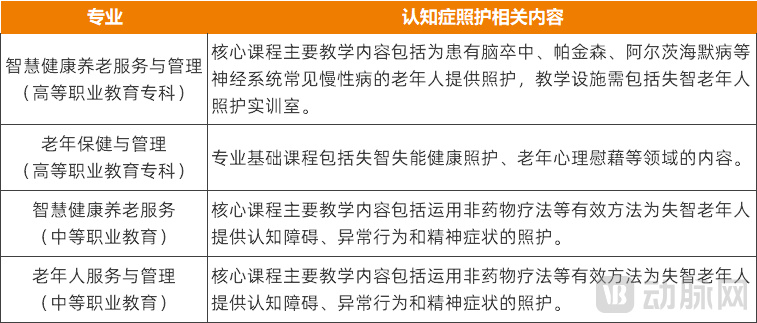
Content Related to Dementia Care in Selected Vocational Education Majors, Source: Ministry of Education
These practices not only directly expand the supply of dementia care professionals but also leverage continuing education to continuously enhance their professional competence, while further strengthening nurses’ sense of professional belonging by improving career development pathways.
On this basis, social public welfare forces can also play a multi-dimensional role, forming synergistic effects with other stakeholders.
For example, in 2022, the Taikang Yicai Public Welfare Foundation, in collaboration with China Social News and the Social Welfare Center of the Ministry of Civil Affairs, launched the “Yiqi Shouhu” Elderly Care Talent Legacy Initiative. This public welfare campaign aimed to enhance social recognition and professional pride among outstanding elderly care practitioners by highlighting their achievements, thereby promoting the healthy and sustainable development of the elderly care services sector. To further strengthen service effectiveness, the “Yiqi Shouhu” initiative underwent a project upgrade in 2025. In partnership with the China Social Welfare Foundation, it warmly launched the “Yicai Kangyang Ren” (Yicai Elderly Care Professionals) Project, injecting public welfare resources into building a high-quality workforce for elderly care services and contributing to healthy aging and the high-quality development of inclusive elderly care services.
To date, the Beijing Taikang Yicai Public Welfare Foundation has partnered with China Social News and the Social Welfare Center of the Ministry of Civil Affairs to identify a group of outstanding elderly care practitioners through the “Yi Qi Shou Hu” (Guarding Together) public welfare initiative, incorporating them into the “Yicai Health and Elderly Care Professionals” project. Among these practitioners, the majority possess practical experience in caring for older adults with dementia, and a cohort of core professionals with deep expertise and strong competencies in dementia care has emerged.
Fei Chao, Director-General of the Shanghai Jinmei Elderly Service Center, is one such outstanding practitioner. With over a decade of experience, Fei has leveraged the center’s frontline practice in serving older adults with dementia to focus on the development and research of dementia-friendly community systems. He has participated in Shanghai’s pilot initiatives for dementia-friendly communities and contributed to the drafting of multiple local standards, including the Guidelines for Building Dementia-Friendly Communities for Older Adults in Shanghai and the Guide for Building Dementia-Friendly Communities for Older Adults. The scientific establishment of dementia-friendly communities helps mobilize diverse community resources, reduce the overall caregiving burden for older adults with dementia, and holds significant importance for shaping the landscape of dementia care in the context of an aging population.
In addition, Qiu Meng, Director of the Huikang Elderly Care Service Center in Guangling District, Yangzhou City, Jiangsu Province; Li Qinggang, Elderly Care Specialist at Taikang Community Yan Garden; and Wang Qingqing from the Tianjin Dementia Elderly Rehabilitation and Care Center, have also made significant positive contributions to the practice and research in areas such as precise screening and assessment of dementia, caregiving skills, and rehabilitation assistance.
For the 100 selected outstanding practitioners, the “Yicai Elderly Care Professionals” project first leverages diverse communication channels to share their professional stories, thereby amplifying their social influence and industry reputation. This not only strengthens practitioners’ sense of professional belonging and value recognition but also draws attention from all sectors of society to the field of dementia care, attracting more dedicated individuals to join the cause.
Meanwhile, the project also collaborates with other empowerment systems under Taikang Yicai, integrating high-quality resources from Taikang Insurance Group Inc. to build an interactive platform for practitioners to exchange experiences and share knowledge. It provides professional skills training and practical hands-on opportunities, while offering targeted support to the institutions where these practitioners work. As of December 2025, the “Yicai Thousand Homes” initiative had cumulatively funded 460 elderly care institutions across China, donated over 37,000 pieces of age-appropriate rehabilitation equipment, trained more than 149,000 elderly care professionals and home-care providers, promoted the quality improvement and upgrading of elderly care services, and helped enhance the quality of life for over 95,000 seniors. The Yicai Starlight Community Elderly Care Project, by supporting social organizations and community actors, has served more than 70,000 senior citizens in Beijing and Shanghai.
Overall, the “Yicai Health & Wellness Professionals” program provides selected practitioners and their affiliated institutions with comprehensive support encompassing professional capacity building, spiritual encouragement, and material assistance.
The elderly care sector inherently possesses significant public attributes. Public welfare organizations, by virtue of their unique characteristics, can effectively complement the initiatives of government departments, industry associations, and enterprises. These organizations not only directly contribute to talent development and workforce stability through concrete actions such as case dissemination and specialized training, but also help foster a collaborative framework characterized by “government guidance, institutional leadership, public welfare empowerment, and societal participation.”
A multi-stakeholder collaborative framework can more comprehensively improve the professional ecosystem for cognitive care providers and the broader elderly care workforce, stimulating their motivation and creativity; it also fosters a societal atmosphere of respect and care for these professionals, providing sustained momentum to resolve the ongoing talent shortage.
With policies continuously improving, market demand steadily growing, and talent development systems gradually becoming more robust,Service models for dementia care are also undergoing transformation. The possession of professional dementia care capabilities and the ability to provide high-quality specialized services have even become key dimensions in measuring the core competitiveness of elderly care institutions.
Amid the accelerating aging of the population, China’s elderly population has grown significantly, while the number of elderly care beds has shown a declining trend. According to statistical data from the Ministry of Civil Affairs and the National Working Commission on Aging, the number of elderly care beds in China peaked at 8.294 million in 2022 and has decreased year by year since then, falling below 8 million to 7.993 million in 2024. Notably, both the number of registered elderly care institutions and the number of beds have been on a downward trajectory over the past three years.
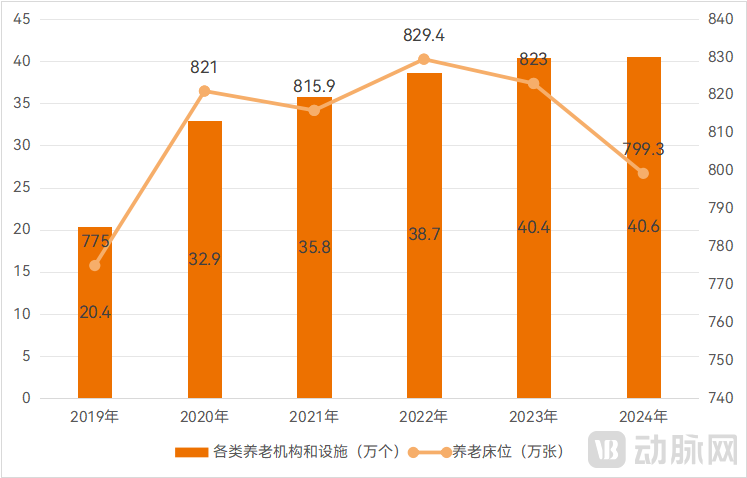
Changes in Various Elderly Care Institutions, Facilities, and Beds in Recent Years. Data Source: National Bulletin on the Development of Aging Cause from Previous Years
The key root cause of this phenomenon lies in the mismatch between the supply and demand of elderly care service resources.Most elderly care institutions can only provide basic daily living assistance, lacking specialized nursing capabilities for disabled and dementia-afflicted seniors, as well as the very elderly;Homogenized basic services have led to competition among institutions being concentrated at the price level, while pure price wars often come at the expense of service quality. In addition, there are alternative options for basic daily care, such as home-based elderly care and community-based elderly care. If institutional elderly care fails to establish advantages in service capability and quality, its competitiveness will inevitably be significantly weakened, leading to operational difficulties or even bankruptcy.
The Report on the Current Status and Development of Care Services for Older Adults with Dementia, released by the China National Committee on Aging, also holds thatProviding professional care services for the elderly with dementia may become a significant opportunity for the transformation of elderly care institutions.
As previously mentioned, many elderly care workers have experience in caring for seniors with dementia, primarily because a large number of such individuals were previously dispersed across various elderly care institutions. In recent years, an increasing number of elderly care institutions with foundational service capabilities and resource integration strengths,In particular, institutions with qualifications for integrated medical and elderly care place greater emphasis on systematic care for seniors with dementia, establishing dedicated dementia care zones within their facilities to achieve a transition from fragmented care to centralized, professional support.
In October 2025, the *Notice on Launching Actions to Promote the Integration of Medical and Elderly Care Services*, jointly issued by five departments including the General Office of the National Health Commission and the General Office of the Ministry of Civil Affairs, explicitly encouraged institutions providing integrated medical and elderly care services to establish dedicated care zones (units) for elderly individuals with dementia.
Taking Taikang Community as an example, its elderly care facilities have established specialized “Memory Care Units” to provide systematic, professional care for seniors with dementia. The program focuses on three key non-pharmacological therapies—multisensory stimulation therapy, music therapy, and reminiscence therapy—alongside a range of lifestyle services. These initiatives aim to improve behavioral and psychological symptoms of dementia (BPSD) and slow disease progression, while meeting basic needs such as nutritional dietary support and recreational activities.
Building on designated zones and specialized services, it has also become possible to develop personalized care plans for elderly residents with varying medical conditions.For example, Taikang Community has developed the "Five-Color Butterfly" staged care model and implemented it in its "Memory Care Zone." The model provides corresponding cognitive training, daily living assistance, and rehabilitative nursing services based on the five stages of disease progression, earning widespread recognition for its precise and meticulous care content.
In summary, from the perspective of industry trends under an aging population, dementia care will become a necessity for elderly care institutions to build long-term development momentum.
Looking back at the implementation of the important standard “Guidelines for the Care of Older Adults with Cognitive Impairment in Elderly Care Institutions,” it represents a critical step in addressing the care needs of key elderly populations and opens up new space for standardized development in the dementia care industry and even the broader medical-care market. Although the industry currently faces many challenges, with talent shortage at its core, the collaborative pattern of “government guidance, institutional leadership, public welfare empowerment, and social participation” will accelerate its formation through the efforts of all stakeholders.
In the future, institutions that possess high-quality service capabilities, sustainable talent development systems, and innovative care models will be able to advance further within the industry and drive the release of greater industry dividends.