

What Kind of Family Doctor Do We Need in the Era of Large AI Models?
In the era of information explosion, no corner is left untouched; even in high-barrier fields such as healthcare, a massive volume of content has rapidly accumulated due to the large-scale adoption of artificial intelligence on the consumer side.
However, the surge in quantity has not been predicated on quality assurance. Amidst the deluge of data, high-value online medical consultations and science-based health information have become increasingly scarce. While users are no longer troubled by the lack of accessible medical content, the intensified challenge of discerning credible information has given rise to even greater concern.
The ailments of the intelligent internet must be addressed through technological innovation within the intelligent internet itself. Recently, at Baidu AI DAY, Baidu Health took the lead in tackling these issues by comprehensively upgrading its “Wenxin Health Steward.”
As revealed at the press conference, this upgrade is not merely an enhancement in model capabilities, but introduces Baidu Health’s industry-first24/7 All-in-One "Family Doctor"”, ushering in a new round of model innovation in “AI + Healthcare”.
Doctors cannot remember every patient, but AI can
Before the advent of 24/7 comprehensive “family doctors,” Wenxin Health Manager focuses on authoritative health education and intelligent consultations, providing users with science-based information and recommendations from physicians at tertiary hospitals. In this process, Baidu Health’s value lies in aggregating authoritative medical information and leveraging intelligent algorithms to identify appropriate solutions for patients.
However, the “user raises a query–large language model provides an answer” paradigm is inherently sporadic and passive. Ideally, users should establish a continuous, proactive communication channel with physicians, thereby enabling patients to access highly relevant, authoritative advice at any time.
The newly launched 24/7 all-around “family doctor” has the potential to break traditional models. At its core, it is a continuously evolving digital human capable of retaining users’ historical information and providing services to their families.Continuous and Personalized...diagnostic and treatment recommendations. From the user’s perspective, it feels as if they truly have a reliable family doctor by their side.
During the live demonstration, Wen Jin, a seasoned user, shared a personal anecdote. A few days ago, her child contracted Influenza A. After receiving a confirmed diagnosis at the hospital in the evening, oseltamivir was prescribed. However, upon returning home, the child vomited, expelling the entire dose of the medication.
At this point, taking the child to the hospital would be overly distressing, yet parents still seek authoritative medical advice. This is where Wenxin Health Manager demonstrates its value: the AI asks further questions and provides personalized answers, which are then reviewed and confirmed by a licensed physician who signs off on the summary; if needed, users can also connect directly with an online human doctor.
As connectivity deepens, the 24/7 all-around “family doctor” can also help users address issues beyond disease consultations. For instance, if elderly individuals frequently forget to take their medications, scanning the medicine box with Wenxin Health Manager automatically generates medication information and pushes reminders to their mobile devices. Similarly, for sub-healthy individuals seeking weight control, Wenxin Health Manager can identify foods in user-captured images and display their respective calorie counts. When necessary, users can also initiate real-time calls with a digital human doctor, who is available 24/7 to provide dietary and other recommendations. This feature is coming soon.
Here is an intriguing detail. The 24/7 comprehensive “family doctor” service did not employ the virtual avatars commonly favored by previous internet healthcare providers; instead, it collaborated with physicians from top-tier (Grade A tertiary) hospitals to create customized “digital humans.” From a user experience perspective, this approach appears to further bridge the gap between AI and patients, thereby enhancing adherence.
Overall, the 24/7 all-around “family doctor” has brought not only an enhancement in service capabilities but also a transformation in healthcare-seeking behavior. It breaks through the capability boundaries of traditional “AI + healthcare” and is poised to become a true “gatekeeper” and “connector” for family health.
In the era of large language models, we may have grown accustomed to various AI agents. However, in the healthcare sector, achieving the breakthrough from “0” to “1” requires enterprises to innovate at the algorithmic level and accumulate substantial data resources.
According to Lu Mei, the 24/7 all-around “Family Doctor” is built on the ERNIE large language model and Baidu Health’s Orion Multi-Agent Human-Machine Collaboration System. By leveraging human-machine collaboration between patient agents and physician agents, it simulates professional clinical workflows to fully replicate the entire process from “consultation records” to “diagnostic reasoning” and “medical documentation.” The system supports multi-role collaboration—such as a dermatologist agent paired with a follow-up agent, or an endocrinologist agent teamed with a nutritionist agent—precisely matching service capabilities to diverse healthcare scenarios.
The knowledge system underpinning the platform is equally critical. Currently, Baidu’s knowledge base encompasses 16 million authoritative popular science articles and journal publications, over 3 million multimodal imaging professional resources, and more than 100 million data points on diagnostic and treatment logic. The cumulative volume of AI-recognized medical images has reached 100 million, covering comprehensive medical knowledge across common diseases, chronic conditions, and rare disorders, thereby ensuring the professionalism and authority of the information provided.
In terms of architecture, Baidu Health has adopted a three-tier model framework, leveraging large models for medical diagnosis and treatment, multimodal reasoning, and medical AIGC content generation to deliver core capabilities such as disease diagnosis, report interpretation, and popular science content creation. Data shows that Wenxin Health Steward achieves a report interpretation accuracy rate of up to 96%, supports preliminary assessment of over 120 types of skin conditions and intelligent interpretation of various medical documents, and delivers more than 80 million medical model services daily.
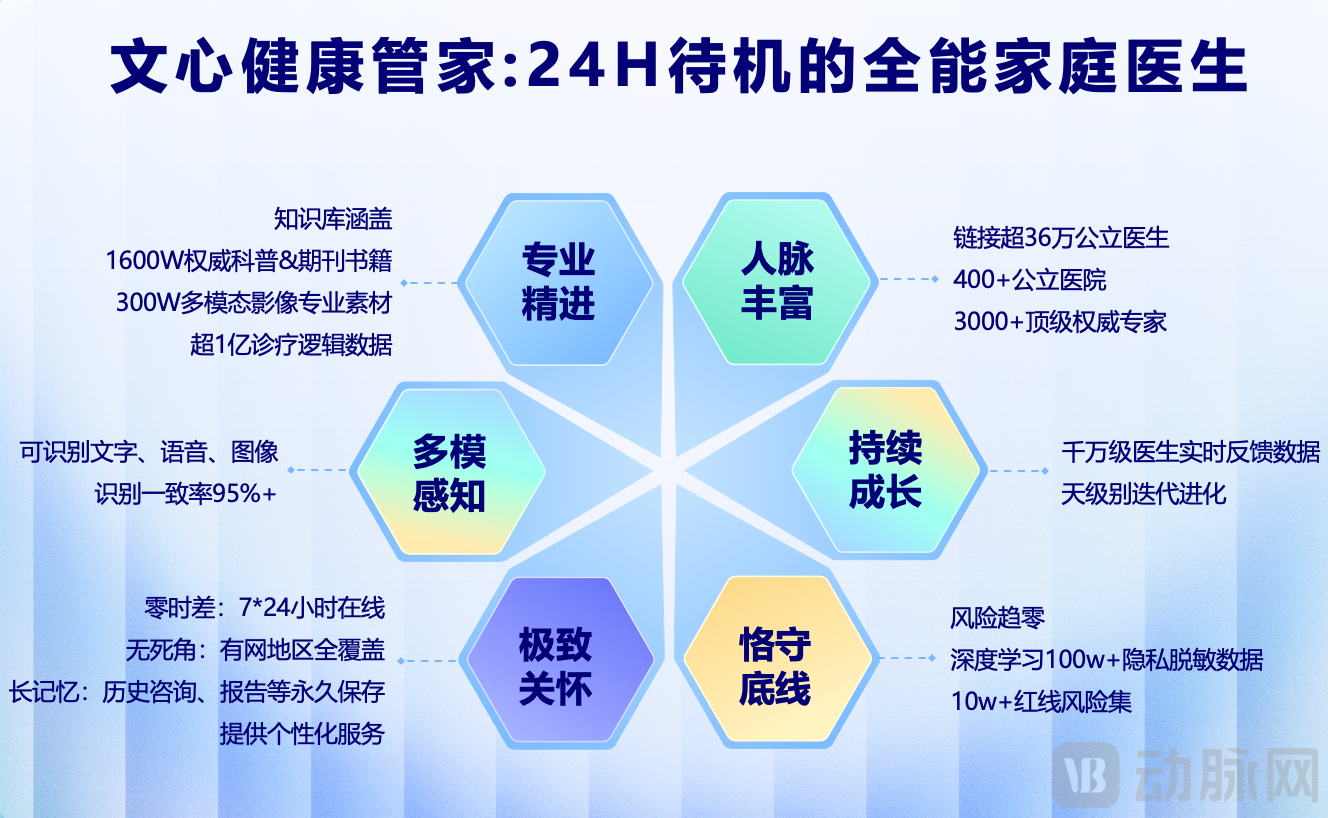
However, the current capabilities of the 24/7 all-around “family doctor” are merely a starting point. Healthcare is a domain that requires frequent communication. In the past, due to the mismatch between the supply and demand of medical resources, many gaps in communication have become entrenched norms. Among these, there are surely many scenarios that neither doctors nor patients have recognized, which can now be addressed by AI.
Therefore, Baidu Health announced that it will continue to enhance the capabilities of its Wenxin Health Assistant. It will gradually roll out a multi-expert group consultation feature, enabling users to initiate multidisciplinary team (MDT) consultations. For complex diseases, this service will rapidly aggregate authoritative experts from relevant fields to synchronously review medical records and collaboratively discuss diagnosis and treatment plans online. Patients can thus access MDT collaborative care from home, breaking down geographical barriers and limitations in expert resource availability, which aligns with the complex disease planning capabilities in Multi-agent collaboration. Additionally, Baidu Health will introduce a digital human feature for full-duplex physician follow-up, allowing users to unlock regular, proactive telephone follow-up services provided by doctors from Grade A tertiary hospitals.
Delivering Valuable Science Popularization to Every Specialty Scenario
Introducing a 24/7 All-Around “Family Doctor”: Another Core Focus of Baidu Health at This AI Development Day Is “Dr. Flow.”
The product is expected to launch its internal beta in January 2026, offering 100 free trial spots.
Baidu Health defines Dr. Flow as the industry’s first AI-powered content creation platform exclusively designed for healthcare professionals. Built around four core strengths—professional controllability (human-AI collaboration to mitigate risks), intelligent assistance (AI ensemble support across the entire content creation workflow), user-friendly operation (conversational interface, enabling video production within 10 minutes), and one-stop management (omnichannel content distribution and diversified revenue streams)—Dr. Flow empowers healthcare practitioners (such as physicians, nutritionists, and psychological counselors) to achieve a leap in creative productivity. It addresses key pain points including lack of inspiration, cumbersome workflows, and monetization barriers.
Simply put, Dr. Flow assists physicians in creating health-related content and provides support throughout the entire process.
There are two key points in the entire process: one is assisted creation, and the other is quality control.
Medicine is a field with an extensive knowledge system. Most physicians at top-tier tertiary hospitals focus their health education efforts on mainstream diseases, leaving relatively little content covering conditions outside this mainstream. Therefore, expanding the scope of health education to encompass a broader range of specialized diseases is of great importance to patients.
In practice, many clinicians are willing to create popular science content but are unable to do so due to limited energy. After all, producing a single health education video in the past required completing processes such as topic selection, scriptwriting, storyboarding, and editing, which demanded the support of an entire team.
Nowadays, Dr. Flow enables a single AI to assume multiple roles. During breaks between outpatient consultations, physicians can upload relevant materials and dictate key professional points. The system then automatically handles tasks such as matching trending topics, generating scripts, and creating illustrations. Within 10 minutes, it produces compliant, easy-to-understand health education videos, achieving precise and rapid responses to social hotspots with professional content, thereby effectively enhancing the timeliness and reach of health communication.
Revisiting Quality Control. Authority and credibility are the lifelines of science popularization platforms; if quality is compromised for the sake of quantity, sustainable development cannot be achieved. Therefore, every stage of Dr. Flow’s workflow incorporates interactive features and manual verification. Additionally, at the final stage, Baidu Health has specifically introduced the role of “Safety and Health Reviewers,” leveraging its authoritative knowledge base accumulated over decades to ensure that the entire content ecosystem remains authoritative.
“Atom Plan” Launched: Baidu Accelerates Digital Transformation of the Healthcare Industry with an Open Ecosystem
The efficient operation of the data flywheel requires a continuous influx of high-quality data. Therefore, in addition to launching the aforementioned two applications, Baidu Health announced the initiation of the “Atom Project” at its AI Open Day. This initiative represents an ecosystem project for open capabilities across the entire industry, offering free access to over 100 core capabilities. It aims to assist B-side partners in rapidly building AI-powered health services, breaking down resource barriers, and promoting the inclusive development of the health industry.
According to Lu Mei, Baidu Health’s existing 600 million pieces of professional health content, services from 360,000 licensed physicians, and over 100 AI-powered tools will be fully opened to external partners. These collaborations span the entire industry chain, including hospitals, pharmaceutical companies, insurance institutions, smart hardware manufacturers, and health app developers. As a result, whether it is a smartwatch requiring health data interpretation capabilities or a pharmaceutical company aiming to build a science popularization content platform, they can directly leverage Baidu Health’s AI technologies and authoritative resources without having to develop them from scratch.
For Baidu, this is a critical move that carries both risks and rewards. While full openness may weaken its competitiveness in the short term, it holds the promise of rapidly expanding its ecosystem and positioning Baidu as a pioneer in the digital health industry.
This decision aligns closely with Baidu’s core value proposition of “authoritative resources + AI technology + end-to-end services + open ecosystem.”
Perhaps, through application and innovation, we can indeed witness Baidu Health gradually resolve issues such as health information asymmetry, low medical service efficiency, lack of transparency in services, and industry resource barriers within a limited timeframe. This will enable the public to access more credible health knowledge, seek medical services more conveniently, and make health decisions with greater confidence, while allowing B-side partners to embrace new AI-driven health opportunities with lower entry barriers, thereby ultimately accelerating the digital transformation of the entire healthcare industry.