

Feng Zhang Team's Nature Breakthrough: mRNA Therapy Reprograms Liver to Secrete Key Immune Factors and Rejuvenate Aged Immunity
Age-related decline in immune function poses a major health threat to the elderly. This not only increases their susceptibility to infectious diseases such as influenza and herpes zoster, but also significantly diminishes the protective efficacy of vaccination, while concurrently elevating the risk of cancer.
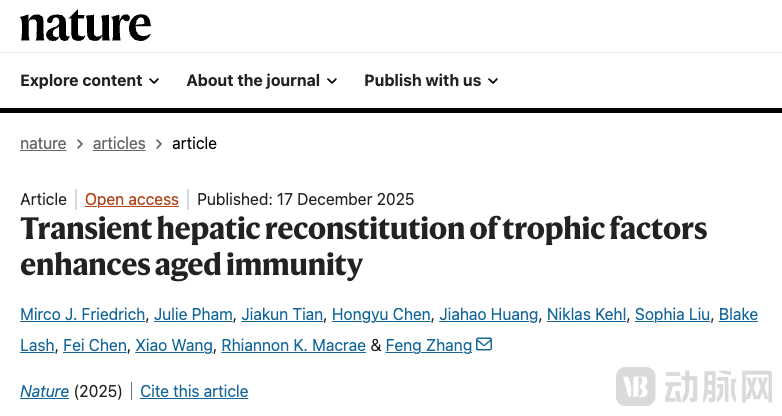
December 17, 2025, the Broad Institute of MIT and Harvard (Broad Institute), USAZhang Feng's TeamA highly innovative study was published in the top-tier journal Nature. Rather than attempting to repair the already atrophied thymus, an immune organ, they took a novel approach,Leveraging mRNA technology to temporarily transform the liver into a site capable of secreting key immune developmental factors.
(Source: Nature)
By inducing liver cells to synthesize and secrete specific proteins, researchers successfully reconstructed a microenvironment resembling that of the young thymus in aged mice. This intervention significantly restored T cell quantity and function,It not only elevated the immune response to vaccines in aged mice to levels comparable to those in young mice, but also achieved complete tumor regression in 40% of aged mice in a refractory melanoma model.
This finding suggests that immune aging is not irreversible; given the appropriate signaling environment, aged immune cells can still be reactivated.
T cells are the core force in the human immune system for combating viruses and tumors. Based on their functions, they are classified into effector T cells, which are responsible for direct cytotoxicity, and helper T cells, which are responsible for coordination and regulation.
However, the development and maturation of T cells are highly dependent on the thymus.The thymus is one of the fastest-aging organs in the human body,From puberty onward, its functional epithelial cell network gradually regresses and is replaced by adipose tissue.
Thymic involution leads to a serious consequence: a sharp decline in the output of new naive T cells. Although the blood of elderly individuals still contains a large number of T cells, these are predominantly memory T cells. While these memory T cells can maintain their population through self-proliferation, they possess limited receptor diversity and primarily target pathogens encountered previously. When faced with novel threats, such as mutated SARS-CoV-2 variants or emerging tumor antigens, the aging body often lacks the naive T cells necessary to recognize these new antigens.
Insufficiently Diverse Naive T Cell Repertoire for Neoantigen Recognition, which is why older adults are more vulnerable when facing emerging infectious diseases or cancer, and also the core reason for the reduced protective efficacy of vaccines in the elderly population.
Given that the damaged thymus is difficult to repair in situ, the research team proposed a novel concept: Could other organs within the body be harnessed to substitute for its function of secreting immune factors? The liver has emerged as an ideal candidate organ due to its robust protein synthesis capacity, abundant blood supply, and unique immune-tolerant microenvironment.
To validate this hypothesis, researchers first needed to identify the key signals provided by the young thymus for T cell development. Through comparative analysis of single-cell sequencing and spatial transcriptomics in young and aged mice, they pinpointed three signaling molecules that decline significantly with age and are crucial for T cell development:
DLL1:Notch signaling pathway ligands are critical for T cell lineage commitment;
FLT3-L:Growth factors that promote the expansion of hematopoietic progenitor cells and dendritic cells;
IL-7:Essential factors for maintaining lymphocyte survival and proliferation.
The research team encapsulated the mRNA encoding these three proteins in lipid nanoparticles (LNPs) and administered them to mice via intravenous injection. These LNPs specifically targeted the liver, enabling hepatocytes to take up the mRNA and initiate the synthesis of these three immune factors, thereby establishing a transient immune-developmental support environment in vivo.
The experimental results are encouraging. In aged mouse models equivalent to humans in their 60s, after 28 days of treatment:
T Cell Repertoire Reconstitution:The number of young naive T cells in peripheral blood and the spleen rebounded significantly, and even the number of common lymphoid progenitors (CLPs) in the bone marrow was restored.
Enhanced Vaccine Response:Following vaccination, the treated group of aged mice generated twice the number of antigen-specific T cells as the untreated group, with expansion capacity and functionality comparable to those in young mice.
Enhanced Anti-Tumor Efficacy:In the B16 melanoma model, which is typically insensitive to immunotherapy, combination therapy with anti-PD-L1 resulted in complete tumor regression and long-term survival in 40% of aged mice.
Safety assessments indicated that this mRNA therapy did not induce systemic inflammation (such as cytokine storm) or autoimmune diseases, and its therapeutic effects were reversible upon discontinuation, demonstrating strong potential for clinical translation.
The core significance of this study lies in validating the concept of the Ectopic Immune Niche.
It demonstratesThe maintenance and regeneration of the human immune system are not entirely confined to specific anatomical structures.(such as the thymus). By ectopically expressing key microenvironmental signals in the liver, it is entirely possible to compensate for impaired thymic function, thereby systematically enhancing immunity.
This also suggests that,The Aging of the Immune System Largely Stems from the Absence of Microenvironmental Signals, rather than a permanent loss of the intrinsic functions of immune cells. Once the appropriate environmental signals are restored, the aged immune system still exhibits significant plasticity and regenerative capacity.
In the future, this technology is expected to become a novel form of immunomodulatory therapy. For instance, short-term mRNA treatment could be used to enhance the baseline immune status of elderly patients prior to the flu season or during cancer immunotherapy, thereby improving vaccine efficacy or overcoming resistance bottlenecks in immunotherapy.
Although this research is currently still in the animal experimentation stage, and issues such as dosing frequency and long-term safety must be addressed before clinical application, it offers a highly promising new direction for anti-aging medicine and immunotherapy. By reshaping the immune signaling environment within the body, we may find a new key to combating aging and extending healthspan.