

Large-Scale Blood Screening Reveals Higher-Than-Expected Prevalence of Alzheimer’s Disease Pathology
Alzheimer's disease (AD) is the most common cause of dementia, and the true prevalence of its characteristic neuropathological changes—amyloid plaques and neurofibrillary tangles—in the general population has long remained an unsolved mystery.
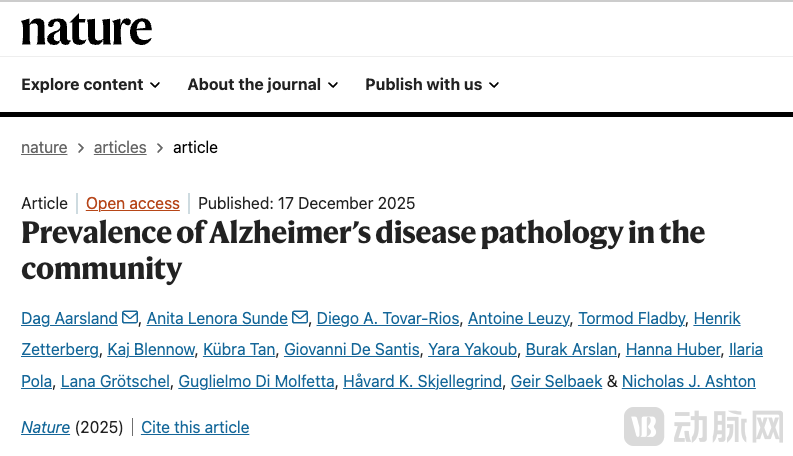
A large-scale Norwegian population study recently published in Nature assessed the prevalence of Alzheimer’s disease neuropathological changes (ADNCs) for the first time in an ultra-large cohort by analyzing blood samples from 11,486 participants aged 58 years and older, using plasma phosphorylated tau at threonine 217 (pTau217) as a biomarker.
(Source: Nature)
Studies have found that33.4% of individuals aged 70 years and older have ADNCs,Prevalence increases significantly with age, rising from less than 8% among individuals aged 58–69.9 years to 65.2% among those aged 90 years and older. This study provides critical epidemiological data for disease diagnosis, treatment decision-making, and healthcare resource planning.
The definitive diagnosis of Alzheimer’s disease relies on the detection of two characteristic neuropathological changes: amyloid-beta (Aβ) plaque deposition and neurofibrillary tau tangles in the brain.
However, traditional diagnostic methods, such as cerebrospinal fluid (CSF) analysis and molecular positron emission tomography (PET), have significant limitations. CSF collection requires lumbar puncture, an invasive procedure with low patient acceptance, while PET scans are constrained by high costs and limited equipment availability.
These technical barriers severely limit the feasibility of assessing Alzheimer’s disease (AD) pathology in large-scale populations, resulting in existing epidemiological data being primarily derived from small-sample, selection-biased clinical cohort studies.
With the advent of disease-modifying therapies (DMTs), such as anti-amyloid immunotherapy, it has become particularly urgent to accurately determine the population prevalence of Alzheimer’s disease (AD) pathology. Only by clarifying how many individuals exhibit AD pathology and how many meet the eligibility criteria for treatment can healthcare systems reasonably predict future medical demands and associated costs.
A recent literature review estimated that the overall prevalence of ADNCs among individuals aged 50 years and older worldwide is approximately 22%; however, these data are largely derived from enrichment studies and may deviate from the situation in the general population.
The Rise of Blood-Based Biomarkers Brings Hope to Solving This Challenge.In particular, plasma pTau217, a tau protein phosphorylated at the specific site threonine 217, has been confirmed to exhibit high accuracy for ADNCs.
Compared with traditional methods, blood tests offer the advantages of being minimally invasive, relatively low-cost, and easy to promote in large-scale populations. In 2024, the Alzheimer’s Association in the United States officially recognized pTau217 as a diagnostic tool for AD, and related tests have been approved in the United States and Europe. However, prior to this, pTau217 had not been applied in large community-based population studies, and its epidemiological value in real-world settings remains to be validated.
To fill this gap, the research team leveraged data resources from the Trøndelag Health (HUNT) Study in Norway. Launched in 1984, the HUNT Study has accumulated health data and biological samples from 250,000 Norwegian participants, boasting unparalleled participation rates and representativeness among similar studies.
This study included blood samples from 11,486 participants aged 58 years and older, among whom 8,949 individuals aged 70 years and older also underwent standardized cognitive assessment and diagnosis. A plasma pTau217 concentration ≥0.63 picograms per milliliter (pg/mL) was used as the criterion for positivity for Alzheimer’s disease neuropathologic changes (ADNCs).
The study revealed a stepwise increase in the prevalence of ADNCs with advancing age.In the 58–69.9-year age group, the prevalence is below 8%; among individuals aged 70 years and older, this proportion rises sharply to 33.4%; and in those aged 90 years and above, the prevalence reaches as high as 65.2%. This trend is evident across all cognitive status subgroups, indicating that age is the most significant risk factor for ADNCs.
A more detailed analysis shows that approximately 10% of the population aged over 70 are inPreclinical(cognitively normal but with existing pathological changes), 10.4% wereProdromal Phase(mild cognitive impairment with pathological changes), 9.8% have progressed toAD Dementia。
This test also helped clarify the true cause of dementia:Approximately 60% of dementia cases are indeed driven by Alzheimer’s disease (AD), whereas nearly 20% of patients test negative for pTau217, suggesting that their cognitive impairment may stem from vascular pathology or other neurodegenerative diseases.
More notably, even among older adults with normal cognitive function, nearly one-quarter exhibit pathological brain changes, indicating they are in the preclinical stage of the disease and face a significantly elevated risk of future cognitive decline.
Genetic and educational factors play a significant role in disease risk.The prevalence of Alzheimer’s disease is significantly elevated among individuals carrying the high-risk *APOE* ε4 allele. Those homozygous for this high-risk allele exhibit a prevalence as high as 64.6%, nearly 2.4 times that of individuals without the high-risk allele (27.1%). Educational attainment demonstrates a clear protective effect: higher levels of education are associated with a lower risk of disease, a disparity that is particularly pronounced in the elderly population. Regarding gender, there is no significant difference in overall prevalence; however, among individuals aged 80–89 years, the prevalence is slightly higher in men than in women.
Based on current standards of care, the research team estimates that approximately 10% of individuals aged over 70 meet the eligibility criteria for disease-modifying therapies. This figure provides a critical reference for healthcare systems to forecast future treatment demands.
The most disruptive aspect of this study lies inRecalibrated our understanding of the prevalence of Alzheimer's disease.A Contradictory Phenomenon Emerges: AD Dementia in the Elderly Is More Common Than Imagined, While Preclinical AD in Younger Individuals Is Much Less Frequent Than Expected
Taking the 85–89-year-old population as an example, this study found that the prevalence of Alzheimer’s disease (AD) dementia was as high as 25.2%, which is 3.5 times the rate reported in the literature review (7.1%); whereas the prevalence of preclinical AD in the 70–74-year-old population was only approximately 8%, significantly lower than the 22% estimated in the literature review.
This discrepancy stems from sample bias in previous studies. The studies included in the literature review largely relied on clinic-based recruitment or volunteer participation, which tends to attract cognitively healthy individuals with a family history of dementia or concerns about their own risk, while often overlooking elderly patients with dementia. In contrast, the HUNT study covers a real-world community population, and its 51.1% participation rate is extremely rare among similar studies, thereby providing a more accurate reflection of the true distribution of the disease. This reminds us that the accuracy of epidemiological data depends heavily on whether the study subjects truly represent the general population.
The protective effect of education on the brain was once again confirmed in this study."Lower levels of education are associated with higher disease prevalence, a correlation that is particularly pronounced among the elderly."
Jason Karlawish, an Alzheimer’s disease expert at the University of Pennsylvania, pointed out incisively, “This really comes down to education and how you use your brain throughout your life.” Education may delay the onset of cognitive decline by building cognitive reserve—the brain’s ability to withstand pathological damage.
Norway’s unique advantages lend greater credibility to this finding. The country boasts a comprehensive social welfare system and universal healthcare coverage, which largely eliminates the confounding influence of economic factors, thereby making the protective effect of education itself more clearly observable. However, the researchers also candidly acknowledge thatLifestyle factors, such as smoking, physical activity, and alcohol consumption habits, have not been adequately assessed.These factors may also influence disease risk.
From a clinical perspective, this blood test opens a new window for precise diagnosis. For patients who have already developed cognitive issues, pTau217 can help physicians determine the underlying cause—whether it is Alzheimer’s disease (AD) or other conditions such as vascular dementia or dementia with Lewy bodies—thereby avoiding unnecessary treatments. For individuals with normal cognition but positive test results, early monitoring and intervention become possible, laying the foundation for future preventive therapies.
However, this test is not flawless. Among the "young-old" aged 70–74 years, approximately 40% of those with a positive result do not actually have AD pathology, whereas in individuals over 90 years of age, this proportion drops to less than 8%. This indicates that the accuracy of the test varies with age and disease prevalence.
Nicolas Villain of the Paris Brain Institute also pointed out that the high threshold adopted in the study might have missed individuals in the early stages of pathology; if the threshold were lowered, the estimated prevalence would rise significantly. Therefore, some experts believe that blood test results still need to be interpreted in conjunction with clinical manifestations and cannot serve as the sole basis for diagnosis.
This study also has several limitations: health status relied on self-reporting, which has limited accuracy; the study population consisted primarily of White Norwegians, so the generalizability of the findings to other ethnic groups remains to be verified; and the cross-sectional design captures only the current state, precluding assessment of lifetime cumulative risk.
Looking ahead, the research team has proposed several avenues worthy of exploration: How do lifestyle factors (such as smoking, sleep, and exercise) influence pTau217 levels? Can long-term longitudinal studies reveal the dynamic relationship between changes in biomarkers and cognitive decline? Is the performance of this assay consistent across different ethnic groups and healthcare systems? Answers to these questions will further refine the application of blood-based tests in the diagnosis of Alzheimer’s disease (AD).
This Norwegian study, involving over 10,000 participants, demonstrates how blood tests are reshaping our understanding of Alzheimer’s disease. A single drop of blood not only reveals that more than one-third of individuals aged 70 and older exhibit cerebral pathological changes, but also overturns previous estimates of prevalence across different age groups—dementia in the elderly is more common than imagined, while hidden pathology in younger people is less prevalent than expected. Furthermore, the protective effect of education has been reaffirmed, underscoring the significant value of lifelong learning and cognitive engagement.
From reliance on lumbar punctures and expensive scans to requiring just a single tube of blood, leaps in diagnostic technology are making early identification of Alzheimer’s disease (AD) readily accessible. This not only helps physicians accurately differentiate the causes of dementia and optimize treatment plans, but also provides public health authorities with a data foundation for forecasting healthcare needs. As this technology is further refined and expanded to broader populations, the era of early diagnosis and precision intervention for Alzheimer’s disease has arrived.