

Nat Commun: A Novel LRBA-Targeting Immunotherapy Strategy Achieves Potent Antitumor Immunity with Significantly Reduced Immune-Related Adverse Effects
In the field of oncology immunotherapy drug development, identifying novel targets and designing molecules with favorable druggability are central to driving breakthroughs in immunotherapy. The advent of immune checkpoint inhibitors (ICIs) has profoundly transformed the landscape of cancer treatment; however, ICI therapy faces clinical challenges such as low response rates and the occurrence of severe immune-related adverse events (irAEs) during treatment. These limitations create an urgent clinical need and significant opportunities for the development of novel immunotherapeutic agents.
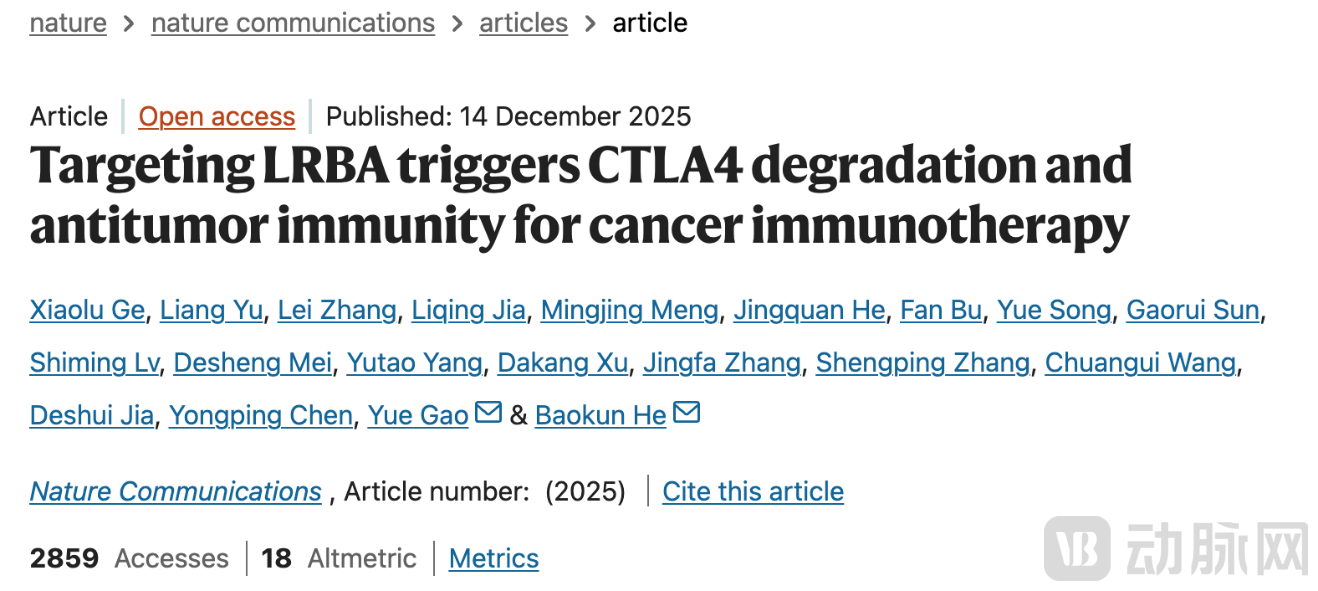
Recently, Shenzhen Hospital of Traditional Chinese Medicine (affiliated with Guangzhou University of Chinese Medicine) and Shanghai Jiao Tong University School of MedicineProf. He BaokunAssociate Chief Physician Yu Liang and Academician Gao Yue’s team published a research paper in Nature Communications, proposing a novel immunomodulatory strategy distinct from antibody blockade. The study systematically elucidated the critical role of the LRBA–CTLA4 axis in tumor immune regulation and successfully developed LC427, the first oral small-molecule candidate drug targeting LRBA.
Antibody drugs targeting the immune checkpoint CTLA-4 have demonstrated potent and durable immune activation in various malignant tumors. However, their clinical application is consistently associated with severe immune-related adverse events (irAEs), particularly immune-mediated colitis, which often leads to treatment discontinuation and can even be life-threatening. This"Efficacy and toxicity are difficult to achieve simultaneously"dilemma, becoming the core bottleneck limiting the further expansion of clinical applications of CTLA-4 antibodies.
Mechanistically, traditional CTLA-4 antibodies achieve rapid clearance of regulatory T cells (Tregs) and relieve immunosuppression by chronically and systemically blocking cell-surface CTLA-4 function, but they also disrupt normal immune tolerance. How to maintain antitumor immune efficacy while reducing systemic immune toxicity is an urgent and important clinical issue that needs to be addressed.
LRBA is a key regulatory protein involved in vesicular trafficking and the maintenance of immune homeostasis. Studies have shown that LRBA can directly bind to the CTLA4 protein and maintain its stability. When LRBA function is genetically knocked out or pharmacologically inhibited, CTLA4 is accelerated toward lysosomal degradation, thereby reducing its immunosuppressive effect. Unlike traditional anti-CTLA4 antibodies, this regulation primarily occurs atIntracellular CTLA4 Protein Pool, rather than directly blocking the function of cell surface CTLA4.
Building on this foundation, the research team obtained the small-molecule compound LC427 through high-throughput screening and systematic structural optimization. Experimental results demonstrated that LC427 specifically binds to the LRBA domain, blocks the LRBA–CTLA4 interaction, effectively reduces CTLA4 protein levels in both murine and human T cells, and thereby significantly enhances antitumor immune responses.
Antitumor efficacy remains excellent
In multiple murine tumor models, LC427 monotherapy significantly inhibited tumor growth and prolonged survival, while markedly increasing the number of tumor-infiltrating CD8⁺ T cells. When combined with a PD-1 antibody, LC427 further enhanced antitumor efficacy and demonstrated synergistic potential even in PD-1-resistant models, suggesting broad application prospects for LC427 in combination immunotherapy.
Significant Improvement in Safety
More importantly, in immunotoxicity assessments, LC427 demonstrated a safety profile distinctly different from that of CTLA-4 antibodies. In the dextran sulfate sodium (DSS)-induced colitis model, CTLA-4 antibodies significantly exacerbated inflammatory responses and caused severe tissue damage, whereas LC427 induced virtually no significant weight loss, elevation of inflammatory cytokines, or histological damage. This suggests thatModulating the intracellular homeostasis of CTLA-4, rather than potently blocking its surface function, holds promise for significantly reducing the risk of immune-related adverse events while maintaining anti-tumor immunity.
From a broader perspective, the significance of this study is not limited to proposing a new mechanism of CTLA-4 regulation that decouples antitumor efficacy from side effects, but alsoProvides a Reusable Framework for Immuno-Oncology Drug DiscoveryBy focusing on the intracellular homeostatic regulation of immune checkpoints, rather than merely blocking signaling at the receptor surface, this study provides new possibilities for precise intervention in highly toxic immune targets and opens up broader regulatory space for subsequent drug design.
Of particular note is the research team’s construction ofHigh-Throughput Screening Platform Based on Protein-Protein Interactions Demonstrates Excellent Scalability and Versatility.By adjusting the screening strategy, the platform can also be used to discover lead compounds that stabilize immune checkpoint function for indications related to immune dysfunction, such as autoimmune diseases. This “same platform, different directions” design philosophy ensures that it is not limited to a single disease or molecule, but possesses the potential for continuous expansion.
From the perspective of development trends in immunotherapy, relevant studies suggest that future innovation in immune-based drugs may shift increasingly from “simple blockade” to “precise modulation.” Intracellular regulatory axes represented by LRBA–CTLA-4, along with corresponding screening and validation systems, provide new tools and directions for the discovery of next-generation immune checkpoint inhibitors.