

Decades-Long Mystery Solved: Rockefeller University Discovers T Cell 'Hidden Spring,' Paving the Way for Next-Generation Immunotherapies
T-Cell ImmunotherapyIt has become one of the most exciting breakthroughs in cancer treatment over the past decade. By reprogramming patients’ own immune systems to precisely identify and destroy cancer cells, this therapy has brought hope for survival to countless patients with advanced-stage tumors.
However, despite significant clinical success, scientists remainT CellsHow exactly is it thatMolecular LevelThere remains a significant gap in our understanding of what it means for these cells to be “lit up” or “activated.” This lack of insight into the underlying mechanisms has, to some extent, limited the widespread application of this therapy—currently, it is effective only against a few types of cancer and remains largely ineffective against most solid tumors.
On December 16, 2025, fromRockefeller UniversityThomas Walz Teamof a landmark study published inNature Communications。
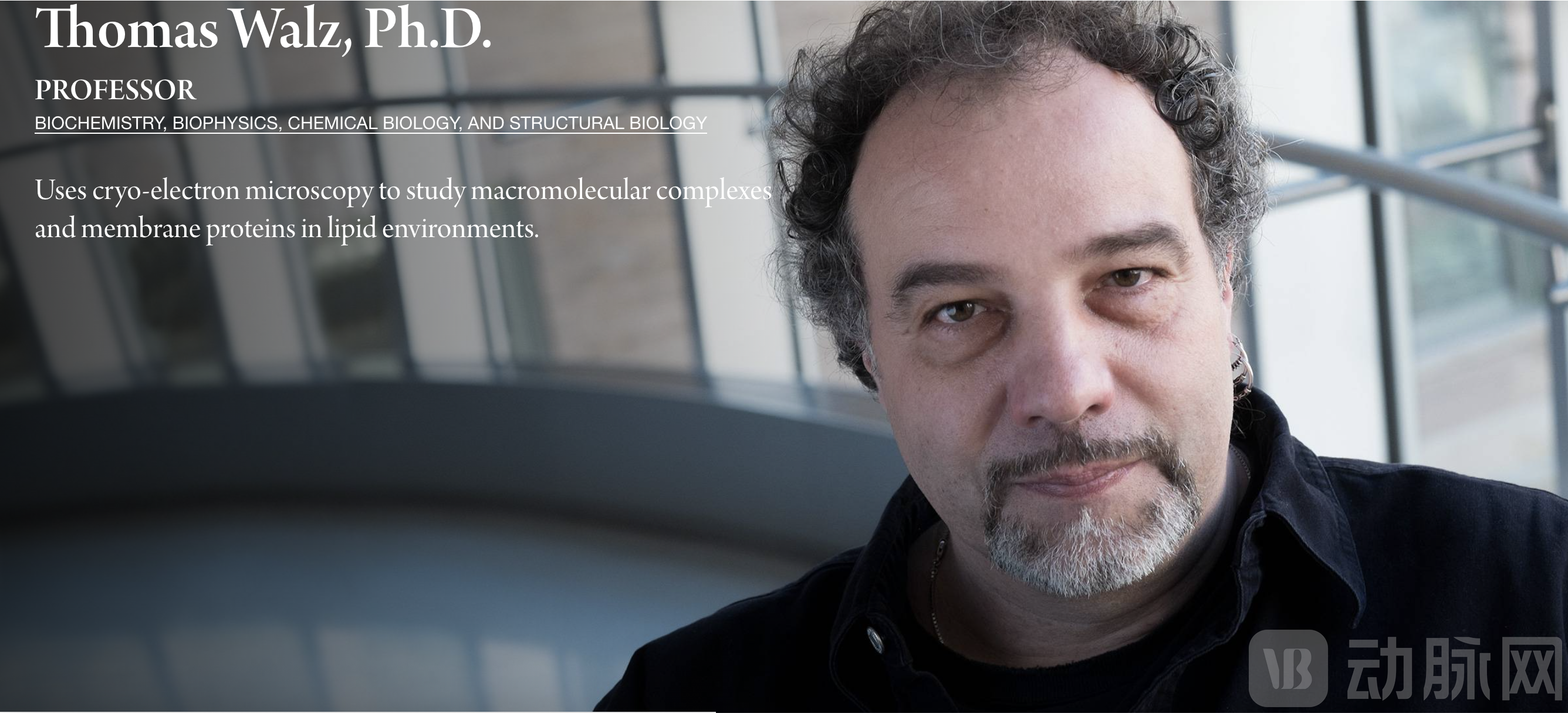
(Source: The Rockefeller University official website)
The research team utilized advancedCryo-Electron Microscopy (Cryo-EM) Technology, successfully resolved for the first time theNative-like Membrane Environment—Nanodiscs(in Nanodiscs)Structure of the Human T Cell Receptor (TCR)-CD3 Complex.
This study reveals a surprising finding: inResting Statebelow,TCRactually in a state of"Close/Tighten"Conformation, until encounteringDanger Signals (Antigens)only to spring open instantaneously like a “jack-in-the-box.” This finding not only puts an end to the decades-long debate in the academic community regarding the TCR activation mechanism, but also provides a key structural blueprint for designing next-generation cancer immunotherapies that are more efficient and broader in spectrum.
T Cell Receptor (TCR)They are the “eyes” on the surface of T cells, responsible for recognizing antigens presented by other cells’ surfaces.Human Leukocyte Antigen(HLA)Presented aberrant signals (such as viral peptides or tumor antigens). Closely linked to theCD3 Protein Complexis responsible for transmitting the recognized signals into the cell, thereby triggering an immune response.
For a long time, in order to study this complex membrane protein machinery, scientists have had to useDetergentExtract the TCR-CD3 complex from the cell membrane. However, this procedure disrupts the native cell membrane environment essential for the protein’s integrity. In all previously resolved structures, the TCR-CD3 complex appears to be consistently in an “open” and “extended” conformation. This has led to a long-standing scientific puzzle: if the TCR is always “awake,” how does itDistinguishing Between "Calm" and "Dangerous"? Does ligand binding actually induce conformational changes?
“It’s like observing a fish in a vacuum and then trying to infer how it swims in water.”
The limitations of these experimental conditions have long led the academic community to mistakenly believe that TCRs do not undergo significant conformational changes during activation, or that the involvement of other external forces (such as mechanical force) is required.
To reconstruct the most authentic biological landscape,Thomas Walz TeamThey adopted a highly innovative approach: abandoning traditional detergents, they instead “planted” the TCR-CD3 complex onto aMiniature Artificial Cell Membranes—Nanodiscsmedium. These nanodiscs are enveloped by membrane scaffold proteins (MSPs) and filled internally withSimulating the Native Membrane Environment of T Cellsa specific lipid mixture.
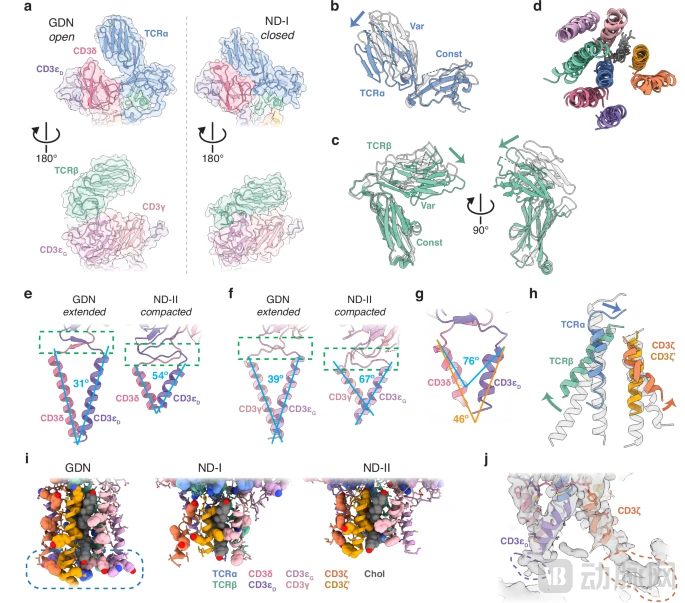
Figure: Unique structural features of TCR–CD3 in nanodiscs
(Source: Nature Communications)
It is precisely in this“Return to Nature”In this environment, the truth comes to light.
PassedCryo-Electron Microscopy (Cryo-EM)High-resolution structural analysis enabled the research team to capture two distinct conformational states of the TCR-CD3 complex in nanodiscs.
First, under resting-state conditions“Close”mode. In the absence of antigenic stimulation, the TCR-CD3 complex is not in a “relaxed” state as previously thought, but rather exhibits two closely related“Closed/Compacted” Conformation (Named ND-I and ND-II). Structural data show that the extracellular domain of the TCR binds tightly to the CD3 complex, not only reducing the overall height by approximately 35 Å (angstroms), but alsoTransmembrane Helices (TM Helices)The perspective has also undergone a significant reversal. This state of contraction is partly due toThe complex with membrane lipids (including cholesterol and specific phospholipids)maintained by specific interactions between them. These lipids act like “glue,” helping to maintainResting Conformation of the Complex。
However, the situation changed dramatically upon antigen appearance. When researchers added specific HLA–antigen ligands to the nanodisc systemSubsequently, a remarkable event occurred: the TCR-CD3 complex rapidly disrupted its original compact conformation, transitioning into the form commonly observed in detergents.“Open/Extended”state. This process is akin to the sudden release of a compressed spring or a “jack-in-the-box.” Upon antigen recognition by the TCR, the extracellular domain “springs up,” driving conformational changes in the transmembrane region.Conformational Rearrangement, thereby transferring the extracellular"Identification Signal"Intracellular Conversion"Activation Signal"。
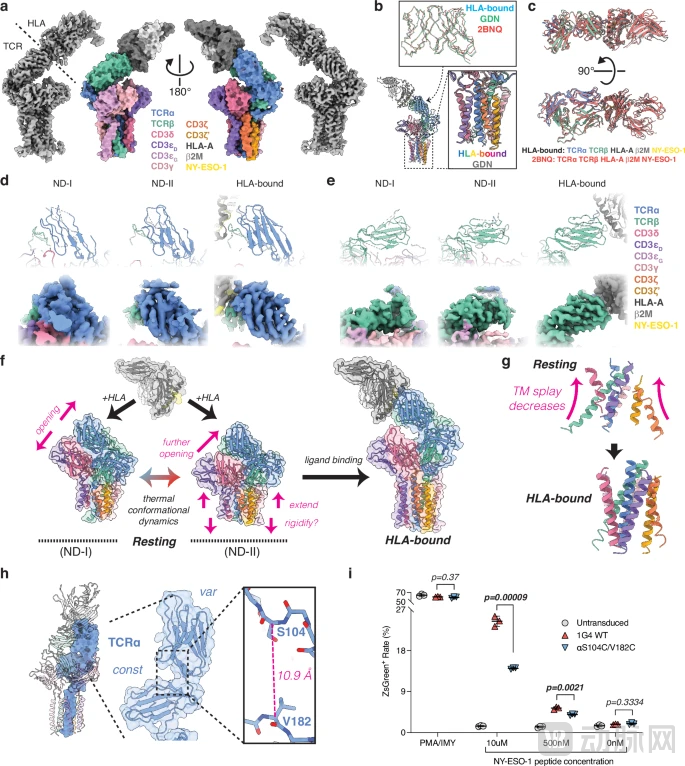
Conformational Changes During TCR-CD3 Activation
(Source: Nature Communications)
To further validate this“Spring Model”physiological significance, the research team designed a set of ingenious experiments. They introduced, via genetic engineering techniques, modifications into key regions of the TCRDisulfide Bond, which is equivalent to putting a “lock” on this “spring,” keeping it in the “closed” state and preventing it from springing open. The results showed that although the “locked” TCR could still recognize antigens normally, it failed to effectively activate T cells. Compared withWild-typeIn comparison, the activation level of mutant T cells decreased by approximately26% to 42%. This key evidence strongly demonstrates that:The conformational change from the “resting state” to the “activated state” is a prerequisite for T cells to initiate an immune response.。
The significance of this finding extends far beyond unravelingA Basic Biology Puzzle. It is used in clinical applications, especiallyCancer Immunotherapyimprovements, pointing to an entirely new direction.
The top priority lies inRebalancing TCR Sensitivity Through Structural Design. CurrentTCR-T Cell Therapy (TCR-T)A Major Challenge Is"Sensitivity"of balance. If the sensitivity is too low, it fails to eradicate the tumor; if the sensitivity is too high, it may inadvertently damage normal cells (off-target effects). The lead author of this research paper, an oncologist and researcherDr. Ryan Q. NottiPointed out:
“Now that we understand how TCRs function like switches, we can”Engineering Modificationto fine-tune the ‘threshold’ of this switch.”
Leveraging the newly resolved closed-state structure, scientists can designSpecific Molecules or Mutations, to modulate the ease with which the TCR “springs off.” For example, for cancers with extremely low tumor antigen expression (such as certain sarcomas), TCRs that “spring off” more readily can be designed to enhance therapeutic efficacy.
Furthermore, this discovery also provides precise navigation for the design of cancer vaccines. In addition to cell therapy, a thorough understanding ofTCR and HLA-Antigen ComplexDynamic interactions on the membrane can help scientists screen for agents that more effectively triggerAntigenic Epitopes with Altered TCR Conformation, thereby enabling the design of vaccines that can induce stronger immune responses.
“This is one of the most important works in the history of my laboratory,” Professor Walz commented.T-cell receptors are the foundation of nearly all tumor immunotherapies.“Surprisingly, while we have been using these tools to treat patients, we have yet to fully understand how they actually work. This is precisely where the value of basic science lies—bridging the knowledge gap and driving leaps forward in medicine.”
With the revelation of this “invisible spring” mechanism, we have reason to believe that future immunotherapies will no longer be akin to “blind men feeling an elephant,” but rather will be rationally designed based on precise molecular mechanisms. This will greatly expandImmunotherapyindications, enabling more patients with terminal illnesses to benefit from it.