

2025 Internet-Plus Nursing Care Services Industry Report: Analyzing Core Demand-Supply Shifts and the Rise of Third-Party S2B2C Platform Models
China’s population aging is exhibiting a “double exceedance” in both scale and speed, with the number of people aged 60 and above surpassing 310 million, placing continuous pressure on the social security system and the supply of integrated medical and elderly care services. In this context, “Internet + Nursing Services,” as a key pillar in the transformation and upgrading of the healthcare system, represents an important pathway to address the challenges of population aging, alleviate the strain on medical resources, and improve patients’ quality of life. However, in practical implementation, this service model has encountered multiple obstacles, such as lower-than-expected service penetration rates, difficulties in achieving sustainable profitability for enterprises, and the absence of a standardized service system. Urgent breakthroughs are needed through model innovation and ecosystem restructuring.
Based on this,VBInsightCombinationZhuopu Nurse# Major Release《2025 Report on the Development Status and Industry Data of “Internet + Nursing Services”》. The report is based on an international perspective, starting fromSupply Side, Demand SideSystematically analyze the industry’s policy environment, core drivers, evolution of user needs, and upgrading of service models; with a focus onPayment TerminalReform Trends: A Deep Dive into Leading Market Business Models Through Case Studies of Top Enterprises, Aimed at Providing Systematic Solutions with Both Theoretical Reference and Practical Value to Break Industry Development Bottlenecks and Promote High-Quality Industrial Growth.
Core Views:
“Internet + Nursing Services” Market Shows Significant Development Potential.Driven by the combined forces of policy, market, social, and economic factors, the market size of “Internet + Nursing Services” continues to expand. The total industry scale is projected to exceed RMB 50 billion in 2025, with a compound annual growth rate (CAGR) remaining above 10%.
The third-party S2B2C platform model, leveraging specialized division of labor, is poised to become the mainstream direction in the industry.The core logic of this model is to optimize social division of labor through a fully managed “system + operations” SaaS service, enabling hospitals to focus on the essence of medical care and thereby achieving dual improvements in service efficiency and quality.
AI technology, as a key enabling tool, drives the industry to improve quality and efficiency while reducing costs.On the supply side, AI technology can optimize resource allocation, drive process digitalization, enhance service accessibility and safety, and build personalized training and competency development systems to reinforce the professional value of nurses. On the patient demand side, AI enables personalized, highly accessible, full-cycle health management, which adds value to services while increasing average revenue per user (ARPU) and patient satisfaction. From a commercialization perspective, AI serves as the core engine supporting third-party S2B2C platforms in achieving scalability and network effects.
Driven by global population aging, the demand for “Internet + Nursing Services” exhibits both universal rigidity and significant differentiation influenced by regional disparities in development levels. Against this industry backdrop, this report selects China, the United States, the United Kingdom, Japan, and Australia as five representative case studies to systematically review the policy frameworks, payment environments, and current development status of the global “Internet + Nursing Services” industry.
From the perspective of industry evolution patterns, global “Internet + Nursing Services” have formed three core common trends: In terms of policy support, robust policy measures have laid a solid foundation for the sustainable development of “Internet + Nursing Services”; regarding service models, standalone online or offline services are gradually being replaced by hybrid models featuring deep online-offline integration, thereby establishing a full-chain closed-loop care system; in terms of technology application, remote patient monitoring, AI, and smart sensing technologies have become key enablers for enhancing service efficiency and quality.

Comparison of the Characteristics of “Internet+ Nursing Services” in Five Countries
The development of China’s “Internet + Nursing Services” is likewise driven primarily by policy; however, current policy instruments in China exhibit an imbalance characterized by the dominance of environmental-type tools and the weakness of demand-side tools.In 2019, the National Health Commission issued the “Pilot Work Plan for ‘Internet + Nursing Services’,” officially kicking off the development of “Internet + Nursing Services” in China. Subsequently, provinces and municipalities across the country rapidly followed suit, formulating corresponding implementation rules tailored to their regional needs.
The report employs a two-dimensional analytical framework to examine China’s “Internet + Nursing Services” policies. The findings reveal that environmental policy instruments account for the largest proportion at 47.11%, followed by supply-side policy instruments at 32.10%, while demand-side policy instruments represent the smallest share at only 20.79%. From the horizontal perspective of development tasks, policies related to innovation-led development and health culture construction have relatively low proportions, accounting for 2.44% and 2.18%, respectively.

Two-Dimensional Coupling Analysis Diagram of China's "Internet + Nursing Services" Policy
The significant imbalance in these policy tools has directly impacted patients, giving rise to a series of practical pain points, including insufficient service accessibility, homogenized service offerings, constrained industry innovation, and poor patient experience. In light of this situation, the report argues that the industry needs to build a more resilient collaborative system that is better aligned with patient needs. This would enhance service accessibility and responsiveness, stimulate service innovation and quality-based competition, and optimize the service experience to empower patients. To this end, the report proposes targeted optimization directions at the policy level, namely optimizing the structure of policy instruments and strengthening demand-side guidance and systemic coordination. For instance, it recommends substantially increasing the use of demand-side policy tools to break through bottlenecks in service accessibility, while simultaneously enhancing the precision of supply-side policy tools in empowering and incentivizing nurses.
Under this optimization framework, the value of regional third-party S2B2C platform models is gradually becoming more prominent.: Such platforms can leverage policies related to “service demonstration” and “cooperation and exchange” to promote the integration of nursing resources across institutions and regions, which is expected to improve the matching efficiency between patients and nursing services, thereby effectively alleviating severe shortages in service accessibility.
Patients and nurses constitute the two core ends of supply and demand within the “Internet+ Nursing Services” ecosystem. The former determines the actual demands on the service demand side, while the latter dictates the quality and efficiency of the service supply side. Based on this, this report specifically deconstructs patients’ “service utilization behavior” and nurses’ “service provision behavior.” This approach not only accurately portrays the current operational status of the “Internet+ Nursing Services” industry but also deeply identifies the core contradictions in supply-demand matching. Furthermore, grounded in these real-world insights, the report explores targeted solutions that align with patients’ core needs while enhancing service quality and efficiency.
1Patient Side: Strong Demand in Lower-Tier Markets, with More Personalized and Specialized Service Offerings
Rural demand is growing rapidly and is expected to become a core growth driver in the future.While demand in rural areas is surging, service penetration remains low. In light of this supply-demand disparity, this report recommends prioritizing strategic deployment in third-tier cities and below, leveraging mature models such as the “Geer Nurse Care Alliance Platform” to build a grassroots service network through collaboration with community medical institutions and township health centers. By 2026, the proportion of users in lower-tier markets is expected to rise to 25%–30%. Meanwhile, policy support should be strengthened, with a focus on optimizing payment and settlement systems and logistics distribution networks in rural areas, thereby laying a solid foundation for the expansion of services into these markets.
Patients’ personalized and diversified needs continue to rise, driving the healthcare industry’s services to upgrade from traditional standardized offerings toward personalized and specialized care.Outdated traditional service catalogs have struggled to meet the segmented needs of patients, resulting in a structural mismatch between supply and demand. In response, this report recommends encouraging platforms and medical institutions to develop high-value-added emerging service packages—such as home-based nutritional guidance, palliative care, and mental health support—centered on patients’ full-cycle health management needs, beyond basic nursing services. This approach not only precisely aligns with the diversified health needs of patients but also enhances industry profitability by increasing average revenue per user, while simultaneously driving income growth for nurses, thereby creating a win-win scenario for all stakeholders.

Data Analysis of the Service Content of “Internet + Nursing Services” from the Demand Side
2Nurse Side: Willingness to Participate Is Influenced by Multidimensional Factors, with Strong Demand for Skills Training
From the “Demand Side” to the “Supply Side,” Training for Nurses Is Both Necessary and Urgent.From the demand side, the intensifying aging of China’s population and the high prevalence of chronic diseases have jointly spurred a substantial and continuously growing demand for home-based nursing care. As of May 2024, more than 3,000 medical institutions across China have launched over 60 on-demand nursing services spanning seven categories, reflecting a sustained rise in market demand for qualified online-booked nurses. However, from the supply side, there is a marked shortage of qualifications and competencies among current online-booked nurses, resulting in a significant gap between their capabilities and patients’ segmented needs as well as administrators’ quality expectations. Therefore, establishing a standardized training system is not only a core lever for improving service quality but also a critical prerequisite for safeguarding nurses’ occupational safety.
"Establishing a scientific incentive system is a crucial support for ensuring the effectiveness of training and activating nurses' service vitality."For instance, implement a flexible pricing model based on a “base service fee + multi-dimensional coefficients (e.g., service complexity, specialty credentials, and service distance),” while simultaneously enhancing the value of non-financial incentives such as career development pathways and honorary recognitions. More importantly, it is essential to ensure transparency in the platform’s revenue distribution mechanism by clarifying allocation rules and streamlining settlement processes, thereby guaranteeing fair compensation for nurses as primary service providers and fostering a virtuous cycle of “training-driven capability enhancement, incentive-based efficiency gains, and quality improvement.”

Data Analysis of the Service Content of “Internet + Nursing Services” from the Supply Side
Currently, the “Internet + Nursing Services” model has primarily evolved into three typical categories. Based on the attributes of the entities involved and their operational logic, these models exhibit differentiated application scenarios and development potential.
1Self-Built Platform Model for Healthcare Institutions
This model involves the independent development and operation of a service platform by large public hospitals, with services primarily limited to discharged patients from the same institution. Its core objective is to establish an integrated service loop encompassing “in-hospital diagnosis and treatment” and “out-of-hospital care.”Its essence lies in an asset-heavy operational model with relatively low efficiency. It serves more as an extension of hospital information system construction rather than a market-oriented internet business model. Therefore, this model is only suitable for a select few top-tier hospitals, where it functions as an avenue for academic exploration or a supplementary form of high-end patient services. It cannot assume the mainstream role in driving the inclusive, large-scale development of “Internet + Nursing Services.”

Analysis of the Advantages and Disadvantages of the Self-Built Platform Model for Healthcare Institutions
2Government-Led Unified Construction Model
This model, led by local governments or health commissions, establishes a unified regional service platform and integrates medical resources within the region through administrative measures. Its core value lies in ensuring equitable access to services and facilitating the implementation of tiered diagnosis and treatment.In the initial phase of project implementation, this model leverages administrative coordination advantages to rapidly achieve service coverage, serving as a critical pillar in establishing primary care nursing service networks. However, its sustainable development hinges on two core conditions: sustained and stable financial investment, and efficient cross-departmental administrative coordination. Without the introduction and activation of market-oriented mechanisms, it is highly prone to falling into the dilemma of “stagnation upon platform completion,” thereby hindering refined operations and long-term development.

Analysis of the Advantages and Disadvantages of the Government-Led Unified Construction Model
3Third-Party Platform S2B2C Model
Compared with the previous two models, the third-party platform S2B2C model represented by Geer Nurses centers on leveraging specialized social division of labor to address systemic industry challenges and build a multi-party win-win ecosystem.. Under this model, the boundaries of rights and responsibilities are clearly defined: hospitals focus on core medical processes, responsible for verifying nurse qualifications and ensuring service quality; while the platform provider assumes full-process operational support, including technology research and development, system operations, market promotion, and risk control, thereby effectively reducing hospitals' trial-and-error costs and operational burdens.
The core value of this model lies in transforming “Internet + Nursing Services” from the “hospital cost center” or “government public welfare project” seen in the first two models into a market-driven ecosystem for value creation. Taking Geer Nurse as an example, its fully managed SaaS service, featuring an integrated “system + operations” approach, enables hospitals to refocus on the essence of medical care. While enhancing the efficiency of social services, it fully unleashes market potential, thereby becoming the leading direction for promoting inclusive and scalable development within the industry.
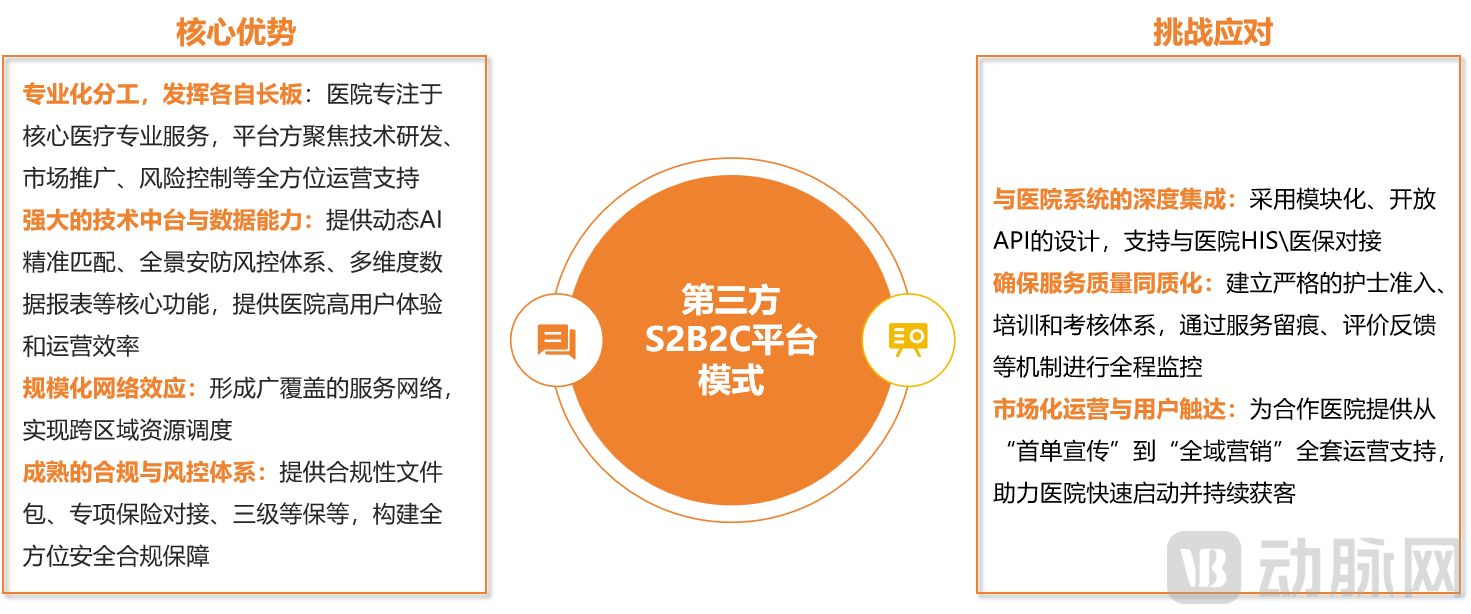
Advantages of the Third-Party S2B2C Platform Model and Strategies to Address Its Challenges
From the perspective of industry development logic, after policies have laid the foundation, China’s “Internet + Nursing Services” must undergo a strategic transformation from being “policy-driven” to being driven by the dual engines of “technological and business model innovation.” Among these,AI Technology as a Core Enabling Tool, with its development direction precisely targeting three core pain points in the industry:
Business ModelAt this level, AI serves as the core engine enabling third-party S2B2C platforms to achieve scalable expansion and network effects, effectively addressing the industry’s challenge of economic sustainability;
Service SupplyAt this level, AI serves as a reliable support for enhancing nursing efficiency and ensuring service safety by optimizing human resource allocation and strengthening quality control, thereby addressing the challenge of optimizing labor supply in the industry;
User ExperienceAt this level, AI is driving the upgrade of health services toward personalization, accessibility, and continuity, serving as an innovative catalyst that precisely matches and meets the diverse needs of patients.
It is worth emphasizing that the development direction of AI in the industry has always been “empowerment” rather than “replacement,” with the ultimate goal of building a multi-party win-win ecosystem, namelyNurses benefit from increased income and expanded career growth opportunities, patients receive more convenient and higher-quality nursing care, medical institutions can focus on core clinical services, and payers such as health insurance funds achieve efficient utilization of healthcare resources.Therefore, future policy directions must align with this trend, focusing on removing obstacles to the compliant deployment and efficient application of AI technologies, and guiding the industry toward high-quality development.
The above is an excerpt from the report. The overall framework of the report is as follows:
Chapter 1 Overview of “Internet + Nursing Services”
1.1 Definition
1.2 Development Drivers and Social Value
1.3 Current Status of "Internet + Nursing Services" in the United States
1.4 Current Status of “Internet + Nursing Services” in the United Kingdom
1.5 Current Status of “Internet + Nursing Services” in Japan
1.6 Current Status of “Internet + Nursing Services” in Australia
Chapter 2 Analysis of China’s Policy Environment
2.1 Summary of Major National and Local Policies in China
2.2 Detailed Breakdown of Policy-Based Fee Structures
2.3 Two-Dimensional Analysis of Policy Instruments
2.4 Key Policy Findings from the Patient Perspective
Chapter 3: Current Status and Market Analysis of the Domestic Industry in 2025
3.1 Policy and Regulatory Environment
3.2 Market Size and Growth Trends
3.3 User Needs and Industry Drivers
Chapter 4 Patient Profiling and Usage Behavior Analysis
4.1 Demographic Characteristics: Age and Gender
4.2 Socioeconomic Characteristics: Geographic Distribution, Income, and Education
4.3 Willingness to Use and Behavioral Preferences
Chapter 5: Multidimensional Analysis of the Nursing Workforce
5.1 Overall Level and Distribution of Willingness
5.2 Current Status of Competencies and Professional Skills
5.3 Safety and Risk Perception
5.4 Economic Incentives and Compensation Structure
5.5 Technical Literacy and Digital Application Competence
5.6 Communication and Humanistic Care Competence
5.7 Nurse Training and Competency System Development
Chapter 6 Service Quality and Key Influencing Factors
6.1. Personnel Structure and Professionalism Level
6.2. Standardized Procedures and Operational Guidelines
6.3. Quality Control and Supervision Mechanisms
6.4. Information Technology Support Platform
6.5. Examples of Literature Interpretation
Chapter 7: Analysis and Insights into Mainstream Business Models
7.1 Overview of the Three Major Models and Economic Dilemmas
7.2 Self-Built Platform Model for Healthcare Institutions
7.3 Government-Led Unified Model
7.4 Third-Party S2B2C Platform Model
Chapter 8: Development Directions for AI-Empowered Industries
8.1 “Intelligent Scheduling and Efficiency Enhancement Tools”: Resolving the Dilemma of Accessibility and Economic Models
8.2 “Quality and Safety Collaborative Control Tools”: Building a Resilient Service System
8.3 “Nurse Empowerment and Training Tools”: Bridging Competency Gaps and Enhancing Professional Value
8.4 “Personalized Health Management Tools” Drive Service Innovation and Demand Segmentation
8.5 Summary
Chapter 9: Strategic Recommendations for Promoting High-Quality Industry Development
9.1 Policy Level: Optimizing Tool Structure and System Synergy
9.2 Market and User Level: Enhancing Penetration and Addressing Segmented Needs
9.3 At the Nursing Staff Level: Building a Composite Incentive System
9.4 Business Model and Technology: Supporting Scalable Growth
9.5 Quality Supervision and Standard Development: Building a Resilient System
Scan the QR code below to access the full report:
