

Universal Influenza Vaccine Development Achieves Breakthrough: Multi-Path Approaches Challenge the Quest for Lifelong Immunity
In recent years, although influenza vaccines have become widely available, the protective efficacy of existing vaccines often hovers between 40% and 60% due to the rapid mutation of the virus, necessitating annual vaccination for the public.
Recently, Nature published an in-depth report on the progress of universal influenza vaccine development.The article provides a detailed account of how leading research teams worldwide are leveraging cutting-edge technologies—including chimeric proteins, gene editing, artificial intelligence, and cellular immunotherapy—to tackle the challenge of influenza virus mutation.
These studies not only aim to developBroad-Spectrum Vaccines Covering Multiple Viral Subtypes, and we aspire to extend the duration of vaccine-induced protection from one year to several years or even lifelong immunity, thereby fundamentally reversing the passive situation in which we must chase influenza viruses as if they were fleeting fashion trends.
By targeting the unchangeable “Achilles’ heel” in viral evolution, scientists are redefining the rules of engagement with infectious diseases, and the development of universal influenza vaccines also demonstrates modern medicine’s shift from"Passive Defense"To"Proactive Engagement"the transformation.
The fundamental reason why the influenza virus is difficult to eradicate lies in its extremely high variability, a phenomenon known asAntigenic Drift. The surface of the influenza virus is covered with two key proteins:Hemagglutinin(Haemagglutinin, HA) andNeuraminidase(Neuraminidase, NA). Among these, hemagglutinin has 18 subtypes (H1 to H18), and neuraminidase has 11 subtypes (N1 to N11). Currently, the predominant strains circulating in humans are the H1N1 and H3N2 combinations.
Hemagglutinin is the key that allows viruses to invade human cells. Its structure resembles a mushroom, consisting of a "head" at the top and a "stem" at the bottom.Current influenza vaccines primarily induce the immune system to target the head of hemagglutinin, as this region is the most exposed and readily recognized by B-cell receptors. However, the head is also the area where the virus mutates most frequently.Once mutations occur in the head domain, pre-existing antibodies can no longer recognize it, rendering the vaccine ineffective. In contrast, the stalk domain is far more conserved. The stalk plays a critical mechanical role in the fusion of the virus with the host cell membrane. Because complex conformational changes are required to complete this fusion process, any mutation that interferes with it may lead to viral inactivation. Consequently, the stalk domain is under strict evolutionary constraints and cannot mutate as freely as the head domain.
This mutation has introduced significant uncertainty into public health defenses. The World Health Organization (WHO) convenes twice annually to leverage global surveillance data in forecasting the strains likely to prevail in the upcoming season. However, such predictions are not always accurate. For instance, in 2014, the WHO predictedH3N2It was identified as the primary threat and incorporated into the vaccine, but by the time the vaccine reached the market, the virus had undergone critical mutations. This minor predictive error had catastrophic consequences: the vaccine’s efficacy against the predominant circulating strain plummeted to just 6%, resulting in one of the most severe influenza seasons in recent years.
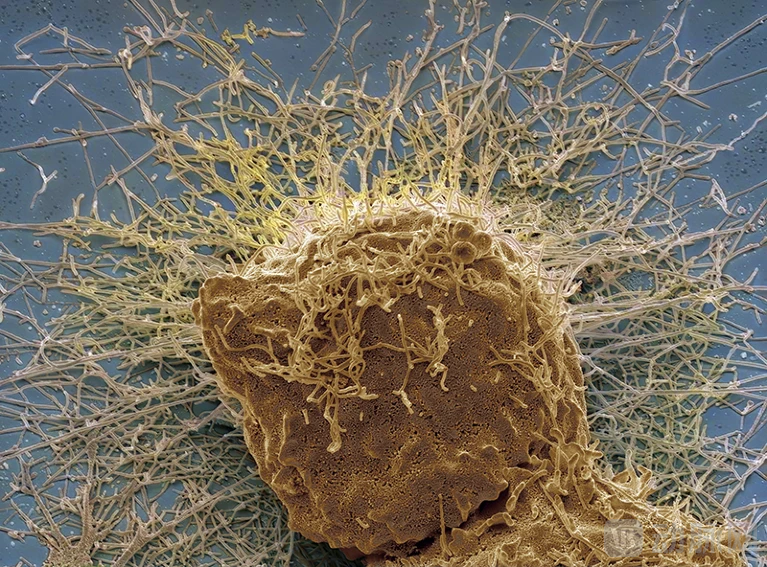
Figure: A human cell infected with the H3N2 influenza virus
(Source: Steve Gschmeissner/SPL)
To address this critical challenge, the scientific community has proposed the concept of a “Universal Flu Vaccine.” If influenza viruses are envisioned as master disguisers, the goal of a universal vaccine is to identify features that remain unchanged regardless of how the virus alters its appearance. Unlike traditional vaccines that chase viral mutations, universal vaccines target highly conserved regions on the virus that are resistant to mutation.If successfully developed, this vaccine would not only significantly boost protective efficacy from the current 40%–60%, but also eliminate the substantial annual costs associated with redeveloping and manufacturing vaccines, truly achieving a “constant response to ever-changing challenges.”
To achieve this goal, scientists are attempting a variety of radically differentdifferent technical pathways. The Icahn School of Medicine at Mount Sinai in the United StatesVaccinologist Florian Krammer’s team adopted a “decoy” strategy. Since the immune system is habitually fixated on the variable head of hemagglutinin, they engineered aChimaeric Protein, which retains the conserved stem region of the virus (e.g., H1 subtype) but replaces the head domain with a rare subtype rarely encountered by the human immune system (such as H8 or H14)。

Figure: Virologist Florian Krammer is developing an influenza vaccine that could protect against multiple flu virus strains.
(Source: Mount Sinai Health System)
The ingenuity of this design lies in its utilization of pre-existing human immune memory. With the exception of newborns, the vast majority of individuals have previously been infected with influenza or vaccinated, thereby establishing a certain degree of immune imprinting against the common H1 stem. Upon administration of this chimeric vaccine, the immune system bypasses the unfamiliar H8 head and instead recognizes the previously encountered H1 stem. This“Redirection” MechanismThis approach artificially dampens the immune response to the head while enhancing the response to the stem. Current Phase I clinical trials demonstrate that this method effectively induces potent antibodies targeting the H1 stem. The team is planning trials for the H3 stem, with the ultimate goal of combining both to establish a dual line of defense.
In addition to reshaping antigens, gene editing technology has also entered the fray.Nicholas Heaton, a microbiologist at Duke University, has adopted a more aggressive “epitope engineering” strategy. His team used gene-editing technology to create more than 80,000 variants of the hemagglutinin head, which differ in key epitopes while maintaining a conserved stalk region.
Faced with such a complex array of head targets, the immune system is forced to shift its focus to the conserved stem region, which remains unchanged. In experiments involving mice and ferrets, this approach successfully induced high levels of stem-directed antibodies. Interestingly, these stem antibodies do not directly neutralize the virus as head antibodies do; rather, theyBy Supporting the Immune SystemIt works by identifying and clearing the virus at an earlier stage. This can significantly reduce the viral burden, thereby alleviating the severity of the disease. Heaton vividly likened this protection to a scenario where someone who would normally need to take two days off work feels no signs of illness, or where a potentially fatal case is reduced to just a few days of mild discomfort.
Meanwhile,The team led by Ted Ross at the Cleveland Clinic has turned its attention to computational biology. They developed a system named “Computationally Optimized Broadly Reactive Antigens” (COBRA).This system not only utilizes data on human influenza viruses but also incorporates viral genomes from animal hosts such as pigs and ducks, thereby expanding the breadth of its predictions.COBRA SystemLeveraging machine learning algorithms to analyze the massive genomic data sequenced since 2010, simulating the evolutionary trajectories of viruses under immune pressure, therebyPredicting Potentially Emerging Conserved Sequences。
In a retrospective study, the team designed a vaccine using only data from before 2009 and found that it effectively protected mice against various H1N1 and H3N2 strains that emerged between 2009 and 2019. Ross concluded that this is, in fact,“Let the evolution of viruses tell us how to make vaccines”。
Another highly promising approach completely moves beyond the realm of antibodies, turning instead to harness the power of T cells. Oregon Health & Science University’sJonah Sacha’s team focuses on the structural proteins within viruses.. They carefully selected three highly conserved core proteins: the matrix protein M1, the nucleocapsid protein, and the viral polymerase PB1. These proteins not only constitute the structural framework of the virus but are also evolutionarily almost “untouchable,” as any mutation would lead to viral disintegration.
The research team used cytomegalovirus (CMV) as a vector to insert the genes encoding the internal proteins of these three influenza viruses.CMV is a virus that can infect humans without causing disease and can remain latent in the body for extended periods; its properties enable it to effectively activate T cells located in sites such as the respiratory mucosa. In a striking challenge study, researchers prepared this T-cell vaccine using the sequence of the 1918 Spanish influenza virus (recovered from frozen tissue samples) and administered it to rhesus macaques. Subsequently, these macaques were exposed to theHighly Pathogenic H5N1 Avian Influenza VirusBelow. The results showed that 6 out of 11 monkeys in the vaccinated group survived, whereas all 6 monkeys in the unvaccinated group died within one week. This demonstrates that T-cell immunity targeting conserved internal proteins provides broad-spectrum protection enduring over a century.
These diversified research strategies indicate that the future of general flowThe influenza vaccine is likely not a “silver bullet” with a single mechanism, but ratherMultiple Protection Mechanismscombination. Ross pointed out that, given the pre-existing immune memory in the human body, relying solely on stem-directed antibodies may be insufficient to establish a perfect defense line. An ideal vaccine should simultaneously mobilize antibodies targeting multiple epitopes as well as T-cell immunity. This multi-pronged strategy can construct a more robust defensive network, ensuring that even if mutations occur at one site of the virus, the immune system can still eliminate it through other recognition sites.
From the perspective of application value, even if we cannot immediately develop a vaccine that provides lifelong immunity with a single dose, a broad-spectrum vaccine offering three to five years of protection would still be revolutionary. This would fundamentally transform the current passive model of influenza prevention and control: vaccine manufacturers would no longer need to rush through the entire process—from strain prediction to production—within a few months each year, but could instead adopt a stable, year-round production model; the burden on healthcare systems would be significantly alleviated; more importantly, such long-lasting protection would substantially reduce the global health risks posed by influenza pandemics. As Kramer stated,“If only a few flu vaccinations were needed in a lifetime, it would be a total game-changer.”
However, the development of universal vaccines still faces numerous challenges. Scientifically, viral evolution is highly elusive, and it remains uncertain whether the immune system can be fully “persuaded” by novel induction strategies. Furthermore, uncertainties in the policy and funding landscape cast a shadow over research and development efforts.
It is worth noting that,National Institutes of Health (NIH)In May this year, a project named “Generation Gold Standard” was announced, aiming to develop universal vaccines against influenza and coronaviruses. However, the whole-virus inactivation technology (based on beta-propiolactone, BPL) planned for use in the project has been questioned by some scientists as an “outdated technique with poor immunogenicity.” This stands in stark contrast to the rapidly advancing new technological approaches such as mRNA vaccines, raising concerns within the scientific community about future resource allocation.
Looking ahead, a universal influenza vaccine is no longer an unattainable scientific fantasy. From mice and ferrets in the laboratory to non-human primates, we have witnessed the dawn of successful proof-of-concept studies. Although there is still a long way to go before widespread clinical application, potentially requiring several years to validate its long-term protective efficacy in humans, the scientific community is making steady progress in the right direction. We may not be able to completely eradicate influenza, but by harnessing the combined power of immunology, genetic engineering, and artificial intelligence, we are poised to transform this deadly seasonal threat into a manageable, low-risk aspect of daily health management.