

Jianxin Superconductor, the Largest Independent MRI Superconducting Magnet Supplier, Debuts on STAR Market
Ningbo Jansen NMR Technology
Developer, Manufacturer, and Supplier of Core Components for Medical Magnetic Resonance Imaging (MRI) Equipment
On December 24, Ningbo Jansen NMR Technology Co., Ltd. (“Jansen Superconducting”), a leading domestic manufacturer of core components for magnetic resonance imaging (MRI) systems, successfully listed on the STAR Market with an initial public offering price of RMB 18.58 per share. The stock surged by 212.81% on its listing day, closing at RMB 58.12. As of December 26, the share price stood at RMB 50.85.
Ningbo Jansen NMR Technology is primarily engaged in the research and development, production, and sales of core components for medical magnetic resonance imaging (MRI) equipment. Its main products includeSuperconducting Magnets, Permanent Magnets, and Gradient Coils, such components account for approximately 50% of the cost of core MRI equipment components.
It is no easy feat for upstream core component manufacturers of medical devices to reach the secondary market, let alone achieve a market capitalization of tens of billions. The technological barriers and market breadth that underpin investor expectations for Ningbo Jansen NMR Technology are rare, with hardly a second comparable case found in the domestic market.
Currently, Ningbo Jansen NMR Technology has mastered zero-boil-off superconducting technology (1.5T, 3.0T) and cryogen-free superconducting technology (1.5T). The zero-boil-off superconducting technology is gradually closing the approximately 20-year technological gap with international giants, enabling domestically produced equipment to enter the high-field superconducting magnet market long dominated by European, American, and Japanese manufacturers. Cryogen-free superconductivity represents a competition in innovative capabilities from the same new starting point; breakthroughs in this area signify that Ningbo Jansen NMR Technology has acquired the capabilities of a first-tier core component manufacturer.
In terms of market share, Ningbo Jansen NMR Technology ranked fifth globally in the superconducting magnet market in 2024, trailing only Siemens Healthineers, GE HealthCare, Philips Healthcare, and United Imaging Healthcare. Its clients include overseas companies such as Japan’s Fujifilm Group, US-based GE HealthCare, and Italy’s Esaote SpA, as well as domestic firms including Wandong Medical, Shenzhen Anke High-tech Co., Ltd., and Longwin Medical.
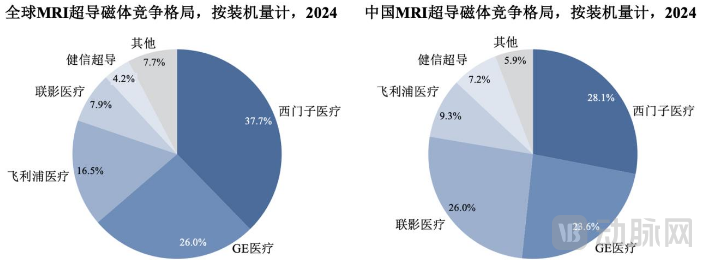
2024 Global (Left) – China (Right) Competitive Landscape of MR Superconducting Magnets (by Installed Base)
In 2022, 2023, 2024, and the first half of 2025 (January–June), Ningbo Jansen NMR Technology reported operating revenues of RMB 252.0981 million, RMB 425.4975 million, RMB 450.6448 million, and RMB 358.9345 million, respectively, with corresponding net profits excluding non-recurring items of RMB 30.3980 million, RMB 50.2676 million, RMB 44.7380 million, and RMB 30.8523 million. Amid the 2024 downturn in the medical equipment sector, Ningbo Jansen NMR Technology experienced a decline in both revenue and net profit, but rebounded in the first half of 2025 in line with market trends.
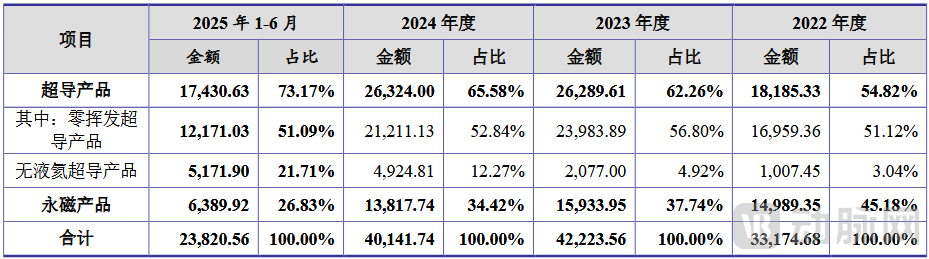 Ningbo Jansen NMR Technology's Main Business Revenue Composition
However, Ningbo Jansen NMR Technology also has its weaknesses. As reflected in public information, on the one hand, its gross profit margin is significantly lower than that of its peers; on the other hand, its product portfolio is relatively homogeneous, resulting in certain deficiencies in risk resistance.
During the reporting period, Ningbo Jansen NMR Technology’s gross profit margin fluctuated around 20%, significantly lower than the industry average of 45%. This discrepancy stems from the fact that a complete MRI system comprises core components such as magnets, gradient systems, radiofrequency (RF) systems, and spectrometers. As Ningbo Jansen NMR Technology primarily specializes in magnets, its raw material procurement costs are relatively high. Key raw materials include mechanical parts, superconducting wires, permanent magnet materials, liquid helium, and cryocoolers. Consequently, the cost of magnets and associated gradient coils accounts for nearly 50% of the cost of core components and 65–70% of the total cost. For permanent magnet products, direct materials account for more than 85% of the cost. To maintain price competitiveness, the company inevitably faces compressed gross margins, a situation unlikely to change in the short term.
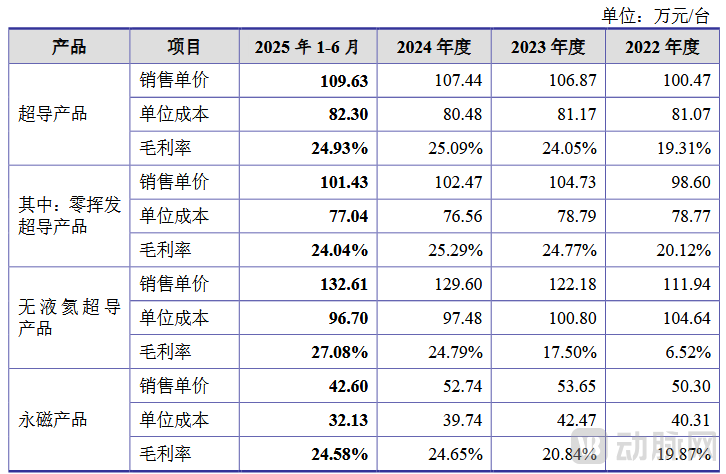
Gross Profit Margin of Ningbo Jansen NMR Technology's Core Business During the Reporting Period
Furthermore, Ningbo Jansen NMR Technology’s production lines are closely centered around magnet manufacturing, appearing relatively narrow compared to industry peers. According to the disclosed primary uses of its financing, the funds raised from the IPO will be mainly allocated to expanding production capacity and researching and developing new superconducting magnets, with no current plans to expand into other core MRI components.
As magnetic resonance imaging (MRI) systems are classified as high-end medical equipment, only a limited number of companies worldwide have achieved mass production capabilities. For Ningbo Jansen NMR Technology, the customers capable of generating significant revenue are merely a few leading enterprises in terms of equipment sales volume within their respective regions. Consequently, the company’s business model primarily focuses on direct product sales and maintenance services, with a sales team consisting of only six members.
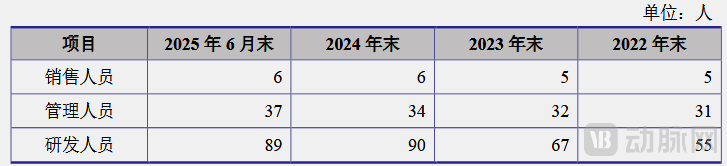
Personnel Composition of Ningbo Jansen NMR Technology During the Reporting Period
However, Ningbo Jansen NMR Technology’s sales concentration remains slightly high. During each period of the reporting period, the combined sales revenue from the top five customers accounted for 73.75%, 76.68%, 79.62%, and 83.43% of the company’s operating revenue for the respective periods. Among them, the largest customer, Fujifilm Group, alone accounted for 34.20%, 44.20%, 42.71%, and 38.79%, exceeding one-third.
Magnets sold to Fujifilm were not retained in the domestic market. Data from Zhaocaitong shows that in China’s medical MRI market in 2024, United Imaging Healthcare, GE HealthCare, Siemens Healthineers, and Philips Healthcare collectively captured a 96.49% market share. In other words,Ningbo Jansen NMR Technology’s installed base is heavily concentrated in overseas markets.(mainly Japan, South America, the Middle East, India, and other countries or regions), adding an extra layer of policy risk amid a volatile geopolitical landscape.
Furthermore, as the sixth-largest customer of Ningbo Jansen NMR Technology in 2022, Besta suspended payments to Ningbo Jansen NMR Technology from September to the end of 2023 due to deteriorating business operations. This led Ningbo Jansen NMR Technology to make a 100% individual provision for impairment on its accounts receivable from Besta, which exceeded RMB 10 million. This indicates that, as an upstream supplier, Ningbo Jansen NMR Technology is significantly affected by the operational performance of downstream whole-machine manufacturers, yet it lacks the managerial leverage to exert substantial influence over them or to alter the market landscape of magnetic resonance imaging (MRI).
Fortunately, with the advent of county-level centralized procurement in 2025, Wandong Medical emerged as one of the biggest winners among mid-range equipment manufacturers. Its surging market share in magnetic resonance imaging (MRI) drove up magnet sales for Ningbo Jansen NMR Technology. In 2024, Wandong Medical purchased superconducting products from Ningbo Jansen NMR Technology totaling RMB 63.4656 million, accounting for 14.92% of the latter’s sales revenue and becoming its second-largest customer that year.
More importantly, in the second half of last year, Ningbo Jansen NMR Technology successfully partnered with GE Healthcare to jointly launch a new magnetic resonance imaging (MRI) system (model unspecified),Achieved a breakthrough in enabling independent magnet suppliers to enter the supply chains of leading OEMs.. From January to June 2025, GE Healthcare became the second-largest customer of Ningbo Jansen NMR Technology, generating revenue exceeding RMB 40 million.
In addition to GE Healthcare, Ningbo Jansen NMR Technology is collaborating with United Imaging Healthcare on prototype testing and is engaged in discussions with other leading whole-system manufacturers. In 2024, the combined market share of GE Healthcare and United Imaging Healthcare exceeded 60%. Even if Ningbo Jansen NMR Technology achieves large-scale replacement of existing magnets in just one model from either company, it would realize a qualitative leap in revenue.
According to 2021 OECD statistics, developed countries such as the United States and Japan have more than 30 MRI units per million people; China has 13.2 MRI units per million people, Brazil has 14.5 MRI units per million people, and other developing countries generally have fewer than 2 MRI units per million people.
Compared with most developing countries, China’s number of MR units per million people has moved beyond the level typical of this group and is approaching that of developed nations. When GDP share is taken into account, the domestic supply of MR systems basically meets population needs.
Therefore, the combined impact of the "Notice on the Catalogue for the Administration of Licensing for the Configuration of Large-Scale Medical Equipment (2023)" and the anti-corruption campaign in the healthcare sector led to the first year-on-year decline in total MRI sales volume in China in a decade in 2023. Although sales have rebounded in subsequent years, the overall growth rate has not returned to its previous levels. Had Ningbo Jansen NMR Technology achieved its technological breakthroughs five years earlier, thereby capitalizing on the full wave of MRI market growth, the current landscape would likely be far more promising.
The market offers no “what ifs,” but for Ningbo Jansen NMR Technology, the hard-to-replicate MR growth trend in China may be reproduced in other developing countries. Going global is a key opportunity for Ningbo Jansen NMR Technology.
Public records indicate that Ningbo Jansen NMR Technology established its Indian and Italian subsidiaries, India Jansen and Italy Jansen, in 2019 and 2021, respectively. This move initially formed a global industrial layout, making the company one of the few in the industry with overseas delivery capabilities for superconducting magnets. However, no further expansion plans were pursued thereafter. With the support of new financing and new customers, Ningbo Jansen NMR Technology may now be poised to further advance its global footprint.
Meanwhile, the trend toward specialization in magnetic resonance imaging (MRI) may also bring a certain scale of incremental market to Ningbo Jansen NMR Technology. In 2024, Ningbo Jansen NMR Technology’s permanent magnet products accounted for approximately 61% of the global market share, making it the world’s largest supplier of permanent magnets. In recent years, pet hospitals have rapidly increased their procurement of medical equipment. Permanent magnet MRI systems are relatively affordable, and as the volume of pet MRI scans is still in its early growth stage, many independent veterinary clinics prefer these cost-effective devices to meet the dual needs of patients and institutions.
Overall, although Ningbo Jansen NMR Technology failed to capture market dominance during the golden age of magnetic resonance imaging (MRI), it has still secured a strategic position by leveraging its technological advantages, positioning itself for further expansion. Its entry into the secondary market is merely the beginning; with more robust cash flow, we may see this leading Chinese developer of core components for high-end medical equipment go even further, writing a new chapter in uncharted territory.