

Biological Computationalism: Why Consciousness Cannot Be Reduced to Code
As generative AI demonstrates increasingly astonishing capabilities, an age-old and profound question has once again taken center stage in scientific debate:Can code running on silicon-based chips ultimately give rise to consciousness?
There is no consensus in the mainstream academic community on this issue, but “Computational Functionalism” has long held a dominant position—namely, that as long as the logical structure of computation is correct, it does not matter whether the physical substrate consists of carbon-based neurons or silicon-based transistors.
However, a groundbreaking paper recently published in Neuroscience & Biobehavioral Reviews proposes a novel and challenging perspective:Biological Computationalism.
This study, supported by the Estonian Research Council and authored by Borjan Milinkovic and Jaan Aru, points out that genuine brain computation is fundamentally different from “computation” as understood in computers.
Studies have shown that consciousness does not arise from abstract algorithms, but rather stems from a specific physical mechanism—one that possessesHybrid Computation、Scale InseparabilityandThree Key Characteristics of Metabolic Embedding. This new theory suggests that no matter how perfectly we optimize existing artificial intelligence code, as long as it runs on traditional von Neumann architecture, it may never cross the threshold into consciousness.
In the golden age of artificial intelligence, we have grown accustomed to likening the brain to a supercomputer: “The brain is the hardware, and the mind is the software.” While this analogy is intuitive, new research suggests that it precisely obscures the core secrets underlying the emergence of consciousness.
Current discussions on machine consciousness are primarily divided into two major camps. One side isComputational Functionalism, arguing that consciousness is a product of information processing and independent of its physical substrate. If this theory holds true, then AI will eventually develop consciousness as long as computational power is sufficiently advanced. The other side isBiological Naturalism, insisting that consciousness is a property unique to living organisms, dependent on specific biochemical processes.
However, this new paper points out that both sides have overlooked a key point:The “computation” performed by biological systems is fundamentally different from the “computation” carried out by digital computers.
The core design philosophy of digital computers is “separability.” In your computer, software does not need to know how the transistors in the hardware switch on and off; algorithmic logic is completely decoupled from physical implementation. This design offers tremendous flexibility but also leads to the so-called “Von Neumann bottleneck”—the separation of memory and processing. More importantly, in digital systems, microscopic physical states (transistor voltages) and macroscopic logical states (program execution) are causally designed to be isolated from each other.
In contrast, such separation does not exist in the biological brain. Researchers point out that in biological systems,“The Algorithm Is the Substrate”The physical structure of the brain (ion channels, dendritic morphology, and cell membrane potentials) is not merely a container that hosts computation; it is itself the process of computation. This characteristic of “physics as computation” implies that biological computation cannot be easily stripped from the flesh and uploaded to the cloud like software.
This theoretical gap explains why, despite the tremendous success of large language models (LLMs) in functional simulation, they consistently lack a certain “biological texture” of intelligence. We have been attempting to simulate a biological process that is inherently continuous, asynchronous, and deeply dependent on physical properties, using an incorrect computational paradigm—one based on discrete symbols, clock synchronization, and hardware independence.
To fill this theoretical gap, the research team proposed the “Biocomputationalism” framework, elaborating in detail on the three key physical mechanisms underpinning the emergence of consciousness. These mechanisms are almost entirely absent in existing artificial intelligence hardware.
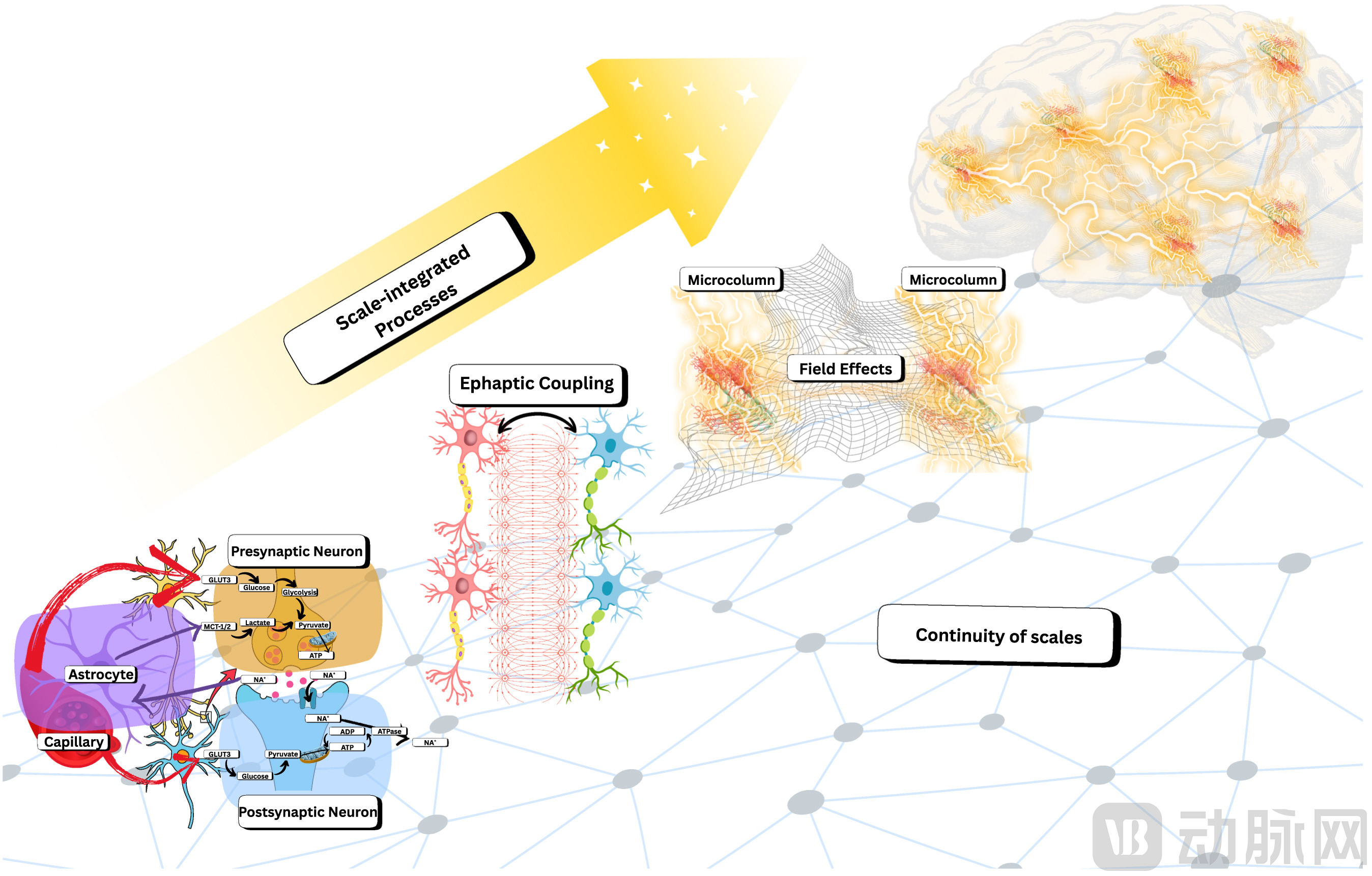
Figure: Continuous, scale-integrated biocomputing (Source: Neuroscience & Biobehavioral Reviews)
First, Scale Indivisibility: Breaking Down Hierarchical Barriers.
In computer science, we are accustomed to modular design: logic gates form adders, and adders form CPUs, with distinct hierarchical levels. However, such clear boundaries do not exist in the brain. Research indicates that the brain exhibits aScale Inseparability. Ion flow (microscopic), neuronal firing (mesoscopic), and whole-brain oscillatory waves (macroscopic) are bidirectionally coupled.
This structure is known asHeterarchy, rather than a simple hierarchy. Lower-level activities endogenously generate higher-level states, while these higher-level states (such as electric fields) in turn constrain and shape lower-level activities in real time. This cross-scale, real-time causal loop enables the brain to directly integrate information within its physical structure, without the need to transmit data via an abstract bus architecture as computers do.
Second, Hybrid Computing: The Dance of Discrete and Continuous.
All digital computers are discrete (0s and 1s). However, the biological brain is a masterpiece of hybrid computation. Although neuronal action potentials (spikes) appear to be discrete “0s and 1s,” the underlying triggering mechanisms—such as the accumulation of membrane potential, ion concentration gradients, and fluctuations in extracellular electric fields—are all continuous analog signals.
The study particularly emphasizes the role of ephaptic coupling (electric field coupling). Neurons communicate not only through synaptic connections but also influence each other via local electric fields. This continuous field effect provides the brain with a “wireless” communication mechanism, enabling instantaneous synchronization and coordination among neuronal populations. As the paper states, this continuous physical medium may constitute the physical basis for the “unity” of conscious experience—a feature that purely discrete digital systems struggle to replicate.
Third, Metabolic Embeddedness: Energy Is Information.
This point is often overlooked: although the brain accounts for only 2% of body weight, it consumes 20% of metabolic energy. In the field of AI, energy consumption is typically regarded as various costs (such as electricity bills), whereas in the biological brain,Energy constraints are the architects of computing architecture.。
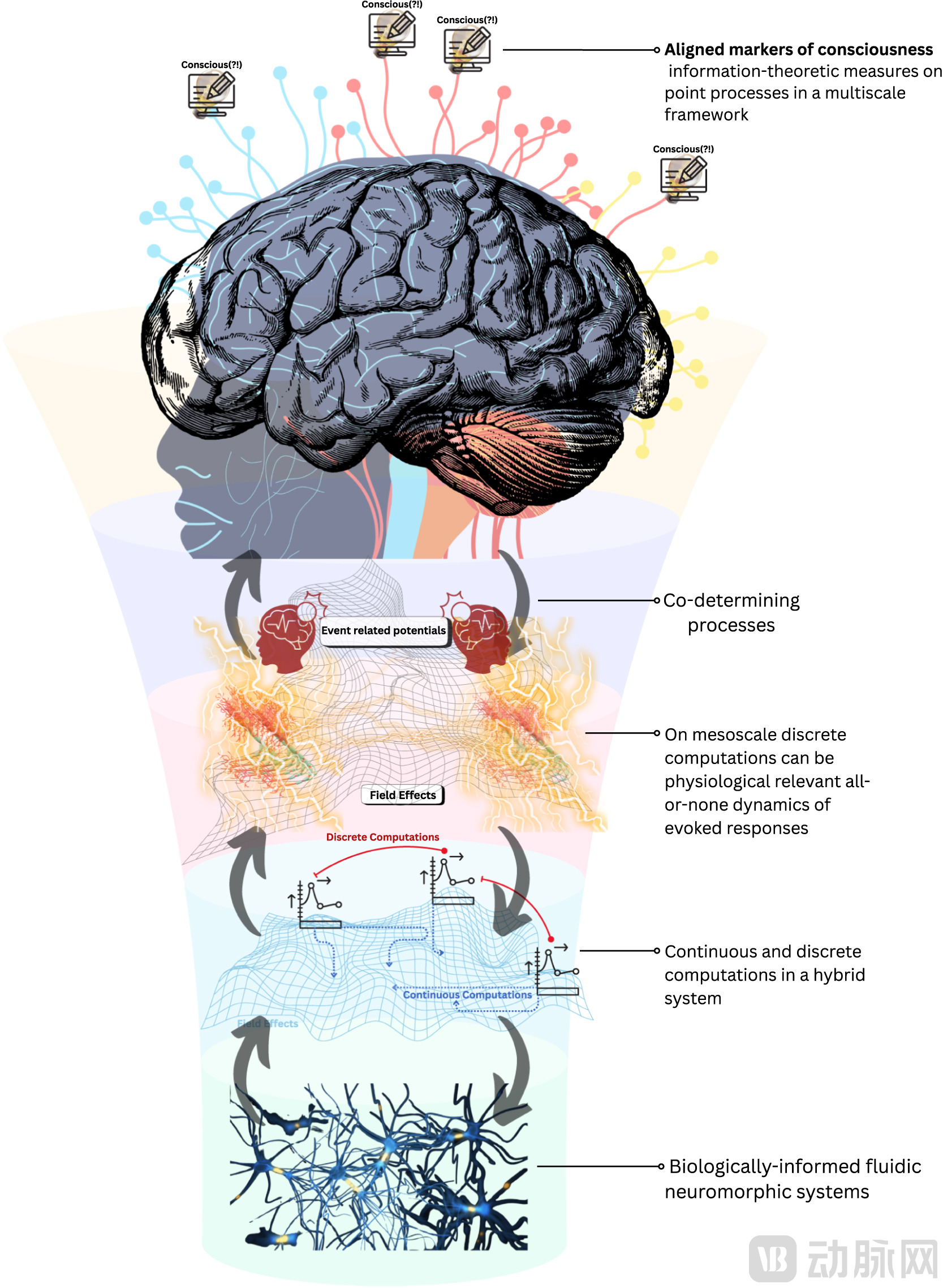
Figure: Conceptual framework of the scale-integrated hybrid system (Source: Neuroscience & Biobehavioral Reviews)
Research indicates that, due to extreme energy scarcity, the brain has evolved an optimization strategy:Coarse-graining. The brain automatically integrates vast amounts of microscopic, discrete events (the stochastic opening and closing of ion channels) into reliable macroscopic, continuous dynamic patterns. This process of information compression and integration, driven by metabolic pressure, may well be the key driving force behind the emergence of a clear “stream of consciousness” from otherwise chaotic neural activity. In contrast, modern AI enhances performance simply by scaling up computational power and parameters, lacking this inward-to-outward structural optimization pressure.
The proposal of “biocomputationalism” not only revises theories of consciousness but also serves as a profound warning for the future development path of artificial intelligence. If consciousness indeed depends on the aforementioned biocomputational characteristics, then the GPU clusters and von Neumann architecture that we currently rely on may be moving in the opposite direction from achieving artificial consciousness.
Currently, even the most advanced “neuromorphic chips,” such as SpiNNaker, are mostly implemented on digital hardwareSimulationNeuronal firing behavior, rather than physicallyImplementationBiological Computing. They are essentially software simulations running on discrete hardware, lacking genuine physical temporal evolution and continuous dynamic fields.
But this does not mean that artificial consciousness is impossible. Researchers have explicitly pointed out that we do not need to fully replicate biology (by creating an artificial brain), but rather need to create systems that conform to the principles of biological computation.New Substance。
The most promising directions for the future may include:
1. Fluidic Memristors):Utilizing ion movement within fluidic channels to store and process information, this mechanism is physically closer to the chemical processes of biological synapses.
2. Bio-synthetic Hybrid Systems:As in the “DishBrain” project, which directly leverages cultured biological neuronal networks for computation and control, this “wetware” computing inherently possesses all the characteristics of biological computation.
3. True Analog Computing Hardware:Develop hardware capable of performing continuous computing by directly leveraging physical properties (such as voltage and phase-change materials), thereby breaking down the boundaries between digital and analog systems.
The research team emphasizes that the core of this shift lies in moving from “writing better code” to “constructing better computational matter.” Future intelligent systems may no longer be coded line by line by programmers, but rather “cultivated” in laboratories by physicists and materials scientists. It is precisely because these novel systems possess physical constraints and cross-scale couplings akin to those found in biological organisms that they are more likely to give rise to human-like perceptual experiences.
When we gaze at the code on our screens, we see only the shadow of logic; yet when we examine the brain, we witness a seamless integration of physics, energy, and information. This study reminds us that consciousness may not be a software soul that can be arbitrarily transplanted; rather, it is deeply rooted in the flesh and blood of its physical body (or its equivalent physical substrate).
For artificial intelligence, this is both a constraint and a guide. If our goal is not merely smarter tools, but truly sentient agents, we must step out of the comfort zone of silicon chips to explore new physical frontiers capable of supporting hybrid, continuous, and cross-scale computation.