

WeMed Breaks Through Commercialization Barriers in Vascular Interventional Robotics with Clinically Validated Innovation

WeMed
Interventional Medical Device Provider
In 2025, the surgical robot market remained highly active. According to bidding data, approximately 397 units of surgical robots were sold in China from January to November 2025, representing a year-on-year increase of 28%, with sales revenue reaching RMB 2.78 billion, a year-on-year growth of 14%.
From the perspective of bid awards, imported brands still hold an absolute dominant position in niche markets such as laparoscopic surgical robots and natural orifice transluminal endoscopic surgery (NOTES) robots, while domestic companies are mostly in a phase of accelerated catch-up.
Among these subcategories, we have identified a niche market in which domestic products hold an absolute leading position: vascular interventional surgical robots.For instance, the National Medical Products Administration (NMPA) released the industry’s first global standard for interventional surgical robots, which was developed with deep involvement from leading domestic enterprises such as WeMed; additionally, WeMed’s globally pioneering high-sensitivity force-feedback coronary intervention surgical robot successfully completed its first complex percutaneous coronary intervention (PCI) procedure at Beijing Anzhen Hospital, a top-tier hospital in China. A series of “global firsts” and “world’s premiers” demonstrate that Chinese-made vascular interventional surgical robots have reached the global first tier.
More importantly, vascular interventional surgical robots are currently in a critical period transitioning from technological breakthroughs and product approvals to commercialization and industrialization.
Against this backdrop, the industry’s focus has shifted from product approval to marketization and commercialization: Can vascular interventional surgical robots gain clinical acceptance? Is this a promising market? And how can relevant companies overcome the challenges of transforming products into commercial commodities?
Previously, several vascular interventional surgical robots had already been approved for market launch. However, the commercial performance of these products has been less than ideal. This has led to ongoing debate in the market: Do vascular interventional surgical robots truly offer value? Can they address well-defined clinical pain points?
In fact, commercialization is never a simple matter. Particularly for large-scale medical equipment such as surgical robots, the procurement process often requires a considerable amount of time. For instance, the procurement cycle for hospitals to acquire large medical devices like surgical robots typically exceeds one year. In contrast, vascular interventional surgical robots have generally received regulatory approval over a shorter timeframe and are still in the early stages of market promotion and hospital adoption.
Meanwhile, the clinical value of first-generation vascular interventional surgical robots has been questioned by the market. An industry researcher stated: “First-generation vascular interventional surgical robots can only perform a small portion of the procedures involved in PCI (Percutaneous Coronary Intervention), resulting in low perceived clinical value. These systems exhibit poor integration with physicians’ traditional clinical experience; operators lack haptic feedback when manipulating catheters and guidewires, relying solely on imaging to assess contact conditions. This deprives senior physicians of tactile sensation, thereby negating their accumulated experiential advantages.”
It must be acknowledged that the industry researcher’s analysis holds some merit. However, the new generation of vascular interventional surgical robots launched by domestic companies has achieved multiple innovations compared to the first-generation products of imported brands, truly addressing clinical pain points in a systematic manner and having been validated in clinical practice.
Regarding the safety profile of greatest clinical concern,Recently, the National Medical Products Administration (NMPA) released a landmark industry standard—YY/T 1994-2025 “Control Systems for Robot-Assisted Vascular Interventional Surgery.” This standard was jointly developed by regulatory authorities, national-level technical review and testing institutions, and leading domestic enterprises such as WeMed. It is the first systematic technical specification globally specifically designed for vascular interventional surgical robots.
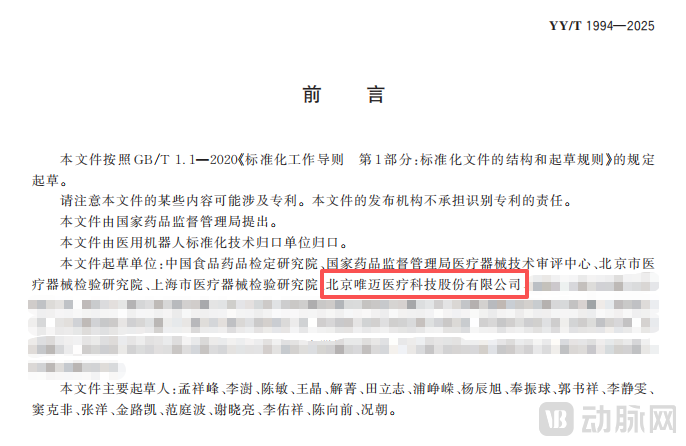
This standard clarifies unified evaluation criteria for safety, performance, and clinical outcomes. With the support of WeMed, it comprehensively defines key performance metrics—such as axial and rotational capabilities—as well as safety features like mechanical protection against accidental collisions for interventional surgical robots, thereby significantly raising the safety standards for such devices.
Establishing this national-level standard was no easy feat; it required industry-wide consensus and had to be both guiding and feasible. The ability to quantify standard indicators, such as safety, stems from the extensive real-world testing conducted by companies involved in the standard-setting process, including WeMed. These efforts have validated key metrics of their interventional surgical robots, including safety and performance.
In addressing real-world clinical pain points,Domestically approved next-generation interventional surgical robots are no longer limited to addressing radiation exposure for physicians; they can now deeply participate in the majority of surgical procedures, delivering superior, high-precision solutions for patients under physician control. Taking WeMed as an example, its interventional surgical robot, ETcath200, is the first domestically developed Class III medical device for interventional surgery to enter and receive approval through the National Medical Products Administration’s “Special Examination and Approval Procedure for Innovative Medical Devices.” It is also the first product in China to be marketed based on controlled clinical trials.
Clinical trial data show that the ETcath200 achieved a 100% procedural success rate, with a 0% incidence of major adverse cardiovascular events (MACE) within 30 days post-procedure, demonstrating its robust performance and reliability.
Furthermore, domestically produced interventional surgical robots have successfully completed complex percutaneous coronary intervention (PCI) cases, further validating their clinical value. In treating a patient with severe stenosis in the mid-segment of the left circumflex artery (LCX) and a large vascular angulation, Professor Zeng Yong’s team from Beijing Anzhen Hospital, Capital Medical University, considered traditional manual manipulation to be highly challenging. By utilizing an vascular interventional surgical robot, they leveraged its intelligent assistance features, force feedback technology, and AI algorithms to provide real-time feedback on mechanical changes in the vessel wall. This enabled precise control over the guidewire’s advancement, retraction, and rotational angle, effectively mitigating the risk of inadvertent entry associated with traditional manual twisting and rubbing of the guidewire, thereby significantly enhancing procedural safety and efficiency. The successful implementation of this robot-assisted surgery, along with the patient’s favorable prognosis, has corroborated this perspective.
Professor Zeng Hesong, a clinical expert, stated after performing surgery using a vascular interventional surgical robot: “During vascular interventional procedures, even slight deviations in manual manipulation at complex lesion sites can lead to complications. The robotic system eliminates natural hand tremors, achieving sub-millimeter precision in positioning. Particularly when addressing complex lesions, the system’s stability and accuracy significantly enhance procedural safety.”
Overall, the safety, efficacy, and systematic capability of domestically produced next-generation vascular interventional surgical robots to address clinical pain points have all been validated.
It is worth noting that WeMed’s interventional surgical robot, ETcath200, continues to conduct post-marketing multicenter clinical studies following extensive validation. These studies aim to verify the stability of the surgical robot in more complex and variable routine clinical settings, while continuously optimizing and iterating the product to meet clinical needs.
Based on the experience with laparoscopic surgical robots, which rapidly entered a phase of high-volume adoption after 24–36 months of market validation, it is anticipated that vascular interventional surgical robots will similarly accelerate installation and achieve rapid volume growth once their clinical value is validated.
From the current perspective, interventional surgical robots are an emerging sector poised for rapid growth.
For interventional surgical robots with validated clinical value, they are considered poised to become standard equipment for interventional therapy in hospitals. Consequently, a large number of clinical experts are eager to engage in the exploratory application of these robots at an early stage, while top-tier hospitals have begun to anticipate procuring and deploying such devices to provide patients with superior innovative solutions.
In addition, the National Healthcare Security Administration recently issued the “Guidelines for Establishing Price Items for Medical Services in the Category of Surgical and Therapeutic Auxiliary Procedures (Draft for Comment)” (hereinafter referred to as the “Guidelines”), which clarify the regulatory framework for pricing advanced auxiliary technologies such as surgical robots, navigation systems, and 5G-enabled remote diagnosis and treatment systems, thereby accelerating the adoption of surgical robots.
Compared with previous versions, the Guidelines have eliminated the "startup fee." The latest pricing model will be: base procedure price + special surcharge × surgical difficulty coefficient.
Meanwhile, the Guidelines introduce three categories of chargeable scenarios (special additional fees) for surgical robotic arms for the first time: first, navigation, where the product is involved only in guiding operations such as navigation and positioning; second, partial execution, where the product participates in general surgical procedures such as drilling and incision; and third, precise execution, where the product is involved in key or all stages of surgical procedures, including resection, reconstruction, repair, and balancing of organs, soft tissues, or hard tissues.
Undoubtedly, medical insurance reimbursement will be based on the clinical value of products. For products offering only basic functions such as navigation, their clinical value is relatively low, resulting in lower reimbursement rates. In contrast, for higher-value third-category scenarios, medical insurance provides support with higher reimbursement multipliers.Domestically produced next-generation vascular interventional surgical robots fall under the third category of scenarios and are innovative products recognized and supported for promotion by the National Healthcare Security Administration.
With the implementation of this guideline, hospitals are expected to accelerate their procurement of interventional surgical robots, driving rapid growth in this market. Data released by the renowned research firm Frost & Sullivan indicates that the market size for vascular interventional surgical robots in China is projected to reach RMB 5.824 billion by 2030, with a compound annual growth rate (CAGR) of 90.3%, demonstrating strong growth momentum and significant market potential.
More importantly, drawing on past industry experience, leading companies such as WeMed will fully benefit from their first-mover advantage in this high-growth market and reap substantial rewards as top-tier players amid rising industry concentration.
For domestically produced vascular interventional surgical robots, technological breakthroughs are not the end goal, nor is product approval. These merely mark a new starting point for their commercialization.
Commercialization has never been an easy endeavor. Past experiences with innovative medical devices and startups have consistently demonstrated this: every stage—from market promotion and physician training to price filing and product pricing—presents numerous challenges and pain points.
At the commercialization starting point of vascular interventional surgical robots, how can companies overcome commercialization challenges? Through in-depth interviews and market research, VCBeat has identified and summarized three key priorities:
First, innovative products address unmet clinical needs in the market, gain market recognition through superior clinical value, and penetrate blue-ocean markets;
Second, reasonable pricing enables more hospitals to afford and utilize these products, which is particularly critical during the current key period of centralized procurement and DRG payment reform, as all stakeholders place significant emphasis on issues such as medical insurance fund management.
Third, market strategies and training systems will help more hospitals and clinical experts understand the value and advantages of vascular interventional surgical robots, thereby increasing their willingness to purchase these products.
Ultimately, the product remains the most critical factor. No matter how disruptive the market strategy or how competitively priced the product, if it lacks clinical value and fails to gain market acceptance, it will struggle to achieve genuine market breakthrough.
For instance, first-generation vascular interventional surgical robots lacked force feedback technology, depriving clinicians of the tactile “feel” during procedures. Interventional physicians typically rely on subtle resistance feedback from guidewires and other instruments to determine whether a vessel wall has been perforated. This limitation has also resulted in limited enthusiasm among physicians for first-generation vascular interventional surgical robots.
However, our research has revealed:Clinical Experts Highly Recognize and Anticipate WeMed's ETcath200 Interventional Surgical Robot with Haptic Feedback Technology, believing that the product is highly innovative and addresses practical clinical pain points and problems, demonstrating significant clinical value.
Compared with the first-generation product, the ETcath200 achieves a minimum force sensing accuracy of 0.01 N, enabling real-time feedback on mechanical changes in the vessel wall and mitigating the risk of inadvertent guidewire misplacement associated with traditional manual twisting and manipulation. Furthermore, the ETcath200 quantifies empirical tactile feedback into data and, through intelligent bionic technology, precisely simulates expert intraoperative maneuvers, thereby standardizing surgical procedures and significantly shortening the physician training cycle.
According to statistics, among the interventional robotics products currently on the market, WeMed's ETcath200 is the world's first percutaneous coronary intervention robotic manipulator featuring high-sensitivity force feedback.
Perhaps it is also due to WeMed’s innovative strength and breakthrough technologies that the company has participated as a core force in tackling key challenges under the “Force Sensing and Force Feedback for Surgical Robots” project, part of the National Key R&D Program’s special initiative on “Intelligent Robotics.” This further demonstrates that WeMed’s innovation capabilities and technological leadership have received authoritative recognition from national-level scientific research programs.
In addition to force feedback technology, WeMed pioneered the “handEyeThe “brain” collaborative model is also highly favored by clinical experts.Most previous vascular interventional surgical robots operated in a passive execution mode, lacking autonomous perception and decision-making capabilities in complex vascular environments. WeMed has integrated the underlying full-stack data of its interventional surgical robots with DSA (Digital Subtraction Angiography) equipment. By leveraging real-time guidance from DSA imaging and analysis and navigation powered by an AI intelligent system, WeMed has effectively equipped its surgical robots with “eyes” and a “brain.” This advancement shifts the competitive dimension of interventional surgical robots beyond mere robotic arms and operational precision, moving toward an intelligent synergy of “imaging, robotic manipulators, and algorithms.”

Based on "handEye"Brain" collaborative mode: When physicians perform robot-assisted vascular interventional procedures, they can visualize lesions and device positions in real time, and achieve surgical path planning and real-time navigation with the support of intelligent algorithms.
From an industry perspective, WeMed’s innovation has propelled interventional surgical robots from standalone devices toward a comprehensive ecosystem, paving a new path for the innovative development of interventional surgical robotics.
Currently, WeMed has identified the core solution to the commercialization challenges of vascular interventional surgical robots: centering on clinical value, leveraging technological innovation to deliver more valuable products for clinical practice, and utilizing policy advantages to refine the commercial support system and accelerate the adoption of interventional surgical robots.
In addition, WeMed in high-sensitivity force feedback, "handEyeBreakthroughs in core technologies such as “brain” coordination have firmly established Chinese-made interventional surgical robots in the global first tier.
For the industry, WeMed’s exploration has not only provided a viable path for resolving its own commercialization challenges but also set a benchmark for Chinese-made medical equipment in transitioning from technological leadership to industrial leadership.
In the future, with deepened clinical adoption, improved training systems, and continuous product optimization and iteration, vascular interventional surgical robots will accelerate their practical application, driving another surge in the market size of surgical robots.