

Do Alternative Therapies for Autism Really Work? Largest-Ever Scientific Review Reveals the Truth
Autism Spectrum Disorder (ASD), as a complex neurodevelopmental condition, affects the quality of life of countless individuals and their families worldwide. Although conventional intervention approaches are available,However, surveys indicate that up to 90% of individuals with autism have tried Complementary, Alternative and Integrative Medicine (CAIM) therapies at some point in their lives.However, behind this widespread application lies a significant concern: the variable quality of evidence and the lack of safety data.

(Source: Shutterstock)
On December 28, 2025, a landmark study published in Nature Human Behaviour filled a gap in this field. Led by Corentin J. Gosling and colleagues from institutions including Paris Nanterre University and the University of Southampton, the research team conducted a large-scale umbrella review, systematically analyzing 248 meta-analyses involving more than 10,000 participants.
The findings are alarming:There is currently no high-quality evidence to support the efficacy of any complementary and alternative integrative medicine (CAIM) therapy for core or associated symptoms of autism, and the safety of most such therapies has never been systematically evaluated.
The core features of autism spectrum disorder include impairments in social communication and restricted, repetitive patterns of behavior, which often significantly impact patients' daily living and social functioning. Beyond the existing medical framework, complementary, alternative, and integrative medicine (CAIM) has become a highly anticipated option for many families.
According to the definition by The Cochrane Collaboration,CAIM encompasses interventions that originate from non-Western allopathic medical systems (such as Traditional Chinese Medicine), are not considered mainstream standard treatments, or are implemented in non-traditional healthcare settings.Statistical data indicate that the median prevalence of complementary and alternative integrative medicine (CAIM) use among individuals with autism spectrum disorder is 54%, with some studies even reporting lifetime usage rates as high as 92%. This high prevalence is primarily driven by the public’s widespread perception of natural therapies as “safe and effective,” as well as by frustration over the limited efficacy or poor accessibility of conventional medical interventions.
However, there is a vast chasm between this eager demand and the current state of scientific evidence.Despite the proliferation of research on CAIM, meta-analyses focusing on the same intervention often yield contradictory results.For instance, systematic reviews on the efficacy of dietary supplements or specific behavioral therapies may reach diametrically opposed conclusions. These discrepancies may stem from variations in inclusion criteria, biases in data analysis, or even methodological errors, leaving clinicians, patients, and their families overwhelmed when confronted with a deluge of information. Such uncertainty not only squanders healthcare resources but also exposes patients to unknown health risks. Parents urgently need a reliable, transparent, and evidence-based resource to guide them in making informed decisions amidst complex treatment options.
It is precisely against this backdrop that conducting an umbrella review becomes particularly important.Umbrella reviews differ from traditional meta-analyses in that they do not directly pool raw data from clinical trials; instead, they use existing systematic reviews and meta-analyses as the units of analysis to conduct a higher-level synthesis.This approach enables the quantitative synthesis of all relevant evidence within a broad field, assesses methodological quality, and rates the certainty of evidence using tools such as the GRADE (Grading of Recommendations Assessment, Development and Evaluation) system. This study employs this methodology to comprehensively evaluate the real-world efficacy and safety of various complementary and alternative integrative medicine (CAIM) interventions—ranging from dietary supplements to mind-body therapies—in the treatment of autism spectrum disorder, aiming to establish a unified evidence benchmark for this contentious field.
The study was designed on a grand and rigorous scale. The research team searched five major databases up to December 31, 2023, initially screening 7,051 articles and ultimately including 53 eligible meta-analyses. These reports encompassed 248 independent meta-analyses, pooling data from 200 controlled clinical trials (CCTs) involving more than 10,000 participants with autism. The researchers used the AMSTAR-2 tool to assess the methodological quality of the included reviews and applied the algorithmic GRADE framework to objectively rate the certainty of evidence for each outcome. The study covered 19 different types of complementary and alternative integrative medicine (CAIM) interventions, including acupuncture, herbal medicine, music therapy, probiotics, vitamin D supplementation, and animal-assisted interventions.
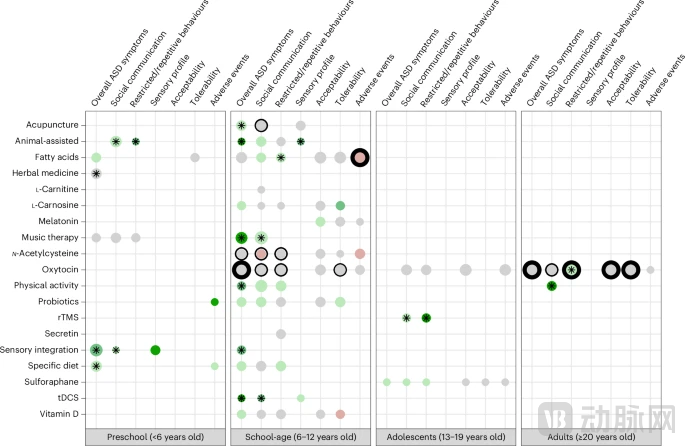
Figure: Pooled effect sizes for each PICO combination
(Source: Nature Human Behaviour)
The core findings of the study reveal a grim reality:Among all the interventions assessed, no complementary and alternative integrative medicine (CAIM) therapy provided high-quality evidence to support its efficacy for core symptoms of autism or related symptoms.Specifically, the intervention considered to have the relatively highest quality of evidence (reaching a “moderate” level) is oxytocin. However, data show thatOxytocin Shows No Statistically Significant Effect in Improving Core Symptoms of Autism in Children and Adults, showing only a small effect in improving stereotyped and repetitive behaviors in adults (standardized mean difference [SMD] = 0.404). This result strongly refutes some of the previously overly optimistic expectations regarding oxytocin as a “magic bullet” for autism.
Meanwhile,Some therapies, although demonstrating large effect sizes in statistical data, are supported by very low-quality evidence.For example, music therapy, animal-assisted interventions, and transcranial direct current stimulation (tDCS) have demonstrated large effect sizes (SMD > 0.8) in improving overall symptoms among school-aged children; melatonin has also shown substantial potential in enhancing both sleep quality and quantity (SMD > 1.0). However, due to small sample sizes, overly wide confidence intervals, or a high risk of bias in the relevant studies, these findings are rated as “very low” quality evidence according to the GRADE criteria. This implies that although these therapies may appear effective, our confidence in their true efficacy is very limited, and future high-quality studies are highly likely to overturn existing conclusions. In this context, the lack of safety data is particularly concerning. Studies indicate that fewer than half of complementary and alternative integrative medicine (CAIM) interventions have been evaluated for acceptability, tolerability, or adverse events. Given their widespread use, this neglect of safety constitutes a significant public health hazard.
This study is not merely an academic review; it is dedicated to translating complex scientific evidence into practical, actionable tools. To address the barriers clinicians and families face in accessing information, the research team has developed a tool namedEBIA-CT (Evidence-Based Interventions for Autism: Clinical Trials) Online Interactive Platform(https://ebiact-database.com/). This platform enables users to query the latest evidence ratings by age group, intervention type, or symptom outcomes. It not only demonstrates the effectiveness of interventions but also clearly indicates the quality level of the evidence, helping users identify which therapies are grounded in robust scientific foundations and which are merely based on weak assumptions. This approach of directly translating research findings into public health service products reflects the research team’s profound commitment to bridging the “research-to-practice” gap.
From theoretical and methodological perspectives, this study provides clear directions for future autism research. The current state of low-quality evidence indicates that merely increasing repetitive studies at a low level cannot advance the field.Future research must shift toward rigorously designed randomized controlled trials (RCTs) with adequate sample sizes and the use of standardized outcome measures.In particular, regarding the selection of outcome measures, researchers have called for the use of tools that allow for blinded assessment, such as the Brief Observation of Social Communication Change (BOSCC), to minimize errors arising from placebo effects or observer bias. Furthermore, safety assessments must become a standard component of all future clinical trials. Especially for therapies involving drug intake (such as supplements) or physical interventions, robust adverse event reporting mechanisms must be established.
For the vast autism community and their families, the message conveyed by this study is both clear and complex. Although there is currently a lack of high-quality evidence supporting the efficacy of Complementary and Alternative Integrative Medicine (CAIM), this does not equate to proving them “ineffective,” but rather underscores that they remain “unproven.” Professor Samuele Cortese, the corresponding author of the study, emphasized, “When people want to know whether a treatment is effective, they cannot rely on a single study. All available evidence and its quality must be considered.” This perspective reminds us to maintain a prudent attitude when facing various emerging therapies.The establishment of the EBIA-CT platform is designed to empower patients and physicians to engage in shared decision-making, ensuring that treatment choices are grounded in the best available scientific evidence rather than hearsay, thereby achieving a balance between personalized needs, individual preferences, and scientific rigor.
This large-scale umbrella review, published in Nature Human Behaviour, provides a sober and objective “health check” for the field of alternative therapies for autism. It reveals the prevailing lack of high-quality evidence supporting current Complementary and Integrative Medicine (CAIM) interventions and highlights a serious gap in safety assessments. By establishing the EBIA-CT online platform, researchers have offered the public a key to cutting through the fog of misinformation. Looking ahead, as more high-quality, rigorously designed clinical trials are conducted, we hope to identify truly safe and effective adjunctive support measures for individuals with autism. Until then, evidence-based practice and prudence remain our best guides on the path to exploring therapeutic options.