

Miliu Intelligence Files IPO Prospectus: Pioneering Fully Homomorphic Encryption to Transform Secure Healthcare Data Utilization

IBM
Computer hardware and software R&D, sales, and consulting service provider
The healthcare industry has entered the AI era, with data serving as the core element driving medical innovation in this new age.
On the one hand, the rise of informatization and digitalization has led to an exponential growth in healthcare data; on the other hand, issues such as low application efficiency and insufficient value extraction from healthcare data in China remain prominent.
Behind the challenges in applying healthcare data, factors such as the lack of established data format standards and inconsistent data quality are compounded by institutions’ concerns over data privacy protection, which have led to a reluctance to utilize such data.
However, from disease prediction to the research and development of innovative drugs and medical devices, and from personalized treatment to full-cycle health management, the application of high-quality medical data is crucial to the development of all sub-sectors within the healthcare industry. Therefore, achieving efficient utilization of healthcare data while ensuring security has become a primary direction for industry development.
After years of development, the industry has established relevant solutions. However, these approaches all have certain limitations. For instance, encrypted transmission and storage only ensure data security in static or transit states; once data enters the computation phase, it must be decrypted, thereby increasing the risk of privacy breaches. Although anonymization removes personal identifiers such as patient names and ID numbers, individual identities can still be re-identified through auxiliary information like medical history. While confidential computing can restrict computational processes to secure areas by leveraging Trusted Execution Environments (TEEs), its security premise relies on the absence of vulnerabilities in chips and software. In recent years, numerous attacks on confidential computing environments have been reported, leading holders of high-value data to remain skeptical about deploying confidential computing in cloud environments.
So, is there really no technology that can both fully guarantee data security and enable the full realization of data value? The answer is no. This technology is Fully Homomorphic Encryption (FHE).
Fully Homomorphic Encryption: Truly Enabling Data to Be “Usable but Invisible”
Unlike other technologies,Homomorphic encryption technology enables full encryption of data during transmission, analysis, and computation, while supporting direct operations on ciphertext. The computational results are entirely consistent with those derived from plaintext, thereby ensuring absolute data security while achieving the paradigm of “data availability without visibility.”
For this reason, expectations for the application of Fully Homomorphic Encryption (FHE) technology are extremely high across various industries, and many global tech giants are already competing to establish their presence in this field. For instance, Microsoft has launched the SEAL encryption library, applying FHE technology to its Password Monitor feature to detect whether user passwords have been compromised while remaining encrypted. Apple has implemented it in Private Information Retrieval (PIR) and Private Nearest Neighbor Search (PNNS), thereby ensuring user privacy within the Apple ecosystem. IBM is exploring FHE application scenarios in the financial and healthcare sectors. Notably, the International Organization for Standardization (ISO) and the International Electrotechnical Commission (IEC) have officially initiated the standardization of FHE algorithms, laying the foundation for standardized global technological applications. As FHE technology gains momentum abroad, relevant enterprises in China are also actively engaging in this field. Among them is MiLiu Intelligence (Shenzhen) Co., Ltd. (hereinafter referred to as “MiLiu Intelligence”).
Leveraging its technical expertise in fully homomorphic encryption (FHE), MiLiu Intelligence’s FHE solutions have been implemented across multiple industries, establishing several benchmark cases. In the financial sector, MiLiu Intelligence has entered into a strategic partnership with the Liaoning Branch of Bank of Communications to jointly develop an encrypted credit assessment project for corporate loans. By utilizing fully homomorphic encryption technology, the project enables “usable but invisible” evaluation of corporate credit data, thereby safeguarding enterprise data privacy while enhancing the efficiency and accuracy of loan approvals. This initiative has been successfully included as an innovative application in the Liaoning Provincial Financial Technology Innovation Regulatory Toolkit (the People’s Bank of China’s financial regulatory sandbox), earning recognition from regulatory authorities. Meanwhile, related collaborations in government affairs, telecommunications, and other fields are also progressing steadily.
Milu Intelligence is a Chinese provider of products and services specializing in the field of Fully Homomorphic Encryption (FHE). To achieve independent research and development as well as industrial application of FHE technology, Milu Intelligence has deeply cultivated a full-chain technological closed loop spanning “underlying algorithms – hardware acceleration – scenario-based products,” thereby establishing three core competitive advantages.
First, at the algorithmic level, with the BFV algorithm invented by Dr. Fan Junfeng, the founder, as its core foundation, MiLiu Intelligence has built a technical matrix integrating multiple fully homomorphic encryption algorithms, including CKKS. This approach enhances autonomy, security, and flexibility while enabling precise adaptation to diverse scenarios.
Secondly, at the hardware level, by independently developing dedicated FPGA hardware acceleration cards optimized for fully homomorphic encryption (FHE) computations, MiLiu Intelligence can increase ciphertext computation speed by more than 100 times, significantly reducing latency in real-time scenarios. This capability enables MiLiu’s products to transcend “laboratory limitations” and effectively meet the stringent performance requirements of practical business applications such as real-time medical diagnostics, thereby accelerating commercial deployment.
Furthermore, at the product level, Miliu Intelligence rejects the generalized positioning of “generic products,” focusing instead on core needs to develop scenario-based solutions that address pain points across multiple industries. In the following section, we will provide a detailed analysis of Miliu Intelligence’s healthcare-related solutions.
Targeting Three Major Application Scenarios to Build End-to-End Solutions
From software frameworks to hardware acceleration, leveraging fully homomorphic encryption technology, MiLiu Intelligence has currently built comprehensive solutions targeting three major healthcare application scenarios.
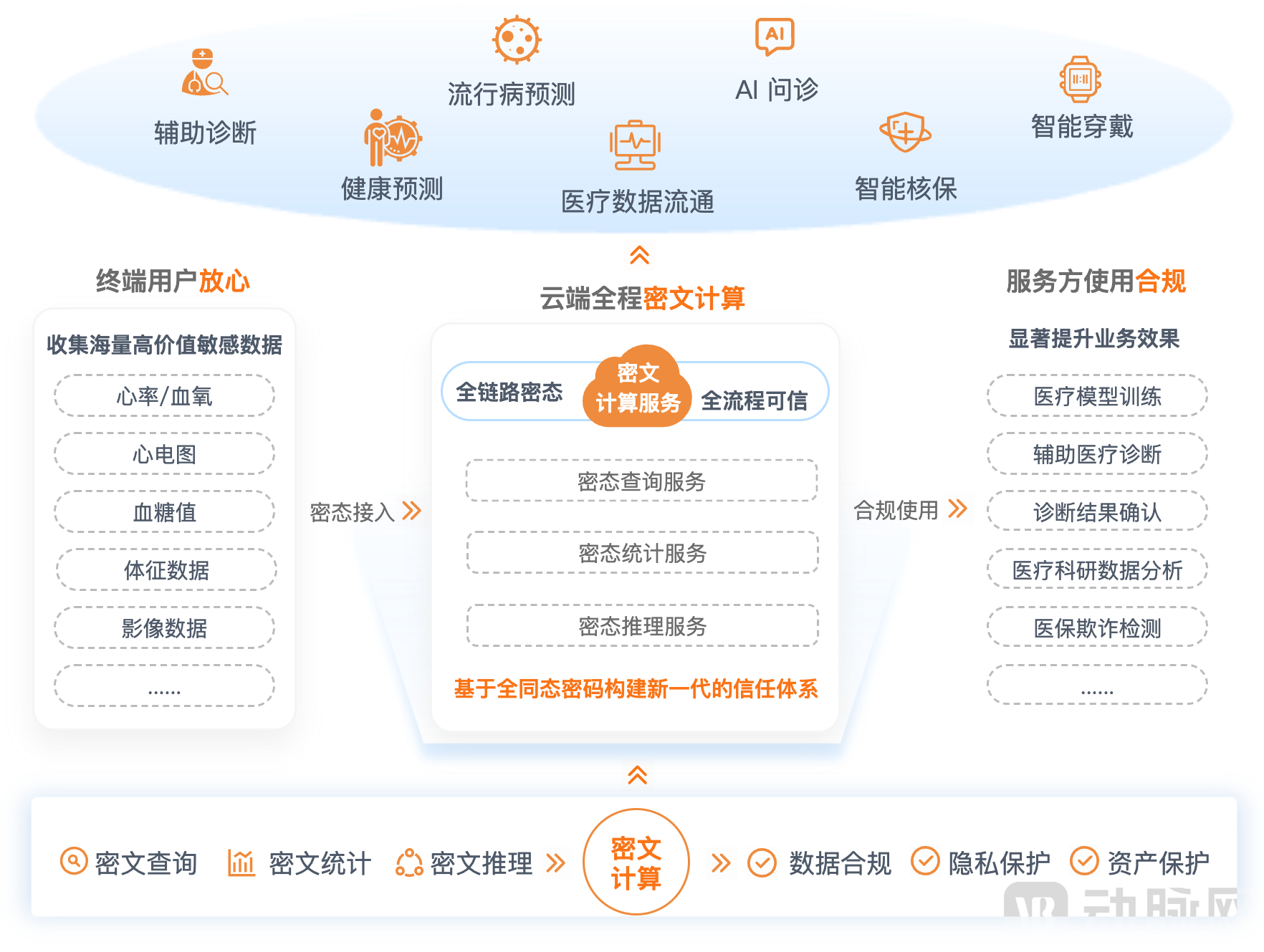
First, a ciphertext inference solution for the secure application of medical AI models. Typically, examination and test data generated during diagnosis and treatment, such as medical images and genetic testing results, must be transmitted to an AI model for inference before diagnostic outcomes and recommendations can be obtained, thereby enabling AI-assisted diagnosis. This process may pose risks of patient privacy leakage. However, supported by fully homomorphic encryption technology, healthcare institutions need only transmit encrypted data to the AI model, allowing it to perform computational inference while ensuring that data remains confidential and the accuracy of the computational results is maintained.
Next is the solution for compliance in medical data sharing. In the past, when healthcare data was shared across institutions and industries, it still faced issues such as data breaches, illegal storage, and misuse by third-party organizations. However, fully homomorphic encryption technology enables "plaintext to remain within the database, encrypted computation on demand, and measurable data availability," thereby ensuring asset security and compliant usage during cross-boundary data sharing.
Finally, an application solution for personal privacy protection in wearable devices is presented. Wearable devices enable health management and health warning functions by continuously collecting and analyzing large volumes of users’ personal physiological and health data. However, this process may expose users’ private information. Homomorphic encryption technology allows users to customize the encryption of their personal data, ensuring that device manufacturers cannot access plaintext data at any stage from collection to usage. Furthermore, only users can decrypt the analytical results, thereby fully safeguarding users’ personal privacy and security.
Furthermore, it is worth noting that MiLiu Intelligence’s industry solutions based on fully homomorphic encryption (FHE) technology offer three core advantages. First, MiLiu Intelligence has developed a fully automated intelligent compiler. AI engineers no longer need expertise in cryptography; with a single command, the compiler can automatically analyze model architecture, replace operators, search for optimal ciphertext refresh strategies, and generate the most efficient ciphertext computation graph. This significantly lowers the development barrier for enterprises.
Second, to address the challenge that ciphertext computation cannot directly handle nonlinear activation functions such as ReLU, where polynomial approximation often leads to a significant drop in model accuracy, MiLiu Intelligence has applied single-stage fine-tuning techniques and hybrid computation strategies, achieving minimal accuracy loss (only 0.2–1.7%).
Third, to address the low computational efficiency and high costs associated with fully homomorphic encryption. In addition to the “Gewu” hardware acceleration card mentioned earlier, MiLiu Intelligence has proposed a Generalized Interleaved Packing (GIP) scheme, which resolves the waste of computing power generated during convolution operations on high-resolution large images, thereby significantly enhancing parallel computing efficiency.
To date, leveraging fully homomorphic encryption technology, MiLiu Intelligence has built an end-to-end solution encompassing model development, ciphertext sharing, and ciphertext inference. According to Dr. Fan Junfeng, MiLiu Intelligence is currently collaborating with a well-known domestic genetic testing team to develop a platform for ciphertext analysis of gene sequences. This platform enables analytical computations on gene sequence data under full-process encryption, thereby mitigating the risk of genetic privacy leaks while fully unlocking the value of genetic data. It provides secure data support for precision medicine scenarios such as genetic disease screening and targeted drug development. Furthermore, MiLiu Intelligence is actively seeking collaborations with more healthcare enterprises and welcomes interested companies to join forces in promoting the practical application of fully homomorphic encryption technology in healthcare settings.
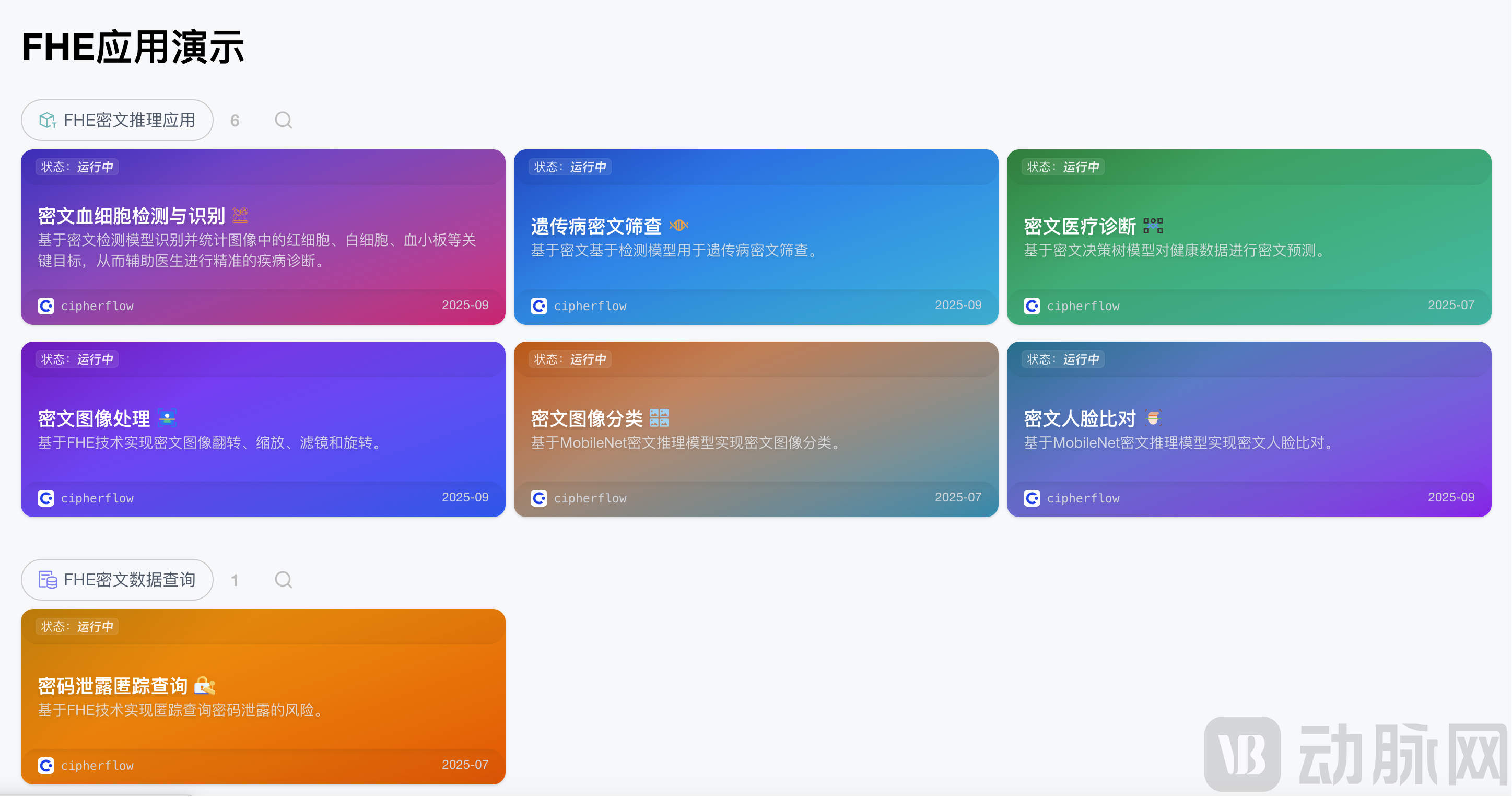
Interested enterprises can visit the official website of MiLiu Intelligence to learn more about its technologies and products, and experience demos related to Fully Homomorphic Encryption (FHE), such as encrypted blood cell recognition and detection, encrypted genetic disease screening, and encrypted medical diagnosis, thereby intuitively perceiving the application effects of the technology in healthcare scenarios.
In the future, on one hand, Miliu Intelligence will continue to collaborate with more partners to deepen the practical application of fully homomorphic encryption technology in the healthcare industry and other sectors; on the other hand, Miliu Intelligence will also persist in algorithm optimization and hardware upgrades, lowering the barrier to entry for industry adoption while continuously striving to enhance computational efficiency.
It is foreseeable that the healthcare industry in the AI era will inevitably be data-driven. The widespread adoption of fully homomorphic encryption technology will undoubtedly enhance the efficiency of healthcare data utilization, thereby bringing revolutionary changes to disease diagnosis, drug development, and personalized medicine, ultimately benefiting everyone.