

Professor Wang Jinwu of Shanghai Ninth Hospital: Turning Scientific Investment into Real Products That Benefit the Public
In May 2008, a sudden major earthquake struck Wenchuan, China.
On the television screen, a series of shocking images scrolled by: a child with both legs crushed under rubble, a middle-school teacher who had lost his right arm, an elderly person whose pelvis was impaled by steel rebar... Each frame represented a case of orthopedic trauma, and every cry for help tugged at Wang Jinwu’s heart.
As an orthopedic surgeon at the Sixth People’s Hospital Affiliated to Shanghai Jiao Tong University (currently Chief Physician of the Department of Orthopedics at the Ninth People’s Hospital Affiliated to Shanghai Jiao Tong University School of Medicine, Professor, Doctoral Supervisor, and Postdoctoral Supervisor at Shanghai Jiao Tong University School of Medicine), Wang Jinwu immediately volunteered to join the medical rescue team for earthquake relief. There, countless severed limbs required replantation, innumerable fractures needed stabilization, and myriad injuries awaited emergency care—This is the most instinctive battlefield for every orthopedic surgeon.
"I specialize in orthopedics. When a major disaster strikes, we should head to the front lines!"
However, fate took an unexpected turn at this juncture. Due to the coordinated reallocation of trauma care resources in the disaster-stricken areas, there was no longer an urgent need for a large-scale deployment of orthopedic surgeons from the first registration batch. Wang Jinwu’s name was moved to another list: overseas advanced training.
With Wenchuan in my heart, I boarded a flight to the other side of the Pacific.
A few months later, he appeared at the Cleveland Clinic in Ohio, USA.
This is a world-class medical sanctuary—calm and orderly, seemingly a world apart from the devastation of Wenchuan. Yet within Wang Jinwu’s heart, a silent “aftershock” is unfolding.
During the period of studying under Professor Joseph Iannotti, former President of the American Shoulder and Elbow Surgeons (ASES), whenever he entered the operating room and saw the precision surgical instruments, advanced internal fixation systems, and minimally invasive arthroscopic equipment, images of the Wenchuan earthquake would always flash through his mind.
"If such equipment were available at earthquake rescue sites, how many lives could be saved? How many people could avoid disability?"
This thought, like a nail driven into the heart, lingers and refuses to fade.
He began to take note of the brands of these medical devices—almost exclusively companies from the United States, Germany, and Switzerland. He then reflected on operating rooms in Chinese hospitals, where expensive imported equipment carried exorbitant prices due to multi-layered markups by distributors, as well as the technological monopolies that created critical bottlenecks.
"Why can't we manufacture it ourselves in China?"
With this question in mind, he began to observe the unique scene at the hospital: on the corridor walls hung not cold, impersonal regulations, but rows of “Honor Rolls.” These boards featured joint photographs of physicians and engineers, smiling side by side as they held up newly developed medical devices they had co-created. Behind each photograph lay a technological innovation that had transformed clinical treatment.
Doctors and engineers are not from two different worlds here; rather, they are comrades-in-arms sitting in the same office.
"Why were they able to develop it? Why is there relatively little R&D in China?"
He began a frantic search for answers. Through observation, inquiry, and comparison, the truth gradually came to light: "Abroad, students first study engineering and then pursue medicine, resulting in a very strong foundation for the integration of medicine and engineering."In China, our physicians are trained in clinical medicine but lack a foundation in engineering."
In China at that time, doctors and engineers existed in two parallel worlds. Doctors lacked knowledge of material mechanics, while engineers were unfamiliar with anatomical pathology.The Invisible Chasm in Between Has Blocked the Path of Independent R&D for Chinese Medical Devices.
What is even more regrettable is that even with strong creativity and design, it is difficult to translate them into actual products. Laboratory prototypes can only be used for animal testing (“feeding mice”); they cannot obtain regulatory approval, cannot enter clinical trials, and ultimately cannot save patients. A substantial amount of research funding ultimately ends up as papers shelved and forgotten, failing to become the “weapons” placed on operating tables that can truly save lives.
Standing in the hallway in Cleveland, a clear image suddenly flashed through Wang Jinwu’s mind:
How wonderful it would be if, one day, Chinese doctors were equipped with advanced devices independently developed and manufactured in China.
He realized that although he had missed a tactical battlefield of saving lives and healing the wounded, he had unexpectedly stumbled into a grander and more arduous strategic battlefield—Medical-Engineering Integration。
On the front lines, he could only save dozens or hundreds of patients at a time.
But if the path to independent research and development of medical devices can be opened up, it will equip tens of thousands of doctors with better “weapons” to treat tens of thousands of patients.
“If we merely act as surgical technicians, we will forever be left trailing behind others.”
"The integration of medicine and engineering is an inevitable path for the development of medical enterprises in China."
This idea took root in the dead of night while he was abroad in 2008. It not only altered the career trajectory of Wang Jinwu alone but also, over the ensuing 16 years, played a pivotal role in breaking new ground in China’s medical device translation and commercialization regulatory framework.
If life were a meticulously controlled experiment, Wang Jinwu’s entry into the field of medicine would initially appear more like a “systematic error.”
In the summer of 1989, the college entrance examination in Shandong Province concluded. High school graduate Wang Jinwu solemnly wrote a series of the most trendy majors of the time on his application form: “Business Administration,” “Economics,” and “Commerce.” In that era, when the spring tide of reform and opening-up was surging, “plunging into the sea of business” was the dream of countless passionate young people.
“At the time of the national college entrance examination, I didn’t deliberately choose to study medicine.” Years later, sitting in his office at the Institute for Translational Medicine at Shanghai Jiao Tong University, Wang Jinwu recalled this episode with a tone tinged with reflection on the hand fate had dealt him.
Fate, like an invisible hand, "dispensed" him to Binzhou Medical University.
Upon entering medical school, the young man, who had originally aspired to a career in business, felt a sense of bewilderment when confronted with tedious anatomical atlases and obscure pathological terminology. He was searching for a reason—a justification that would allow him to establish his place and purpose in life.
The turning point occurred during my sophomore year.
At that time, Wang Jinwu’s grandfather was hospitalized due to illness, and he took leave to return home and provide care. In the ward, filled with the pungent scent of disinfectant, the pharmacological knowledge and nursing fundamentals that had previously existed only in textbooks suddenly became tangible “weapons” in his hands.
"Grandpa, this medicine is for treating that. It’s bitter, but it works..."
"Although lying in this position is uncomfortable, it aids recovery..."
He was surprised to find that he could actually use his acquired knowledge to explain the elderly patient’s condition and offer professional advice. The elder, initially anxious and unsettled by the unknown, gradually grew calm and trusting under the child’s reassurance.
“Being able to apply what I learned before even graduating gave me a unique sense of professional accomplishment. In particular, the trust others placed in me helped clear the fog surrounding my choice of major.”
This trust, like a beam of light, illuminated his medical career path, which had been somewhat dim. He began to faintly sense that,Medicine is not merely a technology; built upon this technical foundation is the most profound trust between individuals.
In fact, the seeds of “the warmth of healthcare” were sown in his memory long ago, during his early childhood.
As a child, Wang Jinwu dislocated his elbow joint due to playful recklessness, and the intense pain made him burst into tears. His parents, consumed with anxiety, took him to see the village’s barefoot doctor.
In Wang Jinwu’s memory, that barefoot doctor did not wear a white coat. His hands bore calluses from years of manual labor, yet his movements were surprisingly gentle. As he smiled and chatted with the child to distract him, he gently palpated to locate the joint.
"A click."
Before he could even react, the dislocated bone had already been reduced. The pain vanished instantly, replaced by a miraculous sense of relief.
“That feeling was very profound,” recalled Wang Jinwu, “and it was also very inexpensive, costing almost nothing. The parents’ anxiety quickly subsided, and the child did not suffer much from surgery.”
Simple, effective, affordable, and compassionate.
This unnamed barefoot doctor, in the simplest of ways, gave young Wang Jinwu an introductory lesson on what it means to be a “good doctor.” That seed continued to steadfastly guide his direction years later when he faced complex choices regarding medical technologies:Can it be more minimally invasive? Can it be more affordable? Can it reduce patient suffering?
Guided by this original aspiration, Wang Jinwu has delved ever deeper into the field of medicine.
After graduating from Binzhou Medical University, he was admitted to the All-Army Trauma and Orthopedics Center at the 89th Hospital of the Chinese People's Liberation Army to pursue his master’s degree. He subsequently entered the Department of Hand Surgery at Huashan Hospital Affiliated to Fudan University to pursue his doctoral degree, studying under the founder of hand surgery in China, the renownedAcademician Gu Yudong。
In 1990s China, microsurgery and limb replantation techniques were advancing rapidly. In the operating room, Wang Jinwu witnessed more “miracles” brought about by these technological advancements.
Fingers severed by machinery in workplace injuries and limbs fractured in car accidents are meticulously repaired under the microscope, with blood vessels sutured stitch by stitch and nerves reconnected fiber by fiber through the skilled hands of surgeons.
"The pale fingertips gradually regained their rosy hue, and the cold limbs warmed once more."
This visual impact of “bringing the dead back to life” deeply shocked the young Wang Jinwu. “Being able to reattach a severed limb and restore its viability through one’s own surgical maneuvers... I felt that this medical technique was extremely refined and truly remarkable.”
From the manual reduction techniques of barefoot doctors to microsurgical replantation at the academician level, Wang Jinwu gradually became convinced thatIt was not merely that he chose medicine, but that medicine chose him.
He is committed to walking the path of human body restoration. What he did not anticipate, however, was that years later, his mission would extend beyond repairing patients’ amputated limbs to bridging the massive “fault line” in China’s medical device translation system.
In July 2009, Wang Jinwu made a decision that might have seemed “foolish” to outsiders: he gave up the opportunity to continue his fellowship in the United States and did not stay at a lucrative overseas medical institution, but instead chose to return to China.
What summoned him back was his unwavering commitment to the integration of medicine and engineering, as well as the inspiration drawn from a respected elder.
During his stay in the United States, Wang Jinwu accepted an invitation to attend the International Conference on Rehabilitation Medicine and Engineering (CRME) held in Shanghai as a distinguished guest from the U.S. This was a premier global academic event, chaired by a Chinese academician—Dai Kerong.
Dai Kerong, an academician of the Chinese Academy of Engineering and an expert in orthopedic biomechanics, is also a pioneer of the “integration of medicine and engineering” in China. In the early years, while most orthopedic surgeons were focused solely on the scalpel, Academician Dai began exploring how to apply engineering principles to orthopedic treatment.
“Are you a student of Academician Dai?” This question was posed to Wang Jinwu on multiple occasions while he was inviting renowned international experts in the fields of medicine and rehabilitation from abroad. Although he was not yet one at the time, their shared passion for digital medicine, 3D printing, and rehabilitation engineering brought the heartbeats of these two generations of physicians into sync.
Upon returning to China, Wang Jinwu was recruited through the “Pujiang Talent Program” and officially joined the Department of Orthopedics at Shanghai Ninth People’s Hospital, becoming a member of Academician Dai Kerong’s team and subsequently serving as his postdoctoral fellow.
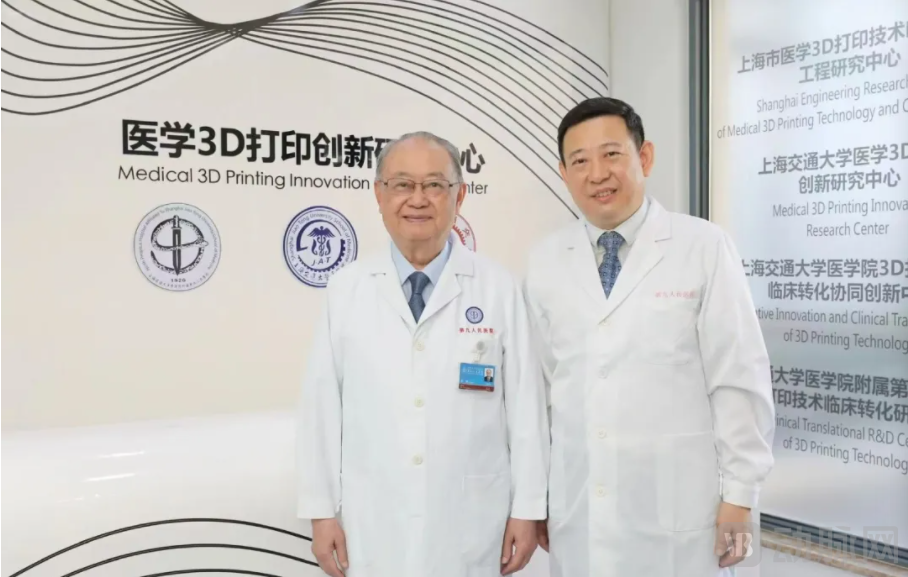
Figure: Academician Dai Kerong and Professor Wang Jinwu (Photo provided by the interviewee)
“I am building a towering peak atop a high plateau.” Wang Jinwu used this metaphor to describe his mentorship relationship. Academician Dai has already laid a solid foundation, and what he aims to do is erect a new skyscraper upon it.
Everything is difficult at the beginning. Although the concept of “integration of medicine and engineering” sounded appealing in Cleveland, its implementation in China at that time faced numerous challenges. Doctors and engineers operated within entirely different linguistic frameworks, often leading to communication breakdowns akin to “talking past each other.”
“Medical-engineering collaboration requires early communication with engineers,” Wang Jinwu said from experience. “It’s not about simply raising an issue and handing it over to engineers, only to review their completed work and say, ‘This won’t do; redo it,’ which wastes time.”
To break through this barrier, Wang Jinwu found an excellent translator—3D Printing.
"When you look at an X-ray film, engineers sometimes have difficulty interpreting it clearly. But if I print out a 3D bone model, both engineers and doctors can understand it."
Leveraging 3D-printed physical models, clinicians’ needs and engineers’ technical language are intuitively aligned: areas requiring resection and those needing support are immediately apparent on the model. This visual communication enables true deep consensus between two fields with vastly different contexts.
Their first targeted "enemy" is the condition that plagues countless elderly peopleOsteoarthritis。
In conventional treatment, end-stage osteoarthritis often necessitates joint replacement. However, during the early to middle stages, patients continue to suffer from severe pain with limited therapeutic options. Wang Jinwu’s team discovered that much of this pain stems from mechanical imbalance in the knee joint—specifically, excessive loading on the medial condyle, leading to significant wear and tear.
“Since genetic factors cannot be altered and inflammatory factors require pharmacological intervention, can we address mechanical factors?”
Leveraging Shanghai Jiao Tong University’s profound expertise in mechanical engineering, Wang Jinwu’s team has designed a personalized3D-Printed Knee Orthosis.
"For medial pain, we use orthotics to transfer some of the force from the medial side to the lateral side. By achieving mechanical balance, the affected area no longer experiences pain."
This principle, which sounds simple, requires extremely high precision in practice. But this time, the doctors understood mechanics, and the engineers understood clinical practice. When the first patient put on the custom-made orthosis and was surprised to find that walking no longer caused excruciating pain, Wang Jinwu knew that they had found the right path.
To broaden this path, with the support of Academician Dai, Professor Wang Jinwu began to prepare for the establishment"Shanghai Strategic Alliance for Technological Innovation in the Rehabilitation Assistive Devices and Elderly Welfare Industry"
This is not merely an organization, but an ecosystem. From a handful of initial members, it has grown to now encompass206 companiesCouncil members, one-third of which are universities and hospitals, and two-thirds are enterprises. Physicians identify needs, universities develop solutions, and enterprises deliver products.
On this platform,Doctors Are No Longer Lonely Tinkerers, but has become the commander of the entire medical innovation industry chain.
During the years when Professor Wang Jinwu returned to China to explore the integration of medicine and engineering, the Chinese biomedical sector was also brewing a major transformation.
In 2013, a national-level strategy was officially launched—"National Major Science and Technology Infrastructure for Translational Medicine (Shanghai)"This is another "major national scientific instrument" deployed by China in the field of biomedicine, following the synchrotron radiation light source and the protein center. It is also China's first comprehensive national-level translational medicine big science facility.
Shanghai Jiao Tong University, as the legal entity for this project, has shouldered a weighty mission:Bridging the gap between basic medical research and clinical application to address major diseases that severely threaten public health.
This grand national strategy converged with Wang Jinwu’s professional predicament at the “Valley of Death.”
In the scientific research community,"Valley of Death"It is a term that strikes fear into the hearts of many. It refers to the vast chasm separating laboratory prototypes from products that are truly viable for clinical use. This chasm is filled with countless complex hurdles, including regulatory approvals, manufacturing licenses, quality system audits, clinical trials, and medical insurance coding.
Years ago, a leader made a thought-provoking remark during a visit to Shanghai Jiao Tong University:
"Many universities and research institutes have received substantial national funding, but due to the 'valley of death' in scientific and technological translation, numerous achievements have ended up going down the drain, literally feeding the rats."
This remark deeply stung the researchers present. Though harsh, it laid bare an awkward reality:A substantial amount of scientific research funding has been converted into papers on paper, but failed to be transformed into products that benefit the public.
“Once we obtain the registration certificate, we can apply it to patients, bypassing countless cumbersome procedures and truly fulfilling the original aspiration of us clinicians and medical researchers—to benefit the disabled and serve society.” Wang Jinwu secretly resolved that he would never let his scientific achievements go to waste by being confined to animal studies.
However, this path is too difficult.
In the past, universities and hospitals were not permitted to directly hold medical device registration certificates. This meant that technologies invented by physicians had to be sold to enterprises first, which would then apply for registration. Throughout this process, researchers faced numerous pitfalls, including intellectual property disputes, benefit distribution issues, and deviations in technology implementation.
Until"Medical Device Marketing Authorization Holder (MAH) System"With the pilot implementation, a ray of hope has emerged. This system allows research institutions and researchers to directly apply for registration certificates and entrust enterprises with production. This aligns perfectly with Shanghai’s strategy to build itself into a globally influential science and technology innovation hub.
Professor Wang Jinwu keenly seized this historic opportunity.
In 2019, a highly significant certificate was awarded to Shanghai Jiao Tong University Intellectual Property Management Co., Ltd.This is the first 3D-printed medical device registration certificate in China obtained by a university and a hospital under the Marketing Authorization Holder (MAH) system.
This thin sheet of paper carries immense weight. It signifies that Chinese universities and physicians can finally bridge the “last mile” directly from the laboratory to the bedside. This also marks a substantive breakthrough in the “pilot initiatives” reliant on the National Major Infrastructure for Translational Medicine.
“You can’t just secure the registration certificate for Academician Dai’s team alone,” the then-president of Shanghai Jiao Tong University told Wang Jinwu. “Now that the path has been cleared, you should help others follow it.”
Thus,"National Major Science and Technology Infrastructure for Translational Medicine (Shanghai) Center for Registration Research and Clinical Translation of Innovative Medical Devices"emerged as the times required. Academician Dai Kerong serves as Honorary Director, and Wang Jinwu serves as Executive Director.
It is akin to building a bridge across the "Valley of Death."
At this center, a dedicated team liaises with medical device regulatory authorities, specialized engineers handle prototype finalization, and designated personnel are responsible for clinical trial design. Young doctors and professors no longer need to stumble through the approval process like headless flies.
The effect is immediate.
In 2025, Wang Jinwu’s team helped various research groups at Shanghai Jiao Tong University secureOver 30 medical device registration certificates. By 2026, this figure is projected to exceed 50.
Behind these registration certificates lie dozens of innovative technologies that might otherwise have been “buried,” now finally granted legal status to enter the market, make their way into hospitals, and be applied in patient care. From 3D-printed implants to rehabilitation robots, the successful commercialization of each achievement serves as the best response to the criticism once leveled at them: “just feeding mice.”
In addition, to ensure that translation goes beyond paper and is implemented in the industry, Wang Jinwu also promoted the establishment of the Yangtze River Delta (Changshu) Translation Base and the Rizhao Translation Base in Shandong Province, and established it in Baoshan District, Shanghai.GMP-Compliant Production Workshop for Bio-3D Printed Medical Devices。
"It’s no longer just about finishing the paper," said Wang Jinwu. "We need to establish a closed loop. From patents to registration certificates, and from manufacturing licenses to medical insurance codes, every step must be successfully completed. That is what constitutes true translation of research into practice."
Having secured the registration certificate and paved the way for commercialization, Wang Jinwu did not rest on his laurels. He harbors an even greater ambition: to advance from “manufacturing” to “regeneration.”
The application of 3D printing technology in healthcare has undergone three stages.
The first stage is to build the "model,"Used for surgical planning;The second stage is implanting the "implant."For instance, titanium alloy joints are used to replace diseased bone. However, these remain “inert” materials that cannot grow with the human body nor degrade.
"Can we 3D-print a living, growing organ that is identical to a human one?"
This is the third stage: bioprinting.In this field, Wang Jinwu’s team is claiming the “crown jewel”—Bio-3D Printing Robot.
In the laboratory of Shanghai Ninth People’s Hospital, this robot, which appears to be straight out of science fiction, is performing a delicate procedure. It is not merely “printing”; it is more akin to “cultivating.” The “ink” it uses is not plastic or metal, but a biomaterial containing living cells and growth factors.
“The crown jewel is the ability to inject cartilage, thereby repairing the articular cartilage after the procedure,” introduced Wang Jinwu.
This is what he has always advocated."Knee- and Hip-Preservation" Concept.
“It’s just like a tooth with a cavity—you get it filled, right?” Wang Jinwu used an extremely layman’s analogy. “If there’s a small defect in our joint, replacing the entire joint is actually not cost-effective.”
This robot functions as a miniature “joint repair specialist.” It can enter the human body through arthroscopic access in a minimally invasive manner, and in situ print new cartilage scaffolds and cells at the site of cartilage defects. These cells will gradually develop into new cartilage, while the scaffold will slowly degrade and disappear. Ultimately, the patient regains a fully restored, living joint of their own.
Once this technology matures, it will completely transform the treatment landscape for osteoarthritis.
From “replacement” to “repair,” this shift reflects the technical expertise that Wang Jinwu’s team has accumulated over many years in developing nine types of bioinks and two sets of 3D bioprinter hardware and software systems, as well as the outcomes of three key national projects under China’s Ministry of Science and Technology, for which he served as chief scientist.
But Wang Jinwu’s vision extends beyond this,Not only "treatment," but also "prevention" and "rehabilitation."
In Qingzhou, Shandong Province, a large-scale project is underway, with Wang Jinwu’s team employing digital screening technologies to assess 110,000 local children for foot deformities and scoliosis.
“If scoliosis progresses to the point where surgery is required, the cost will be at least several hundred thousand yuan,” Wang Jinwu is well aware of the heavy financial burden that major surgery places on families. “In contrast, current early interventions are non-invasive and do not require surgical incisions. If a child becomes disabled due to missed opportunities for timely intervention, the impact on the family and society would be substantial.”
Identify issues through early screening, perform non-invasive correction using 3D-printed orthoses, repair tissue damage via bioprinting, and finally facilitate postoperative rehabilitation through a cloud-based rehabilitation platform.
From early-stage prevention, to mid-stage stem cell and bioprinting therapies, and finally to late-stage joint replacement, as Wang Jinwu stated, “We have developed a comprehensive solution for osteoarthritis, covering the early, middle, and late stages.”
Sixteen years ago, in Cleveland, Wang Jinwu was a Chinese international student who gazed at a wall full of inventions and lamented, “Why don’t we have these?”
16 years later, in Shanghai,He has become a standard-setter for international bioprinting.
The weight of this achievement can be measured by a string of shining data:
As the chief scientist for two consecutive National Key R&D Programs of the Ministry of Science and Technology during China’s 13th and 14th Five-Year Plan periods, Professor Wang Jinwu’s team developed nine types of bioinks, created two sets of software and hardware products for 3D bioprinters, and published more than 100 high-quality papers, including those in Nature and Science subsidiary journals. In 2021, their achievements in 3D bioprinting were featured in a special report on Nature’s official website; in 2024, he was included in the list of the world’s top 2% scientists.
More importantly, they spearheaded the development of China’s first standard for bio-3D printing and the first standard for 3D-printed rehabilitation assistive devices, establishing a total of 14 medical device standards. These standards are not only implemented domestically but also serve as international references.
This is not only a reversal of personal identity,It is a microcosm of China's transition from "following" to "leading" in this field.
“China’s metal 3D printing standards lagged behind those of the United States by three months,” Wang Jinwu candidly stated. “Given that we are still in the early stages, we are striving to catch up.”
"However, the standards for both bio-3D printing and 3D-printed rehabilitation devices were spearheaded by Academician Dai and myself; we also established them earlier than the United States." As he spoke, his tone exuded confidence.
Today, in the field of 3D-printed medical devices, some organizations in the European Union and the United States even proactively seek reference standards from China’s National Medical Products Administration (NMPA). Standards developed by China are beginning to serve as a global benchmark.
On the day of the interview, Wang Jinwu had just received a mayoral delegation from Serbia.
Friends from countries along the "Belt and Road" have shown strong interest in China's advanced digital medical technologies. The rehabilitation equipment and 3D printing technologies developed by Wang Jinwu’s team are poised to expand internationally through collaborations, with exports to these countries underway.
"Previously, we were following or keeping pace with foreign counterparts. To achieve a leapfrog lead, Chinese researchers must master core technologies and translate them into proprietary products."
This young physician, once obscure and later pursuing advanced studies abroad, has earned the respect of his international peers through decades of dedication. In a 2021 exclusive interview with Nature magazine, he articulated his research mission as follows:
"Bioprinting has emerged as a highly promising tool for clinical translation in creating tissue and organ constructs with physiological structural functions and self-repair capabilities. However, significant challenges remain: in addition to the demand for high-precision printing, it is essential to develop bioinks with superior properties and construct bioactive microenvironments."
This statement reveals his clarity of mind:Technological breakthroughs are merely the beginning; the true challenge lies in translating laboratory achievements into clinical practice to benefit patients.
Faced with these achievements, Wang Jinwu has maintained the clarity and honesty characteristic of a scientist.
When asked about the future challenges of bioprinting, he did not shy away from the difficulties: “It’s like this: even if we bioprint a liver now, it still cannot achieve adequate detoxification function; if we print a kidney, it is still unable to produce urine... But the visual representation is promising.”
He candidly admitted that printing complex organs still has “a long way to go” in terms of materials, cells, and growth factors. This unboastful and unexaggerated attitude is precisely the greatest reverence for science.
“Despite the many technological advancements we have today, there is still a long way to go to meet the clinical needs of disease treatment.”
If you spot a figure hurrying along at Shanghai Ninth People’s Hospital or the Minhang Campus of Shanghai Jiao Tong University, you may have just crossed paths with Professor Wang Jinwu. In the medical field, where every second counts in the race against time and death, he has long accustomed himself to “buying time” by walking briskly.
“I usually walk quickly around the hospital, and I walk to and from work whenever possible,” Wang Jinwu said with a smile. In fact, this is his way of “squeezing in” exercise amidst his busy schedule.
Every Tuesday evening, the graduate student group meeting is held without fail. In the conference room of the Translational Medicine Building, the lights often stay on until 11 or 12 at night. Professor Wang Jinwu and his students—these young people who also have backgrounds in medicine and engineering—enthusiastically discuss the latest experimental data or the approval progress of certain registration certificates.
From performing intricate replantation of severed limbs through meticulous surgery in the early days, to regenerating organs via bioprinting robots today; from one individual’s solitary awakening in Cleveland, to leading a coalition team of hundreds in achieving collective breakthroughs; from merely following international standards set by other countries, to having the world look to Chinese standards as a reference.
From a naive teenager with aspirations in business in 1989 to a top-tier scientist holding multiple roles today, the passage of 36 years has propelled Wang Jinwu from the microscopic view under the microscope to the forefront of macro-level industrial transformation.
"Technology changes, roles change, but some things remain constant."
The moment, many years ago in a rural clinic, when he watched the barefoot doctor gently manipulate and reduce the dislocated joint, remains etched in his memory.
"We hope that through the advancement of our healthcare and our technology, we can develop more minimally invasive, more precise, and more affordable techniques to provide treatment plans for the elderly and children that are warm, humanistic, and truly technically advanced."
This may well be the most unadorned yet grandest interpretation of “medicine” in Wang Jinwu’s heart.
"Make healthcare more compassionate, and reduce patient suffering."—This is not only the original aspiration of a physician, but also the ultimate destination of medical innovation in China.