

Hangzhou Zero-Field Medical: Pioneering Industrialization of Zero-Field Medicine from a National Mega-Science Facility
On the map of China’s efforts to scale technological heights in medical equipment during the 14th Five-Year Plan period, an original track stemming from national major scientific and technological infrastructure is accelerating toward maturity.
Recently, Hangzhou Lingci Medical Equipment Co., Ltd. (hereinafter referred to as “Hangzhou Lingci”) obtained the Class II medical device registration certificate for its independently developed multifunctional magnetoencephalography and magnetocardiography imaging system.This device has achieved the world’s first simultaneous, high-precision acquisition of cardiac and cerebral magnetic signals., establishing a novel technical pathway for combined cardiac-cerebral magnetic imaging. This signifies not only the approval of another high-end domestically produced device, but also that zero-field magnetic medicine is transitioning from the laboratory to large-scale clinical application.
Zero-Magnetic Medicine (full name: “Ultra-Weak Magnetic Functional Information Medicine”) refers to the construction of a near-zero magnetic field measurement environment, utilizing high-sensitivity quantum sensors such as atomic magnetometers to capture ultra-weak biomagnetic signals spontaneously generated by organs like the heart and brain, with intensities ranging from one hundred-millionth to one-billionth of the Earth’s magnetic field, thereby enabling the detection of early “functional changes” associated with disease onset.
The approval of Hangzhou’s zero-magnetic-field products represents not only a breakthrough for a domestically produced high-end medical device, but also marks a key milestone for a “Chinese model” that starts from first principles and pioneers an entirely new track in China’s ascent to the peak of the medical equipment industry.
1From “National Strategic Assets” to Fostering Industry-Level Innovation
The story of Hangzhou Zero Magnetic Field began with a major national science and technology infrastructure project aimed at the frontiers of global scientific and technological advancement—“Ultra-High-Sensitivity Ultra-Weak Magnetic Field and Inertial Measurement Device”. At the Hangzhou Zero-Magnetic Science Valley, this national key scientific infrastructure is under construction. It aims to create an extreme environment with a magnetic field one billion times weaker than that of the Earth. Upon completion, it will become the world’s most powerful and largest “zero-magnetic” scientific facility.
Operating this device relies on core technology capable of detecting extremely weak magnetic fields. This technology is rooted in seventeen years of dedicated research by the Institute of Large-Scale Scientific Facilities at Beihang University in the field of quantum precision measurement. One of the ultimate application goals of this technology is to decode the faintest signals of human physiological activity.
Studies have shown that the magnetic fields generated by the human heart and brain are extremely weak. Only in a “near-zero magnetic environment,” where the vast majority of geomagnetic interference is shielded, can these unique “magnetic fingerprints” characterizing vital functions be clearly captured using quantum precision measurement techniques such as high-sensitivity atomic magnetometers.
It is precisely this groundbreaking capability to “visualize” the magnetic fields of life that endows basic research with immense potential for translation into productive forces. How can this be achieved? Fang Jiancheng, an academician of the Chinese Academy of Sciences and the chief designer of the project, proposed the innovative concept of “laying eggs along the way”: advancing technological R&D and industrial commercialization in parallel with facility construction. Hangzhou Zero-Mag is the first and most high-profile “golden egg” incubated under this model.
Under this framework, Hangzhou Zero-Mag Medical Equipment Co., Ltd., an industrialization platform jointly established by the core research team of Beihang University and Hangzhou High-Tech Venture Capital Investment Company, was founded. Leveraging independent core technologies such as quantum precision measurement and magnetic shielding, the company is committed to rapidly engineering and commercializing cutting-edge laboratory discoveries, thereby paving a novel path from the source to break the monopoly on high-end medical equipment and achieve self-reliance and controllability.
2Functional Imaging, Simultaneous Heart-Brain Assessment: The Next Revolution in Medical Imaging
The key significance of Hangzhou’s zero-magnetic-field devices lies in their expansion of the dimensions of medical imaging—elevating it from traditional “structural visualization” to “functional interpretation.”
Conventional mainstream imaging technologies, such as computed tomography (CT) and magnetic resonance imaging (MRI), essentially observe static structural information, including organ morphology and tumor size and location. However, they have limited capability for the direct detection of functional changes, such as myocardial ischemia and abnormal neuronal discharges in the brain. Although existing electrocardiography (ECG) and electroencephalography (EEG) can reflect electrical activity, their signals attenuate and become distorted during conduction through the body, resulting in insufficient spatial resolution.
The core breakthrough of zero-magnetic-field devices lies in their ability to directly “capture” anomalies in these functions. At the heart of the technology is the creation of an ultimate “quantum observation chamber” that shields against all external magnetic interference, enabling arrays of ultra-high-sensitivity atomic magnetometer sensors to stably measure physiological magnetic signals as weak as one-billionth of the Earth’s magnetic field.
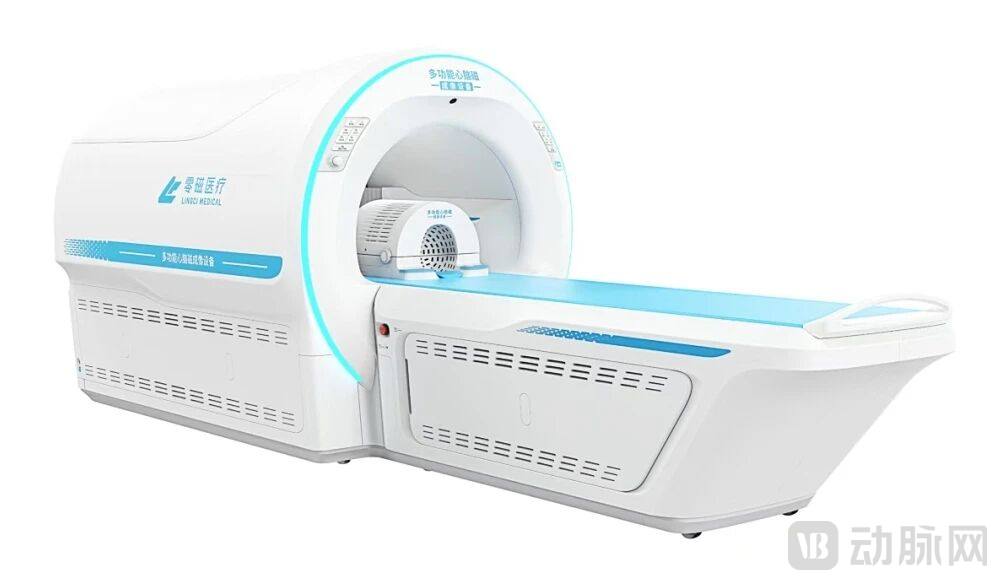
Model Diagram of the Multi-Functional Magnetoencephalography and Magnetocardiography Imaging Device Independently Developed by Hangzhou Lingci — Source: Hangzhou Lingci
This enhancement in capability translates directly into significant clinical advantages: the detection processNon-invasive, radiation-free, and with high spatiotemporal resolution. Its proprietary software supports one-click report generation, while the non-magnetic environment design significantly enhances subject comfort and examination efficiency, making it particularly suitable for pregnant women, children, and cases requiring repeated examinations.
The core breakthrough of the newly approved device lies in“Heart-Brain Synchronization”. It enables the detection of cardiac and cerebral magnetic fields“"Same Time, Same Source, Same Standard"This acquisition eliminates the temporal bias inherent in traditional sequential testing. It represents not merely a simple aggregation of functions, but a paradigm shift in research methodology. It provides the scientific community with an unprecedentedly precise tool for investigating the physiological correlations and pathological interactions between the heart and brain, as well as for the clinical diagnosis of cardiocerebral comorbidities.
This breakthrough is giving rise to entirely new research and clinical applications:
In the cardiovascular field, magnetocardiography (MCG) has demonstrated significant value in early diagnosis. Clinical validation data from a hospital in Hangzhou show that MCG achieves an accuracy rate of over 95% in identifying acute myocardial infarction. For patients with atypical symptoms who are at high risk of delayed treatment, MCG enables physicians to detect subtle changes in cardiac function at an earlier stage, thereby gaining precious time for life-saving interventions.
Furthermore, in Chest Pain Centers, emergency departments, and cardiology departments, the unique perspective of integrated cardio-cerebral assessment is poised to provide more rapid differential diagnosis and multidimensional functional quantification for conditions such as acute myocardial infarction, coronary artery disease, and arrhythmias, thereby surpassing the limitations of traditional examinations.
In the Field of Neuroscience and Psychiatry, the value of magnetoencephalography (MEG) is even more distinctive. It is not only a powerful tool for the precise localization of epileptic foci but also provides objective, quantitative assessments for psychiatric disorders and sleep disturbances. By minimizing the interference of subjective factors, MEG holds promise for offering new evidence to support the diagnosis and therapeutic monitoring of conditions such as depression, addiction, and insomnia.
Currently, the magnetoencephalography (MEG) equipment independently developed by Hangzhou Zero Magnetic Technology has been put into operation at institutions such as Beijing Children's Hospital, marking it as China's first high-end MEG imaging system used for assessing pediatric brain development. It is being utilized to explore early objective screening and intervention assessment for childhood autism and attention-deficit/hyperactivity disorder (ADHD), in an effort to unravel the "black box" of child development.
Additionally,In the Field of Health Management and Rehabilitation, this technology is poised to overcome the limitations of traditional health examinations, which rely on subjective questionnaires or single biochemical markers. By leveraging objective, non-invasive functional magnetic signal data, it enables early warning of cardiovascular and cerebrovascular disease risks, assessment of suboptimal health status, and precise tracking of rehabilitation outcomes, thereby truly facilitating a proactive shift in disease prevention and control.
The market and clinical sectors have responded positively. Currently,HangzhouZero-mag horizontal magnetocardiography, magnetoencephalography, cabin-type magnetoencephalography, and multifunctional magnetocardiography and magnetoencephalography imaging devices have all obtained medical device registration certificates., forming a comprehensive product portfolio that spans from specialized scientific research to multi-scenario clinical applications.
The product’s comprehensive regulatory approvals have paved the way for large-scale clinical validation. To date, 55 units of the device have been deployed in more than 38 hospitals across China, covering multiple clinical research and application centers in Beijing, Zhejiang, Shandong, Guangdong, Shanghai, Wuhan, Chongqing, and other regions.
In addition, Hangzhou Zero Magnetic has established strategic partnerships or application demonstration project collaborations with dozens of top-tier medical institutions, including Peking University Third Hospital, Xuanwu Hospital of Capital Medical University, Qilu Hospital of Shandong University, Guangdong Provincial Hospital of Chinese Medicine, The Second Affiliated Hospital of Zhejiang University School of Medicine, West China Hospital of Sichuan University, Tongji Hospital/Union Hospital Affiliated to Tongji Medical College of Huazhong University of Science and Technology, The First Affiliated Hospital of Fujian Medical University, Shanghai Mental Health Center, and Zhongshan Hospital/Pudong Hospital Affiliated to Fudan University.
A zero-magnetic medical research network, covering major regions across China and deeply embedded in top-tier clinical centers, has rapidly taken shape and continues to expand at an accelerating pace.
3Building a Zero-Magnetic Ecosystem: A Chinese Model of an Innovative Paradigm
Hangzhou Lingci’s strategic goals extend beyond the manufacturing and sales of equipment. Leveraging the continuous innovation capabilities of national major science and technology infrastructure, it is building a complete industrial ecosystem for “Zero-Field Medicine.”
The cornerstone of this ecosystem is a highly collaborative R&D and commercialization system. The Institute for Ultra-Weak Magnetic Fields in Hangzhou has gathered over 1,000 researchers dedicated to overcoming core technological challenges. Meanwhile, construction has begun on a zero-magnetic medical equipment production base in Binjiang, Hangzhou, with a total investment of approximately RMB 120 million, which will serve as the primary vehicle for translating research outcomes into practical applications.
The industry’s expansion follows a clear strategic layout. In addition to Hangzhou’s R&D and core manufacturing headquarters, an industrial cluster characterized by “geomagnetism+” is taking shape in Deqing, Zhejiang, attracting enterprises across the entire supply chain—from upstream sensors to shielding devices. Supported by special-purpose industrial funds established by local governments and the spatial configuration of “Hangzhou Headquarters + Deqing Manufacturing Base,” a complete value chain spanning basic research, technological development, industrial manufacturing, and clinical applications has clearly emerged.
Hangzhou Lingci’s trajectory offers a model for China’s high-end medical equipment industry to “overtake on a new curve.” Rather than chasing competitors in the saturated “structural imaging” market, it has leveraged national strategic scientific and technological strengths to pioneer a new frontier rooted in “functional imaging.”
Standing at a new starting point, the potential applications of zero-field magnetic technology are continuously expanding. From the perspective of global trends in zero-field magnetoencephalography (ZFMG), “lightweight and wearable” device design is clearly one of the key frontiers. In the long term, this high-precision capability for measuring biomagnetic signals is poised to achieve deep integration with cutting-edge fields such as brain-computer interfaces and smart health management.
From the “national heavy weapon” that shields against Earth’s magnetic field to the “precision instrument” that detects biomagnetic fields, the growth of Hangzhou Zero-Mag clearly outlines a cutting-edge path pioneered and successfully traversed by both national strategic scientific and technological forces and market vitality. This “golden egg” hatched from a national laboratory is now incubating a future health industry ecosystem centered on functional sensing.