

Lilly Commits Over $2.15 Billion in Dual Strategic Moves Targeting Inflammatory and Oncology-Immunology Therapies

InduPro
Bispecific Antibody Drug Developer
Over $2.15 Billion, Two Deals in One Day.
This is the amount Eli Lilly wagered simultaneously on the two major fronts of inflammatory diseases and tumor immunity on January 7, 2026, local time.
First, Eli Lilly and Ventyx Biosciences (NASDAQ: VTYX, hereinafter referred to as “Ventyx”) announced that they had entered into a definitive agreement under which Eli Lilly would acquire Ventyx for $1.2 billion. Ventyx is a San Diego-based clinical-stage biopharmaceutical company focused on developing innovative oral therapies for patients with inflammation-mediated diseases.
On the same day, a biotechnology company dedicated to defining the spatial relationships of membrane proteins to develop novel therapies for cancer and autoimmune diseasesInduPro, Inc. (hereinafter referred to as “InduPro”) also announced that it has entered into a global strategic collaboration and license agreement with Eli Lilly and Company (Lilly), along with an equity investment, aimed at leveraging InduPro’s proximity-guided platform to discover novel oncology therapies. Under the terms of the agreement, the two companies will collaborate on up to three targets, with the total transaction value reaching up to approximately $950 million. Meanwhile, Lilly will also make an equity investment in InduPro.
While these two initiatives may appear independent, they in fact jointly point to Eli Lilly’s strategic direction at the start of the new year.
NLRP3 Inhibitor: The Therapeutic Star That Sent Shares Soaring 71%
Let’s first examine Ventyx’s pipeline portfolio in isolation.
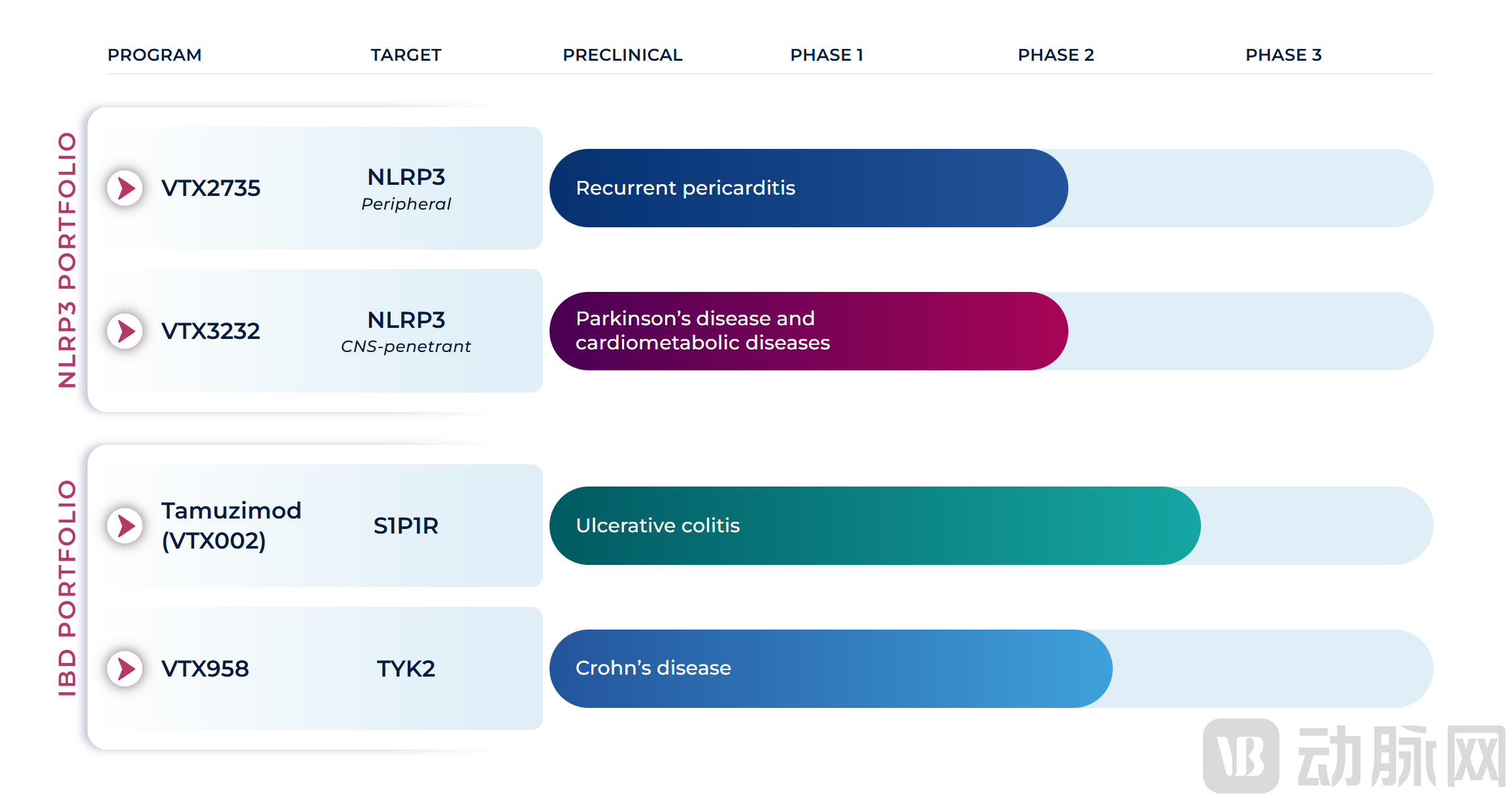
Ventyx Pipeline, image source: Ventyx official website
Leading the charge is the core asset portfolio of NLRP3 inhibitors, comprising VTX3232, a central nervous system (CNS)-penetrant NLRP3 inhibitor, and VTX2735, a peripherally restricted NLRP3 inhibitor. The indications for VTX3232 include the currently high-profile areas of obesity, cardiovascular disease, Parkinson’s disease, and Alzheimer’s disease. VTX2735 targets recurrent pericarditis and familial cold autoinflammatory syndrome (FCAS). Both pipelines are currently in Phase II clinical trials.
At the very core is the NLRP3 inhibitor VTX3232, the primary driver behind the 71% surge in Ventyx’s stock price in October 2025.
According to a 2025 review article published in *Chinese Journal of Clinical Oncology*, titled “Regulatory Network of the NLRP3 Inflammasome in the Tumor Microenvironment of Head and Neck Squamous Cell Carcinoma and Targeted Therapeutic Strategies,” the NLRP3 inflammasome, formally known as NOD-like receptor family pyrin domain containing 3, serves as a central regulatory hub of the innate immune system. By integrating signals from exogenous pathogen-associated molecular patterns (PAMPs) and endogenous damage-associated molecular patterns (DAMPs), it precisely regulates the maturation and release of pro-inflammatory cytokines such as IL-1β and IL-18, thereby acting as a key molecular switch linking inflammation to malignant tumor transformation.
According to data from PharmCube, as of the end of 2025, there were no marketed drugs targeting NLRP3 worldwide. As of the end of 2024, more than 100 pharmaceutical companies were advancing over 100 NLRP3 inhibitor projects (including preclinical stages). However, the number of pipelines in clinical development (Phase III, Phase II, and Phase I) was relatively small, totaling only slightly more than 20, with most being inactive (no R&D progress in the past three years). In contrast, the preclinical pipeline was much larger, with significant participation from Chinese biotech companies.
Thus, Ventyx has gained a first-mover advantage by entering Phase II clinical trials, while VTX3232 has delivered satisfactory results from its completed Phase II clinical trial.
Phase II data for Ventyx’s NLRP3 inhibitor, VTX3232, demonstrate a rapid and sustained reduction in high-sensitivity C-reactive protein (hsCRP) in obese patients with cardiovascular risk, potentially giving oral NLRP3 inhibitors an advantage over IL-6 monoclonal antibodies and helping to reduce cardiovascular risk in this population. The Phase II clinical trial evaluated the efficacy of VTX3232 as monotherapy and in combination with semaglutide, showing that it rapidly and sustainably lowered hsCRP—a key biomarker of cardiovascular risk—with a favorable safety and tolerability profile.
Notably, Ventyx reported that combination therapy with VTX3232 and semaglutide significantly reduced levels of high-sensitivity C-reactive protein (hsCRP), interleukin-6 (IL-6), fibrinogen, erythrocyte sedimentation rate (ESR), and hepatic inflammation compared with semaglutide monotherapy, although specific numerical data were not provided. Ventyx also stated that monotherapy with VTX3232 significantly reduced IL-6, fibrinogen, and ESR, with statistical significance.
Overall, VTX3232 demonstrated favorable safety and tolerability profiles in both monotherapy and combination therapy. Its combination with semaglutide conferred additional benefits. However, VTX3232 did not exert any significant effect on body weight, regardless of whether it was administered as monotherapy or in combination.
“Proximity Induction” + “Micro-Mapping” Offer New Solutions to Dilemmas in Tumor Immunotherapy
Lilly’s other bet, InduPro, also boasts an impressive pedigree. In late 2025, InduPro entered into a collaboration with Sanofi. Lilly’s equity investment in the company had been signaled in advance. Given that InduPro was only founded in 2024, it appears that multinational corporations (MNCs) have been strategically planning this move for quite some time.
According to Eli Lilly’s disclosure, the company will leverage InduPro’s proximity-based platform to discover novel disease-specific protein–target pairs. This strategy aims to develop new therapeutic approaches for bispecific antibody–drug conjugates (ADCs) and T-cell engagers (TCEs), thereby enhancing safety, potency, and tumor selectivity.
In fact, to understand Eli Lilly’s latest move, it is helpful to look back at the collaboration between InduPro and Sanofi.
In December 2025, Sanofi announced a strategic investment and R&D collaboration with InduPro to jointly advance a bispecific PD-1 agonist program, targeting autoimmune diseases.
Among these factors, “PD-1 agonists” have undoubtedly captured significant market attention. After all, while PD-1 inhibitors continue to push the boundaries of cancer treatment, PD-1 agonists have yet to achieve a definitive breakthrough. Notably, AnaptysBio’s PD-1 agonist rosnilimab previously failed to meet its primary endpoint in a Phase II trial for ulcerative colitis (a form of inflammatory bowel disease, IBD), underscoring that PD-1 agonists still face substantial challenges heavily dependent on specific disease contexts and the immune microenvironment. Sanofi was also involved in the collaborative development of AnaptysBio’s PD-1 agonist.
Therefore, the market’s skepticism hits the nail on the head: Does the predicament facing PD-1 agonists stem from target selection or from the R&D paradigm itself?
InduPro may offer a novel solution. Diverging from the traditional monoclonal antibody approach, InduPro does not focus on a single target per se; instead, it centers on the spatial proximity relationships of membrane proteins and the conditions for immune signal triggering, aiming to reconstruct the logic of immune regulation through “proximity-induced” mechanisms.
InduPro’s core technology, “MicroMapping,” revolutionizes the traditional paradigm of target discovery: by labeling known cell-surface proteins (such as cancer antigens) with antibodies, reactive molecules on the antibodies leave chemical “fingerprints” on neighboring proteins upon blue light stimulation. Scientists can then precisely identify these neighboring proteins using mass spectrometry. This technology efficiently identifies novel targets that co-occur with disease-related proteins, providing a scientific basis for the design of bispecific and trispecific antibodies.
It is reported that this technology has enabled InduPro to identify five novel target combinations, all of which have entered the preclinical development stage. Among them, IDP-001 is a bispecific antibody-drug conjugate (ADC) targeting EGFR and CDCP1, the latter of which was discovered by InduPro to frequently co-localize with and be overexpressed alongside EGFR.
Two Transaction Models Complement Each Other to Seize the High Ground in Next-Generation Therapies
Eli Lilly has established an undisputed leadership position in the field of metabolic diseases, particularly diabetes and obesity, with its GLP-1 receptor agonist tirzepatide becoming a blockbuster phenomenon. However, its pipeline in inflammatory diseases is relatively weak, lacking flagship products capable of competing with dominant multinational corporations (MNCs) such as AbbVie (e.g., adalimumab) and Johnson & Johnson.
In addition to balancing the existing product portfolio, the acquisition of Ventyx is expected to generate a “1+1>2” effect through the combination of Ventyx’s core products with Eli Lilly’s flagship offerings in the metabolic disease area.
After all, combination strategies will transform NLRP3 inhibitors, represented by Ventyx’s VTX3232, from the role of “anti-inflammatory drugs” to “modulators of inflammatory foundations” and “enhancers of existing therapies,” becoming a key strategic consideration for avoiding homogeneous competition and building competitive barriers. Perhaps for Eli Lilly, the key lies in whether it can integrate Ventyx’s core products to design and validate revolutionary combination regimens.
On the other hand, although Eli Lilly already has multiple marketed products in the oncology space, its competitive advantage in the currently hottest field of cancer immunotherapy is not particularly significant compared to other multinational corporations (MNCs). The collaboration with InduPro represents Eli Lilly’s attempt to “overtake on a bend” in the realm of tumor immunotherapy. Rather than chasing competitors in the already crowded PD-1/PD-L1赛道, Eli Lilly chose to invest in an entirely new technology platform with the potential to generate breakthrough next-generation immunotherapies. Through early involvement, Eli Lilly not only secured development rights for three specific projects but, more importantly, gained deep access to and learning opportunities from this cutting-edge technology platform.
Correspondingly, Eli Lilly adopted different collaboration models for its two deals in a single day.
The partnership with InduPro represents a higher-risk, higher-reward exploratory investment. The proximity-induced platform is an entirely new technological paradigm whose clinical feasibility has not yet been fully validated. However, should it succeed, the potential returns could be substantial. By opting for collaboration rather than acquisition, Eli Lilly can share the early-stage development risks with InduPro while retaining the flexibility to decide whether to increase its investment in the future based on project progress.
The acquisition of Ventyx represents a relatively low-risk, medium-to-high-return investment. If the pivotal Phase III clinical trial for VTX3232 remains successful, Eli Lilly will secure a complete product with multi-indication potential that can be directly integrated into its global commercialization infrastructure.