Zhejiang University to Transfer Breakthrough Single-Cell RNA Sequencing Technology for RMB 1.5 Million

10x Genomics
DNA Sequencing Technology Developer
Zhejiang University has recently published multiple notices on the transfer of patents, proposing to“A Single-Cell Transcriptome Sequencing Method and Its Application”the transfer of relevant patent rights and interests to industry partners, with the transaction covering multiple countries and regions including China, the United States, Japan, Singapore, Australia, Europe, and Hong Kong, China,CumulativeTransaction amount reaches1.5 million yuan。
This patent falls within the niche field of single-cell sequencing under biotechnology. Its innovations focus on addressing the core pain points of existing high-throughput single-cell transcriptome sequencing technologies, aiming to overcome limitations in sample compatibility and enhance detection coverage and sensitivity. It establishes a whole-transcriptome sequencing technology system suitable for diverse sample types and multiple species, precisely covering downstream application areas such as microbiology, basic medicine, clinical medicine, agronomy, and cell biology, thereby forming a core positioning of “technological breakthroughs–multi-field adaptability.”
The most widely used high-throughput single-cell RNA sequencing technology currently is10X Genomics, Inc.DevelopedSingle-Cell Sequencing Technology Based on Droplet Microfluidics Platforms. This technology enables the labeling, sequencing, and analysis of thousands of cells, thereby obtaining gene expression profiles at the single-cell level, facilitating the identification of cell subpopulations and the detection of differentially expressed genes among these subpopulations. Similar technologies includeinDrop and Drop-seq Technologies。
The fundamental principle and workflow of 10x Genomics transcriptome sequencing involve preparing the sample into a single-cell suspension. Subsequently, using a microfluidic platform, individual barcoded beads (each consisting of a gel bead conjugated with primers) are co-encapsulated with single cells within oil droplets. Within each droplet, the gel bead dissolves, and the cell is lysed to release mRNA, which is then reverse-transcribed into cDNA tagged with barcodes and Unique Molecular Identifiers (UMIs) for sequencing. After breaking the oil emulsion, the cDNA is collected and amplified to construct a cDNA library. The library is then sequenced on an Illumina platform, thereby generating extensive gene expression data at the single-cell level.
The primer sequences attached to the gel beads used in the aforementioned sequencing technology consist of four parts:Illumina TruSeq Read 1 sequencing primer, a 16-nucleotide barcode, a 12-nucleotide UMI, and a 30-nucleotide poly(dT) reverse transcription primer.Among these, the TruSeq Read 1 sequencing primer is a known short nucleotide sequence used for subsequent sequencing on the instrument. Barcodes correspond one-to-one with microbeads, with a total of 4 million unique barcodes. The UMI (Unique Molecular Identifier) is a sequence composed of random bases; each DNA molecule possesses its own unique UMI sequence, which serves to distinguish different samples during multiplexed sequencing (i.e., to identify which sequenced reads originate from the same original cDNA molecule). The Poly(dT) reverse transcription primer is a homopolymeric DNA fragment containing 30 thymine (T) bases, used to capture transcripts with poly(A) tails.
High-throughput single-cell transcriptome sequencing technologies, represented by 10X Genomics, exclusively employ poly(dT) reverse transcription primers. Consequently, these methods capture only partial 3’-end transcript information and fail to detect non-polyadenylated RNAs, including degraded mRNA fragments as well as miRNAs and lncRNAs lacking poly(A) tails. This limitation results in extremely low sensitivity in practical applications, with typically less than 10% of mRNAs being detected.
Meanwhile, this technique imposes stringent requirements on RNA quality. To achieve optimal sequencing results, the cell viability of the samples must exceed 80%. Sequencing using cryopreserved or fixed samples often yields suboptimal outcomes. Furthermore, as bacterial RNA lacks poly(A) tails, existing high-throughput single-cell transcriptome sequencing technologies are not applicable to bacterial transcriptome sequencing.
These pain points directly constrain the widespread adoption and in-depth application of single-cell transcriptome sequencing technology, providing a clear direction for the team’s research and development.
Addressing the core limitations of existing technologies such as 10x Genomics, which rely on Poly(dT) primers, require high sample viability, and offer a narrow detection range, this patent establishes an innovative end-to-end technical framework. The core breakthroughs are concentrated in the following four key modules:
First, innovation in sample processing models,Pioneered the "Fixative Pre-treatment + Multi-type Sample Compatibility" Solution,Supports over ten types of simple or mixed fixatives, such as paraformaldehyde and acetic acid-alcohol mixtures, and is compatible with fresh samples, frozen samples, and formalin-fixed paraffin-embedded (FFPE) samples, thereby completely eliminating the dependence on cell viability inherent in traditional techniques.
Second, the RNA capture mechanism has been upgraded, abandoning the use of single Poly(dT) primers,Using reverse transcription with random primers(or a mixture thereof with target-specific primers), which can bind randomly to RNA sequences, enabling comprehensive capture of coding RNAs and non-coding RNAs such as miRNAs and lncRNAs, thereby addressing the technical gap in detecting RNAs lacking poly(A) tails.
Third, optimization of the labeling and partitioning system: designing encoded microspheres containing upstream amplification primer-complementary sequences, barcodes (preferably three), UMIs, and capture adapter-complementary strands, throughDual LabelingEnsure precise traceability of individual cells and individual original cDNA molecules, while integratingMicrofluidic chip or microplateAchieve high-efficiency single-cell partitioning with contamination rateLess than 2%。
Fourth, innovation in expanding application scenarios,First Extension of High-Throughput Single-Cell Transcriptome Sequencing Technology to the Prokaryotic Domain, covering prokaryotes such as bacteria and cyanobacteria, as well as various research subjects including unicellular algae and viruses. Moreover, it demonstrates significantly higher RNA detection sensitivity than existing microfluidic technologies at equivalent sequencing depths, providing a novel tool for multidisciplinary research.
The team has established a robust intellectual property protection system centered on core technological innovations,Establish a comprehensive protection framework encompassing “Core Methodology – Key Technologies – Application Expansion – Parameter Optimization,”and simultaneously advancing its global footprint. Patent applications and grants have been secured in multiple countries and regions, including Australia (AU), Europe (EP), Hong Kong, China (HK), Singapore (SG), Japan (JP), the United States (US), and Mainland China, thereby establishing technical barriers across key markets.
The protection system primarily covers four key dimensions:At the core methodology level,Exclusive protection is granted for the end-to-end sequencing workflow comprising “fixed sample – in situ reverse transcription – capture adapter modification – single-cell partitioning – double-stranded cDNA synthesis”;Key Technical Aspects, clarify the scope of protection for core technologies such as the design and application of random primers for reverse transcription, adaptation schemes for multiple types of fixatives, and methods for adding capture adapters;In terms of application expansion,This method covers application scenarios across multiple species (eukaryotic cells, prokaryotes, unicellular algae, etc.), diverse sample types (fresh samples, frozen samples, paraffin-embedded samples, etc.), and various research fields.At the level of parameter optimization,Precise protection of core reaction parameters, including fixed timing, enzymatic digestion conditions, and amplification cycle numbers, to comprehensively secure the intellectual property advantages of technological innovations.
The global single-cell transcriptome sequencing sector currently exhibits a competitive landscape characterized by “equipment manufacturers dominating the market and technological patents achieving breakthroughs across multiple fronts.” Core participants include international giants, domestic innovative enterprises, and collaborative research institutions. Technological approaches are engaged in differentiated competition focused on sample compatibility, detection efficiency, and multi-dimensional analysis.
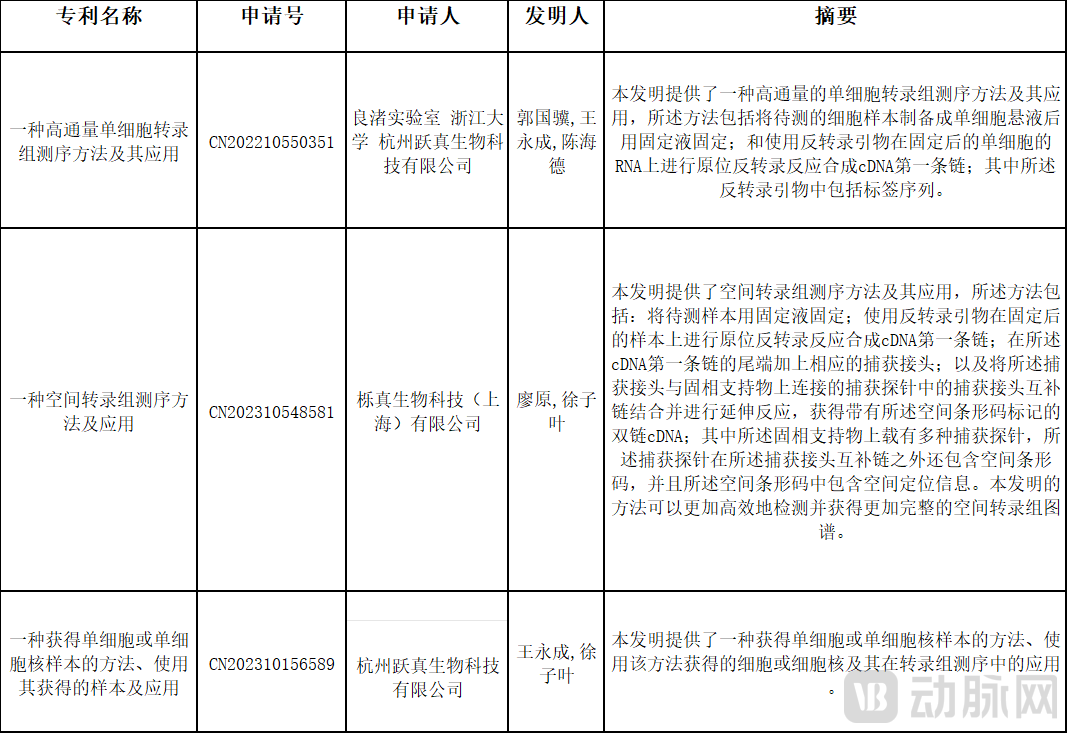
Some Domestic Patents in the Same Field
In the international arena10X Genomics, USALeveraging the dominant Chromium™ droplet microfluidics system, it enables efficient labeling and sequencing of thousands of cells; however, it imposes stringent requirements on cell viability (must exceed 80%) and can only capture transcripts with poly(A) tails.
Illumina and Bio-RadThe jointly launched Single-Cell Sequencing Solution enables parallel detection of multiple samples using droplet separation technology, offering significant cost advantages and making it a common choice in the research field.
BD (Becton, Dickinson and Company)The Rhapsody™ system, based on microfluidic chip technology, supports integrated transcriptomic and proteomic analysis with high customization flexibility. Furthermore,Fluidigm The C1™ system can obtain full-length transcriptome information,WaferGen The ICELL8(®) system offers a cost-effective solution for medium-throughput requirements.
In the domestic market,MGI TechLeveraging its proprietary DNBSEQ technology, the company has launched cost-effective sequencing instruments, with its overseas penetration rate continuing to rise;Singleron, Xunyin Biotech, Dapu BioFocus on the research and development of dedicated single-cell equipment, optimizing technical solutions to meet local scientific research needs;Mozhuo Biotech, Wancheng GenomicsAchieved breakthroughs in the integration of microfluidic chips and reagents, gradually breaking the international technological monopoly.
At the level of technical patents,Liangzhu Laboratory, Zhejiang University, and Hangzhou Yuezheng Biotechnology Co., Ltd.The jointly developed “A High-Throughput Single-Cell Transcriptome Sequencing Method and Its Applications” also employs fixative-based sample processing and in situ reverse transcription technology, enhancing detection throughput by incorporating barcode sequences into the reverse transcription primers.
Lizhen BioIt focuses on spatial transcriptomics detection, utilizing spatial barcodes on solid-phase supports to capture localization information, with a primary emphasis on obtaining efficient and comprehensive spatial transcriptomic maps.
As demand for single-cell transcriptome sequencing technology continues to rise in both scientific research and industrial sectors, technological iterations are accelerating toward “broader sample compatibility, higher detection accuracy, and more diverse application scenarios.” Through global intellectual property layout and breakthroughs in core technologies, this patent from Zhejiang University not only establishes a solid barrier for its own technology transfer but also creates differentiated competition and complementarity with domestic and international equipment manufacturers and technical patents. This will drive capability upgrades across the industry in key dimensions such as sample processing flexibility, RNA detection integrity, and cross-species applicability, providing more innovative technical solutions for fields including microbiological research, clinical sample analysis, and new drug development.