

Anhui Medical University First Affiliated Hospital to Transfer Two Patents Valued at RMB 63,600 to Spin-off Biotech Firm Co-Founded by Lead Inventor
On December 17, 2025, the First Affiliated Hospital of Anhui Medical University proposed to commercialize the following two job-related scientific and technological achievements, with the transaction subjects including“A Control Method for Adjusting Jet Trajectory”and“Recombinant Late Embryogenesis Abundant Protein and Cryoprotectant Solution Containing the Same”。
According to the public notice, the patentee isThe First Affiliated Hospital of Anhui Medical University, the representative of the achievement contributors isWang Jianye. Proposed TransfereeHefei Miguang Biotechnology Co., Ltd., representing the founders of the achievements who established an enterprise through equity contribution based on valuation.
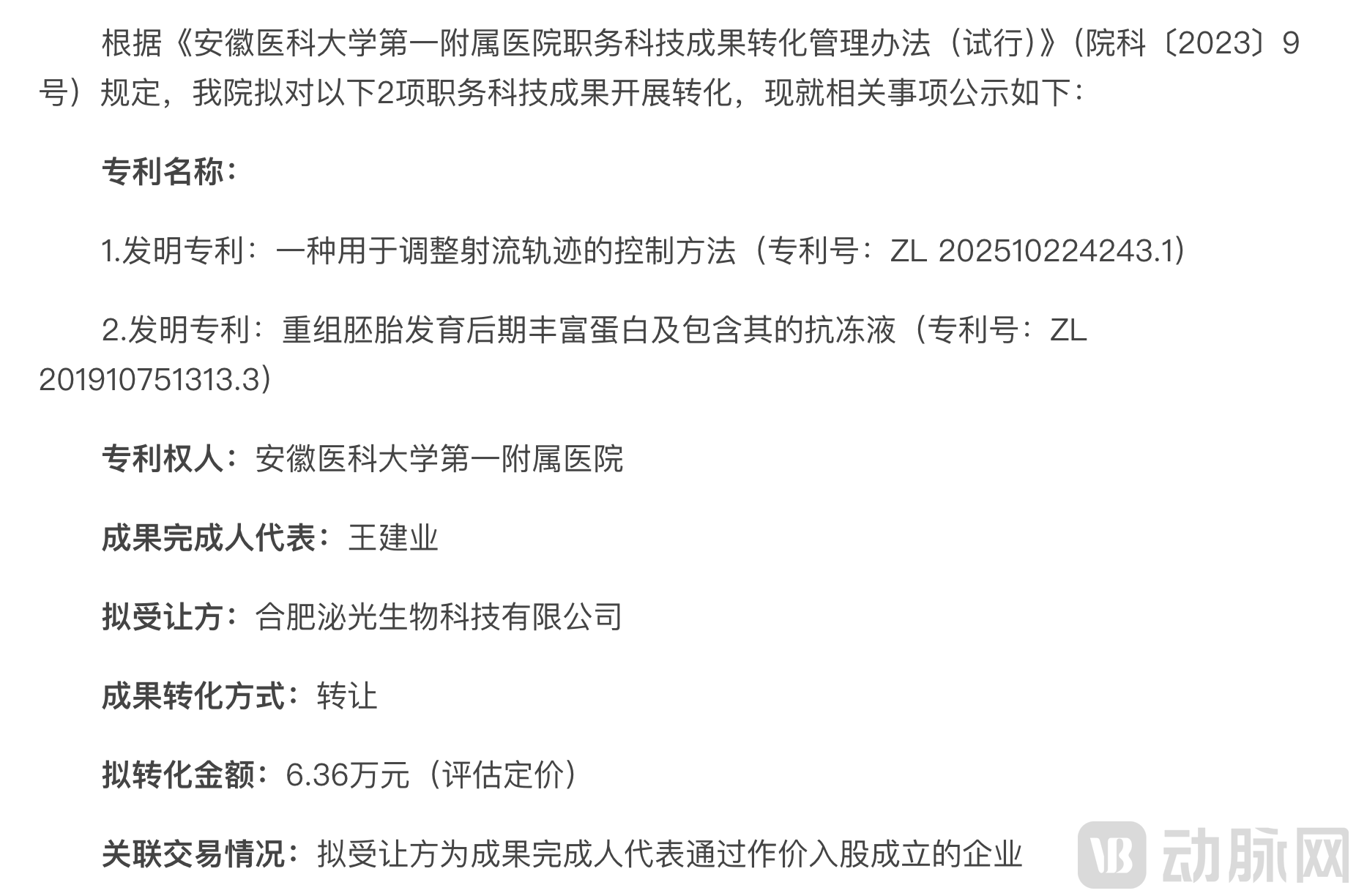
The technological achievements involved in this transaction, the former has established“Image Trajectory Recognition - Initial Adjustment of Electrode Repulsion - Fine-Tuning of Equipotential Ring Level”a three-tier jet trajectory control system that achieves dynamic and precise correction of the vertical jet trajectory in precision spraying scenarios; the latter provides a new molecular intervention strategy for maintaining the viability of biological samples during cryopreservation by reconstituting the expression of proteins specifically abundant in the late stages of embryonic development and formulating them with cryoprotectant solutions.
In clinical and experimental scenarios involving precision medical procedures and biological sample handling, two key technical bottlenecks urgently need to be overcome.
First, in operations such as microfluidic jetting and micro-volume spotting of biological samples, the jet trajectory is prone to deviation due to factors like flow field disturbances and fluctuations in ambient temperature and humidity. Traditional mechanical control methods suffer from delayed response and insufficient precision, resulting in poor uniformity of droplet/particle spatial distribution, which directly compromises the reproducibility of experimental data and the precision of clinical procedures.
Second, during the cryopreservation of fragile biological samples such as embryos, existing cryoprotectants largely rely on the physical effects of permeating protective agents and lack targeted protection mechanisms for stabilizing the structure of biological macromolecules. This results in a high rate of post-thaw viability loss, thereby constraining the effective utilization of biological sample resources in fields such as reproductive medicine and tissue engineering. The two patented technologies being commercialized here are precisely targeted technical solutions designed to address these clinical and experimental needs.
(1) Jet Trajectory Control Technology
Addressing the technical pain point of jet trajectory deviation, this technology innovativelyDevelop a multimodal collaborative correction system integrating “visual feedback, electric field modulation, and mechanical fine-tuning.”Its core mechanism involves using high-speed image acquisition technology to capture the morphology and angular deviation of the jet in real time. The acquired data is input into the electric field control unit, where a non-uniform electric field generated by parallel electrodes applies precise lateral repulsive forces to the jet, achieving initial trajectory correction. Building on this, the system incorporates an equipotential ring structure capable of horizontal displacement; by fine-tuning its position relative to the nozzle, secondary dynamic compensation is applied to the jet. This composite control strategy reduces the vertical deviation rate of the jet from 15%–20% with conventional methods to≤3%, significantly improving the accuracy of the spray landing point.
(II) Recombinant Protein Cryopreservation Solution Technology
Addressing the challenges of cryopreservation of biological samples, this antifreeze solution technology is based on“Molecular Protection–Physical Protection”synergistic mechanism. The technical approach involves the recombinant expression of Late Embryogenesis Abundant (LEA) proteins, which are specific to the late stages of embryonic development. Leveraging their chaperone-like properties, these proteins effectively stabilize the structure of biological macromolecules, such as cell membranes and proteins, under low-temperature conditions, thereby preventing inactivation due to ice crystal damage. Furthermore, this technology optimizes the formulation by combining recombinant LEA proteins with permeating cryoprotectants (e.g., ethylene glycol) and non-permeating protectants (e.g., sucrose) to create a synergistically enhanced protective system. Experimental data demonstrate that embryo samples treated with this cryopreservation solution exhibit a post-thaw survival rate approximately 25% higher than that achieved with conventional protocols, providing a more reliable technical guarantee for the long-term preservation of biological samples.
Both patented technologies demonstrate significant innovation and advantages in their core principles and application efficacy, which can be summarized into two major dimensions.
First, the innovation and advantages of jet trajectory control technology are primarily manifested in the precision and universality of multimodal collaborative control.Compared to traditional single mechanical regulation methods, this technologyPioneering the "visual feedback–electric field regulation–mechanical fine-tuning" three-tier linkage mechanism,By establishing a closed-loop control system, this approach not only addresses the pain points of traditional methods—namely, response lag and insufficient correction accuracy—but also adapts to application scenarios involving fluids of varying viscosities and different jetting rates, demonstrating strong versatility. Furthermore, this technology does not require extensive retrofitting of existing jetting equipment; it only necessitates the addition of electrode and equipotential ring modules. This offers industrialization advantages such as low cost and ease of integration, enabling rapid enhancement of precision medical operations including biological sample spotting and microfluidic chip fabrication.
Second, the innovation and advantages of recombinant protein cryoprotectant technology are reflected in the breakthrough nature and enhanced safety of molecular targeted protection.This technology departs from the conventional single-path approach of cryoprotectants that rely solely on chemical reagents for physical protection. It innovatively introduces recombinant Late Embryogenesis Abundant (LEA) proteins, which are specifically expressed during the late stages of embryonic development, to fundamentally reduce ice crystal-induced cellular damage during low-temperature cryopreservation. Building on this foundation, the technical solution employs a synergistic formulation of recombinant proteins and low-concentration chemical cryoprotectants. This approach not only improves the post-thaw survival rate of embryo samples but also significantly reduces the cytotoxicity associated with high-concentration chemical reagents, thereby addressing the industry-wide challenge of "high protection efficacy coexisting with high toxicity" in traditional cryoprotectants. Furthermore, the recombinant proteins can be manufactured at scale through genetic engineering. Compared to their naturally extracted counterparts, they offer advantages such as high purity, controllable costs, and strong batch-to-batch stability, laying the groundwork for clinical translation and large-scale application of the technology.
The two patented technologies, with their precise targeting of clinical pain points and technological innovation, possess broad potential for translation and significant market value.
FromClinical TranslationDimensionFrom this perspective, jet trajectory control technology can be directly adapted to medical and scientific equipment such as microfluidic jetting devices, biological sample spotting systems, and precision drug infusion apparatuses. Its low-cost integration characteristics enable rapid upgrading of existing equipment in hospital laboratories at all levels and biotechnology enterprises, with direct application scenarios in specialized fields such as reproductive medicine microinjection and tumor-targeted drug development. Meanwhile, recombinant protein cryoprotectant technology fills the gap in targeted protection for low-temperature preservation of biological samples. It is not only applicable to clinical scenarios such as embryo cryopreservation and immune cell storage but also extends to areas like cold preservation for organ transplantation and the establishment of biobanks, aligning closely with the standardized construction requirements of current national-level biological sample storage platforms.
FromMarket ValueFrom a global perspective, the precision jetting equipment market is expanding at a steady pace, while the penetration rate of microfluidics-related technologies in the medical field continues to rise, providing substantial market capacity for jet trajectory control technology. Meanwhile, the antifreeze market is exhibiting structural growth; the global market size for liquid antifreezes from 2025 to 2030The projected compound annual growth rate (CAGR) is 5.8%., with bio-based, low-toxicity, and environmentally friendly products growing at a rate significantly higher than the industry average. This recombinant protein antifreeze technology aligns precisely with the market trends toward environmental sustainability and functionalization. Meanwhile, both technologies possess core advantages for industrial-scale implementation: the jet trajectory control technology can beModular ComponentsFormRapid technology transfer; recombinant proteins can beGenetic EngineeringScalable manufacturing, balancing cost control with batch-to-batch consistency, lays the foundation for mass production. Furthermore, with the rapid advancement of cell therapy, organ transplantation, and precision medicine, clinical demand for high-precision operational techniques and efficient biospecimen preservation solutions continues to rise. The commercial application of these two technologies not only fills technological gaps in related fields but also establishes competitive barriers through differentiated advantages, creating a diversified revenue model encompassing technology licensing, component supply, and customized solutions, thereby delivering significant economic and social value.