

West China Hospital Licenses Six AI-Driven Critical Care Patents to Yunsy Tech for RMB 1 Million
On December 16, 2025, the official website of West China Hospital, Sichuan University published a “Notice of Patent License Implementation,” announcing its intention to“Integrated Medical-Education-Research System Based on a Shared Underlying Architecture,” “Training Method, Interpretation Method, and Apparatus for Dynamic Ultrasound Image Interpretation Models”Wait6 itemsPatented technology is granted to Yunshuyi (Chengdu) Technology Co., Ltd. under an exclusive license.
The proposed pricing for this transaction is1 million yuanRMB, the Licensor isWest China Hospital, Sichuan University, the Licensee isYunshuyi (Chengdu) Technology Co., Ltd.Notably, the inventor teams for all six patents were led by Professor Yin Wanhong from the Department of Critical Care Medicine at West China Hospital. Furthermore, patent ownership records indicate that some of these patents are jointly held by West China Hospital and Yunshuyi Technology, reflecting the close collaborative relationship established between the two parties during the research and development phase.
The Core Inventors of This Patent PortfolioProf. Wan-Hong Yin, is a renowned expert in the Department of Critical Care Medicine at West China Hospital, Sichuan University. He serves not only as a Chief Physician and Doctoral Supervisor but also as the Director of the Visual Diagnosis and Treatment & Artificial Intelligence Laboratory under the Institute of Critical Care Medicine at West China Hospital. His research focuses on multiple organ dysfunction syndrome (MODS), monitoring and support of critical organ function, critical care ultrasound, and visual diagnosis and treatment, which align closely with the patented technology being transferred herein.
LicenseeYunshuyi (Chengdu) Technology Co., Ltd.It is an emerging technology enterprise specializing in healthcare informatization and artificial intelligence. Although public information is limited, its joint patent applications with West China Hospital demonstrate that the company is not merely a technology purchaser but a partner deeply involved in early-stage research and development.
The six patents licensed herein constitute an interconnected, progressively layered technical system, with its core centered on the clinical needs of critical care medicine,Build an intelligent closed-loop ecosystem that integrates data collection, intelligent analysis, clinical decision-making, and teaching and research.
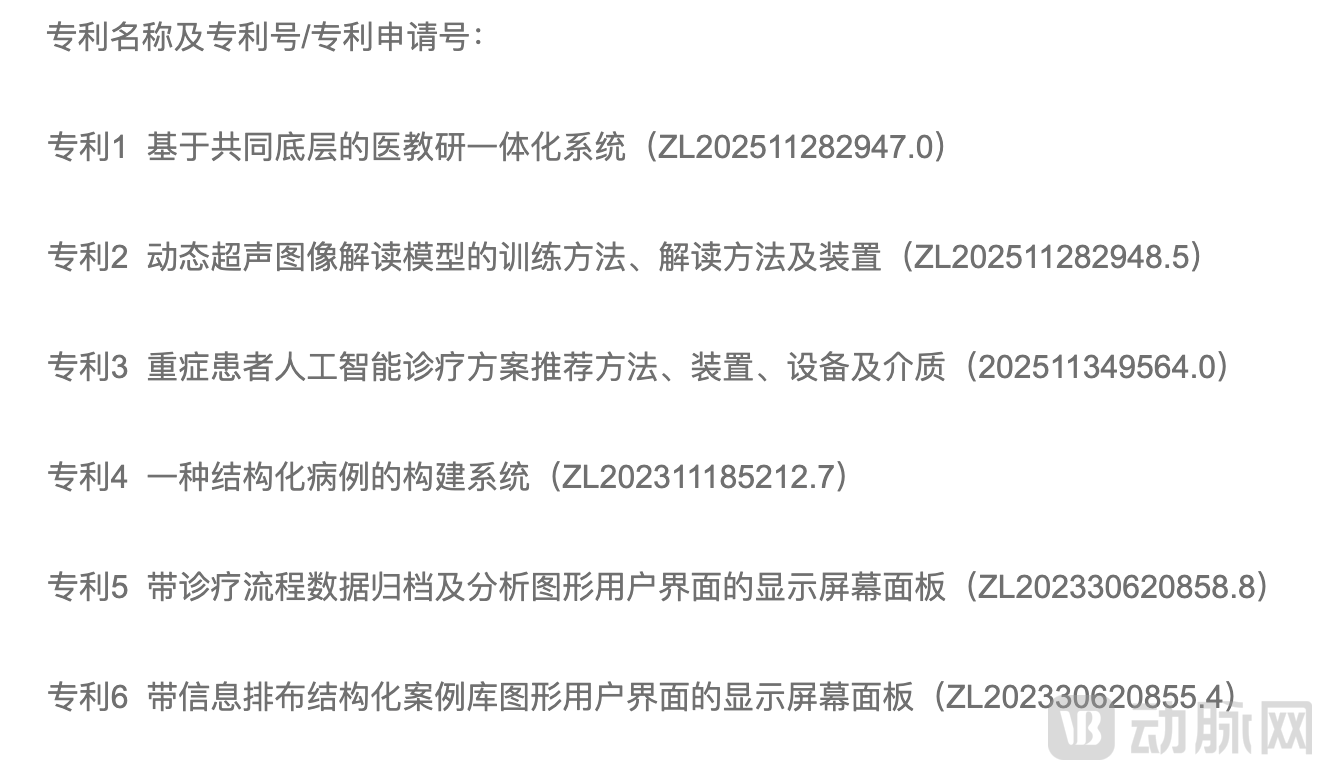
“Integrated Medical, Educational, and Research System Based on a Common Underlying Infrastructure” aims to address the “information silo” problem caused by the current independence of the three major systems—medical care, education, and scientific research—and the lack of data interoperability among them.It integrates clinical diagnosis and treatment data, research cohort data, and teaching case data through a “triune” data engine, forming a closed loop: clinical problem identification → research validation → knowledge updating → feedback to teaching and clinical practice. This lays the foundation for achieving true “data-driven” smart healthcare.
Meanwhile, “A Structured Case Construction System” focuses on addressing the standardization issue at the data source.This patent standardizes case documentation and data collection processes by defining a series of standardized clinical information modules (such as clinical differentiation, critical care ultrasound assessment, and interpretation of pathophysiological phenotypes), thereby significantly enhancing data quality and usability. The two design patents ensure that these systems feature user-friendly and efficient user interfaces.
“Training Method, Interpretation Method, and Device for Dynamic Ultrasound Image Interpretation Models” targets critical care ultrasound, a key technology.Critical care ultrasound (Point-of-Care Ultrasound, POCUS) has become the “new stethoscope” in intensive care units (ICUs) due to its non-invasive, real-time, and bedside-operable characteristics. However, interpreting dynamic ultrasound images requires extensive experience, and significant variability exists among physicians, particularly when performing complex assessments such as cardiac function and hemodynamics. The innovation of this patent lies not merely in simple image recognition, but in a specialized annotation method that integrates “temporal key points,” “dynamic ROI trajectories,” and “logic chain labels.” This approach enables AI models to learn the complete “chain of thought” of experts. Consequently, the AI can not only “interpret” the images but also understand the significance of their temporal changes, outputting dynamic change analysis data based on predefined pathophysiological rules and diagnostic logic. Its stability and accuracy are expected to surpass those of human experts.
“Method, Apparatus, Device, and Medium for Recommending AI-Assisted Diagnosis and Treatment Plans for Critically Ill Patients” directly applies AI capabilities to clinical decision-making.It employs a “dual-safeguard” mechanism: on one hand, it leverages deep learning models to directly recommend diagnostic and treatment plans; on the other hand, it matches similar cases in a large case database to provide solutions based on past successful experiences. When discrepancies arise between the two approaches, both are presented simultaneously for physician reference. This approach not only harnesses the innovativeness of AI but also ensures decision-making safety, offering robust support to less experienced clinicians.
The Department of Critical Care Medicine is one of the most data-intensive, time-sensitive, and technology-dependent clinical specialties, making it a natural ideal scenario for AI applications. From patient monitoring and early warning to multi-organ function support and precision therapy, AI holds immense potential in enhancing the efficiency and quality of critical care.
Meanwhile, the global ultrasound equipment market is projected to maintain rapid growth over the next decade. The integration of AI with ultrasound, particularly in point-of-care ultrasound (POCUS), can effectively empower primary care physicians by enhancing their diagnostic capabilities, thereby serving as a critical approach to addressing imbalances in medical resource distribution. West China Hospital’s portfolio of patents precisely targets these two high-growth sectors.
West China Hospital of Sichuan University’s recent patent implementation license, valued at one million yuan, offers a glimpse into how China’s top-tier hospitals transform clinical needs into innovation momentum. By deeply integrating with industry, they forge cutting-edge artificial intelligence technologies into powerful clinical tools that serve patients.