

Guang Xinchen of Ailian Health: Nursing Care Insurance Poised to Become the Next Phenomenal Health Insurance Product
Recently, Guang Xinchen, Founder and CEO of Ailian Health, was invited to attend the “Kunlun Summit · Molecular Laboratory 2026 Molecular InsurTech Festival,” where he delivered a speech on “The Servitization of Healthcare Payment Services.” Guang Xinchen stated that China currently faces a substantial unmet demand for nursing care services. The shift from mere financial compensation to comprehensive benefits under an “insurance + services” model has become a new pathway for the insurance industry to meet customers’ end-to-end protection needs and achieve high-quality development in health insurance. Consequently, long-term care insurance is poised to become the next blockbuster commercial health insurance product.
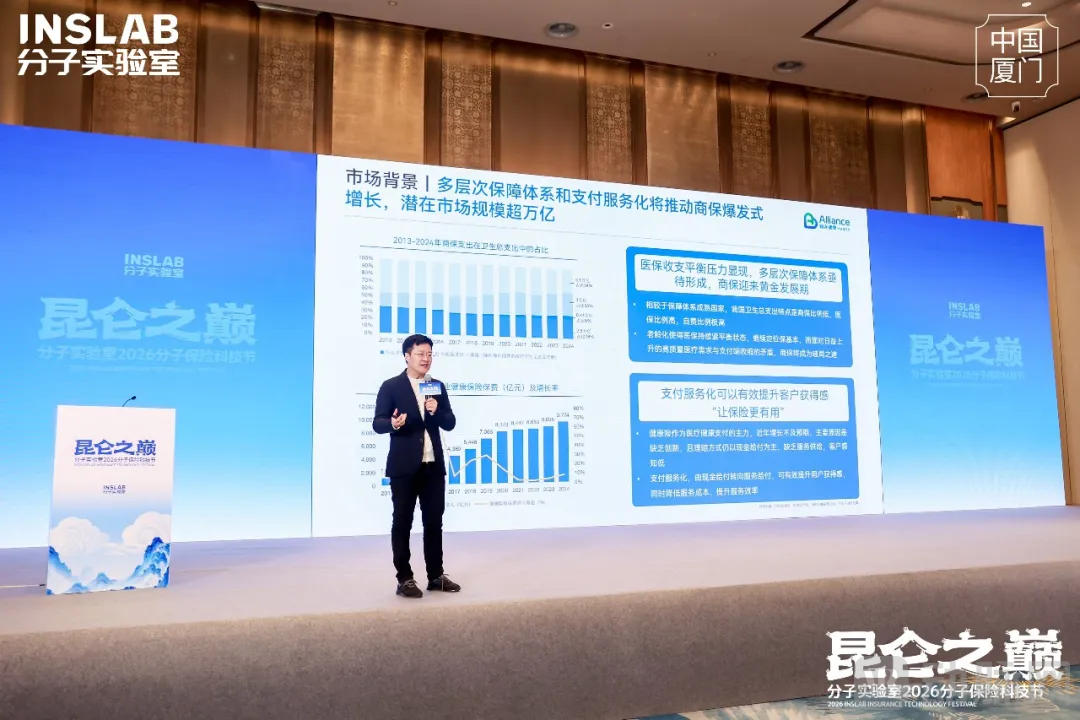
Ailian Health Founder and CEO Guang Xinchen. Image source: Molecular Lab
“Suo You Hu” Bridges the Final Mile of Full-Lifecycle Coverage
As an innovative healthcare payment-as-a-service platform, Ailian Health is committed to driving the insurance industry’s transition from “cash benefits” to “service-based benefits.” This aligns with the transformation path emphasized in the “Guiding Opinions on Promoting High-Quality Development of Health Insurance,” issued by the National Financial Regulatory Administration in September 2025, which calls for health insurance to shift from “indemnity coverage” to “extended services.” The shift from cash benefits to service-based benefits can effectively enhance policyholders’ sense of gain, while reducing service costs and improving service efficiency.
As China’s population aging accelerates, the number of individuals requiring care continues to rise. By 2050, China’s aging rate is projected to reach 38%, with the elderly population exceeding 480 million and average life expectancy reaching 84.9 years. Meanwhile, aging increases the likelihood of disease and accidents; currently, 75% of elderly people in China live with chronic conditions.
Contradicting this trend is the continuous decline in the number of caregivers. On one hand, demographic shifts have resulted in a situation where two young adults are responsible for caring for four elderly individuals. More importantly, population migration has led to children living apart from their parents, making it impossible for them to provide timely care for the elderly.
Guang Xinchen pointed out that in the past, insurance marketing mainly focused on “access to medical care” and “access to elderly care,” safeguarding the baseline of life and health through medical coverage and fulfilling expectations for later years through pension protection. However, “access to medical care” and “access to elderly care” must ultimately culminate in “access to long-term care” to bridge the final “last mile” of full-lifecycle protection. Currently, the biggest gap in China’s commercial insurance market lies in “care.” Therefore, long-term care insurance is the most likely phenomenon-level commercial health insurance product to replace million-yuan medical insurance in the future.
Long-term care insurance primarily drives life insurance business from three levels:
● New Customer Acquisition: Complements million-yuan medical insurance, featuring low premiums, broad coverage, and easy enrollment;
● Additional coverage for existing clients: Fill gaps in current protection to ensure comprehensive support—medical care, retirement income, and long-term care.
● New Hire Retention: For new hires, “clear concepts that are easy to align with, and simple skills that are easy to master”; for customers, “needs that are easy to understand, and affordable prices that make insurance purchase straightforward.”
Ecosystem Collaboration Accelerates Comprehensive Upgrade of the Assurance System
Guang Xinchen emphasized that a successful innovative health insurance product model in the future requires collaboration among all ecosystem stakeholders to form a complete closed loop encompassing the “service supply side (health technology companies) – product side (insurers) – marketing side – client side – underwriting, claims, and service delivery side.”
As a key connector in the industrial ecosystem, Ailian Health leverages an intelligent platform to precisely match insurance customers’ needs with service resources. By employing technologies such as intelligent assessment, digital scheduling, and end-to-end quality monitoring, it ensures the standardization and reliability of service delivery. The company provides its partners with comprehensive solutions spanning product design, operational management, product training, marketing campaign planning, and fulfillment services.
Lian Health, leveraging its leading big data analytics capabilities, has established a fully realized and closed-loop business model. Its nursing services primarily focus on two scenarios: inpatient care and long-term home-based care. The company has successfully built a comprehensive system of benefit-type nursing insurance products, including one-year and multi-year policies. These offerings cover standalone nursing insurance as well as supplementary riders attached to various insurance categories, such as health insurance, group insurance, and auto insurance.
As a technology company, Ailian Health Future also aims to collaborate with its AI subsidiary and robotics firms to develop home care robots, thereby enhancing the “Care Plus Care, Care Plus Medicine, and Care Plus IoT” ecosystem, while strengthening its AI capabilities to enable faster and more efficient service delivery.