

Changping Lab's Chen Mingchen Team Unveils PPIFlow: The First Open-Source Antibody Design Model Achieving Picomolar Affinity
The PPIFlow framework, recently released by Chen Mingchen’s team at Changping Laboratory, successfully generated picomolar (pM)-affinity binders and nanobodies under zero-shot conditions by integrating flow matching generative models with a physics energy-guided “in silico affinity maturation” strategy.
This article provides an in-depth analysis of the algorithmic logic underlying PPIFlow and conducts a rigorous, multi-dimensional comparison with leading closed-source models such as Chai-2, JAM-2, and Latent-X2, exploring the unique value of open-source tools in enhancing the precision and transparency of drug discovery.
I. The “Last Mile” of Computational Design
With breakthroughs in deep learning for protein structure prediction and generation, de novo design of protein binders has become possible. However, molecules generated by existing mainstream methods (such as RFdiffusion) can bind to targets, but their affinity often remains at the micromolar (µM) level.
To achieve the nanomolar (nM) or picomolar (pM) level of affinity required for therapeutic efficacy, it is still generally necessary to rely on costly and time-consuming in vitro experiments (such as yeast display or phage display) for affinity maturation. This discrepancy between computational design and practical application is known as the “Affinity Gap.”
Recently, the team at Changping Laboratory proposed PPIFlow, an integrated computational framework designed to bridge this gap through purely computational means, enabling the direct generation of high-affinity antibodies and protein binders without the need for wet-lab optimization.
II. PPIFlow: Co-evolution of Flow Matching and Physical Energy
PPIFlow is not a single generative model, but rather a systematic framework encompassing generation, optimization, and screening.
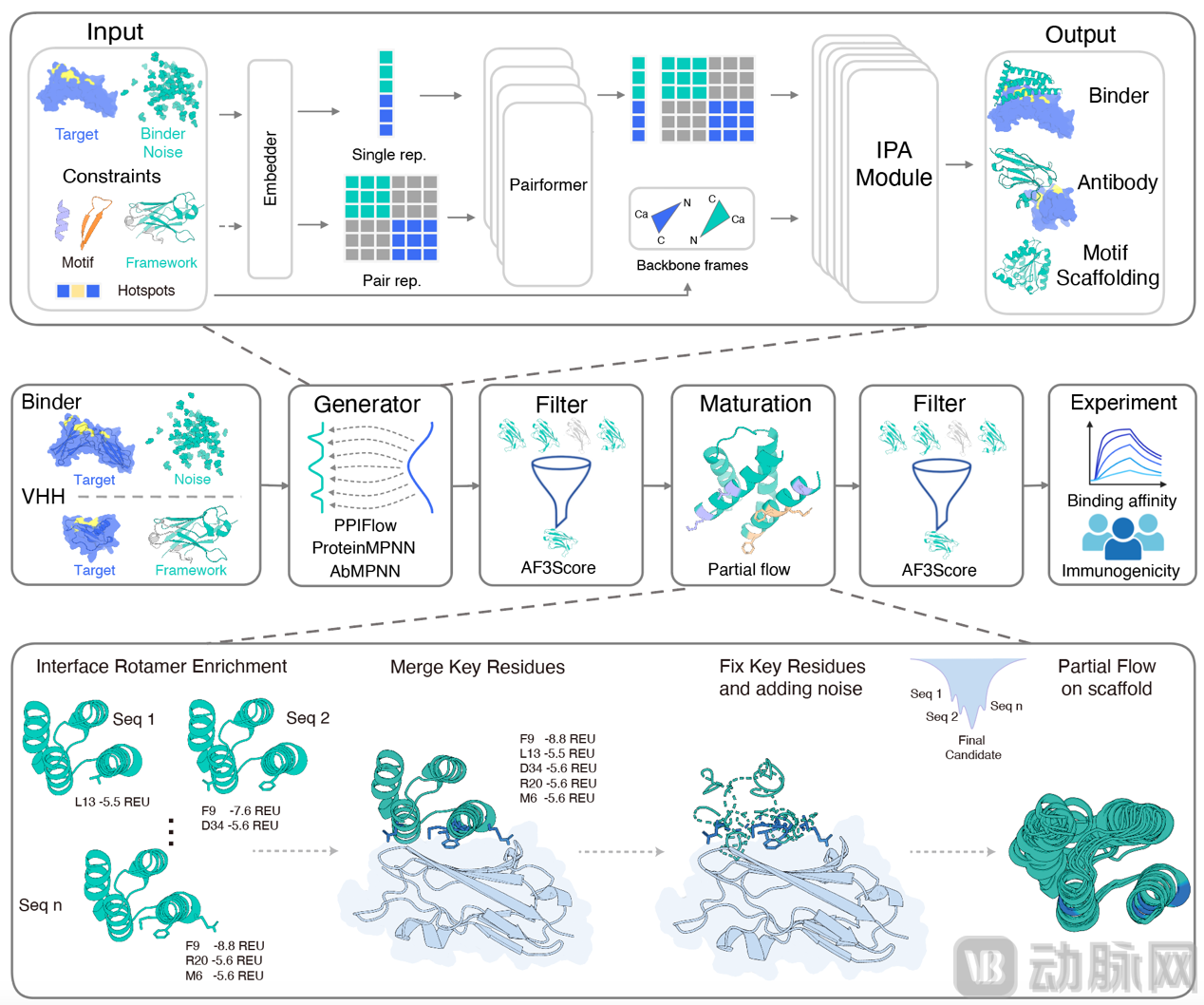
The key to achieving high affinity lies in two critical technological innovations:
1. Backbone Generation Based on Flow Matching
Unlike diffusion models, PPIFlow employs SE(3) Flow Matching technology. This model leverages the Pairformer architecture to explicitly reason about geometric and chemical interactions between residue pairs, modeling rigid-body transformations of the protein backbone as a continuous flow.
Compared with diffusion models, flow matching demonstrates advantages in training stability and sampling efficiency, enabling more precise structure generation constrained by interface conditions.
2. In Silico Affinity Maturation
This is the key step that distinguishes PPIFlow from other models, aiming to simulate the affinity maturation process in vivo. This strategy consists of two stages:
● Interface Key Amino Acid Residue Enrichment (Interface Rotamer Enrichment): Utilizing the Rosetta physical energy function to precisely identify “anchor” residues with optimal energy (< -5 REU) at the binding interface.
● Partial Flow Refinement: Fix the aforementioned key anchor points, introduce noise to the remaining backbone regions, and revert to the intermediate flow state for regeneration.
This strategy allows the backbone to fine-tune interface packing while maintaining key interactions, thereby escaping local optima, resolving steric hindrance, and achieving atomic-level tight complementarity.
Furthermore, to address the issue of screening efficiency, the research team employed AF3Score, the “score-only” version of AlphaFold 3. This approach enhanced computational efficiency by approximately 100-fold while maintaining high-fidelity structural evaluation, thereby enabling large-scale computational screening.
3. Experimental Validation: Picomolar-Level Breakthrough in Zero-Shot Settings In wet-lab validation against 15 therapeutic targets, PPIFlow demonstrated exceptional performance:
Thirty samples per target were submitted for wet-lab validation. In mini-protein generation, the PPIFlow model achieved picomolar (pM)-level affinity for 6 out of 7 targets.
In terms of nanobody design, binding ligands were successfully obtained for 7 out of 8 targets, with several achieving picomolar (pM) to nanomolar (nM) affinity. The VHH Kd values for 4 targets fell within the single-digit nM range. These success rates match or even surpass those of three closed-source models from overseas.
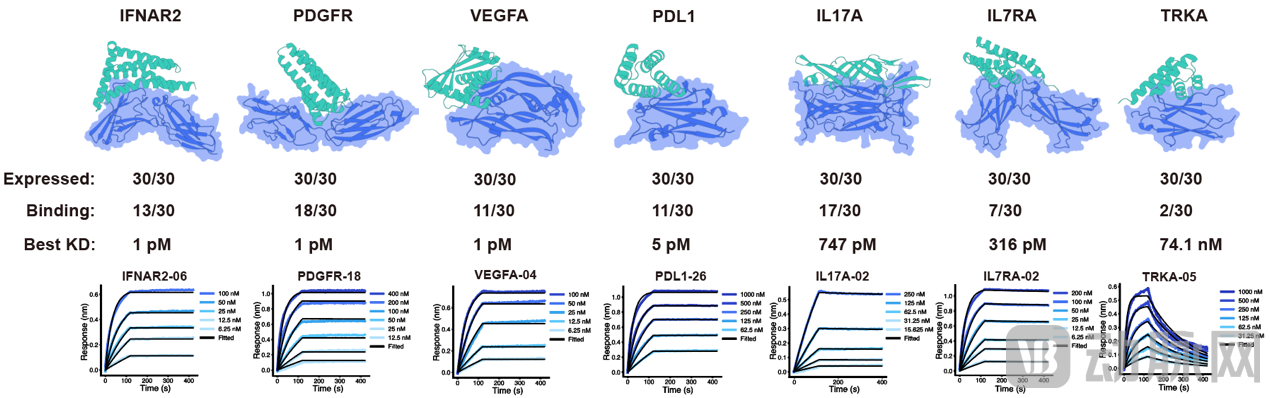
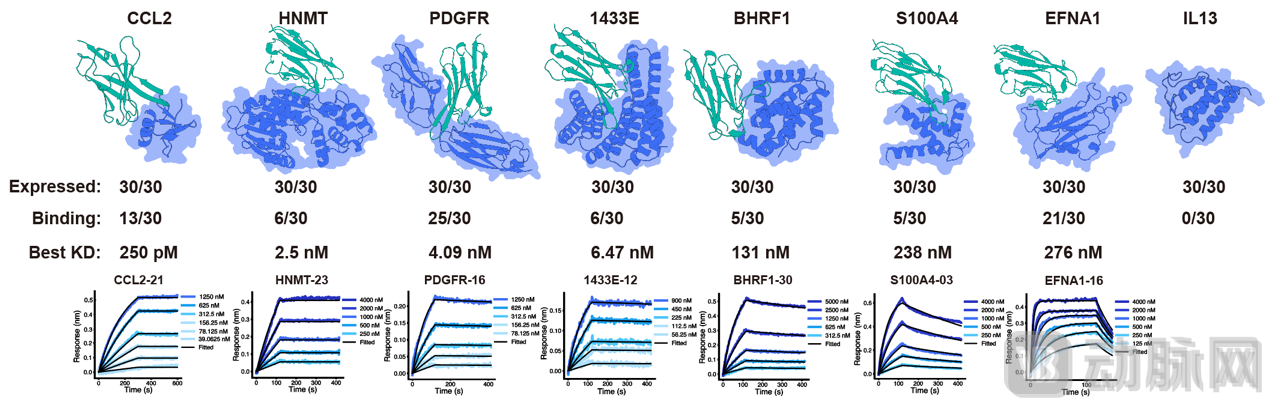
● Unparalleled Affinity: Without in vitro optimization, the affinity of minibinder proteins targeting IFNAR2, PDGFR, VEGFA, and PD-L1 reached within 10 pM; the affinity of nanobodies (VHH) designed against CCL2 reached 250 pM.
● High Success Rate: The overall hit rate (< 1 µM) of mini-binders was 36.2%, while that of VHH antibodies was 33.8%.
III. Horizontal Evaluation: Comparison Between the Open-Source Model PPIFlow and Proprietary Commercial Models
To objectively assess the technical standing of PPIFlow, the team conducted a scientific comparison with three recently released top-tier proprietary commercial models—Chai-2 (Chai Discovery), JAM-2 (Nabla Bio), and Latent-X2 (Latent Labs)—across five core dimensions.
1. Affinity
● PPIFlow: By incorporating physicochemical features for refinement, PPIFlow demonstrates exceptional performance in achieving upper-bound affinity. Its generated miniprotein binders for IFNAR2, PDGFR, VEGFA, and PD-L1 (<10 pM) and CCL2 VHH (250 pM) demonstrate that purely computational approaches can match or even surpass the “zero-shot” affinity levels of certain commercial models.
● Latent-X2: Also demonstrated exceptionally high affinity, with its HDAC8-targeting scFv achieving 26.2 pM and its PHD2-targeting macrocyclic peptide reaching 1.54 nM.
● JAM-2: Achieved picomolar (pM) or single-digit nanomolar (nM) affinity at half of the tested targets (e.g., PRL < 100 pM).
● Chai-2: Miniproteins can achieve picomolar (pM) affinity, but antibody designs typically exhibit nanomolar (nM) affinity (e.g., 2.2 nM – 17 nM).
● Conclusion: PPIFlow ranks among the top-tier commercial models in terms of affinity metrics, particularly leveraging a strategy that integrates physics-based energy optimization, which confers unique advantages in fine-grained structural refinement.
2. Success Rate & Efficiency
● JAM-2: Demonstrates exceptional robustness. It achieved a 100% target success rate across 16 novel targets, with an average sequence hit rate of 39% for the VHH-Fc format.
● PPIFlow: The target hit rate for VHH design was 7/8, and the binding hit rate for all 240 VHHs was 33.8%, comparable to JAM-2. Its advantage lies in achieving ultra-low-cost computational screening by integrating AF3Score.
● Latent-X2: Extremely high sample efficiency, requiring only 4–24 designs per target to identify hits, with a target success rate of 50%.
● Chai-2: In large-scale validation against 52 targets, the average hit rate of antibody design was approximately 16%.
● Conclusion: PPIFlow achieves a higher sequence hit rate than Chai-2 and performs comparably to JAM-2, demonstrating the efficiency of its generation strategy.
3. Target Breadth and Difficulty (Target Scope)
● JAM-2: Achieved significant breakthroughs in the design of membrane proteins (GPCRs), successfully targeting the orthosteric sites of CXCR4/CXCR7.
● Latent-X2: Its unique advantage lies in its macrocyclic peptide design capability, successfully overcoming the challenge of targeting intracellular proteins (such as K-Ras).
● Chai-2: Validated the most extensive target set (52 targets) and demonstrated cross-species cross-reactivity design capabilities.
● PPIFlow: Currently, validation has primarily focused on soluble therapeutic targets. Although validation data for specific high-difficulty targets (such as GPCRs) are less extensive than those for JAM-2, its general architecture provides a foundation for community-driven secondary development tailored to specific targets.
4. Open Source & Accessibility: This is PPIFlow’s greatest differentiating advantage.
● Chai-2/JAM-2/Latent-X2: All are commercially closed-source or restricted-access models.
● PPIFlow: Fully open source. The code and related sequence experimental data have been made publicly available on GitHub.
This means that researchers worldwide can not only utilize this tool but also delve into the underlying mechanisms of its “simulated maturation” and make improvements based on these insights. For the academic community, this represents a critical step toward the democratization of technology.
IV. Summary and Outlook
Changping Laboratory’s PPIFlow marks a solid step forward in antibody discovery, transitioning from “random screening” to “rational design.”
Compared with leading commercial models such as Chai-2, JAM-2, and Latent-X2, PPIFlow has demonstrated comparable capabilities in terms of binding affinity accuracy and design success rate.
More importantly, the open-source nature of PPIFlow has broken down the technical barriers to high-affinity antibody design. It demonstrates that key pain points in the biopharmaceutical industry can be addressed through sophisticated algorithmic design—specifically, flow matching combined with energy-guided simulated affinity maturation—without relying on massive proprietary datasets or computational resource moats.
This provides the entire protein design community with a transparent, reproducible, and high-performance infrastructure, poised to accelerate the discovery of innovative drug molecules.
Open-source code:
https://github.com/Mingchenchen/PPIFlow
Open-source paper:
https://www.biorxiv.org/content/10.64898/2026.01.19.700484v1
* References:
1.High-Affinity Protein Binder Design via Flow Matching and In Silico Maturation (Changping Laboratory)
2.Chai-2: Zero-shot antibody design in a 24-well plate (Chai Discovery)
3.JAM-2: Fully computational design of drug-like antibodies with high success rates (Nabla Bio)
4.Drug-like antibodies with low immunogenicity in human panels designed with Latent-X2 (Latent Labs)
5. nest.bio Member | Chen Mingchen’s Team Globally Launches PPIFlow, an Open-Source Platform for Designing High-Affinity Protein & Antibody Binders