

Bangshun Pharma Files for HKEX IPO with RMB 2.387 Billion Valuation, Advancing Two Near-Commercial Oral Small Molecule Drug Candidates

BIOSUN PHARMA
Innovative Drug Developer

Huadong Medicine
Large Comprehensive Pharmaceutical Product Developer
On January 22, Hangzhou BIOSUN PHARMA Co., Ltd. (“BIOSUN PHARMA”) formally filed its prospectus with the Main Board of the Hong Kong Stock Exchange, with China Securities International acting as the sole sponsor.
BIOSUN PHARMA was established in 2020 and is aApproaching the Commercialization Stagepharmaceutical company,Focused on the R&D of oral small-molecule drugs in the fields of oncology and autoimmune diseases.It has established a highly selective small-molecule drug discovery platform and a molecular glue discovery platform, with a pipeline comprising one New Drug Application (NDA)-stage candidate (bezexitinib), one registrational clinical-stage candidate (CX1440), and five preclinical-stage candidates (CX03, CX12, CX13, CX15, and CX16).
The primary use of the proceeds from this IPO by BIOSUN PHARMA is to support the company’s transition from the R&D stage to the commercialization stage, facilitate product launches, and achieve sustainable development:
① Clinical trials and regulatory filings: Conduct clinical trials for bezexertinib and CX1440, including preparation for related regulatory filings, to accelerate product approval and market launch. ② Preclinical research and future clinical development: Carry out preclinical studies and plan future clinical development for candidate drugs (such as CX15 and CX16) to expand the product pipeline. ③ Commercialization preparation: Establish a commercialization team and conduct marketing and promotional activities to prepare for post-launch market promotion and sales. ④ Production facility construction: Build manufacturing plants, auxiliary buildings, and install production equipment to meet commercial production demands and ensure supply chain stability. ⑤ Working capital and general corporate purposes.
“Spun off” from Huadong Medicine
BIOSUN PHARMA was founded in Hangzhou, Zhejiang Province in 2020 and shares deep historical ties with Huadong Medicine, which also originated in Hangzhou, Zhejiang.
First, the founder and core R&D members of BIOSUN PHARMA all previously worked at the New Drug Research Institute of Huadong Medicine Group.
For example, Lü Yubin, Co-founder, Chairman, and General Manager of BIOSUN PHARMA, previously served as Dean and General Manager of the New Drug Research Institute at Huadong Medicine. He spearheaded the development and market launch of dozens of innovative drugs and first-to-market generics for oncology, metabolic diseases, and infectious diseases, with multiple projects receiving support from national major science and technology special programs, including the “Major New Drug Development” special project. Zheng Mei, Deputy General Manager of BIOSUN PHARMA, formerly worked as a Synthesis Researcher and Manager of the Second Development Department at the New Drug Research Institute of Huadong Medicine, where she was responsible for product R&D, project initiation, and overall project development management. Qing Yali, Deputy General Manager of BIOSUN PHARMA, previously served as an R&D Scientist and Manager of the Registration Management Department at the New Drug Research Institute of Huadong Medicine, overseeing the R&D of sirolimus, acarbose, and everolimus, as well as drug registration and quality management.
Second, Li Bangliang, a key controller of BIOSUN PHARMA (who currently holds approximately 31.25% of the company’s shares through multiple enterprises), was once a pivotal leader in the development history of Huadong Medicine.From 1972 to 1992, Li Bangliang worked at Hangzhou Huadong Pharmaceutical Factory, serving successively as workshop director, section chief, office director, deputy factory director, and factory director. He subsequently served as Chairman and General Manager of Huadong Medicine Co., Ltd. from 1993 to 2016, and as Chairman of Huadong Medicine Co., Ltd. from 2016 to 2019, leading the company to become one of the first listed pharmaceutical enterprises in China to undergo strategic transformation.
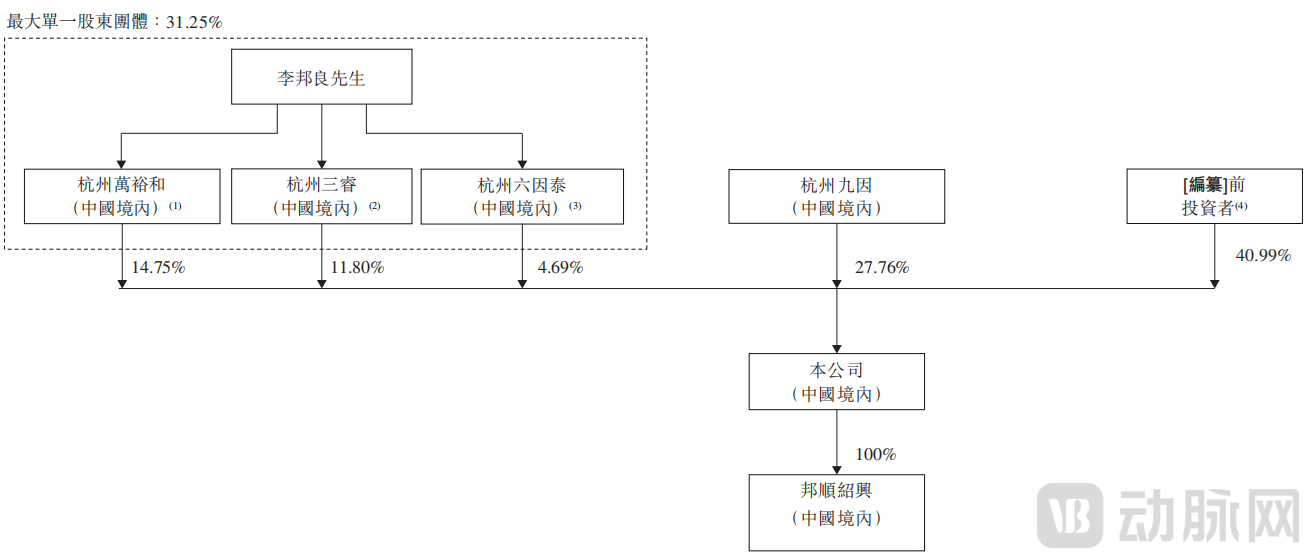
Current Shareholding Structure of BIOSUN PHARMA, Source: Prospectus
Li Bangliang earned his bachelor’s degree in Rocket Manufacturing from Nanjing University of Science and Technology (formerly known as East China Institute of Technology) in 1968. Over the decades, he has been widely acclaimed for his contributions to China’s pharmaceutical industry. In April 1999, he was awarded the National May 1st Labor Medal by the All-China Federation of Trade Unions. In April 2000, he was conferred the title of “National Model Worker” by the State Council. In October 2002, he was named “China’s Master of Business Management” by the Development Research Center of the State Council and China Tertiary Industry Magazine. From 2003 to 2007, he served as a deputy to the 10th National People’s Congress, where he spearheaded the drafting and proposal of the Employment Promotion Law. From 2008 to 2017, he served as a deputy to the 11th and 12th Zhejiang Provincial People’s Congresses, contributing to the formulation of local economic and industrial development policies. In August 2019, he was honored with the Commemorative Medal for the 70th Anniversary of the Founding of the People’s Republic of China, jointly awarded by the Central Committee of the Communist Party of China, the State Council, and the Central Military Commission of the Communist Party of China, in recognition of his lifelong dedication and contributions to the national pharmaceutical industry and public welfare endeavors.
It is evident that prior to the establishment of BIOSUN PHARMA, Li Bangliang and the R&D team led by Lv Yubin had long maintained a professional collaboration in the field of drug research and development and innovation through the New Drug Research Institute of Huadong Medicine. Notably,The patent rights to BIOSUN PHARMA’s core products, bezetraptinib and CX1440, were also acquired through assignments from several entities controlled by Huadong Medicine’s New Drug Research Institute. The two companies maintain deep collaboration in terms of both key personnel and R&D pipelines. However, from an equity structure perspective, both enterprises are independent legal entities with no direct controlling relationship, maintaining independent decision-making and operational frameworks.
# Core Product’s Clinical Progress Ranks First Globally
Under the team’s leadership, BIOSUN PHARMA has established two proprietary drug discovery platforms: a highly selective small-molecule drug discovery platform and a molecular glue drug discovery platform. Leveraging these technological platforms, BIOSUN PHARMA has developed a pipeline comprising one candidate drug at the New Drug Application (NDA) stage (bezexitinib), one candidate drug in registrational clinical trials (CX1440), and five preclinical candidate drugs (CX03, CX12, CX13, CX15, and CX16).
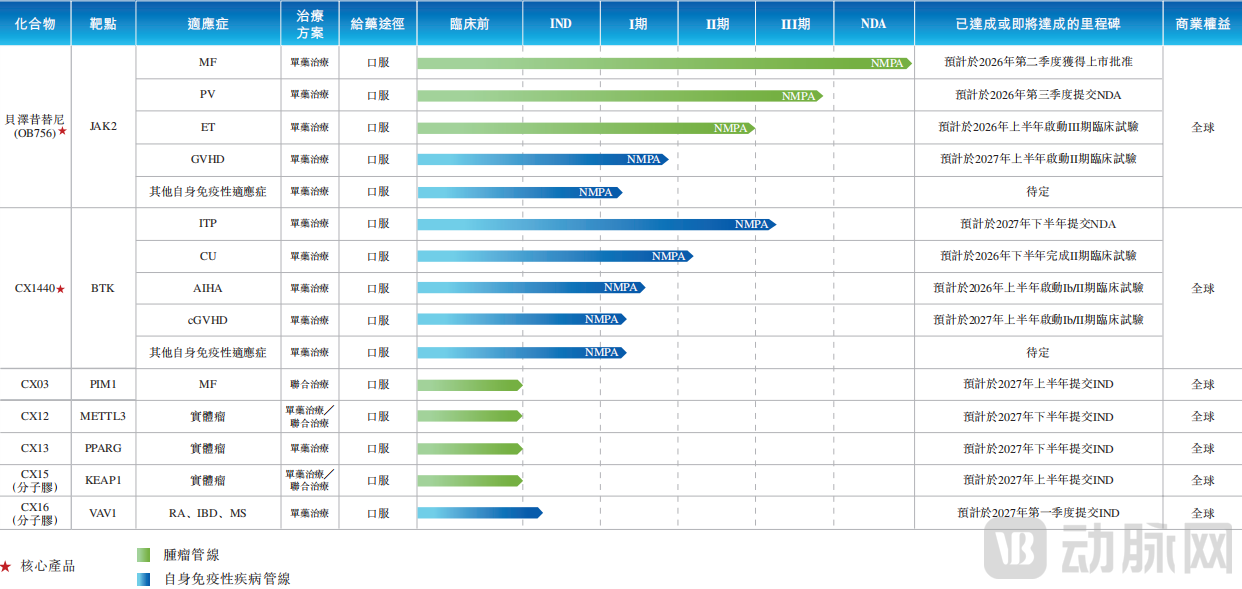
BIOSUN PHARMA’s Pipeline Under Development, Source: Prospectus
Centered on AI-enabled structure-based drug design (SBDD), the platform leverages advanced computational methods to prospectively enhance potency, selectivity, pharmacokinetic properties, and safety through multi-parameter optimization. Its key advantage lies in the precise engineering and rigorous validation of molecular selectivity, significantly reducing the risk of off-target effects during the early discovery phase.
Leveraging its highly selective small-molecule drug discovery platform, BIOSUN PHARMA has successfully developed multiple candidate drugs with high target selectivity and favorable safety profiles, including its core products, bezexertinib and CX1440.
Among them, bezelitinibIt is a highly selective JAK2 inhibitor. Preclinical kinase activity assays demonstrated that bizecitinib exhibits 5- to 55-fold greater selectivity for JAK2 over other JAK kinases. Although most existing JAK inhibitors have been developed primarily for autoimmune diseases, BIOSUN PHARMA has adopted a differentiated strategy by focusing the development of bizecitinib on myeloproliferative neoplasms (MPNs), a disease area with unmet clinical needs and limited treatment options.
It boasts the most extensive coverage in this field: multiple clinical trials of bizebrutinib have been conducted in myeloproliferative neoplasm (MPN) diseases, including myelofibrosis (MF), polycythemia vera (PV), and essential thrombocythemia (ET). The results demonstrate that bizebrutinib exhibits favorable efficacy and safety profiles across these indications, supporting its potential to become a best-in-class therapy. Beyond MPNs, bizebrutinib may hold further development potential in other diseases driven by abnormal activation of the JAK-STAT signaling pathway, including indications with significant unmet medical needs such as graft-versus-host disease (GVHD).
Maintains a global lead in clinical progress: In August 2024, BIOSUN PHARMA submitted the first New Drug Application (NDA) to the Center for Drug Evaluation for bezexitinib in the treatment of myelofibrosis (MF), with regulatory approval expected in the second quarter of 2026. According to Frost & Sullivan data, this product is poised to become one of the first three domestically produced JAK inhibitors approved in China for the treatment of myelofibrosis (MF). In terms of clinical progress, bezexitinib is the leading JAK inhibitor in China for the treatment of polycythemia vera (PV) and ranks first globally for the treatment of essential thrombocythemia (ET).
Another core product, CX1440, is also on the verge of commercialization.Its Phase III clinical trial for the treatment of immune thrombocytopenia (ITP) has been initiated, with the New Drug Application (NDA) for this indication expected to be submitted in the second half of 2027. It is a BTK selective inhibitor with best-in-class potential.
BIOSUN PHARMA has also adopted a differentiated strategy regarding the indications for CX1440. Currently, the development of multiple BTK inhibitors that are either marketed or in late-stage clinical trials primarily focuses on B-cell lymphomas. Leveraging the molecular properties and differentiated selectivity profile of CX1440, BIOSUN PHARMA has strategically focused its R&D efforts on autoimmune diseases. To date, the company has initiated clinical studies of CX1440 for four autoimmune indications. In terms of clinical progress, CX1440 ranks among the top three BTK inhibitors globally for the treatment of immune thrombocytopenia (ITP), and among the top two globally for the treatment of chronic urticaria (CU) and autoimmune hemolytic anemia (AIHA).
This platform addresses the fundamental limitations of traditional small-molecule drug discovery, particularly the challenge of modulating disease-related proteins that are refractory to conventional inhibition or binding strategies. By inducing target protein degradation via proximity-based mechanisms, molecular glues offer a differentiated solution capable of engaging traditionally “undruggable” targets and accessing disease-modifying mechanisms beyond the reach of traditional therapeutic modalities. The platform integrates rational molecular design based on ternary complex formation, off-target risk prediction, and optimization of degrader-like drug properties. Leveraging a multidimensional evaluation system encompassing degradation efficiency, selectivity, pharmacokinetics, and safety, this platform transforms molecular glue discovery from a serendipitous endeavor into a predictable and design-driven process.
Leveraging this platform, BIOSUN PHARMA has advanced preclinical candidate drugs including CX15 (a covalent allosteric molecular glue degrader) and CX16 (a CRBN-recruiting degrader, which has currently entered the IND-enabling study phase).
To enhance the R&D efficiency of candidate drugs, BIOSUN PHARMA has established not only a drug discovery platform but also in-house clinical development capabilities.For example, in terms of end-to-end clinical management, BIOSUN PHARMA has established a comprehensive clinical management system covering the entire cycle of clinical development, encompassing all stages from protocol design to regulatory submission, thereby accelerating its clinical progress. The company’s efficient clinical execution capability has been demonstrated in the bezelertinib pipeline: during the development of this pipeline, BIOSUN PHARMA advanced from obtaining ethical approval for the Phase I trial in myelofibrosis (MF) to completing patient enrollment in the Phase III trial.It took only about two years and ten months, whereas other JAK inhibitors for the same indication took approximately five years.
Loss of RMB 179 Million in 9 Months
BIOSUN PHARMA’s technology and differentiated pipeline have gained recognition from multiple institutions. Since its establishment, the company has undergone multiple rounds of financing, raising a total of approximately RMB 800 million. Investors include Shenzhen Capital Group, Puhua Capital, Dongwu Innovation Capital, West Lake Innovation Investment, Huiding Investment, Binhai Industrial Fund, Yuhang State-owned Capital, Datai Yikai, and Huarui Ruiyin, among others. In December 2025, BIOSUN PHARMA completed its Series C financing round of RMB 87 million, reaching a post-money valuation of RMB 2.387 billion.
As BIOSUN PHARMA currently has no products approved for commercial sale, it does not generate any revenue from product sales. Consequently, the company reported losses of RMB 88.444 million, RMB 66.336 million, and RMB 179.4 million for the year 2024 and the nine months ended September 30, 2024 and 2025, respectively. As of September 30, 2025, BIOSUN PHARMA held cash and cash equivalents amounting to RMB 158 million.
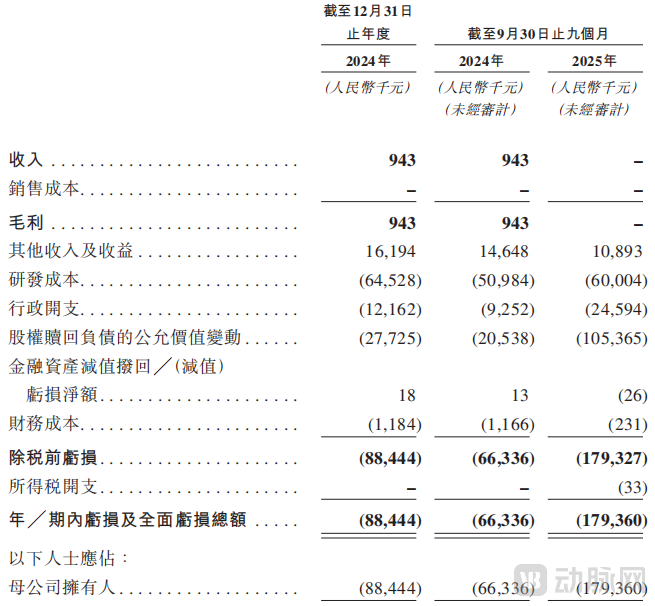
BIOSUN PHARMA Income Statement, Source: Prospectus
These losses were primarily attributable to its research and development (R&D) costs and administrative expenses. Specifically, BIOSUN PHARMA’s R&D costs amounted to RMB 64.528 million in 2024, and RMB 50.984 million and RMB 60.004 million for the nine months ended September 30, 2024 and 2025, respectively. The increase in R&D costs was mainly driven by the clinical development of drug candidates, particularly its core products, bezetrexib and CX1440.
Regarding its future business operations and financial performance, BIOSUN PHARMA stated that these depend on the Company’s ability to successfully advance its drug development programs, demonstrate satisfactory safety and efficacy outcomes in clinical trials, obtain necessary regulatory approvals, ensure adequate production capacity, and commercialize its products in target markets as planned. It is anticipated that Chinese innovative pharmaceutical companies, represented by BIOSUN PHARMA, will enter the international capital markets, accelerate the commercialization of core products and the development of their subsequent pipelines, consolidate their leading position in small-molecule innovative drugs for oncology and autoimmune diseases, and open pathways for investors to share in the high-growth dividends of China’s innovative pharmaceutical sector.