

Alibaba Health's AI Product 'Hydrogen Ion' Launches 'Dynamic Evidence Localization' Feature, Bringing 'Living Evidence' to Every Medical Query

AliHealth
Medical and Health Services Network Service Provider
On January 26, AliHealth’s medical AI application “Hydrogen Ion” rolled out a key version update, launching the new “Dynamic Evidence Localization” feature. This feature precisely identifies the specific sentences in the source text that directly support the stated viewpoints, while simultaneously verifying their timeliness, authority, and logical consistency. It effectively upgrades the previous approach of “vaguely citing a passage” in AI responses to “pinpointing exactly which sentence is credible, why it is trustworthy, and whether it remains valid at present.”
In clinical and research decision-making, physicians’ trust in AI has never been solely about “whether a source exists,” but rather “whether that source remains valid at this moment.” The core of the dynamic evidence localization feature lies in upgrading the industry-standard “static citations” into evolvable “living evidence.” Traditional approaches rely on static knowledge bases, retrieving relevant passages through keyword matching. This method only addresses the spatial localization of “where it comes from,” but fails to determine whether the content is outdated or the evidence is reliable, making it difficult to assess whether the underlying basis remains valid and trustworthy.
Hydrogen Ion has systematically resolved this industry challenge through its proprietary “Three-Dimensional Evidence-Based Architecture” technical framework. In its intelligent Q&A functionality, it is the first to integrate timeliness (When) and authority (Quality) into its citation logic. By performing daily updates and intelligent screening of global guidelines and literature, it ensures that every response is consistently grounded in the most current and reliable medical evidence.
For example, when a user searches on H2 Search for “What are the primary endpoint (ORR, PFS, OS) data from the Phase II clinical trials of erdafitinib?”, the system not only provides structured medical conclusions and analyses but also annotates each conclusion with citation tags. Clicking on these tags allows users to view the original literature and specific supporting statements cited for each conclusion. This seamless traceability from conclusions to evidence ensures that every citation is verifiable and credible.
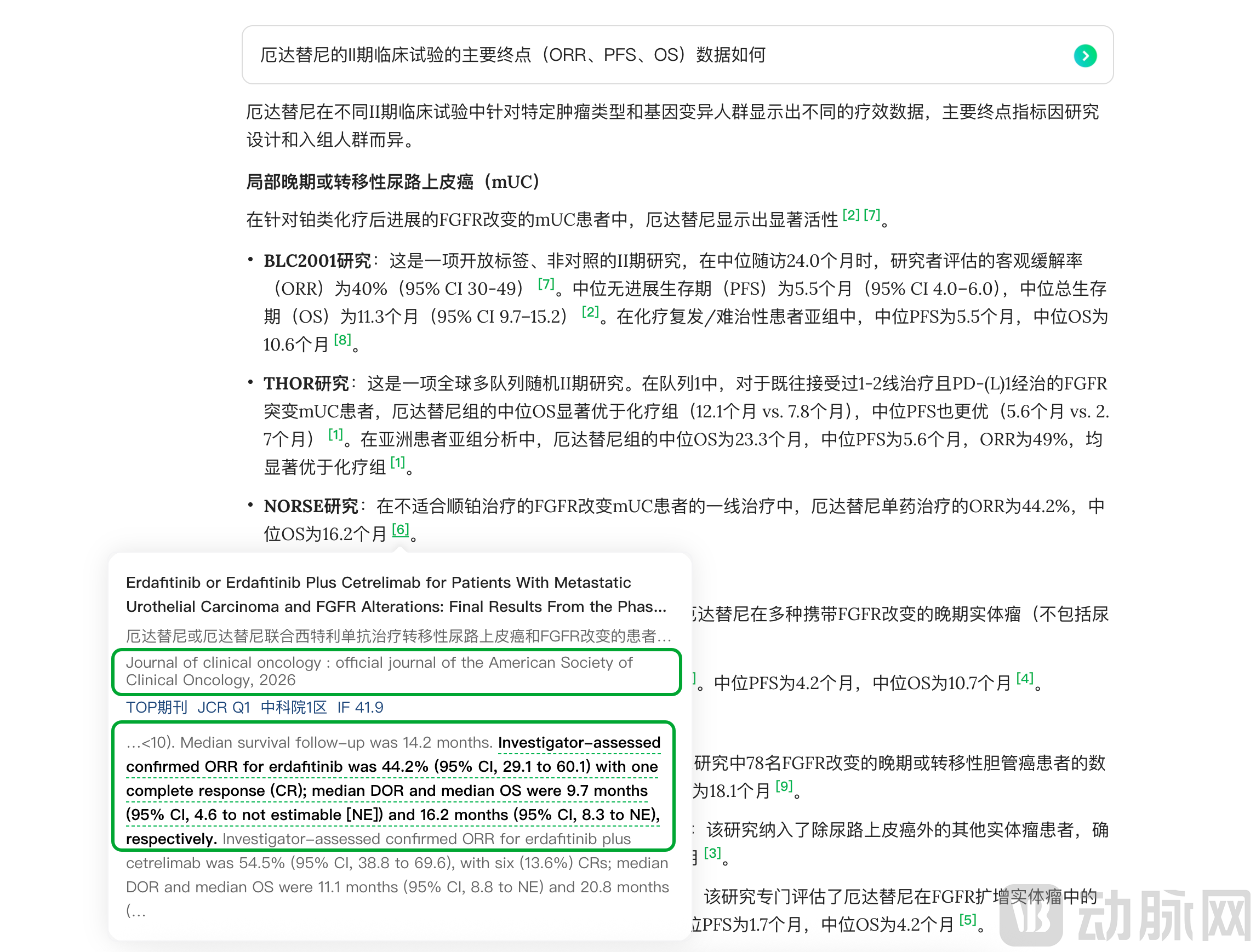
“The core objective of this technology is to ensure that physicians can truly trust and confidently utilize it.” According to the product’s person in charge, “The system updates and screens global authoritative guidelines and literature on a daily basis, ensuring that the presented content always remains within the valid window of current medical consensus. Meanwhile, we apply authority-based weighting to hundreds of millions of data points worldwide, thereby minimizing interference from low-quality information at the source. What is ultimately delivered to users is not coarse-grained paragraph citations, but precisely extracted key statements that substantiate the conclusions.”
For clinical practice and scientific research, this signifies a significant reduction in the cost of information verification. Physicians no longer need to pause their decision-making to consult original literature, as AI has already performed a triple validation of “current validity, source authority, and logical soundness.” As one user remarked, “We now feel confident adopting AI-generated responses because the evidence provided is not merely a one-click link back to a specific paragraph, but rather a dynamic and verifiable evidence localization.”