

Zhejiang University to Transfer RAFT Emulsion Polymerization Technology Package for RMB 3.6 Million
Recently, Zhejiang University released a public notice on patent transfer, proposing to transfer its developed“An OCA Optical Pressure-Sensitive Adhesive and Its Preparation Method”Five achievements were transferred through listed trading, with a transaction amount of3.6 million yuan.
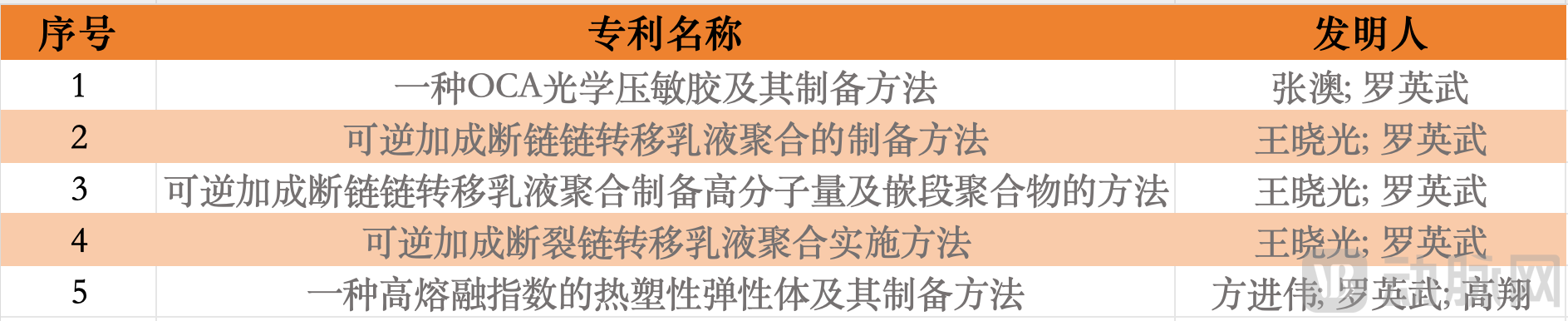
Five Patent Titles
All five patents transferred in this transaction revolve aroundReversible Addition-Fragmentation Chain Transfer (RAFT) Emulsion Polymerization Technologyexpansion, with the core commonality lying inAmphiphilic Macromolecular Chain Transfer AgentAs key materials, they do not require additional traditional emulsifiers. By precisely controlling reaction conditions, polymers with controllable molecular weights and narrow distributions are achieved. These materials feature simple processes, low energy consumption, environmental friendliness, and strong suitability for industrialization, making them widely applicable in fields such as chemical engineering, electronics, display devices, and polymer materials. This technology transfer will provide core preparation technology support to related industries, demonstrating strong industrial application orientation and value for technological commercialization.
From the perspective of the application logic of aggregation technology,Emulsion PolymerizationandReversible Addition-Fragmentation Chain Transfer (RAFT) TechnologyThe combination is an important direction for achieving the preparation of high-performance polymers. Emulsion polymerization, with water as the dispersion medium, has natural advantages such as efficient heat transfer, low system viscosity, and environmental friendliness. Additionally, the radical isolation effect can simultaneously ensure a high reaction rate and high molecular weight products.
Meanwhile, RAFT technology, with its broad monomer applicability and controllable polymerization process, enables precise regulation of polymer molecular weight and molecular structure. The integration of these two approaches is expected to yield high-quality emulsion products with controlled molecular weight, narrow molecular weight distribution, high colloidal stability, and no residual traditional emulsifiers.
However, in actual industrial exploration, this technological integration has consistently faced core contradictions, with the industry long plagued by multiple pain points.
First, insufficient polymerization controllability,Polymer molecular weights tend to deviate from design values and exhibit broad distributions, resulting in poor consistency of product performance and failure to meet the precision requirements for high-end materials;2. Imbalance in System Stability, the emulsifiers relied upon in traditional emulsion polymerization can impair the film-forming properties of the product, while soap-free polymerization systems struggle to balance polymerization controllability with emulsion stability, often leading to coagulation and phase separation during the reaction;Third, production efficiency is relatively low.Existing technologies generally suffer from prolonged inhibition periods and insufficient monomer conversion. For instance, in the batch emulsion polymerization of styrene using poly(ethylene oxide) macromolecular RAFT agents, the conversion reaches only 66.7% within 22.7 hours, which severely compromises the economic viability of large-scale production.
Therefore, existing technical solutions have numerous flaws in both design and implementation, specifically manifested at the following levels:
First,Unreasonable reagent design,Some amphiphilic macromolecular RAFT agents require the addition of an alkaline solution for neutralization to achieve dissolution due to an imbalance in the ratio of hydrophilic to hydrophobic segments. This results in an aqueous phase pH ≥ 5.5, leading to uncontrolled molecular weight and broadened molecular weight distribution. In contrast, small-molecule RAFT agents exhibit poor compatibility with emulsion polymerization systems; increasing the target molecular weight leads to broader distribution, while using agents with low chain transfer constants fails to produce products with narrow molecular weight distributions.
Second,The operational process is complex,Although the "starved-feed" method for emulsion polymerization can provide a certain degree of control over the polymerization process, its cumbersome procedure makes it unsuitable for industrial-scale mass production. Some approaches also require auxiliary agents, such as cyclodextrins, to facilitate the migration of RAFT agents, resulting in high operational costs and limited efficacy.
Thirdly,Balancing Performance and Efficiency Is Challenging, When existing technologies employ amidated RAFT agents for the emulsion polymerization of styrene, although the emulsion stability is relatively good, the molecular weight distribution exceeds 1.70; when neutralized amphiphilic macromolecular RAFT agents are used, the product readily forms a core-shell structure, but the molecular weight deviates from the theoretical value.
Furthermore, most protocols suffer from slow reaction kinetics, prolonged inhibition periods, and low final conversion rates, while the emulsions are prone to coagulation, failing to meet the core industrial requirements for high efficiency and stability.
The five patents transferred in this transaction revolve around reversible addition-fragmentation chain transfer (RAFT) emulsion polymerization technology, establishing a complete and synergistic technical system. WithCore Reagent Optimization, Key Process Innovations, and Expanded Functional ApplicationsBy deeply integrating the three major pillars, it forms a full-chain solution ranging from basic polymerization methods to high-end functional materials, demonstrating distinct overall technological advantages and strong industrial adaptability.
In the design of the core reagent system, all are based onCustomized Amphiphilic Macromolecular RAFT AgentsAs the core support, this reagent leverages its amphiphilic nature to serve dual functions as both a chain transfer agent and an emulsifier, thereby eliminating the need for traditional emulsifiers at the source and resolving the adverse effects of their residues on product performance.
Some of these patents further introduce innovationsSmall-Molecule RAFT Agents Forming Composite Systems, while simultaneously throughPrecise Regulation of the Hydrophilic-Hydrophobic Segment Ratio, which not only preserves system stability but also significantly enhances the flexibility of molecular weight regulation, effectively overcoming the application limitations of single reagents in reactions and enabling more comprehensive control over the polymerization process.
Unwavering Commitment to Process OptimizationAqueous Dispersion SystemThis eco-friendly core not only fully leverages its inherent advantages of high heat transfer efficiency and low energy consumption, but also achieves a significant performance leap through two key process innovations:"Post-Alkali Addition" TechnologyPrecisely Addressing Emulsion Stability Challenges by Enhancing System Dispersion Uniformity Through Promoting Ionization of Hydrophilic Segments,"Staged Temperature Control"thereby tailoring to the reaction characteristics at different polymerization stages, achieving a precise balance between reaction efficiency and product performance.
It is worth noting that all of these patents supportIntermittent Polymerization Mode, the raw materials can be added to the reaction system in a single batch, eliminating the need for continuous feeding during the process. This significantly simplifies process equipment and provides convenient conditions for industrial-scale mass production.
Meanwhile,Dimensions of Functional ExpansionIt also demonstrates a clear progressive logic. Starting with the preparation of general-purpose polymer emulsions, it gradually extends to intermediate products such as high-molecular-weight polymers and multiblock copolymers, ultimately focusing on high-end functional materials like high melt-flow-index thermoplastic elastomers and high-performance OCA (Optically Clear Adhesive) optical pressure-sensitive adhesives.
By flexibly adjusting monomer types, feeding sequences, and compounding ratios, we have achieved comprehensive coverage from general-purpose chemical materials to specialized materials for the electronics, display, and other sectors, precisely meeting the differentiated needs of various industries and fully realizing technological value across diverse application scenarios.
As an organic whole, the five patents share the core advantages of RAFT emulsion polymerization technology—precise molecular weight control, high reaction efficiency, excellent emulsion stability, and environmental friendliness—while employing differentiated designs in reagent combinations, process adjustments, and functional focus to avoid technological redundancy and broaden application boundaries. This“Basic Methods - Intermediates - High-End Materials”This systematic layout not only firmly consolidates the core technological barriers in the field of RAFT emulsion polymerization, but also provides the market with a comprehensive solution for polymer material preparation that is flexibly adaptable, highly efficient and environmentally friendly, and capable of sustainable iteration.
RAFT emulsion polymerization, as an efficient and controllable novel polymerization technique, has spurred a series of innovative products in pharmaceuticals, textiles, building materials, electronics, and other fields by virtue of its core advantages—including the absence of traditional emulsifier residues, precisely tunable product properties, and environmental friendliness—thereby enabling related industries to overcome technical bottlenecks.
Zhejiang University and Jiangxi Alpha High-Tech Pharmaceutical Co., Ltd.:Jointly developed methacrylic acid-acrylate copolymer latex is an innovative product specifically designed for enteric coating materials. Prepared via RAFT emulsion polymerization, this product is free from traditional emulsifiers harmful to health and exhibits excellent pH responsiveness. It effectively protects drugs in the gastric acid environment (pH ≤ 5.0) and enables efficient drug release in the intestinal environment (pH > 6.2), making it suitable for acid-labile drugs such as omeprazole magnesium. Currently, the invention patent application for this product has been published. Laboratory validation and pilot-scale trials have been completed, demonstrating stable polymerization processes and product performance that meets specified standards.
Zhejiang Sci-Tech University:Development of Polymer-Encapsulated Pigment Inks for Digital Inkjet Printing on TextilesWe have developed polymer-encapsulated pigment inks for digital inkjet printing on textiles, featuring a pigment core and a copolymer shell. By adjusting the ratio of soft to hard monomers through RAFT emulsion polymerization, a unique soft-core/hard-shell structure is formed. This design offers advantages such as high color fastness, minimal bleeding, and resistance to printhead clogging, while also providing self-adhesiveness and versatility for use on various fabric substrates. The technology is currently at the stage of published invention patent application. Small-scale trials and comprehensive performance testing have been completed, with key indicators—including particle size, viscosity, and color fastness—meeting industry standards. The product can effectively replace similar imported alternatives and is now at a critical stage of pilot-scale preparation and promotion for large-scale production.
Yingchuang New Materials (Shaoxing) Co., Ltd.:A high-elasticity, low-temperature-resistant waterproof coating has been developed, successfully addressing the industry-wide challenge of "heat-induced stickiness and cold-induced brittleness" associated with traditional acrylate coatings. This product is prepared using RAFT emulsion polymerization technology to synthesize tri-block or penta-block copolymers. After film formation at room temperature, it exhibits a mechanical strength of no less than 1.0 MPa, an elongation at break of no less than 800%, and low-temperature flexibility down to -20°C, while also demonstrating excellent weather resistance and adhesion. The product has been granted an invention patent, completed pilot-scale trials and performance validation, and complies with industry standards such as GB/T 16777-2008. Currently in the stage of industrial application, it supports large-scale construction through various methods including brushing, scraping, and spraying, meeting waterproofing needs in diverse scenarios such as residential buildings, tunnels, and bridges.
These innovative products, based on RAFT emulsion polymerization technology, all demonstrate the common characteristics of “excellent performance, environmental friendliness, and industrial scalability.” With continuous technological iteration and deepened industrialization in the future, these products will further empower upgrades across multiple sectors, holding promise for driving the high-quality development of the polymer materials industry toward greater efficiency, precision, and sustainability.