

Xinxiang Medical University Seeks to Transfer Hemoglobin-Adsorbing Hydrogel Patent for RMB 40,000
Recently, Xinxiang Medical University released a public notice on the transformation of scientific and technological achievements, proposing to transfer its“A Hemoglobin-Adsorbing Hydrogel and Its Preparation Method”Transfer via negotiated pricing, with the transfer price being40,000 yuan. This patent is held byZhao Liang et al. (6 people)Co-development.
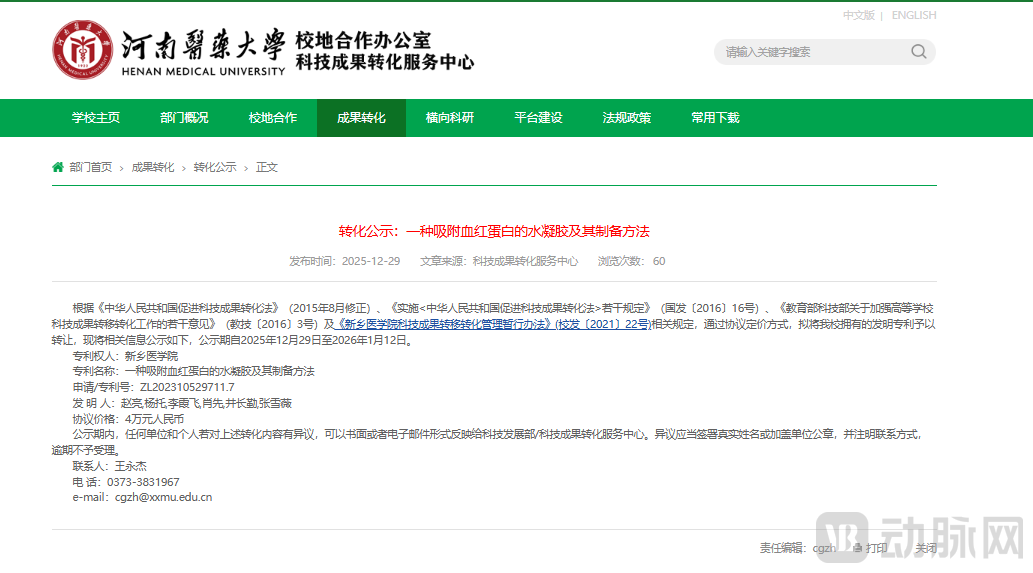
Image source: Official website of Xinxiang Medical University
This patent belongs to the field of pharmaceutical technology, targetingAcute Kidney Injury Induced by Free Hemoglobin During Cardiopulmonary Bypass in Cardiac Surgeryof clinical problem R&D. ByGraphitic Carbon Nitride, Chitosan, and CarrageenanComposite cross-linked hydrogels were prepared to address the pain points of traditional carbon nitride powders, which are prone to leakage and difficult to recover, as well as the limited adsorption capacity of chitosan and carrageenan.
In the clinical treatment of cardiovascular diseases,Vascular Bypass SurgeryAs a mainstream treatment modality, its extracorporeal circulation phase presents pressing clinical pain points that need to be addressed, therebyClearance of Free Hemoglobinbecoming a critical challenge during surgery. Cardiopulmonary bypass in cardiac surgery can cause mechanical rupture of red blood cells, releasing free hemoglobin that, if exceeding the renal metabolic threshold, is highly likely to induce acute kidney injury and exert toxic effects on the patient’s kidneys.
However, current clinical interventions for this issue have significant limitations. Pharmacological treatments are prone to accumulating adverse effects in elderly patients with impaired metabolic function. Adjunctive therapies, such as long-term oxygen therapy, are not only susceptible to external factors but also increase the financial burden on patients. Therefore,Adsorption of Hemoglobin Using Adsorbentshas emerged as a more promising therapeutic direction, but existing adsorbent materials suffer from numerous application-related drawbacks.
Although graphitic carbon nitride exhibits excellent adsorption properties and can bind to hemoglobin via hydrogen bonding and hydrophobic interactions, its micro- and nano-powder forms are prone to aggregation in the bloodstream, difficult to recover, and may leak into the circulation, thereby compromising biosafety. Chitosan, a natural material with good biocompatibility, suffers from low adsorption capacity and poor mechanical strength. While carrageenan can form gel beads with chitosan to enhance stability, the electrostatic attraction between the composite and hemoglobin remains weak, resulting in limited adsorption efficacy. These shortcomings of existing materials underscore an urgent clinical need for a hemoglobin adsorbent that combines strong adsorption capacity, high biosafety, and ease of recovery.
Composite Ternary Materials and Process Innovation: Creating a High-Efficiency Hemoglobin Adsorption System
The core innovations of this patented technology for hemoglobin-adsorbing hydrogels are reflected inMaterial Compounding, Preparation Process, and Performance Optimizationmultiple breakthroughs, fundamentally addressing the application drawbacks of traditional adsorption materials and achieving a dual enhancement in both adsorption efficacy and biosafety.
The first is an innovative composite material system, which for the first time employs a ternary compounded cross-linking of graphitic carbon nitride, chitosan, and carrageenan to fully leverage the advantages of each material.By leveraging the superior adsorption properties of carbon nitride to enhance hemoglobin binding, and capitalizing on the excellent biocompatibility of chitosan along with the gel stabilization characteristics of carrageenan, this approach addresses the limitations of single-component or binary composite materials. It resolves industry-wide challenges such as the propensity for carbon nitride powder leakage and the limited adsorption capacity of chitosan and carrageenan.
Second, an optimized preparation process design was implemented, establishing a standardized and adjustable preparation protocol.Chitosan was dissolved in an acetic acid solution of a specific concentration and combined with calcium chloride to form a mixed solution. Carbon nitride was ultrasonically dispersed and compounded with carrageenan, then added dropwise at a 1:2 ratio to induce cross-linking and form gel beads, which were subsequently freeze-dried to obtain the final product. Key process parameters were optimized, including an optimal carbon nitride addition level of 0.2%–0.4% and a cross-linking time of 20–30 minutes, ensuring the stability and reproducibility of product performance. The entire process was conducted under mild conditions such as room temperature, offering a simple procedure that is readily scalable for industrial production.
Third, synergistic innovation in structure and performance: ternary composite hydrogels exhibit smoother surfaces and more uniform textures compared to traditional binary hydrogels.It not only preserves the adsorption mechanism involving hydrogen bonding and hydrophobic interactions between carbon nitride and hemoglobin, but also immobilizes carbon nitride particles within a gel structure, thereby facilitating the convenient recovery and reuse of the adsorbent. Meanwhile, it mitigates the biosafety risks associated with powdered carbon nitride, achieving an organic integration of high-efficiency adsorption and biocompatibility.
Product Portfolio Strategy for Hemoglobin Adsorption: Focusing on Material Properties and Scenario Adaptability
Currently, dedicated adsorption products for the clearance of free hemoglobin in blood remain globallyR&D-Focused with Scarce Marketed Productsstage. Most existing related products are general-purpose biomolecular adsorbents or modified natural polymer medical materials, and no hemoglobin-specific adsorbent designed for cardiopulmonary bypass scenarios in cardiac surgery has yet been commercialized. Related competing products on the market are mainly divided intoHigh-End Adsorbent Materials Under Development and Marketed Modified Natural Polymer Medical MaterialsTwo Major Categories.
Among the hemoglobin adsorption materials under development,WithMetal Ion-Modified Composite MicrospheresHigh-end adsorbent materials, primarily prepared using immobilized metal ion affinity chromatography (IMAC) technology, exhibit high hemoglobin adsorption capacity and demonstrate significant application potential in the field of hemoglobin separation and purification. They represent a key direction in the current research and development of advanced adsorbent materials. Furthermore, hemoglobin adsorbents developed from carbon-based materials and mesoporous silica have become a research hotspot in the scientific community due to their superior intrinsic adsorption properties, offering additional technical insights for the innovative development of hemoglobin adsorption materials.
Marketed related products withModified Chitosan Medical MaterialsCentered on this core, such products leverage the excellent biocompatibility of chitosan and, after modification, possess stable physicochemical properties. They have achieved industrial-scale mass production and are widely used in clinical scenarios such as surgical hemostasis and cardiovascular interventions, demonstrating a high level of technological maturity and broad market application. Meanwhile, there are also a small number of modified natural polysaccharide gel products on the market, such as those based on carrageenan and sodium alginate. These materials can form stable gel structures and have achieved commercial application in fields like tissue engineering scaffolds and drug carriers, exhibiting good biocompatibility and moldability.
The hemoglobin-adsorbing hydrogel patent slated for transfer by Xinxiang Medical University represents a technological achievement addressing clinical pain points in cardiopulmonary bypass during cardiovascular surgery. By leveraging ternary material compounding and cross-linking, this innovation achieves a breakthrough, yielding a hydrogel that combines high-efficiency adsorption, biosafety, and hemocompatibility, thereby meeting core clinical requirements. As cardiovascular clinical demands evolve, the integration of composite materials and clinical applicability has become a prevailing trend. The commercialization of this patent may inject new vitality into the development of blood purification materials.