

Nanjing Medical University Second Affiliated Hospital to Transfer Novel Cardiac Assist Pump Patent for RMB 100,000
Recently, the Second Affiliated Hospital of Nanjing Medical University released a public notice on the transformation of scientific and technological achievements. Through assessment-based pricing, the hospital intends to“A Cardiac Assist Pump”The relevant patents have been assigned to Taizhou Nuobo Medical Technology Co., Ltd. for use, with a total transfer fee of RMB100,000 yuan. The inventor of this patented technology isTeam Li Qingguo.
This technology is a cardiac assist pump,Designed to assist cardiac pumping while addressing the safety and reusability issues of existing devices:The cleaning fluid containing debris is recovered through the return pipe to prevent it from entering the human body, thereby enhancing usage safety; additionally, the device can be cleaned and disinfected by coordinating the cleaning port and control valve with cleaning fluid and high-temperature gas, supporting reuse to reduce costs.
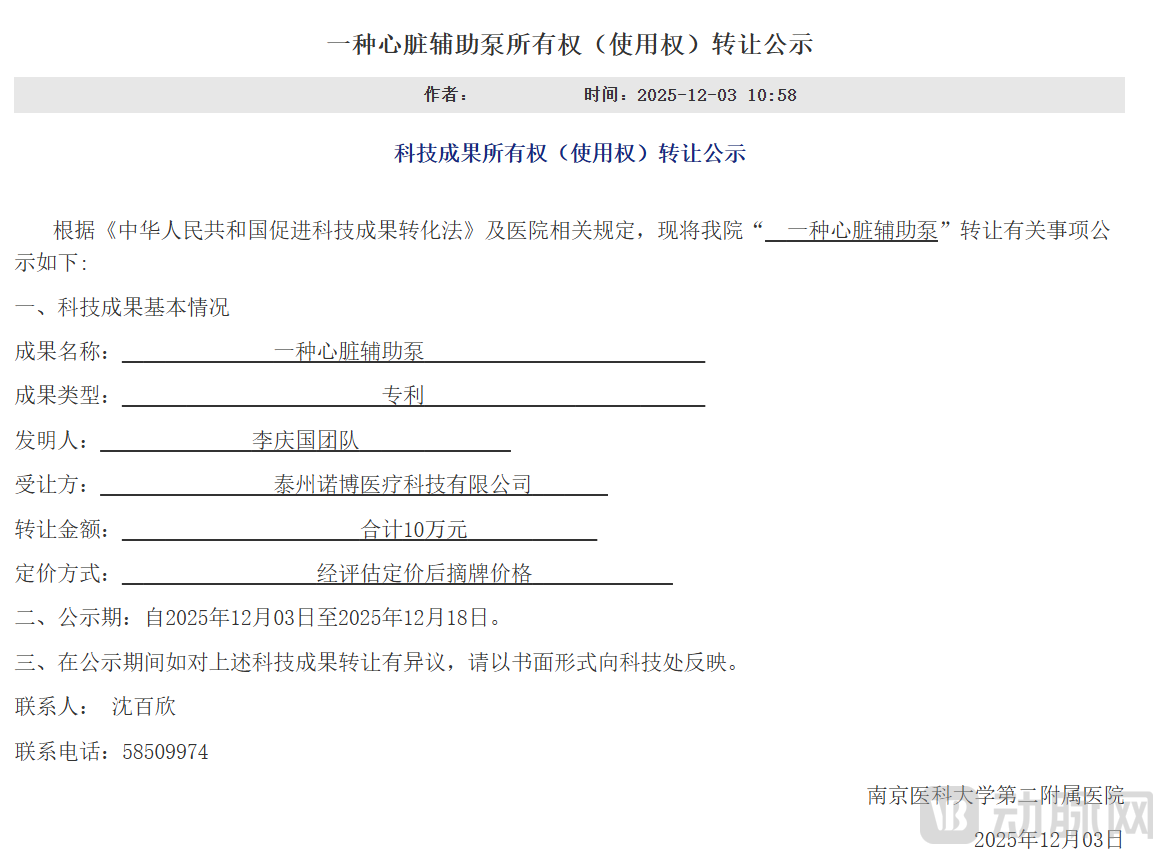
Image from the official website of the Second Affiliated Hospital of Nanjing Medical University
Cardiac assist pumps (such as interventional and implantable ventricular assist devices) are critical equipment for the treatment of patients with severe heart failure and for related medical research. The core requirement is to avoid human safety risks caused by device wear debris while assisting cardiac pumping, and at the same time meet the needs for reuse in both experimental stages and clinical applications. Safe, reliable, and reusable technical solutions are particularly important, especially in scenarios requiring long-term supportive therapy or control of experimental costs.
In clinical and experimental settings, existing cardiac assist pumps have significant limitations:First, residual debris poses safety hazards,Debris generated from the wear of moving parts, such as bearings in traditional blood pumps, can easily enter the human body with the cleaning fluid or blood, causing organ damage or complications. Although some technologies have attempted to block the flow of debris, residual cleaning fluid carrying debris still accumulates in the gap between the rotor and stator, making it difficult to completely remove.Second, the cleaning efficiency of reusable components is low, and blood pumps are expensive to manufacture.Both experimental and clinical applications require reuse to reduce costs; however, existing cleaning methods cannot rapidly flush out debris from gaps and lack targeted disinfection and drying capabilities, resulting in incomplete cleaning that compromises the safety of subsequent use.
Meanwhile, existing equipment still suffers from two major critical pain points: on the one hand,Conflict Between Cleaning and Usage Status, some devices have channels designed to improve cleaning efficiency, which can cause the cleaning solution to flow too quickly during use, requiring additional increases in inlet water pipe pressure, thereby increasing the operational burden and complexity of device operation; on the other hand,Imbalance Between Cost and Safety, imported equipment or traditional reusable solutions are either prohibitively expensive or require frequent replacement due to inadequate cleaning, which not only increases the medical financial burden on patients but also raises the cost of consumables during the experimental phase.
Furthermore, existing devices lack adaptive control capabilities, making it difficult to balance operational safety protection with efficient clearing during cleaning. In scenarios involving long-term use or high-frequency reuse, the risk of debris accumulation increases with the number of uses. Current technologies cannot achieve automatic opening and closing of the cleaning channel, requiring manual intervention for adjustment, which compromises operational convenience and equipment stability. Meanwhile, issues such as poor backflow of cleaning fluid and inadequate sealing performance may lead to blood regurgitation or equipment malfunction, thereby endangering patient lives or compromising the accuracy of experimental data.
Therefore, existing cardiac assist pumps suffer from significant drawbacks in practical applications, including high safety risks, difficulties in cleaning for reuse, cumbersome state regulation, and persistently high costs. There is an urgent need for improved technologies that ensure thorough debris recovery, high cleaning efficiency, adaptive regulation, and controllable costs, to meet the escalating demands of clinical treatment and medical research.
The core advantage of this patented technology lies in overcoming the performance bottlenecks of traditional cardiac assist pumps, namely inadequate safety protection and low reuse efficiency, by“High-Efficiency Debris Recovery + Integrated Cleaning and Disinfection + Adaptive State Regulation + Optimization of Key Structures”Quadruple Innovation: Building a Safe, Efficient, and Reusable Cardiac Assist Pump Solution to Systematically Address Long-Standing Industry Pain Points Such as High Risk of Debris Retention, Cumbersome Cleaning Processes, and Heavy Reliance on Manual Operation in Existing Technologies.
First, the innovative design of the reflux tube enables efficient debris recovery and source blockage.
Traditional blood pumps struggle to completely remove cleaning fluid carrying wear debris, posing a safety risk of debris entering the bloodstream. This technology incorporates a pair of arc-shaped return tubes on the annular plate near the water inlet pipe. The end of these tubes closer to the annular plate features a gradually expanding opening, creating a large overlapping area with the annular space between the tubes and the plate. Working in conjunction with the negative pressure generated by an external water pump, this design efficiently aspirates the cleaning fluid flowing through Bearing 1 and Bearing 2, promptly expelling the debris-laden fluid from the body. This approach significantly reduces the risk of debris retention within the pump at its source, effectively blocking its pathway into the bloodstream and substantially enhancing the safety of device usage.
Second, the integrated cleaning and disinfection mechanism significantly improves reuse efficiency.
To address the issues of incomplete cleaning and complex procedures associated with traditional reuse processes, this technology integrates high-pressure flushing with high-temperature gas treatment. During the cleaning phase, high-pressure cleaning fluid is simultaneously injected through the water inlet and return pipes to thoroughly flush critical areas such as the rotor-stator gap and bearings. Subsequently, dry high-temperature gas is introduced to simultaneously achieve internal sterilization and rapid drying. Additionally, a dedicated cleaning port is installed on the annular plate away from the return pipe, further widening the flow channel and enhancing flushing coverage. This integrated process significantly shortens the cleaning cycle and improves reuse reliability, helping to meet the demands for high-frequency, low-cost repeated use in clinical and laboratory settings.
Third, intelligent adaptive control enables seamless switching between usage and cleaning modes.
Traditional devices are prone to disrupting hemodynamic balance during normal operation due to the presence of fixed cleaning channels. This technology employs a control valve composed of an elastic waterproof layer (made of rubber), a power arm, a valve plate, and a spring leaf to achieve automatic opening and closing of the cleaning port. When the blood pump is in operation, blood pressure acts on the elastic waterproof layer, driving the valve plate to move and misalign with the connecting port to seal the cleaning port. This prevents abnormal diversion of cleaning fluid, thereby reducing the pressure requirements for the water inlet pipe. During cleaning, the external pressure is released, and the spring leaf resets to drive the valve plate to open the cleaning port, ensuring an unobstructed flushing channel. The entire process requires no manual intervention, which not only ensures operational stability but also enhances cleaning convenience, effectively resolving the conflict between operational and cleaning states.
Fourth, key structural optimization comprehensively enhances system reliability.
The technology features a refined design for core transmission and sealing components: the opposing end faces of the annular plate and the fixed ring are both equipped with 45-degree chamfered surfaces, which, in conjunction with ball bearings embedded within the ring groove, not only ensure the stability of the rotating shaft at high speeds but also effectively reduce mechanical wear, thereby suppressing debris generation at the source. The elastic waterproof layer, crafted from high-sensitivity rubber material, provides dynamic sealing at the moving port while precisely responding to pressure changes within the chamber. When combined with the system’s overall positive-pressure flushing strategy, it effectively mitigates the risks of blood backflow and fluid leakage. The overall structure balances transmission efficiency, sealing safety, and operational robustness, making it suitable for various application scenarios of cardiac assist pumps, including interventional and implantable types, thus providing a solid technical foundation for long-term therapeutic support and high-frequency experimental reuse.
In the field of cardiac assist pumps, with the surge in the global number of heart failure patients and the escalating demand for critical care,Percutaneous Ventricular Assist Devices (pVAD) and Implantable Left Ventricular Assist Devices (LVAD)Two major technological pathways have become the core of competition. International giants dominate the primary market by leveraging their first-mover advantage, while domestic enterprises are accelerating their breakthroughs through technological innovation and differentiated design, creating a competitive landscape characterized by “international leadership and domestic catch-up.” Continuous advancements in miniaturization, safety, and compatibility across various products are driving the industry toward greater efficiency and enhanced safety.
Abiomed (a Johnson & Johnson company) Impella series of percutaneous heart pumps,As a global benchmark enterprise in the field of interventional cardiac pumps, Abiomed’s Impella product series has long dominated the international percutaneous ventricular assist device (pVAD) market, leveraging its core advantages of high flow rates and low shear stress. Following Johnson & Johnson’s $16.6 billion acquisition of the company in 2022, R&D investment and marketing efforts have been further intensified. The product portfolio addresses varying flow requirements, including the Impella CP for moderate-to-low flow support (2.5–4.0 L/min), the Impella 5.0 for high-flow support (4.0–6.0 L/min), and the Impella ECP designed for patients with cardiogenic shock. These devices can be implanted via minimally invasive approaches such as the femoral or axillary artery, providing short-term circulatory support for patients with acute heart failure or those undergoing high-risk percutaneous coronary intervention (HR-PCI). Currently, the Impella series has received regulatory approval and is commercially available in numerous countries worldwide.
Procyrion Aortix™ pLVAD Interventional Cardiac PumpProcyrion specializes in the research and development of minimally invasive percutaneous cardiac pumps. Its flagship product, the Aortix™ pLVAD, is distinguished by its ultra-miniaturized design, with a diameter of only 6 mm and a length of 6.5 cm. It can be percutaneously implanted via the femoral artery into the descending aorta to provide short-term circulatory support for up to 7 days. Indicated for patients with acute decompensated heart failure (ADHF), the device alleviates heart failure symptoms by reducing cardiac afterload and increasing renal perfusion. In February 2024, the company completed a $57.7 million Series E financing round, with the proceeds primarily allocated to advancing the pivotal DRAIN-HF IDE trial to evaluate the safety and efficacy of Aortix™ in ADHF patients. The trial is currently in the clinical validation phase.
Abbott HeartMate 3 Implantable Left Ventricular Assist Device, Abbott’s HeartMate 3 is a leading product in the global field of implantable artificial hearts. It adopts full magnetic levitation technology to avoid blood cell damage and device wear caused by mechanical friction, significantly enhancing long-term safety. Its five-year survival rate is comparable to that of heart transplantation, making it suitable for long-term circulatory support in patients with end-stage heart failure. The product received approval from China’s National Medical Products Administration (NMPA) for market launch in 2024, becoming the only imported fully magnetically levitated LVAD approved in China.
In summary, competition in the cardiac assist pump sector is intensifying. International giants maintain dominance through technological maturity and extensive clinical experience, while Chinese manufacturers are accelerating their breakthroughs via differentiated innovation and localization, creating a competitive landscape where domestic and foreign players vie on equal footing. From addressing core pain points to achieving four key technological breakthroughs, and further to the iterative competition among domestic and international products, the industry is steadily advancing toward miniaturization, enhanced safety, reusability, and cost reduction. The rise of Chinese technologies holds promise for breaking import monopolies, further lowering healthcare costs, expanding clinical applications, and providing heart failure patients with higher-quality, more accessible treatment options, thereby driving high-quality development in the field of cardiac assist therapy.