

Ningxia Medical University to Transfer Patent for Multi-Component Assay Method of Jinlian Qingre Granules for RMB 40,000
Recently, Ningxia Medical University released a public notice on the transformation of scientific and technological achievements, proposing to transfer a patent right under the university’s name concerningJinlian Qingre Granules Testingthe transfer of its invention patent achievements to Ningxia QIYUAN Chinese MEDICINE Co., Ltd., with a proposed transfer amount of40,000 yuan. The inventor of this technology isZhang Xia and Her Team。
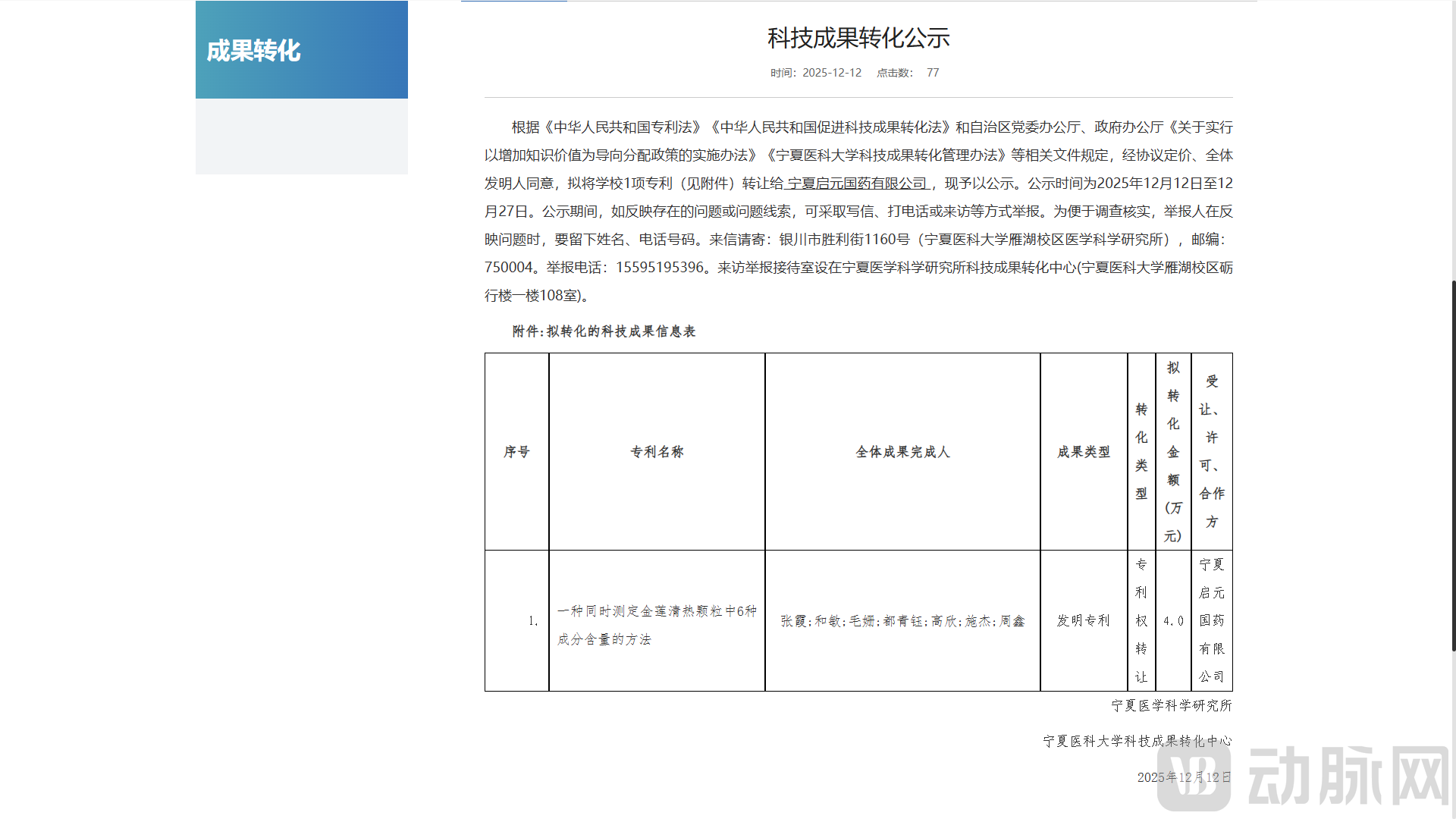
Image from the official website of Ningxia Hui Autonomous Region Institute of Medical Sciences
The core innovation of this patent lies inEstablished a detection method based on Quantitative Analysis of Multi-components by Single Marker (QAMS)Using orientin-2″-O-β-galactoside, orientin, and vitexin—the three major constituents of Trollius chinensis, the principal herb in Jinlian Qingre Granules—as optional internal reference standards, this method enables the simultaneous quantification of six components, including mangiferin, veratric acid, and harpagoside, by calculating relative correction factors combined with HPLC analysis. This approach overcomes the limitations of traditional quality control based on a single component, reduces the reliance on reference standards, significantly simplifies the analytical procedure, and lowers testing costs. Furthermore, it avoids the resource waste associated with the repeated selection of internal reference standards in conventional multi-component evaluation methods, thereby providing reliable technical support for comprehensive quality assessment and standard enhancement of Jinlian Qingre Granules.
Jinlian Qingre Granules are clinically used primarily to treat symptoms such as high fever, thirst, dry throat, sore throat, and cough caused by exogenous heat syndromes. As a proprietary Chinese medicine formulated from seven herbal ingredients—Trollius chinensis (Jin Lian Hua), Isatis indigotica leaf (Da Qing Ye), Anemarrhena asphodeloides (Zhi Mu), gypsum (Shi Gao), Scrophularia ningpoensis (Xuan Shen), Rehmannia glutinosa (Sheng Di), and bitter apricot kernel (Ku Xing Ren)—it features Trollius chinensis and Isatis indigotica leaf as the sovereign herbs for clearing heat and detoxifying; Anemarrhena asphodeloides and gypsum as the minister herbs for clearing heat at the qi level; Scrophularia ningpoensis and Rehmannia glutinosa as the assistant herbs for nourishing yin and clearing heat; and bitter apricot kernel as the guiding herb for ventilating the lung and relieving cough. The compatibility of these herbs results in a multi-component, multi-target therapeutic profile, making it a commonly used medication in the clinical treatment of exogenous febrile disorders.
Currently, there is only a single standard protocol for the quality control and testing of Jinlian Qingre Granules in clinical practice, which involves onlyVitexinThis single component serves as the quality control indicator for the formulation, used to determine the quality grade and compliance of the drug product. However, this existing testing protocol has significant inherent limitations. As Jinlian Qingre Granules are composed of multiple traditional Chinese medicinal herbs with a complex internal chemical profile, test results based on a single component cannot comprehensively or accurately reflect the overall constituent content and actual pharmacological efficacy of the formulation. Consequently, it is difficult to effectively control the intrinsic quality of the drug, nor can it provide adequate quality assurance for the safety and effectiveness of clinical medication.
AlthoughMulti-Component Analysis of Traditional Chinese MedicineIt has become the mainstream direction for quality control in the industry, as it better aligns with the multi-component characteristics of Traditional Chinese Medicine (TCM) and enables a comprehensive evaluation of formulation quality. However, this model still faces numerous practical obstacles in actual implementation. Some TCM chemical reference standards are difficult to isolate and extract, and their market acquisition costs are high. The adoption of multi-index quality control will inevitably significantly increase the costs associated with production testing for pharmaceutical enterprises, research and development for scientific institutions, and supervisory spot checks by drug regulatory authorities. This directly limits the widespread application of the multi-index quality control model in the production, scientific research, and regulatory oversight of proprietary Chinese medicines, such as Jinlian Qingre Granules.
To address this issue, the industry has adopted the Quantitative Analysis of Multi-components by Single Marker (QAMS) method. Although QAMS enables the simultaneous determination of multiple components using a single active ingredient as an internal reference, thereby overcoming the challenges of scarce reference standards and high detection costs, its application in the quality control of Jinlian Qingre Granules still suffers from redundant research on Relative Correction Factors (RCFs). Specifically, RCFs are repeatedly established solely due to the selection of different internal references, even when the analytical methods and target analytes remain identical. This not only results in a serious waste of scientific research resources but also contradicts the original design intent of QAMS, which is to provide an efficient and convenient solution.
In this context, there is an urgent need in both clinical and industrial sectors for a comprehensive, efficient, and cost-effective analytical method for Jinlian Qingre Granules. Such a method should overcome the limitations of single-component quality control by enabling precise multi-component quantification, while reducing the use of reference standards, lowering testing costs, and avoiding resource waste. This will establish a solid technical foundation for enhancing the quality standards of this formulation, ensuring production quality control, and promoting rational clinical use.
The simultaneous determination technology for the six components of Jinlian Qingre Granules, developed under this patent, achieves innovative breakthroughs by addressing critical pain points in the quality control of traditional Chinese medicines. It combines scientific rigor, practical operability, and cost-effectiveness. Its core advantages and innovations are manifested across multiple dimensions, and its high reliability and practicality have been validated through systematic testing.
First,Innovative Construction of a Multi-Internal Reference Standard-Based QAMS System, overcoming the limitation of traditional quantitative analysis of multi-components by single-marker (QAMS) method that relies on a single internal reference substance, and selecting Trollius chinensis, the sovereign drug in Jinlian Qingre Granules, which has well-defined pharmacological effects and high contentOrientin-2″-O-β-galactoside, Orientin, VitexinAny of the three components can be optionally selected as an internal reference substance; selecting any one of them suffices to determine the contents of all six components, thereby avoiding the need to repeatedly establish relative correction factors due to different choices of internal reference substances under identical detection conditions. This approach reduces the waste of scientific research resources at the source and aligns with the original design intent of the quantitative analysis of multi-components by single-marker (QAMS) method for high efficiency and convenience.
Second,Achieving Precise Synchronous Detection of Multiple Components, addressing the limitations of relying on a single quality control indicator, this method enables the simultaneous determination of the contents of six constituents: mangiferin, orientin-2''-O-β-galactoside, homoorientin, veratric acid, vitexin, and harpagide. This breakthrough overcomes the current practice of using vitexin as the sole quality control marker for Jinlian Qingre Granules, providing a more comprehensive and accurate reflection of the formulation's intrinsic compositional profile and offering multidimensional data support for its comprehensive quality evaluation.
Thirdly,Significantly Reduce Testing Costs and Enhance PracticalityThis method requires only a small amount of reference standards to achieve multi-component detection, effectively addressing the industry-wide challenges of difficult isolation and high acquisition costs associated with certain chemical reference standards for traditional Chinese medicines. Meanwhile, it simplifies the testing process, enhances detection efficiency, and reduces costs for pharmaceutical manufacturers in production quality control, research institutions in scientific studies, and drug regulatory authorities in supervisory sampling and testing, thereby facilitating broader adoption in practical production and regulatory oversight.
Fourth,Methodological validation is comprehensive, with accurate, reliable, and robust results., validated through multiple tests including precision, repeatability, stability, and spike recovery, all test indicators met the analytical requirements. Furthermore, reproducibility studies conducted on different chromatographic columns and high-performance liquid chromatography (HPLC) instruments of different models showed that the fluctuations in relative correction factors and relative retention times were within reasonable ranges. The analysis of 21 batches of Jinlian Qingre Granules samples demonstrated that the percentage difference between the results obtained by this method and those by the external standard method was ≤3.0%, indicating that the method can be stably applied under various experimental conditions with accurate and reliable results.
Fifth,Optimized and Refined Experimental System with High Adaptability of Detection ConditionsBy systematically optimizing conditions such as the extraction solvent, concentration, and time, as well as the HPLC mobile phase, column temperature, and flow rate, the optimal parameters for sample preparation and detection were established. This ensures effective separation of chromatographic peaks for all components and accurate detection data, laying a solid technical foundation for the practical application of the method.
Lianhua Qingwen Granules, a first-line clinical Chinese proprietary medicine for clearing heat and relieving exterior syndromes, features a formulation of multiple Chinese herbal ingredients, including Forsythia Fruit (Lianqiao), Honeysuckle Flower (Jinyinhua), processed Ephedra Herb (Zhi Mahuang), and Bitter Apricot Seed (Ku Xingren). It primarily targets symptoms such as fever, sore throat, and cough caused by exogenous wind-heat. Its clinical application scenarios highly overlap with those of Jinlian Qingre Granules, making it a core market competitor. The product’s quality control system has been upgraded to multi-index testing, incorporating multiple marker components—such as forsythin, chlorogenic acid, and emodin—into the quality control scope. This comprehensive approach is significantly superior to traditional single-component testing methods.
From a market perspective, the modernization of Traditional Chinese Medicine (TCM) and the enhancement of industry quality standards have spurred a surge in demand for efficient and cost-effective multi-component detection technologies. The patented Quantitative Analysis of Multi-Components by Single-Marker (QAMS) method boasts broad application prospects and is poised to drive upgrades in industry standards. Meanwhile, demand for TCM proprietary medicines with heat-clearing and exterior-releasing effects remains stable; technological advancements will strengthen clinical and market recognition of these products. Future expansion to a wider range of TCM varieties will facilitate the internationalization of TCM, generate economic benefits for enterprises, and promote the standardized, high-quality development of the TCM industry, demonstrating significant market potential and application value.