

Zhejiang University to Transfer Integrated Medical Transport-and-Examination Cart for RMB 250,000
Recently, Zhejiang University released a public notice on the transformation of scientific and technological achievements, proposing to transfer via agreed pricing“A Medical Transport and Examination Integrated Cart and Its Method of Use”Transfer of relevant patent achievements, with a proposed transfer amount ofRMB 250,000. The inventor of this patent isProfessor Chen Laijuan。
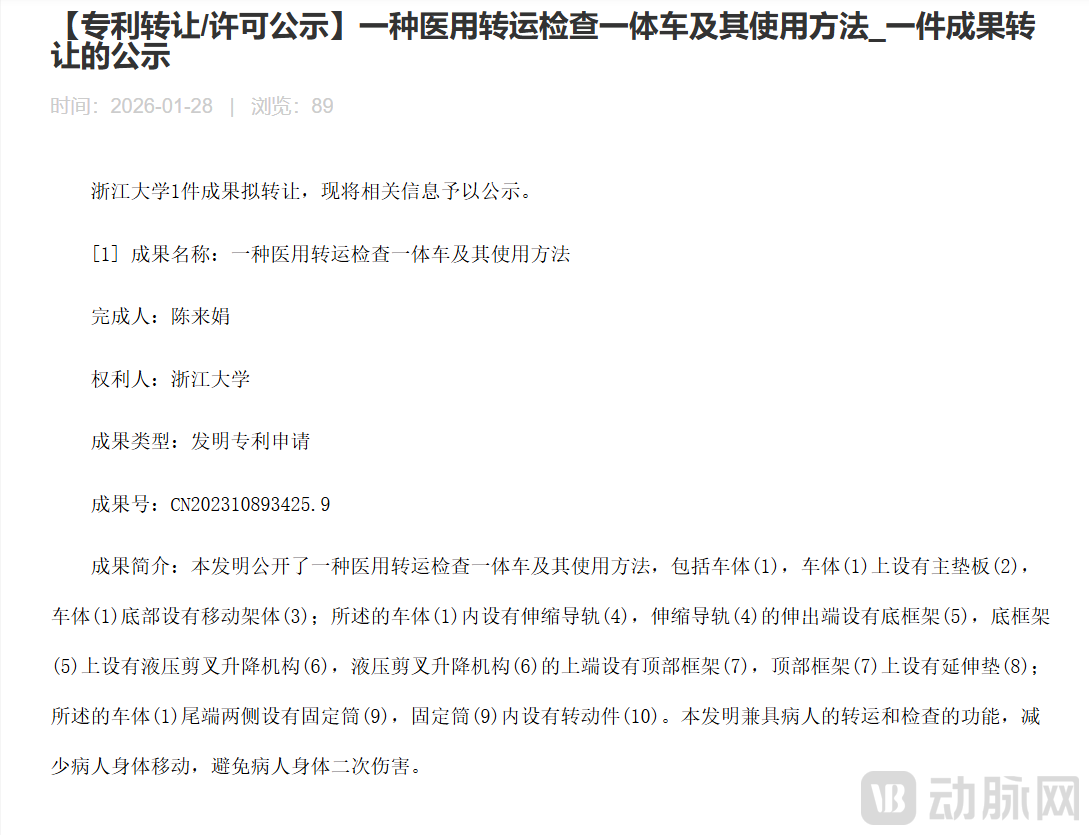
Image from the official website of Zhejiang University
Based on a vehicle chassis, this device employs designs such as telescopic guide rails, hydraulic lifting mechanisms, and adjustable support structures to enable flexible switching between transport and examination modes. It eliminates the need for significant patient repositioning throughout the process and incorporates auxiliary functions including braking, height adjustment, and IV pole mounting, thereby enhancing operational convenience for healthcare professionals and improving patient comfort.
Medical Transfer CartAs a core medical support device connecting wards, operating rooms, and diagnostic departments, it is indispensable in the diagnosis and treatment processes for surgical patients, high-risk postoperative patients, and critically ill patients.
With the increasing demand for clinical diagnosis and treatment, cross-departmental transfers of critically ill patients are becoming more frequent, driving a continuous rise in market demand for efficient and safe transport equipment. However, traditional transport carts offer limited functionality and are significantly disconnected from medical examination processes. Existing solutions suffer from numerous critical pain points that severely constrain clinical efficiency and compromise patient safety.
On the one hand,Separation of patient transport and examination necessitates multiple bed transfers, with an objective risk of secondary injury.. Traditional transport carts only possess mobility functions; after patients arrive at the examination department, medical staff must manually lift and transfer them onto the examination bed. As noted in the background of related patent technologies, existing transport methods “still require shifting the patient’s body position” during lateral transfer. This manual bed-to-bed transfer is highly prone to causing inadvertent injury to patients, resulting in pain. Particularly for patients with fractures, unhealed postoperative wounds, or spinal injuries, changes in positioning can easily trigger traction pain, wound dehiscence, or even deterioration of their condition. Meanwhile, repeated lifting not only consumes significant physical energy from medical staff but also increases the probability of medical adverse events such as falls from the bed and collisions, which contradicts the modern medical concept of “patient-centered care.”
On the other hand,Poor Device-Scenario Adaptability Hinders Diagnosis and Treatment WorkflowsMost traditional transport carts are not directly compatible with imaging environments (such as high-magnetic-field settings or specific examination table interfaces). Magnetic components may interfere with image acquisition or compromise equipment safety, necessitating repeated procedures or equipment replacement. Furthermore, the poor height compatibility between traditional transport carts and hospital beds or examination tables, coupled with the lack of convenient lifting mechanisms and seamless docking capabilities, further exacerbates the difficulty and time consumption associated with patient transfers.
Although some institutions have attempted to introduce specialized examination beds, the high procurement costs, large footprint, and lack of mobility prevent them from effectively covering high-frequency transport-related examination scenarios such as preoperative screening and postoperative follow-up. Traditional transport carts suffer from inadequate auxiliary design; accessories such as IV poles and vital signs monitoring devices are mostly externally attached, resulting in poor stability and cumbersome operation, which fails to meet the need for continuous diagnosis and treatment during patient transport.
Meanwhile, the fragmentation of multiple stages in the traditional workflow—“transfer, waiting, lifting, and examination”—leads to discontinuities in inter-departmental coordination. A significant amount of time is consumed by non-clinical activities, reducing the overall operational efficiency of hospitals and easily causing congestion in diagnostic departments, especially during peak hours.
Furthermore, there is still room for improvement in the safety design and personalized support of existing medical transport equipment. Some products have imperfect braking performance, the firmness of locking mechanisms, and support adjustment functions for patients of different body types. These issues collectively lead to clinical transport falling into"High safety risks, low diagnostic and treatment efficiency, and heavy burden on medical staff"...dilemma. The market urgently needs a medical device that integrates patient transport and examination, utilizing mechanical structures (such as telescopic guide rails and synchronized lifting mechanisms) to achieve “zero-displacement” patient transfer, thereby addressing pain points across the entire workflow from patient transport to examination implementation.
Addressing the issues highlighted in the background technology“Secondary injuries caused by manual lifting, fragmentation between transport and examination equipment, and inefficient coordination across multiple stages”such as core pain points, developed by our team"Integrated Medical Transport and Examination Cart and Its Method of Use"With“Zero-Shift Bed Transfer for Injury Prevention + Integrated Dual-Mode Transport and Examination”With dual-core advantages, it constructs a seamless, end-to-end solution covering transport, positioning, examination, and return transport, breaking through the limitations of traditional equipment characterized by “single functionality and significant safety hazards.”
Manual lifting is a primary trigger for adverse events such as traction pain and wound dehiscence in postoperative, fracture, spinal injury, and critically ill patients. This technology, through patentedTelescopic Guide Rails + Hydraulic Scissor Lift Mechanism + Multi-Directional Locking Mechanismcollaborative design, enabling patient"Zero Displacement"Seamless transition between transport and examination modes is achieved without any manual lifting. The hydraulic scissor mechanism, operated via a foot pedal, enables height adjustment of the cart body to align the extension pad flush with the main support surface. Combined with the smooth telescoping motion of the guide rails, this design ensures seamless extension of the patient support surface, physically eliminating various injuries caused by positional changes. Additionally, the equipment features an interlinked braking system that locks the wheels by engaging the brake switch through a transmission rod when the brake pedal is depressed, effectively mitigating the risk of cart slippage during transport and examination procedures.
In terms of core functionality and scenario adaptation, this technology achieves structural innovationBreaking the Dilemma of “One Vehicle Struggling to Fit Multiple Scenarios” with One-Click Dual-Mode SwitchingIn transport mode, the extension pad is stowed beneath the main tabletop, and the footrest folds away for compact storage, resulting in a compact and maneuverable unit that can freely navigate through corridors, elevators, and other confined spaces. In examination mode, the extension pad is pulled out and raised to align flush with the main tabletop, while the footrest is deployed and locked into place, thereby forming a complete examination surface. This design enables rapid mode switching via a mechanical mechanism, simplifying the traditionally cumbersome patient transfer process. Additionally, an IV pole holder is integrated at the front of the unit to ensure uninterrupted intravenous infusion during both transport and examination, addressing the stability issues associated with traditional external accessories. The foot tray connects to the footrest via a universal ball joint, allowing height and angle adjustments along guide rails to meet the personalized leg support needs of patients with varying body types.
In terms of clinical application and industrial adaptation, this technology demonstrates"High usability, modular structure"advantages. Medical personnel can complete all operations through simple actions such as stepping, pushing/pulling, and rotating, eliminating the need for complex training. Mode switching can be performed independently by a single operator, significantly reducing labor costs. Core components, such as telescopic guide rails, hydraulic systems, and braking mechanisms, adopt mature mechanical structures that facilitate manufacturing and maintenance. The overall design is compact with a small footprint, allowing flexible deployment across various departments, in contrast to the solutions mentioned in the background technology that require specialized mobile examination beds or multiple patient transfers. Furthermore, key parameters such as lifting stroke, guide rail extension length, and locking angle are clearly defined by mechanical limits, ensuring stable and consistent equipment performance and offering strong potential for standardization.
Furthermore, this technology inEnhancing Hospital Operational Efficiencysignificant potential in this regard. By eliminating the manual process of changing beds, non-diagnostic and non-therapeutic time consumption can be substantially reduced, thereby improving the turnover rate of diagnostic departments and alleviating congestion during peak hours. Its“Safety First, Efficiency Paramount”The design philosophy aligns closely with the modern healthcare trend of “patient-centered care,” and can be rapidly replicated and promoted across surgical departments, intensive care units (ICUs), rehabilitation departments, and other areas in hospitals at all levels, offering broad market application prospects.
Integrated Medical Transport and Examination Cart“Strong Magnetic Field Safety Compatibility, Zero-Displacement Bed Transfer to Prevent Injury, Efficient Multi-Scenario Switching”Three Core Demands Drive Domestic and International Enterprises and Research Institutions to Launch R&D and Product Strategies. Currently, Similar Technologies in the Market Have Formed“Non-Magnetic Specialized Transport” and “Integrated Functional Integration”Two Major Mainstream Tracks, the FormerAddressing Pain Points in MRI Scenario Safety, the latterFocus on the Integration of Patient Transport and Examination Processes, with the overall competitive landscape characterized by “mature specialized equipment and breakthroughs by new integrated products.”
Asia Clays Technology Co., Ltd.As a pioneer of non-magnetic products in China, with its market share ranking among the top two in the industry, it has long provided supporting components for mainstream imaging equipment manufacturers such as GE, Philips, and United Imaging. Its core productsNon-magnetic Transfer BedConstructed from high-strength aerospace-grade aluminum, this unit completely eliminates the weak magnetism associated with traditional stainless steel. It is equipped with 127mm non-magnetic imported casters and features safety guardrails on both sides of the cart. The entire structure is non-magnetic, ensuring no interference with MRI imaging and eliminating the risk of magnetic attraction. This product has achieved standardized mass production and is widely used in MRI departments across hospitals at all levels.
Tianjin Haoluojie Yueying Medical Technology Co., Ltd.Specializing in the niche field of MRI-dedicated patient transport, it has launchedYueying Non-Magnetic Stretcher CartFeaturing a fully non-magnetic design as its core, the product adopts a split-bed structure and scientifically engineered mechanics to deliver superior load-bearing capacity with tight, seamless connections between modular components. It can be directly wheeled into the MRI room, enabling “one-stop” patient transport without the need for intermediate transfers. This significantly reduces the risk of secondary injury in patients with fractures or critical conditions, while completely eliminating magnetic interference that could affect MRI equipment and image quality. The product has completed clinical validation.
Anruan Medical (Shenzhen) Co., Ltd.LaunchedAnjieja Non-Magnetic Transfer Bed AR-5003, featuring dual treatment with non-magnetic materials and degaussing technology, a split design for the stretcher and frame, manual lifting mechanism, and non-magnetic braked casters, with a maximum load capacity of 240 kg. The product offers smooth maneuverability and stable lifting; the mattress consists of sponge wrapped in easy-to-clean leather, balancing patient comfort with infection control requirements. It is suitable for routine patient transport in MRI suites, has obtained medical device registration, and is widely used in primary care hospitals and specialized hospitals.
Guangzhou Klarity Medical Equipment Co., Ltd.Leading layout in the field of high-end transfer systems, itsKlarity TRAVELER™ Air Suspension Transport BedCentered on air suspension technology, the system ensures ultra-smooth patient transfer, allowing two personnel to complete the entire process and significantly reducing the physical burden on healthcare staff. Equipped with features such as one-touch electric lifting, height memory, and one-touch emergency stop and locking, it incorporates a high-capacity battery and is compatible with multiple scenarios including CT, MRI, and linear accelerator treatment rooms. Serving as a platform for patient positioning and repositioning, it substantially improves room turnover rates. With high technical barriers, this product has been deployed in the radiation oncology and radiology departments of major tertiary hospitals in China, representing a high-end technological direction for integrated patient transport.
Non-magnetic transport products have achieved large-scale industrialization, with technological upgrades focusing on lightweight design and intelligence; integrated products are mostly in the clinical validation or small-batch trial production stages, with key R&D efforts directed toward“Deep Integration of Non-Magnetic Design and All-in-One Functionality” “Further Simplification of Operational Procedures”and“Interconnectivity with Hospital Information Systems”In the future, products that combine “full non-magnetic compatibility, zero displacement during bed transfer, multi-scenario adaptability, and low-cost operation and maintenance” will become the core direction for addressing the pain points of clinical transport and examination, driving the industry’s transformation from “single-function” to “seamless end-to-end integration.”