

Dongguan People's Hospital to Transfer Anorectal Surgery Retractor Patent for RMB 40,000
Recently, Dongguan People's Hospital released a public notice on the conversion of its scientific and technological achievements, proposing to“Retractor for Anorectal Surgery”Patent assignment to Jiangsu Annuoruike Medical Devices Co., Ltd., with a transaction amount of40,000 yuan。
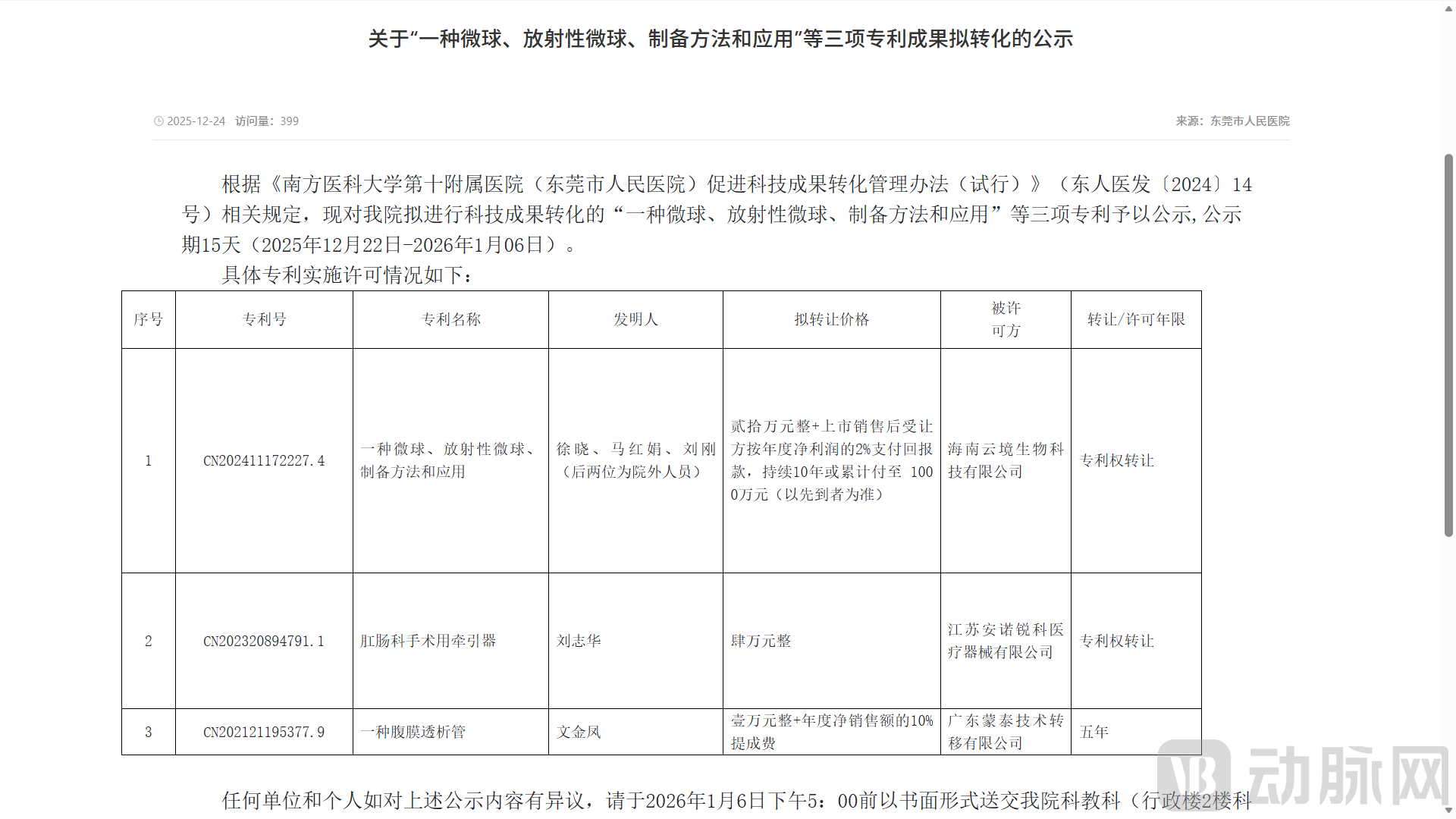
Image from the official website of Dongguan People's Hospital
This patent describes a specialized surgical instrument designed to meet the clinical operational needs of colorectal surgery. It features an adsorption structure that adheres to and retracts the patient's buttocks, thereby addressing the issue of traditional traction devices being prone to dislodgement and ensuring compatibility with the requirements of colorectal surgical procedures.
In the clinical practice of anorectal surgery, surgical procedures for anorectal diseases are inherently constrained by human physiological anatomy. The natural convergent structure of the buttocks toward the anal region makes it difficult for conventional medical instruments to effectively retract and expose the anus and its internal tissues, which are critical to the surgery. This not only significantly narrows the surgical field of view and increases operational difficulty for medical staff, but also compromises surgical precision due to limited visibility, representing an inherent and unavoidable technical challenge in anorectal surgical procedures.
Currently used anal traction devices in clinical practice attempt to achieve retraction and spreading of the patient's buttocks through a combined structure consisting of crescent-shaped buttock attachment plates, connecting straps, and hooks. These devices also rely on adhesive negative electrode plates to secure the instrument to the patient's buttocks. However, this adhesive fixation method has significant technical drawbacks, as the attachment plates are highly prone to detaching from the patient's buttocks during surgical procedures. Accidental detachment of the device not only directly interrupts the normal progress of surgery and disrupts the operational rhythm but may also cause local tissue injury due to intraoperative displacement or falling off of the instrument, further compromising surgical precision and clinical safety. This technical limitation represents a core market pain point that urgently needs to be addressed for anorectal surgical instruments in clinical applications.
In short, current traction devices for anorectal surgery fail to achieve precise anatomical conformity with the human buttocks due to structural limitations, making it difficult to overcome surgical field restrictions imposed by physiological anatomy. Furthermore, core technical defects in their fixation mechanisms compromise stability throughout the procedure. The combined deficiencies in both fixation and adaptability create a dual bottleneck in clinical surgical operations. This industry pain point is driving the upgrade of anorectal surgical instruments toward structurally adaptive designs and innovative fixation methods, highlighting an urgent need for a specialized traction device that balances conformability and stability to resolve clinical operational challenges.
Driven by clinical practice needs, this anorectal surgical retractor features multiple innovations in structural design and functional implementation, specifically addressing the core limitations of traditional instruments. Its key innovations are reflected in the dual optimization of structural design and suction principles:
First, the innovative adoption of a movable dual-adsorption plate structure, the suction plate can flexibly adjust its angle according to the contour of the patient's buttocks. This allows for better conformity to the human buttocks, enhancing the adaptability of the device to the body and ensuring secure fixation from a structural standpoint.
Secondly, abandoning the traditional adhesive method, an innovative negative pressure adsorption structure is designed, featuring a cavity, piston plate, sliding cylinder, and piston rod working in coordination.By pulling the piston rod to drive the piston plate to slide within the cavity, a stable negative pressure is generated in the suction chamber to achieve gluteal suction. This negative pressure suction method significantly enhances fixation stability, fundamentally preventing detachment issues.
Third, the adsorption chamber features a differentiated design,The corresponding adsorption chambers are machined to varying depths, and each is internally fitted with a breathable protective pad of appropriately matched height.It ensures effective negative pressure suction while preventing tissue damage to the patient's buttocks caused by excessive suction force. Meanwhile, the breathable material does not impede gas exchange, balancing practicality and safety.
Fourth, the addition of a matching limit structure comprising a limit pin and a limit slot. After the suction plate completes negative-pressure adsorption, the limit pin can be inserted into the limit groove of the piston rod. This effectively prevents the piston rod from slipping back, which would cause the suction plate to lose its suction force, thereby stably maintaining the negative-pressure adsorption state and further ensuring the stability of instrument fixation during surgical procedures;
5. Retain the hook and integrate it with the connecting strap and frame to form a complete traction and fixation system; secure the hook to the bed frame and then straighten the connecting strap.It can maximally retract the patient's buttocks, and combined with stable negative pressure suction, it creates a synergy between the expansion of the surgical field of view and the effectiveness of instrument fixation.
Currently, in the market for traction and buttock retraction devices used in anorectal surgery, several targeted medical products have already been implemented in clinical practice. Below are three specific products that are widely used in the market:
This product is a dedicated retractor for proctology, representing a classic clinical anal dilator. It is suitable for retracting the gluteal and anal tissues during routine proctological surgeries, such as those for hemorrhoids and anal fistulas. The device features an ergonomic curved design that conforms to the contour of the perianal tissues. Equipped with an easily adjustable locking buckle, it allows the dilation width to be tailored to surgical requirements. Its operation is straightforward, requiring no complex assembly.
Zhuolaiman Disposable Anorectal Surgical Retractor and FixatorDeveloped and manufactured by Jiangsu Zhuolang Medical Technology Co., Ltd., this product features an integrated “retraction + fixation” design. It provides basic gluteal retraction while offering gentle fixation of internal anal tissues, thereby preventing tissue displacement that could interfere with surgical procedures. Designed for single use, it complies with clinical sterile operation requirements and is suitable for routine surgeries in both the outpatient and inpatient departments of proctology.
Xinhua Ande Lonestar Anal Surgery RetractorThis product features a disc-shaped retractor structure paired with an adjustable traction strap. It not only facilitates lateral retraction of the buttocks but also enables traction on the deep tissues surrounding the anus via the retractor, thereby further optimizing the surgical field and accommodating certain anorectal internal procedures with higher operational difficulty.