

Sun Yat-sen University Cancer Center to Transfer Nasopharyngeal Carcinoma Immunotherapy Response Prediction Technology for RMB 900,000
Recently, Sun Yat-sen University Cancer Center released a public notice on the transformation of scientific and technological achievements, stating that the hospital intends to“Predictive Model for Nasopharyngeal Carcinoma Treatment Efficacy and Its Application”The right to apply for the relevant patent was assigned to Shenzhen Judong Biomedical Engineering Co., Ltd., with a transfer fee of RMBRMB 900,000。
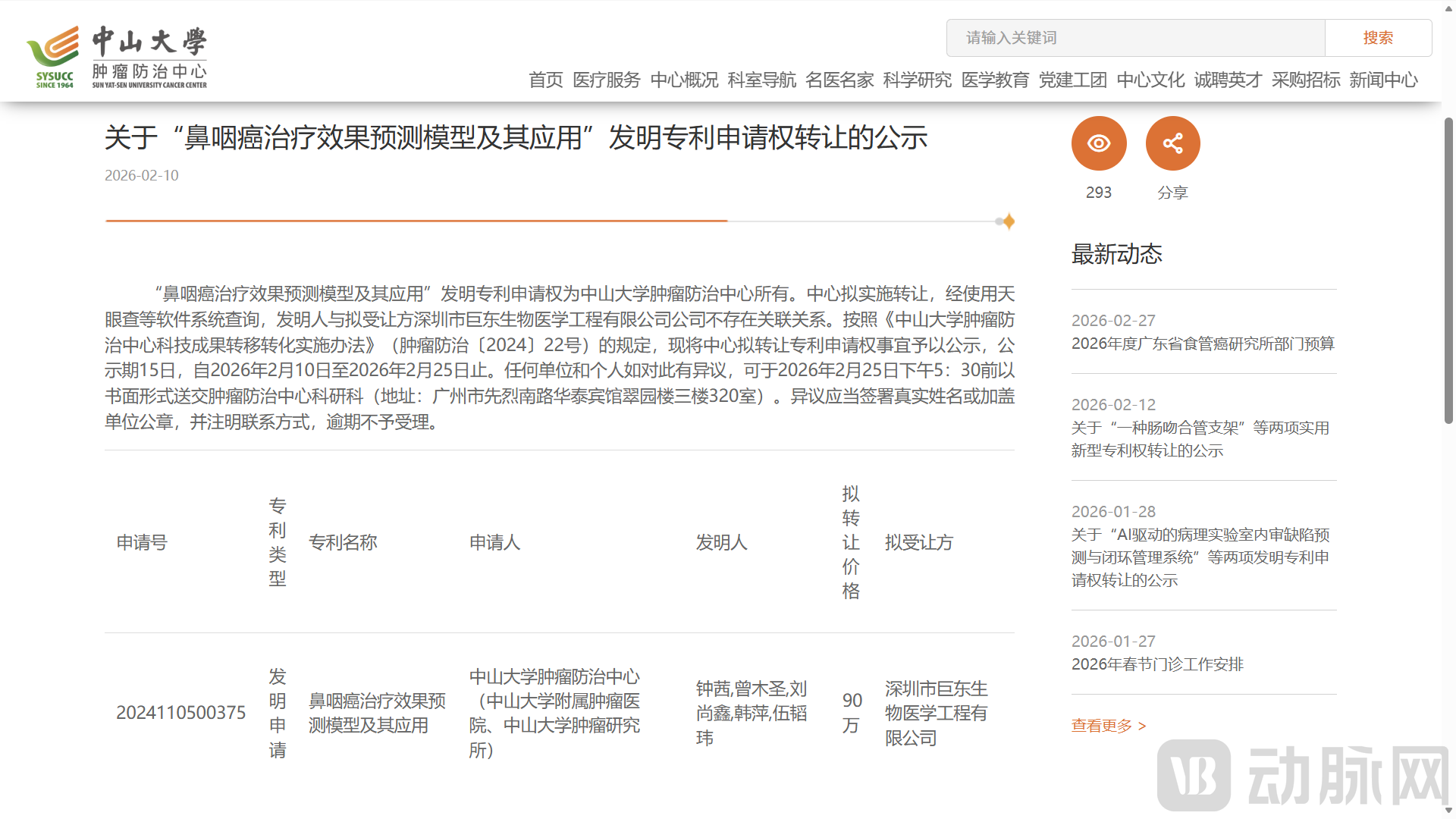
Image from the official website of Sun Yat-sen University Cancer Center
This technology was developed by the Sun Yat-sen University Cancer Center.Predictive Technology for Immunotherapy Efficacy in Nasopharyngeal Carcinoma, with the core objective of constructing a quantitative model based on specific biomarkers to accurately predict the efficacy of immunotherapy in patients with nasopharyngeal carcinoma. Additionally, it assesses prognostic outcomes, including the risks of recurrence and metastasis as well as survival rates following immunotherapy, thereby providing clinical guidance for personalized immunotherapy in nasopharyngeal carcinoma.
Nasopharyngeal carcinoma, a high-incidence malignancy in South China, accounts for 48% of new global cases. Due to its insidious onset and nonspecific early symptoms, 75% of patients are diagnosed at locally advanced stages, making it a key challenge in the treatment of head and neck tumors. Immunotherapy, with its favorable antitumor activity and safety profile, has become an important direction for the treatment of recurrent/metastatic nasopharyngeal carcinoma.PD-1 Inhibitor Monotherapy or Combined with ChemotherapyThis treatment modality has become a focal point of clinical research, offering new hope for patients with advanced nasopharyngeal carcinoma.
There is significant individual variability in the efficacy of immunotherapy among patients with nasopharyngeal carcinoma. While some patients achieve complete or partial tumor remission, others experience stable disease or even progression. Ineffective immunotherapy not only delays subsequent treatment opportunities but also increases healthcare costs and exacerbates the physical and financial burden on patients.
Therefore,Accurately predict the efficacy of immunotherapy before treatment, identify patients likely to benefit, and develop personalized treatment plans., has become a core requirement in the clinical management of nasopharyngeal carcinoma. There is an urgent need for reliable predictive tools to guide clinicians in appropriately selecting candidates for immunotherapy, thereby avoiding ineffective treatments and enhancing both the overall efficacy of immunotherapy for nasopharyngeal carcinoma and the efficiency of healthcare resource utilization.
In the field of predicting immunotherapy efficacy for nasopharyngeal carcinoma, a standardized and highly accurate specialized prediction system has not yet been established. There is a lack of targeted biomarkers and quantitative prediction models in clinical practice, making it difficult to accurately assess immunotherapy outcomes. Although existing studies have explored some immune-related indicators, they mostly focus on single-biomarker analyses without considering the synergistic effects among multiple indicators or the spatial relationships between cells. Consequently, the predictive accuracy remains insufficient to meet the demands of precise clinical diagnosis and treatment.
Meanwhile, traditional prediction methods have not established standardized procedures for detection, analysis, and interpretation. Variations in testing methodologies and evaluation criteria across different medical institutions result in a lack of comparability, thereby hindering their widespread clinical adoption.
More critically, existing prediction methods can only simply determine whether the treatment is effective or ineffective, failing to simultaneously assess prognostic outcomes such as the risk of recurrence, risk of metastasis, and survival duration following immunotherapy. This limitation hinders the provision of comprehensive references for clinical diagnosis and treatment, preventing physicians from formulating subsequent follow-up and intervention plans based on predictive results. Furthermore, certain detection techniques are complex and time-consuming, while reagents and equipment lack unified standards and exhibit poor compatibility, further restricting their application in primary healthcare institutions. Consequently, the clinical widespread adoption of predictive models for immunotherapy efficacy in nasopharyngeal carcinoma remains elusive, leaving a large number of patients trapped in the dilemma of "blind treatment." These challenges underscore an urgent clinical need for a highly accurate, comprehensive, and standardized prediction scheme for immunotherapy efficacy in nasopharyngeal carcinoma, thereby addressing the current industry bottlenecks in precision diagnosis and treatment.
In the Field of Predicting Immunotherapy Efficacy for Nasopharyngeal CarcinomaInsufficient Precision, Single Evaluation Dimension, and Non-standardized Testing Process...and other industry pain points, developed by the Sun Yat-sen University Cancer Center“Prediction Model for Nasopharyngeal Carcinoma Treatment Efficacy and Its Application” Technology, with its core advantage lying in the establishment ofMulti-marker Combination + Spatial Feature Consideration + Quantitative Scoringan integrated prediction system that achieves full-chain technological breakthroughs from biomarker screening and model construction to detection application, creating a precise prediction solution for nasopharyngeal carcinoma immunotherapy tailored to clinical needs, thereby filling the gap in standardized predictive tools in this field.
The primary core advantage of this technology isScreening for multi-dimensional core biomarkers and constructing a quantitative risk scoring model to achieve precise prediction of immunotherapy efficacy.Unlike the inefficient prediction methods based on traditional single biomarkers, this technology is the first to integrateDensities of tertiary lymphoid structures (TLS), CXCL9⁺MECA79⁺ cells, and CXCR3⁺CD4⁺ T cells, as well as the mean distance between CXCL9⁺MECA79⁺ cells and CXCR3⁺CD4⁺ T cells, in nasopharyngeal carcinoma tissue specimensThese four independent prognostic factors were incorporated into the predictive system, which not only considers cell density metrics but also innovatively integrates intercellular spatial relationships, thereby comprehensively covering the key immune features of the tumor microenvironment.
Meanwhile, throughLASSO Regression and Multivariate Cox RegressionAnalyze and determine the weight coefficients of each biomarker, establish a standardized risk scoring formula, and combine it with the optimal threshold of 25.074 to transform qualitative analysis into quantitative assessment, thereby achieving precise stratification of responders and non-responders to immunotherapy. Clinical validation demonstrated that the immunotherapy response rate among high-scoring patients in the training set reached100%, the validation set reached90.9%, with a significant improvement in predictive accuracy.
Secondly,The technology achieves the dual functions of therapeutic efficacy prediction and comprehensive prognostic assessment,To provide comprehensive and valuable reference for clinical diagnosis and treatment. This prediction model can not only accurately determine the immediate efficacy of immunotherapy in patients, but also simultaneously assess key prognostic indicators such as the risk of recurrence, the risk of metastasis, disease-free survival (DFS), distant metastasis-free survival (DMFS), and overall survival (OS) after immunotherapy, forming"Efficacy Prediction - Prognostic Assessment"of the integrated analysis results.
When the risk score exceeds the threshold, it indicates that immunotherapy is effective for the patient, with a low risk of recurrence and metastasis, and a more favorable prognosis regarding survival. Conversely, when the score falls below the threshold, the opposite is true. Based on these results, physicians can develop personalized treatment plans and subsequent follow-up intervention strategies for patients. This approach fundamentally overcomes the limitations of traditional predictive methods, which could only provide a single assessment of therapeutic efficacy, thereby enhancing the practical implementation of precision and individualized immunotherapy for nasopharyngeal carcinoma.
Third,The technology has established a standardized and actionable workflow for testing and analysis., combining clinical adaptability with scalability. This technology establishes a standardized detection method that employs multiplex immunofluorescence staining combined with opal fluorophores and specific antibodies to detect various biomarkers, and utilizes HALO image analysis software to perform cell density calculations and spatial distance measurements. By standardizing detection reagents, operational procedures, and analytical tools, it effectively addresses the issues of inconsistent methodologies and lack of comparability in results associated with traditional detection approaches.
Concurrently, supporting designs were developed.A detection system comprising a detection module, an analysis module, and an output module, andComputing Devices and Computer-Readable Storage Media Capable of Performing Model Computations, standardizes the entire workflow of biomarker detection, score calculation, and result interpretation. Detection data can be directly imported into the analysis module to automatically complete risk scoring and output results. The system is easy to operate and provides objective results without requiring complex professional procedures. It not only meets the needs for precision diagnosis and treatment in large oncology centers but also facilitates promotion and application in primary healthcare institutions, significantly enhancing the clinical applicability of the technology.
Furthermore, the technology has undergone rigorous clinical validation and demonstrates strong practicality, providing reliable technical support for personalized immunotherapy in nasopharyngeal carcinoma (NPC). The model was constructed using clinical data from 59 NPC patients who received immunotherapy, with 30 cases assigned to the training set and 29 to the validation set. Strict adherence to clinical inclusion and exclusion criteria was maintained. The area under the ROC curve (AUC) for the validation set reached 0.790, indicating robust predictive performance. Meanwhile, the model’s criteria for assessing therapeutic efficacy are aligned with the widely used RECIST 1.1 guidelines for tumor response evaluation. The required NPC tissue specimens are routinely obtained in clinical practice, and both the detection reagents and equipment are commercially available, eliminating the need for specialized experimental conditions. This design closely aligns with real-world clinical diagnostic and treatment scenarios, facilitating rapid translation into clinical applications. It guides physicians in rationally selecting patients likely to benefit from immunotherapy, thereby avoiding ineffective treatments, improving the efficiency of medical resource utilization, and paving a new path for precision immunotherapy in nasopharyngeal carcinoma.
As immunotherapy for nasopharyngeal carcinoma becomes increasingly prevalent in clinical practice, efficacy prediction has emerged as a focal point of market R&D, given its central role in precision diagnosis and treatment. Domestic and international enterprises and research institutions are actively deploying strategies across multiple dimensions, including tumor marker detection, multi-omics analysis, and clinical model construction, thereby shaping a competitive landscape characterized by the maturation of conventional tumor marker detection products and the innovation of targeted assays for the tumor microenvironment.
Kuoran Biomedical Technology (Shanghai) Co., Ltd.Deeply engaged in the field of tumor microenvironment detection, it has launchedOne-Stop NGS Testing Solution for Nasopharyngeal Carcinoma, centered onDesign for Analysis of the Tumor Microenvironment in Nasopharyngeal CarcinomaKey indicators such as MECA79, CXCL9, CXCR3, CD4, and CD20 can be incorporated to predict prognosis and immunotherapy efficacy in patients with nasopharyngeal carcinoma. The underlying technical principle is also based on the detection and analysis of tumor microenvironment features, including tertiary lymphoid structure (TLS) density, CXCL9⁺MECA79⁺ cells, and CXCR3⁺CD4⁺ T cells, while exploring the predictive value of intercellular spatial relationships for immunotherapy response. Furthermore, the company has validated the molecular mechanism by which interferon-responsive high endothelial venules (IFN-HEVs) secrete CXCL9 to recruit CXCR3⁺CD4⁺ T cells, thereby driving TLS formation, using spatial transcriptomics and single-cell sequencing technologies. This provides a solid foundation of basic research support for its detection assay, and the related technological achievements have been successfully translated into clinical diagnostic applications.
GeneseeqAs the leading enterprise in the field of tumor gene testing, its approved and marketedGenetron Health One® TMB Testing Kit for Non-Small Cell Lung Cancer Tissue, is a benchmark product in the field of efficacy prediction for immunotherapy in China. Although it primarily targets non-small cell lung cancer, its matureNGS Large Panel Testing Technology, it has become a universal tool for predicting immunotherapy outcomes in pan-solid tumors and is also clinically applied to predict the efficacy of immunotherapy in nasopharyngeal carcinoma. This product is the first and only NGS large-panel Class III medical device in China to receive innovative approval from the National Medical Products Administration (NMPA). It achieves clinically compliant tumor mutational burden (TMB) testing by detecting 425 tumor-related genes. As a core biomarker for immunotherapy recommended by clinical guidelines, TMB serves as an important reference indicator for predicting the efficacy of immunotherapy in nasopharyngeal carcinoma. Its detection method is endorsed by the CSCO guidelines and the TMB expert consensus. Currently, it has been implemented in hundreds of Grade A tertiary hospitals and specialized oncology hospitals across China. Furthermore, multi-center clinical trials for all indications have been completed in the United States, and formal registration with the U.S. Food and Drug Administration (FDA) has been submitted.