

Shanxi Medical University to Transfer Novel Cardiovascular Puncture Assistance Device Patent for RMB 500,000
Recently, Shanxi Medical University, regarding its held utility model patents“A Cardiovascular Puncture Assistance Device”Proposed to500,000 yuanThe price in RMB for the full transfer of all rights to this patent to Taiyuan Shuangding Technology Co., Ltd. The inventor of this patent isWang Yuyao and Her Team。
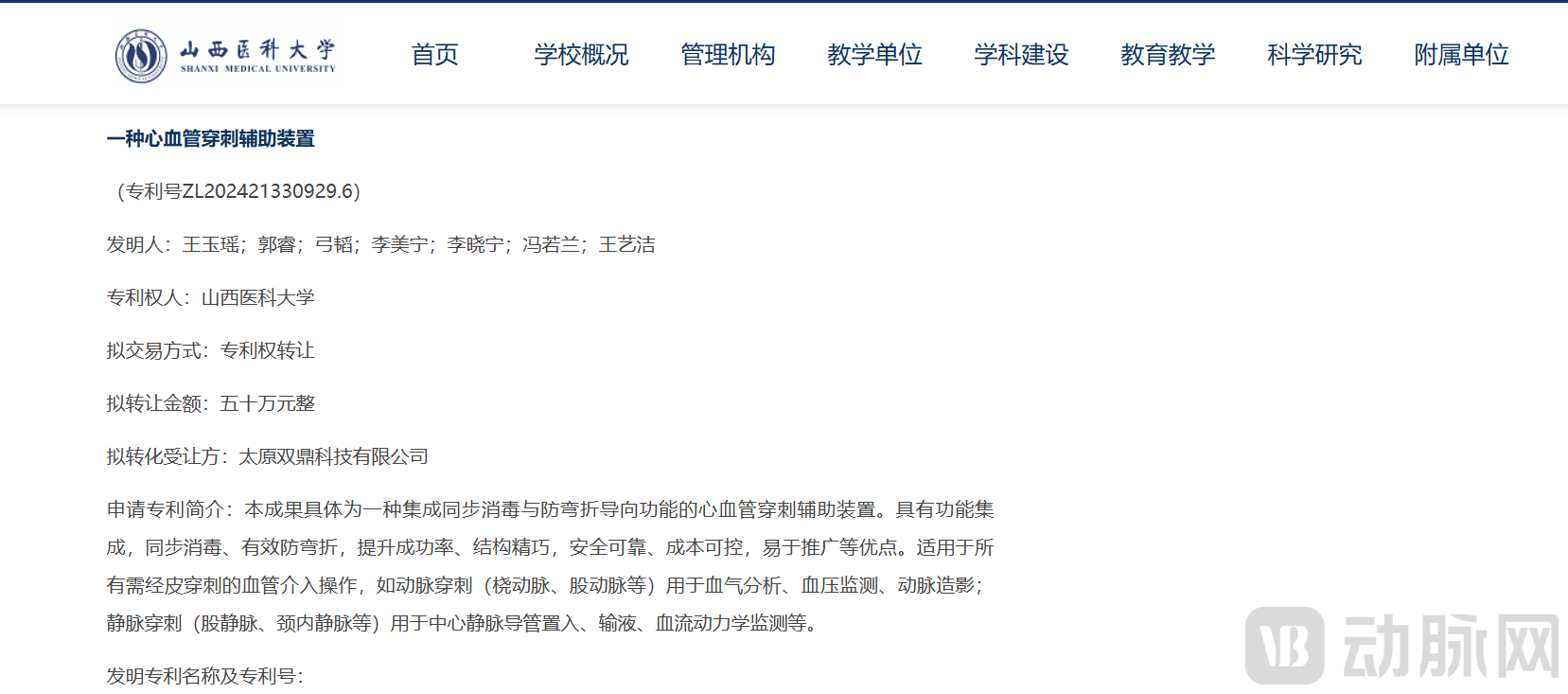
Image from the official website of Shanxi Medical University
The core of the present invention lies inIntegrated Synchronous Sterilization and Anti-Kinking Guidance Function:By incorporating a built-in three-way stopcock structure containing a disinfectant sponge, the device automatically performs surface disinfection as the trocar passes through. Meanwhile, a guide ring system equipped with guide balls and a conical shield effectively prevents catheter kinking caused by thrust forces, ensuring smooth operation. This device addresses clinical pain points associated with existing puncture assistance tools, such as the inability to perform simultaneous disinfection and insufficient anterior support leading to catheter deformation, thereby significantly enhancing the safety, precision, and efficiency of cardiovascular puncture procedures.
In current clinical practice,Cardiovascular Puncture (Including Arterial and Central Venous Puncture)As a fundamental component of critical medical procedures such as intensive care, perioperative management, interventional diagnosis and treatment, and hemodynamic monitoring, its safety and success rate directly impact patient prognosis and healthcare quality. Although the widespread adoption of imaging technologies, such as ultrasound guidance, has significantly improved puncture accuracy, the mechanical manipulation during the puncture process remains highly dependent on the support of auxiliary devices. However, existing puncture assistance devices still exhibit numerous limitations in structural design, functional integration, and clinical applicability, failing to meet the comprehensive demands of modern precise, safe, and efficient puncture procedures.
First,Disconnection between disinfection and puncture procedures, with inadequate aseptic assurance.Current standard operating procedures require chemical disinfection of the skin (e.g., with povidone-iodine or chlorhexidine) prior to puncture, allowing it to dry before proceeding. However, this “two-step” approach creates operational gaps in both time and space: after disinfection is complete, the needle, catheter, or operator’s gloves may inadvertently contact peripheral skin areas that are not fully isolated, posing a risk of potential microbial contamination.
Particularly in high-load settings such as emergency departments and intensive care units (ICUs), the rapid pace of procedures and complex environments heighten the risk of cross-contamination, thereby increasing the likelihood of local infections and even catheter-related bloodstream infections (CRBSI). Currently, the vast majority of puncture-assist devices on the market do not integrate real-time disinfection capabilities, failing to achieve simultaneous surface sterilization at the moment instruments penetrate the skin barrier. This results in a “technical loophole” in aseptic technique at critical junctures.
Secondly,The guide structure design is simplistic, lacking effective mechanical support for the catheter/needle body.Most existing assistive devices offer only static angular guidance and cannot dynamically adapt to changes in tissue resistance. During procedures involving longer puncture paths (such as femoral artery puncture in obese patients) or deeper vascular locations (such as the internal jugular vein), the needle or guidewire is prone to bending, deviation, or even "kinking" due to lateral resistance from heterogeneous tissues, including subcutaneous fascia and adipose layers, during advancement.
Once the catheter tip loses its linearity, it not only reduces the success rate of first-attempt puncture but may also cause mechanical complications such as intimal tearing, pseudoaneurysm formation, and hematoma. More seriously, some low-cost or single-use auxiliary devices made of insufficiently rigid materials may deform under stress, further exacerbating guidance failure.
Third,Absence of anterior support, resulting in poor puncture stability.Existing devices mostly provide initial angular constraints on the skin surface, but lack a continuous support mechanism for the mid-to-distal path of the needle after it enters the subcutaneous tissue. Once the needle tip penetrates the epidermis, the procedure reverts to a “freehand” state, relying entirely on the operator’s tactile feedback and experience to control the insertion trajectory.
This structural flaw, characterized by “stable anteriorly but drifting posteriorly,” is particularly pronounced in complex scenarios such as vascular anatomical variations, hypotension-induced vascular collapse, or patient agitation. It significantly increases the failure rate and the number of repeat punctures, thereby prolonging procedure time, exacerbating patient suffering, and elevating the risk of complications.
Fourth,Limited functionality and lack of system integration.Puncture-assistance products currently available on the market exhibit a “fragmented” landscape: some are designed solely to fix the puncture angle, others serve merely as guidewire channels, and still others rely on external sterilization steps. Few devices organically integrate core functionalities—such as sterilization, guidance, anti-kinking, and stable advancement—into a single structure. This functional fragmentation not only increases procedural steps and consumable usage but also raises the technical proficiency required of operators, hindering standardized adoption. These limitations are particularly pronounced in primary healthcare institutions and emergency rescue scenarios.
Finally,There is a significant application gap between high-end and low-end products.On one hand, high-end puncture systems based on electromagnetic navigation, robotic assistance, or augmented reality (AR) offer advantages in high precision and intelligence, but their high cost, bulky size, and operational complexity hinder widespread adoption in routine clinical settings. On the other hand, simple plastic puncture guides, while low-cost, have limited functionality and insufficient reliability, failing to meet the demands of complex puncture procedures. This situation, characterized by “prohibitively expensive high-end options and unreliable low-end alternatives,” highlights an urgent clinical need for a mid-range, integrated puncture assistance device that combines high performance, low cost, ease of use, and broad applicability.
In summary, existing puncture assistance devices inSterility Assurance, Mechanical Support, Structural Continuity, Functional Integration, and Clinical AccessibilitySystemic shortcomings in these areas make it difficult to meet the comprehensive requirements of modern precision medicine for operational safety, efficiency, and standardization.
Therefore, there is an urgent need to deeply integrate engineering innovation with clinical demands to develop an integrated cardiovascular puncture assistance device capable of simultaneously achieving automatic disinfection, dynamic guidance, and anti-kink protection—this is the core issue that this patented technology aims to address.
The cardiovascular puncture assistance device proposed in this patent systematically addresses the inherent deficiencies of existing puncture assistance devices in terms of sterility assurance, guidance stability, and operational convenience through structural innovation and functional integration, demonstrating significant technical advantages and clinical value. Its core innovations are mainly reflected in the following four aspects:
First, it pioneered an integrated "simultaneous disinfection-puncture" mechanism.The device integrates a three-way lumen containing a disinfectant-soaked sponge into its main structure. As the trocar advances, it automatically passes through this lumen, achieving immediate, closed-loop disinfection of the instrument’s outer surface prior to skin penetration. This design overcomes the temporal and spatial disconnect inherent in the traditional “disinfect first, puncture later” approach, effectively blocking pathways for secondary contamination during the procedure. By technologically reinforcing the sterile barrier, it significantly reduces the risk of infection.
Second, construct a multi-level anti-kinking guidance system.The distal end of the device features a composite guidance structure composed of a guide ring, a conical shroud, and embedded ball bearings. The guide ring provides initial axial constraint, while the conical shroud forms a progressively tapering channel to center the needle during advancement. Meanwhile, the embedded ball bearings roll to reduce friction and dynamically correct deviations as the catheter is advanced. This multi-stage synergistic mechanism not only effectively prevents bending or kinking of the puncture needle or catheter due to tissue resistance but also enhances the linearity and controllability of the puncture trajectory, making it particularly suitable for deep vascular access or patients with complex anatomical conditions.
Third, compact structure, easy operation, and controllable cost.The entire device adopts a modular design, with the main body injection-molded from disposable medical-grade polymer materials. It requires no external power source or complex control system, ensuring both biocompatibility and usage safety while significantly reducing manufacturing costs. During clinical operation, the device simply needs to be adhered and fixed to the skin to achieve dual functions of disinfection and guidance. This significantly simplifies the operational workflow, shortens the learning curve, and facilitates its promotion and application in medical institutions at all levels, particularly in primary care settings.
Fourth, it demonstrates strong adaptability and covers a wide range of puncture scenarios.This device is designed to meet the requirements of both arterial and venous puncture. It can be widely used for blood gas sampling and invasive blood pressure monitoring via the radial and femoral arteries, as well as for central venous catheterization procedures involving the internal jugular vein, femoral vein, and other sites. Its universal design eliminates the need for multiple specialized instruments tailored to different vessel types, thereby improving equipment utilization and clinical practicality.
In summary, the present patent technology achieves this by“Sterilization—Guidance—Anti-Kinking”The integrated triad of functions significantly improves the first-attempt success rate, operational efficiency, and standardization level of cardiovascular puncture while ensuring operational safety. It fills the technological gap in existing mid-range puncture assistance devices and holds clear prospects for clinical translation and industrialization value.
Currently, products or technical solutions on the market with functions similar to those of this patent, “A Cardiovascular Puncture Assistance Device,” are mainly concentrated in several representative categories of devices and patented designs. Although each has its own focus, none has achieved an organic integration of the three core functions: sterilization, guidance, and anti-kinking.
Arrow (Teleflex)ofArterial/Central Venous Puncture KitIt is a classic product widely used in clinical practice. Its accompanying plastic guide frame provides only basic angle fixation, featuring a simple structure and low cost, and has achieved high penetration globally in the fields of critical care and anesthesiology. In recent years, Arrow has enhanced ultrasound compatibility in its kits. Meanwhile, its central venous catheterization kits, leveraging mature solutions and high cost-effectiveness, lead in penetration within the global anesthesia and critical care sectors, underpinned by a solid market foundation.
3M CompanylaunchedIoban™ Antimicrobial Incise Drapes and ChloraPrep™ Series Skin Prep Systemsrepresents another technological pathway—Continuous antimicrobial activity at the puncture site achieved through adhesive films containing iodine or chlorhexidine.Such products have clear evidence-based support in preventing catheter-related infections and have been included in recommendations from multiple clinical guidelines. Currently, in China’s hospital infection prevention and control market, 3M Ioban™ Antimicrobial Incise Drapes and the ChloraPrep™ Skin Preparation System, backed by robust evidence and explicit guideline recommendations, have achieved high penetration rates in key departments such as tertiary hospitals and ICUs, becoming core consumables for the prevention and control of catheter-related infections.
Overall, the current market for puncture assistance devices exhibits a “polarized” landscape: at one end are traditional guide frames, which are widely adopted but offer limited functionality; at the other are intelligent navigation systems, which are precise and efficient yet costly and complex. Mid-range integrated products that balance safety, practicality, and cost-effectiveness remain scarce. As healthcare quality standards rise, primary care capacity building advances, and hospital infection prevention and control measures become increasingly stringent, clinical demand for puncture assistance tools that are “one-step, safe, reliable, and require no additional training” will continue to grow.