

Nantong University Affiliated Hospital to Transfer Novel EphA8-Based Breast Cancer Diagnostic and Therapeutic Patent for RMB 22,000
Recently, the Affiliated Hospital of Nantong University released a public notice on the transfer of patent rights, proposing to assign its held invention patents“Application of the EphA8 Gene in the Preparation of Anti-Breast Cancer Drugs and Diagnostic Kits”Transferred to Chengdu Pengfei Technology Co., Ltd., with a transfer fee of RMBRMB 22,000. This patent is held byNi Qichao, Wang Guihua, Wang Xudong, Huang JianfeiR&D.
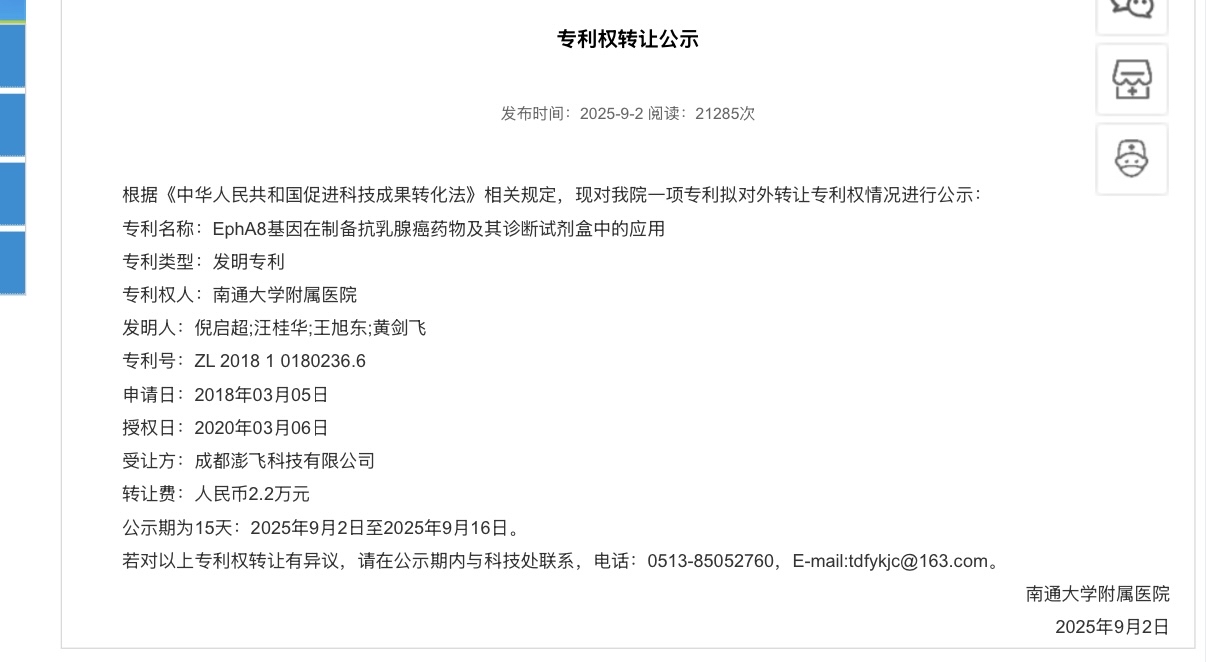
Image from the official website of Affiliated Hospital of Nantong University
The core innovation of this patent lies inEphA8 Gene Identified for the First Time as a Novel Molecular Target for the Diagnosis and Treatment of Breast Cancer, confirming that this gene is highly expressed in breast cancer tissues and associated with poor patient prognosis. Four siRNA sequences capable of specifically inhibiting EphA8 gene expression were designed, effectively suppressing the proliferation and invasion of breast cancer cells. Furthermore, diagnostic and prognostic kits for breast cancer can be developed based on this gene, filling the gap in the research and application of the EphA8 gene in the field of breast cancer within existing technologies, and providing a novel technical solution and research direction for precise targeted diagnosis and treatment of breast cancer.
Breast cancer is a malignant tumor arising from the mammary epithelial tissue. It has currently become the most prevalent malignancy among women in China, posing a serious threat to their physical health and life safety, and thus represents a key disease target in clinical oncology diagnosis and treatment. With advancements in molecular biology technologies and a deeper elucidation of tumorigenic mechanisms at the cellular and molecular levels, breast cancer treatment has entered a new era of molecular targeted therapy. Compared with traditional systemic chemotherapy and radiotherapy, targeted therapy can efficiently and selectively kill tumor cells while minimizing damage to normal tissues and reducing adverse reactions, thereby becoming a central focus of research in breast cancer treatment.
At present, multiple targeted therapies have been introduced into clinical research and application, such asTrastuzumabCan bring significant survival benefits to patients with HER2-positive breast cancer,PARP and VEGF InhibitorsThe combined use also demonstrates promising application prospects in breast cancer treatment. Developing targeted drugs against signaling pathways involved in the initiation and progression of breast cancer has become a key direction for clinical precision therapy.
However, current targeted diagnosis and treatment regimens for breast cancer still exhibit significant limitations, failing to meet the clinical demand for precision and personalized care. On one hand, the scope of targets covered by existing targeted therapies is limited, with an insufficient number of clinically actionable molecular targets. This restricts the availability of diverse targeted treatment options for breast cancer patients with varying pathological characteristics, leaving some patients without specific targeted therapeutic strategies.
On the other hand, the lack of effective biomolecular markers in clinical practice makes it difficult to accurately predict the progression of breast cancer and scientifically assess patient prognosis. This results in a lack of precise evidence for formulating clinical treatment plans, thereby affecting treatment efficacy and patients' quality of life.
Meanwhile, within the Eph (erythropoietin-producing human hepatocellular carcinoma receptor) family—the largest family of receptor tyrosine kinases—although studies have confirmed that certain members are involved in tumorigenesis and progression, such as EphA2, which is overexpressed in various tumors and exhibits oncogenic characteristics, with its signaling pathway potentially serving as a novel therapeutic target for breast cancer, there are very few research reports on the EphA8 gene in the field of oncology. Its expression profile in breast cancer tissues, its association with clinicopathological parameters, and its impact on the invasion and migration of breast cancer cells have not been clearly elucidated, leaving a gap in related diagnostic and therapeutic applications.
In this context, there is an urgent clinical need to identify novel breast cancer-related biomolecular markers and therapeutic targets. This will help refine systems for early diagnosis and prognosis, expand the scope of targeted therapy development, and provide new technical support for precision medicine in breast cancer. Ultimately, these efforts aim to enhance the accuracy and efficacy of diagnosis and treatment, improve patients’ quality of life, and prolong survival.
This patented technology centers on the development of diagnostic and therapeutic applications for breast cancer targeting the EphA8 gene. It combines groundbreaking technical innovations with significant clinical advantages, filling a critical technological gap in the field of precision diagnosis and treatment for breast cancer. Its core innovations and advantages are demonstrated across multiple dimensions, including target discovery, technical design, experimental validation, and clinical application, as detailed below:
1. The target discovery is pioneering, as it is the first to clearly identify the EphA8 gene as a novel molecular target for the diagnosis and treatment of breast cancer,This breakthrough overcomes the existing limitations of research on the Eph family of genes in breast cancer. Previously, reports on the EphA8 gene in the field of oncology were scarce, and its association with breast cancer had not been investigated. This technology confirms, through large-scale tissue testing, that EphA8 protein expression is significantly elevated in breast cancer tissues, and that high expression is directly correlated with poor patient prognosis. These findings identify a novel, specific biomarker for the diagnosis and prognostic assessment of breast cancer, while also opening new avenues for targeted therapy.
2. Targeted intervention design is characterized by specificity and efficacy,Four siRNA sequences were specifically designed to precisely interfere with EphA8 gene expression, and the one with the highest silencing efficiency was selected through experimental screening.EphA8-siRNA-3 Sequence, which can efficiently and specifically inhibit the expression of the EphA8 protein in breast cancer cell lines, achieving precise targeted intervention against tumor cells. Compared with traditional targeted drugs, this sequence is designed for a novel target, thereby avoiding the issue of insufficient coverage of existing targets, and provides a core sequence that can be directly applied to the development of targeted therapies for breast cancer.
3. Comprehensive and Rigorous Experimental Validation System, usingIn Vitro and In Vivo Integrationexperimental methods to complete multi-dimensional validation, in vitro throughWestern blot, CCK-8 assay, Transwell chamber, flow cytometry, and other techniques, confirming that downregulation of EphA8 gene expression can significantly inhibit the proliferation and invasion capabilities of breast cancer cells, as well as alter the cell cycle; in vivo throughConstruction of Stable Cell Lines and Xenograft Tumor Assays in Nude Mice, which validated that RNA interference-mediated suppression of EphA8 expression significantly slowed the growth rate of subcutaneous breast cancer xenografts, and that this approach exhibited synergistic antitumor effects when combined with paclitaxel, thereby providing experimental evidence for clinical combination therapy; the reliability and persuasiveness of the experimental results were highly robust.
4. Diverse and Practical Technical Application Scenarios, achieving dual applications of the EphA8 gene in the diagnosis and treatment of breast cancer. It can be used to develop diagnostic kits for breast cancer by detecting its expression levels to assist in clinical diagnosis, as well as prognostic assessment kits to evaluate patient survival outcomes based on expression patterns. Meanwhile, siRNA sequences targeting this gene can be directly applied to the development of anti-breast cancer drugs, with a single technical solution coveringDiagnosis, Prognosis, TreatmentThree Core Clinical Needs, with Significant Application Value and Expansion Potential.
5. The advantages of targeted therapy align with the clinical demands for precision medicine,Therapies targeting the EphA8 gene extend the core advantages of molecular targeted therapy by efficiently and selectively acting on breast cancer tumor cells, thereby reducing damage to normal breast tissue and minimizing treatment-related adverse effects. Compared with conventional chemotherapy and radiotherapy, this approach offers greater precision and safety, while also addressing the limitations of existing breast cancer targets. It provides new therapeutic possibilities for patients lacking effective targeted treatment options, further advancing the development of precision medicine in breast cancer.
Meanwhile, the technology has undergone comprehensive in vitro and in vivo experimental validation. Its high level of technological maturity lays a solid foundation for subsequent clinical translation and product development. In the future, during the process of commercialization, it can leverage R&D and industrial resources in the biopharmaceutical sector to accelerate the development and market launch of related diagnostic products and therapeutics. This will establish a unique product portfolio in the precision diagnosis and treatment market for breast cancer, providing new options for clinical care. Furthermore, it holds promise for further market expansion and deeper application in the niche field of targeted tumor diagnosis and therapy.
This patent centers on diagnostic and therapeutic applications targeting the EphA8 gene for breast cancer, aligning with the trend toward precision medicine in breast cancer care and offering strong market prospects. As a novel molecular target in the field of breast cancer diagnosis and treatment, the EphA8 gene holds dual value in both diagnostic and therapeutic contexts, enabling it to meet diverse clinical needs. It can be developed into kits for diagnosis and prognosis assessment, serving as a new tool for precise breast cancer diagnosis, or leveraged as a target for the development of anti-breast cancer drugs, thereby providing new directions for targeted therapy.
The Ki-67 detection kit is a core reagent used in tumor pathology diagnosis for detecting Ki-67 protein expression,Taking Beyotime Biotechnology as an example. This protein is a key biomarker for assessing the proliferative activity of tumor cells. The assay kits primarily rely on technical principles such as immunohistochemistry (IHC) and enzyme-linked immunosorbent assay (ELISA), combined with high-specificity Ki-67 antibodies to achieve precise identification and detection of the target protein. These kits effectively reflect the proliferative activity of tumor cells, providing important evidence for determining tumor malignancy and supporting clinical diagnostic and therapeutic decision-making. Currently, mainstream kit products are compatible with various detection platforms, with some enabling high-throughput screening. Their operational procedures balance standardization and convenience, meeting the diverse needs of clinical pathological testing and scientific research. Furthermore, they are suitable for multiple sample types, including formalin-fixed paraffin-embedded (FFPE) tissues and cell lysates.
These assay kits have a wide range of market applications and serve as routine reagents in the pathological detection of various malignant tumors, including breast cancer, lymphoma, and lung cancer. They are extensively used in pathology departments of healthcare institutions at all levels worldwide, specialized oncology diagnosis and treatment centers, and life science research laboratories. The market features international brands that dominate the high-end segment with mature technological systems, stringent quality control, and extensive clinical validation data, while domestically produced kits cover a broad spectrum of clinical and research scenarios through their cost-effectiveness and localized service advantages. Overall market demand continues to grow alongside advancements in precision oncology diagnostics. Products are continuously evolving toward greater sensitivity, ease of use, and enhanced compatibility, while the establishment of standardized testing systems has become a significant trend in industry development.
Roche HER2 IHC Test Kit is in the field of HER2 immunohistochemistry testing for breast cancerAs a classic benchmark product, it is powered by proprietary high-specificity monoclonal antibodies and integrated with the brand’s self-developed fully automated staining detection platform to form an all-in-one testing solution. Standardized operations are implemented throughout the entire workflow—from sample pre-processing to staining and result presentation—maximizing the reduction of errors caused by manual handling and comprehensively ensuring the accuracy, consistency, and stability of test results. This kit can precisely identify different expression states of the HER2 protein. As a core companion diagnostic reagent for HER2-targeted therapy in breast cancer, its test results serve as a key basis for clinically selecting candidates for targeted drugs and formulating individualized targeted treatment plans, making it an indispensable testing tool within the precision diagnosis and treatment system for breast cancer.
Leveraging a mature technological platform, rigorous quality control, and extensive clinical validation data, this product is widely used in clinical oncology diagnostics worldwide. In China, it has become the mainstream choice for HER2 testing in breast cancer at high-end oncology diagnosis and treatment institutions, tertiary hospitals, and specialized cancer centers, serving as a core routine reagent for pathology departments conducting such assays.
Breast Cancer Molecular Diagnostic KitAs a core tool for precision oncology diagnosis and treatment, the overall market continues to unlock its development potential, driven by the widespread adoption of precision medicine concepts and escalating demands in clinical applications. With breast cancer diagnosis and treatment advancing toward personalization and stratification, clinical demand for diagnostic reagents capable of accurately identifying tumor molecular characteristics, aiding therapeutic decision-making, and facilitating prognostic assessment is steadily rising, thereby driving continuous technological R&D and expanding scenario-based applications for such products.
Meanwhile, continuous innovation in molecular diagnostic technologies, coupled with improvements in healthcare infrastructure and heightened awareness of cancer screening, further underpins the market development of such products. These products are evolving toward greater detection accuracy, enhanced operational convenience, and broader applicability across diverse settings. Their value continues to become increasingly prominent throughout the entire clinical pathway—including early screening, diagnosis, and treatment efficacy assessment for breast cancer—indicating substantial growth potential for the overall market.