

Huazhong University of Science and Technology to Transfer Five Conjugated Carbon-Iodine Polymer Patents for RMB 500,000
Recently, Huazhong University of Science and Technology released a public notice on the conversion of scientific and technological achievements, proposing to transfer its“Five Patents Including ‘A Conjugated Carbon-Iodine Polymer for Preparing CT Localization Markers’”Transferred to Wuhan Yikangan Technology Co., Ltd. through negotiated pricing, with a transaction amount ofRMB 500,000. The inventor of this patent isLuo Liang and His Team。
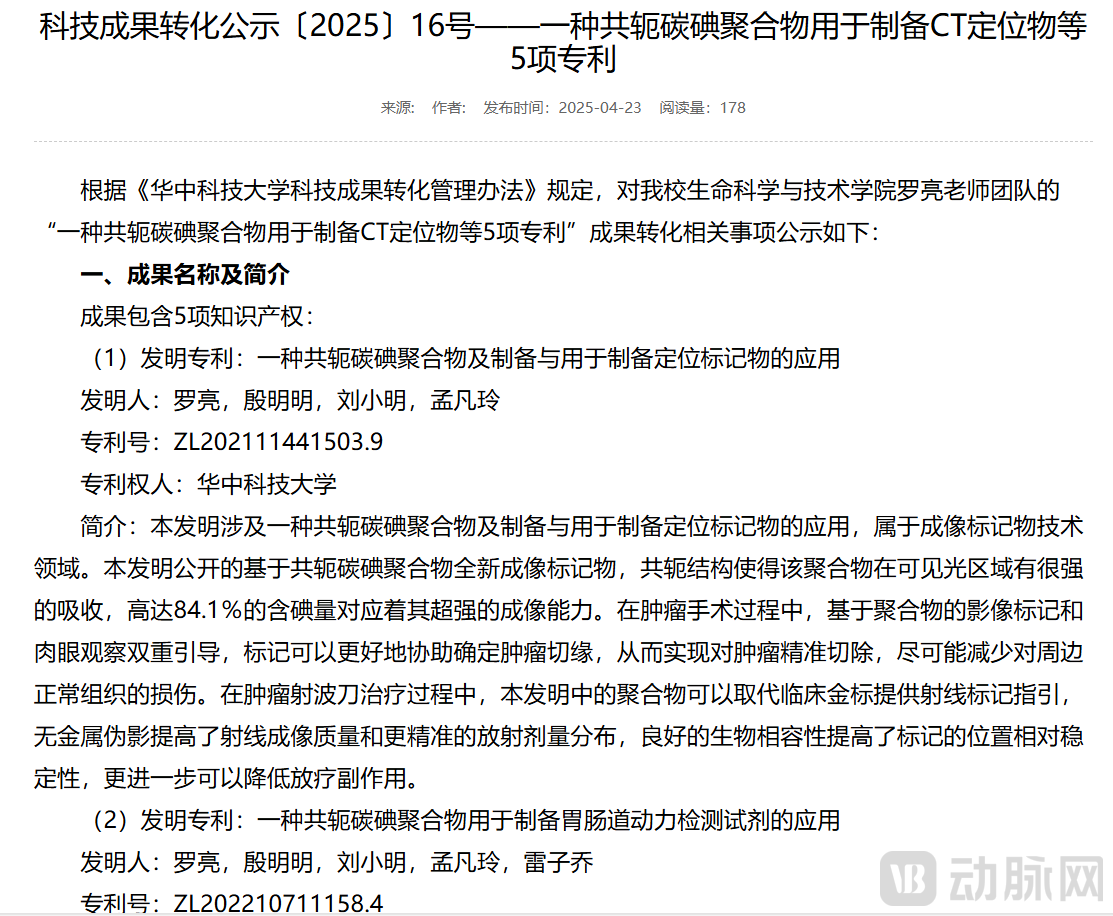
Image from the official website of Huazhong University of Science and Technology
The five core patents involved in this transfer revolve around conjugated carbon-iodine polymers, leveraging84.1% ultra-high iodine content, free of metal artifacts, excellent biocompatibility, and biodegradableits core advantages can address pain points in traditional medical imaging, such as insufficient marker accuracy, high contrast agent dosage, and the discomfort associated with invasive examinations, thereby providing technical support for precision tumor surgery and radiotherapy, as well as non-invasive diagnosis of vascular and gastrointestinal diseases.
From the perspective of disease mechanisms, the core of tumor treatment lies in achieving precise localization and resection. Physiological activities such as respiratory motion can easily cause tumor displacement, necessitating real-time tracking via markers. The diagnosis of vascular diseases requires the use of contrast agents to enhance the density difference between lesioned and normal tissues, thereby clearly visualizing vascular morphology. For gastrointestinal disorders, such as motility insufficiency, abnormal wall morphology, and inflammatory bowel disease, diagnosis relies on assessing gastrointestinal peristaltic patterns, wall structural integrity, and lesion permeability.
InOncology Diagnosis and TreatmentField,Precision Resection and RadiotherapyThe core lies inReal-Time Tracking and Precise Delineation of Tumor Location, but physiological activities such as respiratory motion and changes in body position can easily cause dynamic shifts in the relative position between the tumor and the body surface. This issue directly leads to difficulties in accurately determining tumor margins during surgery, making it highly likely to damage surrounding normal tissues due to excessive resection or result in residual tumor due to insufficient resection; meanwhile,Stability of Radiotherapy MarkersIt directly determines the accuracy of radiation dose distribution; marker displacement or artifact interference can significantly reduce the efficacy of radiotherapy, and even cause radiation-induced damage to normal tissues.
AtAngiographyIn this field, traditional contrast agents require high-dose injections to effectively differentiate between diseased and normal tissues. The administration of volumes often exceeding hundreds of milliliters not only significantly increases the risk of iodine allergy in patients but also exacerbates the metabolic burden on the kidneys. More critically, most traditional contrast agents are small-molecule structures that readily diffuse through vascular walls into surrounding tissues after intravenous injection. This results in a short effective circulation time within the vasculature and a narrow imaging window, making it difficult to capture clear details of vascular lesions and failing to meet the precision diagnostic requirements for conditions such as vascular stenosis and aneurysms.
InDiagnosis of Gastrointestinal DiseasesIn this field, the clinical dilemmas are even more pronounced. Although endoscopic examinations such as gastroscopy and colonoscopy are considered the gold standard for diagnosis, they are invasive procedures that cause significant discomfort to patients, including pharyngeal irritation, abdominal pain, and bloating. Some patients refuse these examinations due to fear, leading to delayed diagnosis and treatment. While barium meal contrast imaging is a non-invasive diagnostic method, it has drawbacks such as susceptibility to sedimentation and the generation of streak artifacts. It not only fails to clearly display the subtle structures of the submucosal layer of the gastrointestinal wall but also struggles to accurately identify early inflammatory lesions or minute pathological changes. Furthermore, barium meal examinations require large volumes of contrast agent to achieve adequate gastrointestinal filling, which increases the burden on the patient’s gastrointestinal tract. In patients with impaired gastrointestinal motility, this may induce adverse reactions such as bloating and constipation, severely restricting early diagnosis and efficacy assessment for conditions like gastrointestinal motility disorders and inflammatory bowel disease.
These five patents innovatively adoptMonoiodo Substitution Design and Topological Polymerization Technology,enabling PIDA to achieve a CT imaging efficiency 1.76 times higher than that of iohexol, a commonly used clinical contrast agent. Its conjugated structure imparts a blue-black appearance, facilitating dual localization through “imaging guidance + visual observation” during tumor resection surgery. This helps surgeons precisely identify tumor margins and minimize damage to normal tissues. When used in CyberKnife radiotherapy, it can replace clinical gold fiducial markers. It not only eliminates metal artifacts and improves the accuracy of radiation dose distribution but also exhibits good biocompatibility and natural degradability after treatment. This addresses the clinical challenges associated with permanent retention of gold markers in the body, which can easily cause edema and localization shifts.
Building on the core materials, the team further expanded into four specialized application scenarios to fully realize the value of the technology:For Vascular Imaging Needs, leveraging the property of conjugated carbon-iodine polymer nanofibers that they do not readily penetrate vascular walls, to achieve prolonged blood circulation time—requiring only5mg/mLUltra-low concentrations can clearly visualize vascular details, far below the 300 mg/mL of traditional iohexol, significantly reducing the risk of iodine allergy; three patents focused on gastrointestinal diagnosis and treatment form a complementary closed loop:Gastrointestinal Motility Testing ReagentEncapsulating PIDA in hydroxymethyl cellulose capsules, which release PIDA into the digestive tract after ingestion by patients. The substance distributes along with intestinal peristalsis and is naturally excreted within 24 hours, allowing for the diagnosis of gastrointestinal dysfunction through X-ray tracking.Reagent for Morphological Examination of the Gastrointestinal WallLeveraging the strong adhesion of nanofibers to the gastrointestinal mucosa, this technology replaces highly invasive gastroscopy and barium meals prone to sedimentation and aggregation, enabling non-invasive, high-resolution imaging of the entire gastrointestinal tract;Inflammatory Bowel Disease (IBD) Diagnostic ReagentsIt ingeniously leverages the altered gastrointestinal wall permeability at inflammatory lesion sites, enabling PIDA to accumulate and remain at the lesions for a prolonged period. This allows precise localization of inflammatory regions via CT imaging, thereby accomplishing comprehensive screening of gastrointestinal tract lesions in a single session.
This system leverages the shared advantages of core materials as a nexus to achieve precise market entry.Tumors, Blood Vessels, Gastrointestinal TractAddressing Diagnostic and Therapeutic Pain Points in Three Key Clinical Areas. It maintains consistency in its technological approach while adapting to diverse clinical needs through minor structural adjustments and formulation optimizations. This not only significantly enhances the precision and efficiency of diagnosis and treatment but also reduces patient discomfort and side effects during examinations and therapies, providing a safe and efficient innovative solution for the clinical translation of precision medicine.
In the current era of rapid development in precision medicine,Imaging Markers and Contrast AgentsAs a critical tool for disease diagnosis and treatment guidance, it has always been a focal point of research and development in the biomedical sector. Its performance directly impacts the precision and safety of diagnosis and treatment, while also driving the continuous iteration and upgrading of products across various technological pathways. The patent for conjugated carbon-iodine polymers (PIDA), developed by Professor Luo Liang’s team at Huazhong University of Science and Technology, represents an innovative achievement targeted at this field. Currently, multiple competing products are distributed across different niche segments, leveraging their unique technical principles and product characteristics to secure corresponding market positions in clinical applications.
Accuray, InnoDx (Xiamen) Technology Co., Ltd.Metallic fiducial markers used for precise localization guidance during tumor radiotherapy (e.g., CyberKnife), providing radiographic markers via CT imaging to offer clear tumor position references for radiotherapy equipment, thereby facilitating accurate radiation targeting and enhancing the precision of radiotherapy.
Iohexol:Non-ionic small-molecule CT contrast agent with an iodine content of 46.4%, suitable for various applications including angiography, contrast-enhanced CT scanning, and body cavity examinations. It enhances the CT imaging contrast of tissues and organs through intravascular or intracavitary injection, providing clear imaging support for the radiological diagnosis of various clinical diseases and assisting physicians in delineating the boundaries between pathological and normal tissues.
Bayer Healthcare Germany Iopromide:Monomeric non-ionic contrast agent, formulated as an injectable solution, is indicated for clinical applications such as angiography and contrast-enhanced CT imaging. It reduces the risk of allergic reactions associated with ionic contrast agents, thereby enhancing clinical safety and providing clear imaging evidence for the diagnosis of vascular and visceral lesions.
Iodixanol:Isotonic Iodinated Contrast Media, with an iodine content of 49.1%, is suitable for angiography, central nervous system imaging, and other procedures. Its isotonic properties reduce vascular irritation, making it safer for patients with renal insufficiency, while clearly visualizing blood vessels and related organ structures to aid clinical diagnosis.
Barium Meal (Barium Sulfate Suspension):A suspension prepared from barium sulfate powder, used for gastrointestinal X-ray contrast examinations. After oral administration, it forms high-density images within the gastrointestinal tract, assisting physicians in visualizing the contour of the digestive tract and identifying pathological changes, thereby providing fundamental imaging reference for the diagnosis of gastrointestinal diseases.
Technetium-99m-Labeled Gastrointestinal Motility Agents:Technetium-99m-labeled radiopharmaceutical for gastrointestinal motility assessment: Evaluates gastrointestinal peristaltic patterns via radionuclide tracking to provide objective data support for the diagnosis of gastrointestinal functional disorders.
Quinoline-thiophene covalent organic polymer (TapB-Qot COP):Covalent Organic Polymers with High Iodine Adsorption Capacity, Achieving an Iodine Adsorption Weight Ratio of 464%. Primarily Applied in the Field of Iodine Adsorption Materials, They Can Be Used for Nuclear Wastewater Treatment, Iodine Resource Recovery, and Other Environmental Protection Scenarios, Enabling Efficient Iodine Adsorption and Separation.
The aforementioned products cover multiple key scenarios, including tumor radiotherapy positioning, angiography, and gastrointestinal disease detection, forming the mainstream application system for reagents related to precision diagnostic imaging. These competing products each have their own technical focuses and clinical scopes of application, having accumulated mature usage experience and a solid market foundation over long-term application. In the future, with continuous technological innovation and the ongoing escalation of clinical demands, various products are likely to undergo further optimization and iteration through competition and complementarity, contributing more significantly to improving the efficiency and safety of disease diagnosis and treatment.