

Jilin University to Transfer Patent for Automated Ice-Crushing Device for Organ Transplantation at RMB 100,000
Recently, Jilin University released a public notice on technology transfer, proposing to assign the patent“An Automated Ice Crushing Device for Organ Transplantation”Patent assignment completed; the assignor is Jilin Province Precise Medical Technology Co., Ltd., with a transaction amount of100,000 yuan。
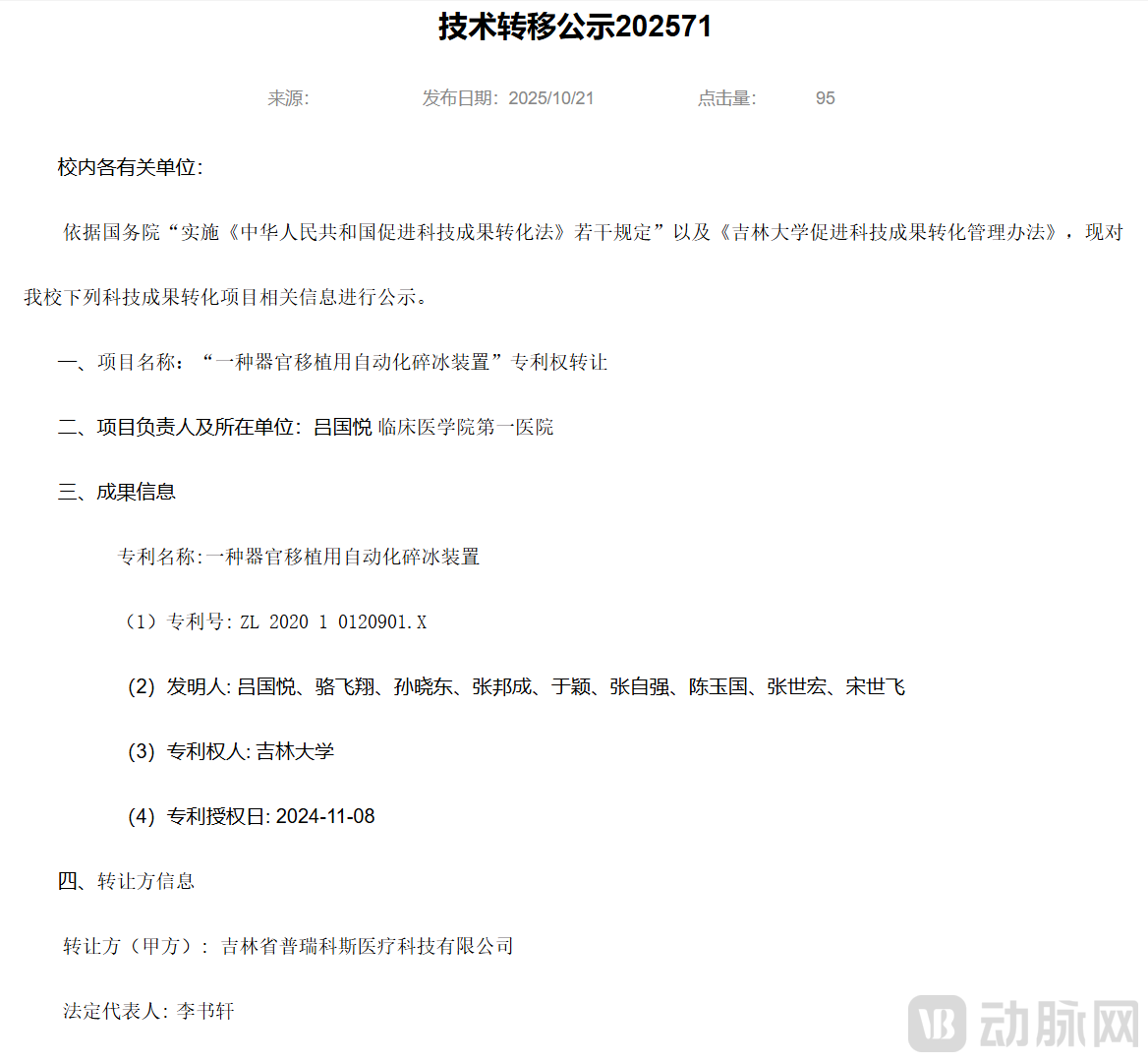
Image from the official website of Jilin University
This patent is by9 inventors including Lv GuoyueR&D has developed a specialized medical ice-crushing device designed specifically for organ transplantation surgeries. Its core innovation lies in the fully automated, high-efficiency crushing of normal saline ice cubes. By precisely coordinating crushing teeth with baffles, it produces ice particles that meet medical standards. The device also features a sliding drive mechanism and a detachable ice-crushing structure, balancing the clinical need for large-batch ice production with medical protocols for convenient post-operative disinfection. Additionally, it offers advantages such as a compact design, small footprint, and low manufacturing cost.
Organ transplantation is the core curative approach for the clinical treatment of end-stage diseases of organs such as the heart, liver, and kidneys. These end-stage organ diseases lead to complete organ failure, which, without transplant intervention, poses a severe threat to patients' lives, whereasMaintenance of Viability in Transplanted OrgansIt is the critical core step that determines the success or failure of organ transplantation surgery, directly affecting the survival and functional recovery of the transplanted organ. In clinical practice,Low-Temperature Storage on Ice Using Saline Ice Cubes, is currently the simplest, most direct, and most widely used clinical approach for maintaining the viability of transplanted organs. This method reduces cellular metabolic rates and minimizes cell damage through a hypothermic environment, thereby buying valuable time for the transport and transplantation of organs from donors to recipients.
However, a persistent clinical shortfall in supporting equipment has long plagued the critical step of organ preservation. Currently, clinical practice relies on bulk saline ice blocks, which are too large to directly meet the precise requirements for organ storage and must be crushed into medical-grade ice particles before use. Yet, there remains a lack of specialized ice-crushing devices designed specifically for organ transplantation surgeries. The use of conventional ice crushers in clinical settings fails to precisely control particle size to match medical standards and cannot accommodate the high volume of ice required, along with the need for immediate, on-site preparation during transplant procedures. Conventional devices suffer from low efficiency and uncontrolled specifications; moreover, design flaws may prevent compliance with sterilization protocols required in medical environments, creating a detailed bottleneck that hinders the efficient and standardized conduct of organ transplantation surgeries.
Based on this, there is an urgent and clear clinical demand for an automated ice-crushing device specifically designed for organ transplantation scenarios. The device must not only achieve efficient, fully automatic crushing of normal saline ice blocks to produce ice particles with dimensions that meet medical standards—thereby satisfying the need for large-volume ice production—but also comply with operational and management protocols in medical settings. It should balance convenience, operability, and sterilizability, thereby filling the market gap for specialized ice-crushing equipment in organ transplantation and providing reliable equipment support for the smooth conduct of organ transplant surgeries.
This automated ice-crushing device for organ transplantation was developed specifically to address clinical needs. It features multiple innovations and significant advantages in both technical design and practical application, effectively filling the market gap for specialized ice-crushing equipment in organ transplantation.
AtCore Ice Fragmentation Technology, the device features an innovative designPrecision Engagement Structure Between Ice-Crushing Teeth and Stop Teeth, The outer periphery of the ice-crushing roller is equipped with four rows of ice-crushing teeth that are uniformly distributed circumferentially and arranged in an alternating pattern. The cutting end features a 40° inclination angle. The spacing between adjacent ice-crushing teeth within the same row is precisely controlled at 30 mm to 35 mm. During rotation, the ice-crushing teeth accurately engage into the gaps between the blocker teeth of adjacent rows, achieving standardized ice fragmentation through crushing and cutting. This design ensures the stable production of physiological saline ice particles that meet medical standards. Meanwhile, the strategic positioning of the blocker teeth effectively prevents the ice-crushing teeth from becoming jammed by ice blocks, thereby significantly enhancing ice-crushing efficiency.
InStructural DesignAbove,The device adopts a modular assembly design.The flat structure of the ice crusher roller mandrel mates with the flat socket of the connecting sleeve, simplifying the assembly and disassembly of the transmission connection. The drive unit features a dual parallel slide rail design, allowing it to slide along the rails and be secured with locking nuts. Combined with a coupling mechanism that enables power disengagement, this design allows the ice crusher to be easily detached from the bracket, meeting stringent disinfection requirements in medical settings and addressing the clinical challenge of inadequate sterilization commonly associated with conventional devices.
AtAutomation and PracticalityLevel, DeviceIntegrated with control device and position adjustment device, the control box enables precise regulation of the drive unit’s start/stop functions and rotational speed, as well as motorized adjustment of the ice collection tray position. This facilitates fully automated ice crushing with minimal manual intervention, efficiently meeting the core demands of organ transplantation surgeries for large volumes of freshly prepared ice on-site. Meanwhile, the device features a compact structure with a small footprint, streamlined component design, and low production costs, balancing clinical operational convenience with economic viability for widespread adoption.
Furthermore, the device is capable of crushing normal saline ice blocks of various shapes and sizes, demonstrating strong adaptability. During operation, bearings provide stable support for the roller mandrel, ensuring operational stability and extending service life, thereby offering reliable equipment support for the efficient and standardized conduct of organ transplantation surgeries.
Overall, the current ice crusher market is characterized by a competitive landscape dominated by high-end international brands, with domestic Chinese brands deeply entrenched in the mid-to-low-end segments. The medical ice crushing equipment sector exhibits a high degree of concentration, with a limited number of manufacturers capable of meeting medical-grade standards. Furthermore, existing products primarily focus on basic medical and laboratory applications, while specialized ice crushing devices for high-end clinical procedures, such as organ transplantation, remain a gap in the market.
Xi'an Bino XH-100 Laboratory Ice CrusherIt is the brand's flagship flake ice-making equipment and also the mainstream model of general-purpose ice crushers used in laboratories across China.Adopts an integrated ice-making and crushing structure, equipped with imported transmission and power components, ensuring stable operation and low noise. The device features a fully computerized program control system for easy operation, along with multiple fault protection functions such as ice-full and water-shortage alerts. Its compact design fits laboratory spaces, and the materials are easy to clean, facilitating convenient daily maintenance.
In terms of market applications, this model is primarily used in various scientific research settings, including physics, chemistry, and biology laboratories at universities and research institutes. It is also suitable for R&D experiments in fields such as chemical engineering and food processing, providing crushed ice support for low-temperature storage of experimental samples and maintaining ice-bath environments. Additionally, it is employed in the basic clinical laboratory departments of some medical institutions to meet the ice requirements for routine low-temperature sample processing.
Scotsman's classic commercial medical ice crusher.For example,AF100-ASAs a representative model of international ice-making equipment brands, it adopts an integrated design for professional ice production and crushing. With mature craftsmanship in core components and strong operational stability, it is equipped with hygienic protection features suitable for both medical and commercial scenarios. The body is constructed from food-grade stainless steel, balancing ease of cleaning with usage safety. Intelligent control enables adaptable crushed ice output to meet the demands of various applications.
In terms of market applications, leveraging the brand’s technological expertise and quality assurance, this model is widely used in departments such as clinical laboratories and outpatient clinics within high-end medical institutions. It also serves commercial scenarios with stringent requirements for crushed ice quality and hygiene standards, including star-rated hotels, premium dining establishments, and research laboratories, making it the mainstream choice for mid-to-high-end crushed ice needs.
Jilin University’s patent for an automated ice-crushing device for organ transplantation precisely addresses the specialized ice-crushing requirements of this advanced clinical procedure, filling a market gap and offering broad prospects for market development. From the demand side, the global and domestic organ transplantation industries are experiencing rapid growth, with a continuous increase in the number of transplant surgeries. There is a rigid, high-frequency demand for physiological saline ice that meets medical standards for organ preservation, thereby creating a dedicated market space for this patented product.
FromIndustry EnvironmentThe market size of medical ice-making equipment is continuing to climb. Policy support for innovation and localization of medical devices, coupled with the demand from healthcare institutions for upgrading high-end surgical ancillary equipment, has provided a favorable policy and industry environment for the commercialization of this patented product. Meanwhile, the product boasts core advantages tailored to clinical surgery, including automation, ease of sterilization, and a compact structure. It aligns well with the actual needs of sterile operations in operating rooms and large-volume, on-demand ice production, demonstrating significant advantages in scenario adaptability compared to general-purpose equipment.
FromMarket CompetitionCurrently, there is no dedicated ice-crushing equipment designed specifically for organ transplantation scenarios. Leveraging its core competitive advantages of scenario-specific customization and specialized technology, this patented product can rapidly capture a niche market. Its low production cost and ease of promotion facilitate widespread adoption among medical institutions in China qualified to perform organ transplants. In the future, further technological iterations could enable expansion into related medical applications, such as organ transport and cryogenic storage of biological samples. With significant market expansion potential, the product offers both industrialization value and clinical application value.