BeiGene's Growth Question: How Far Can Zanubrutinib Go in the Next Five Years After Topping U.S. Market Share?
BeOne
Developer of Molecular Targeted and Immune Anti-Tumor Drugs
Since the release of the 2025 preliminary earnings announcement and the 2026 earnings forecast,BeOne MedicinesThere was no significant rise in A-shares, Hong Kong stocks, or U.S. stocks.
However, 2025 marked BeOne Medicines’ first full-year profit in its 12-year history, and according to data from a research report by SDIC Securities,In Q3 2025, zanubrutinib’s U.S. market share reached 33.8%, surpassing ibrutinib to claim the top spot, with its global market share exceeding 30% in Q4 2025.
However, stock performance has shown a divergence. VCBeat has learned from multiple industry insiders in the healthcare sector that this may be related to market expectations for zanubrutinib, with widespread concern over whether its growth has already peaked.
BeOne Medicines stated to VCBeat that its 2026 guidance represents a preliminary assessment based on currently available information, including the global economic environment, industry developments, the company’s operational performance, and business trends.
“The Company’s 2026 total revenue guidance remains underpinned by expectations of robust growth.“The company expects the U.S. market to continue delivering strong growth, with net prices remaining relatively stable; meanwhile, all markets are projected to sustain growth and benefit from continued expansion in other key global markets,” BeOne Medicines noted.
Medical industry expert Liu Jian told VCBeat that zanubrutinib has not been on the market for long and has certainly not yet reached its revenue peak, with continued growth expected. The market has always had high expectations for zanubrutinib; the slight gap between the publicly released 2025 preliminary earnings results and 2026 earnings forecasts and market expectations is, in fact, a case of “high expectations leading to harsh criticism.”
“BeOne Medicines has maintained high growth, and the market is unaccustomed to the recent slowdown in its growth rate. Amid sensitive market sentiment and volatility in the Hong Kong stock market, fluctuations in the company’s share price are normal. However, this pessimistic mood is unlikely to last long, as the fundamentals remain optimistic,” said Liu Jian.
01.
Five-Year Review: Rebalancing Scale and Speed
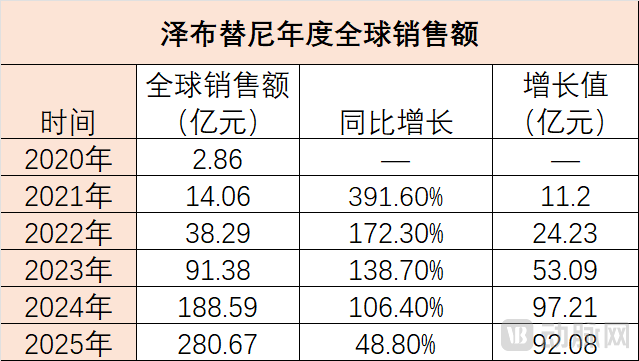
Image source: VCBeat New Medicine
Reviewing the development trajectory of zanubrutinib from 2020 to 2025, its growth trend demonstrates“Shifting Growth Gears, Sustaining Incremental Gains”characteristics.
Although the year-on-year growth rate has gradually slowed from 391.6% in 2021 to 48.8% in 2025, this should not be simply interpreted as “sluggish growth,”Rather, it is the process of entering a higher-order growth phase after achieving explosive initial growth from 0 to 1.
The high initial growth rate was driven by a low base. In 2021, zanubrutinib’s sales surged from RMB 286 million to RMB 1.406 billion, demonstrating its market potential with an nearly fourfold increase.
As sales volume expands rapidly, the growth rate begins to decline.However, the “gold content” of the growth—namely, its absolute value—has become increasingly substantial.
In 2023, zanubrutinib’s global sales surpassed the RMB 9 billion mark, with a year-on-year increase of RMB 5.309 billion, exceeding its total annual sales in 2022.
In 2024, zanubrutinib’s sales approached RMB 19 billion, with its annual growth (RMB 9.721 billion) nearly 34 times the full-year sales in 2020. Even in 2025, when the growth rate slowed to 48.8%, the increase of RMB 9.208 billion remained at a historic high.
This “volume growth without price reduction” trend is inseparable from the deepening of zanubrutinib’s global strategic layout.
The U.S. market continues to serve as the core engine, contributing the majority of sales volume with over RMB 20 billion in revenue in 2025. The European market is emerging as a new high-growth pole, with sales jumping from RMB 2.564 billion to RMB 4.265 billion over two years. Meanwhile, the Chinese market has maintained steady growth, with approved indications continuously being included in the National Reimbursement Drug List.
However, based on the growth rate in 2026, BeOne Medicines forecasts revenue of approximately RMB 43.6 billion to RMB 45.0 billion, representing a year-over-year revenue growth of about 14.12%–17.79%, compared with a 40.4% revenue growth rate in 2025.
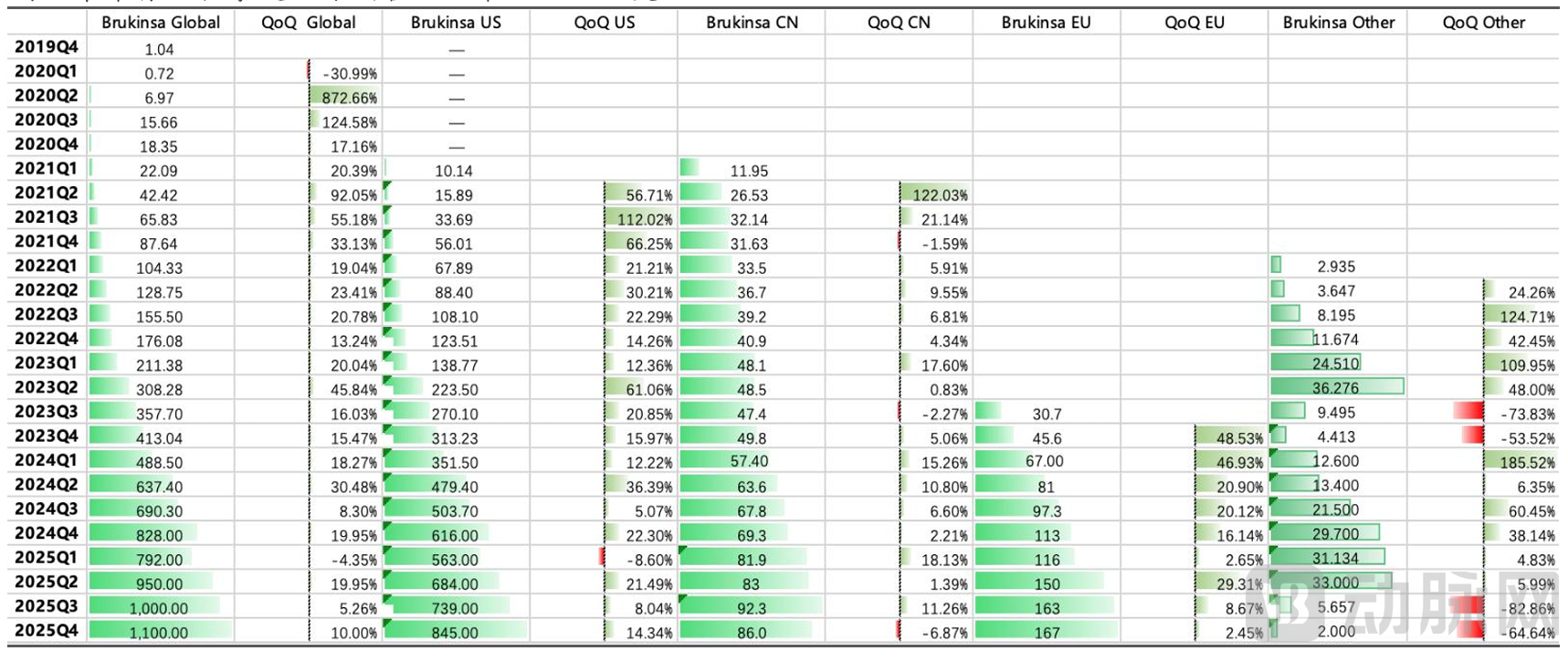
Additionally, according to research data from SDIC Securities, the volatility of zanubrutinib’s quarter-on-quarter growth rate appears to have increased in 2025:
● In the first quarter, global sales of zanubrutinib amounted to $792 million, representing a 4.35% quarter-on-quarter decline;
● Sales rebounded sharply in the second quarter, reaching $950 million, a significant 19.95% increase quarter-over-quarter;
● In the third quarter, sales surpassed the $1 billion mark for the first time, with the quarter-on-quarter growth rate slowing to 5.26%.
● In the fourth quarter, sales climbed to $1.1 billion, representing a 10% quarter-on-quarter increase.
In Q4 2025, the growth rate of zanubrutinib in China slowed down, with sales reaching $86 million, a quarter-on-quarter decrease of 6.87%. Sales in Europe amounted to $167 million, representing a quarter-on-quarter increase of 2.45%.
Zanubrutinib Global Sales by Quarter (in million USD)
Image source: SDIC Securities research report
02.
“Old Enemies” and “New Threats”
Behind the slowing growth rate, zanubrutinib may face competitive pressures from two fronts—joint competition from AstraZeneca and AbbVie, as well asThird-Generation BTK Inhibitorsstress.
AstraZeneca and AbbVie are “long-standing rivals” of BeOne Medicines. According to data compiled by the Insight database, multiple BTK inhibitors have been approved for marketing worldwide, including ibrutinib (Johnson & Johnson/AbbVie), acalabrutinib (AstraZeneca), zanubrutinib (BeOne Medicines), tirabrutinib (Gilead Sciences/Ono Pharmaceutical), orelabrutinib (InnoCare Pharma), andPirtobrutinib(Eli Lilly) etc.
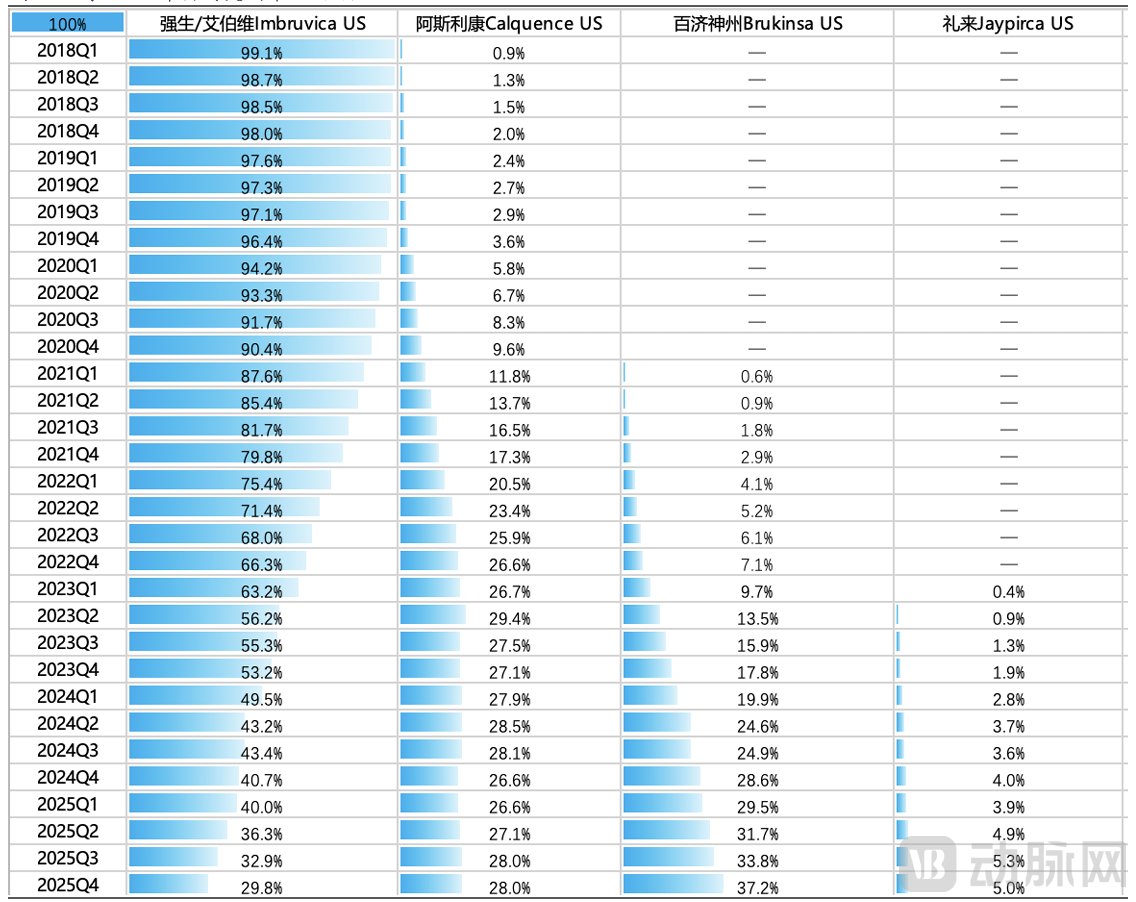
In 2024, the global market size for BTK inhibitors reached approximately USD 12.5 billion, with ibrutinib, zanubrutinib, and acalabrutinib accounting for over 97% of the market share. In Q3 2025, zanubrutinib’s market share in the United States reached 33.8%, surpassing ibrutinib to become the leading product, while its global market share exceeded 30% in Q4 2025.
U.S. Market Share of Different BTK Inhibitors
Source: SDIC Securities
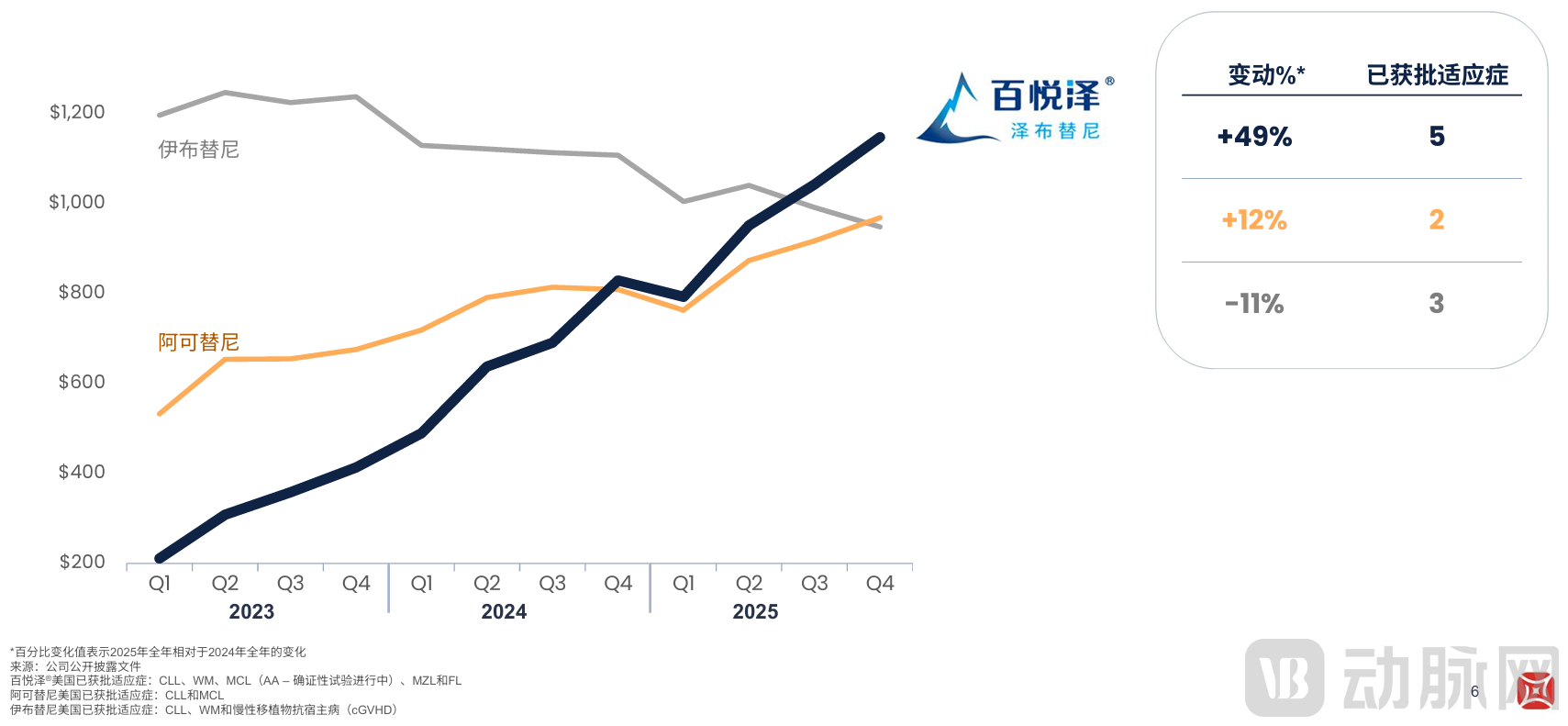
Growth Rate Data for Ibrutinib, Acalabrutinib, and Zanubrutinib
Source: BeOne Medicines
Despite its strong momentum in market share, the continuous treatment model represented by zanubrutinib, a BTK inhibitor, is facing new challenges.
On June 6, 2025, AstraZeneca announced that acalabrutinib in combination with venetoclax (a BCL-2 inhibitor, an AbbVie product)Fixed-Duration Treatment RegimenApproved in the European Union for the treatment of adult patients with previously untreated chronic lymphocytic leukemia (CLL).
February 20, 2026: Acalabrutinib in Combination with VenetoclaxApproved by the U.S. as the first all-oral, fixed-duration treatment regimen, indicated for the treatment of adult patients with chronic lymphocytic leukemia (CLL) and small lymphocytic lymphoma (SLL).
BeOne Medicines pointed out to VCBeat that the current treatment landscape for CLL is roughly divided into two categories: one group of patients receiving continuous treatment with BTK inhibitors, and the other group receiving a fixed-duration therapy.
It is understood that the advantages of fixed-duration therapy include inducing deeper remission, providing treatment-free intervals, and potentially reducing long-term toxicity; however, it remains inconclusive whether the efficacy of fixed-duration therapy is superior to that of continuous therapy.
“Existing fixed-duration treatment regimens still have limitations.“We believe that to change the treatment paradigm and achieve long-term benefits comparable to those of zanubrutinib, a fixed-duration regimen must be able to induce deep responses, demonstrate sustained progression-free survival (PFS) benefits, exhibit a high safety profile (with a minimal increase in infection risk compared to continuous BTK inhibitor therapy), and offer convenient administration,” stated BeOne Medicines.
Further downstream pressure may also stem from technological iteration—the third-generation BTK inhibitors.
Ibrutinib is a first-generation BTK inhibitor, while acalabrutinib and zanubrutinib are second-generation agents.
According to experts at the First Affiliated Hospital of Nanjing Medical University, ibrutinib, zanubrutinib, and acalabrutinib are all covalent BTK inhibitors (BTKi) that share the same mechanism of action: they bind to the C481 residue of BTK, thereby inhibiting BTK enzymatic activity and reducing the proliferation of malignant B cells.
ButLong-term use of covalent BTK inhibitors may face resistance challenges, with C481 being the most common resistance mutation site.。Studies have shown that 70% of patients with progressive chronic lymphocytic leukemia (CLL) develop resistance mutations at the C481 site, which is the most common resistance locus in covalent BTK inhibitor (BTKi) therapy.
To address drug resistanceQuestion, with Pirtobrutinib(Pirtobrutinib)represented byThird GenerationBTK inhibitors have been developed and applied in clinical trials; these BTKi can reversibly bind to the BTK kinase and are known asNon-covalent BTKi。
It is reported that pirtobrutinib was developed by Eli Lilly, with Innovent Biologics responsible for its commercialization in mainland China.
In October 2024, pirtobrutinib was approved by the National Medical Products Administration for marketing as a monotherapy for adult patients with relapsed or refractory mantle cell lymphoma (MCL) who have previously received BTK inhibitor therapy.
On March 2, 2026, pirtobrutinib was officially approved in China for a new indication: the treatment of adult patients with chronic lymphocytic leukemia (CLL)/small lymphocytic lymphoma (SLL) who have received at least one prior systemic therapy that included a Bruton’s tyrosine kinase (BTK) inhibitor.
Meanwhile,Eli Lilly is taking the offensive with a series of head-to-head Phase III trials, simultaneously challenging ibrutinib, acalabrutinib, and zanubrutinib in MCL, while directly targeting ibrutinib in CLL/SLL.
Additionally, Merck & Co.’s third-generation candidate drug MK-1026 (nemtabrutinib), also a high-affinity non-covalent BTK inhibitor, has entered Phase III clinical trials, with published data further demonstrating its clinical potential.
03.
Zanubrutinib’s “Combination Therapy”
In the face of these potential competitive pressures, BeOne Medicines is continuously widening the moat for zanubrutinib.
First, continuously throughHead-to-Head TrialDrive growth.
According to the announcement,InFixed-Duration Treatment RegimenIn this regard, BeOne Medicines is advancing head-to-head trials directly against AstraZeneca and AbbVie.— The first patient has been enrolled in the Phase 3 trial comparing zanubrutinib plus sotoclax versus acalabrutinib plus venetoclax for the treatment of adult patients with previously untreated chronic lymphocytic leukemia (CLL).
BeOne Medicines told VCBeat that zanubrutinib currently holds approximately 50% of the market share among new patients receiving continuous BTK inhibitor therapy in the United States.
“In the future, zanubrutinib will not only serve as a continuous treatment regimen but can also be combined with sotorasib to provide a potential best-in-class fixed-duration treatment option for patients who prefer a defined course of therapy. The combination of zanubrutinib and sotorasib (ZS) will enable us to tap into the fixed-duration treatment market, an area we have not yet entered.”
It is understood that sotoclax, like AbbVie’s venetoclax, belongs to the class of BCL-2 inhibitors.
Furthermore, BeOne Medicines stated that the Phase 3 MANGROVE trial, evaluating zanubrutinib in combination with rituximab versus bendamustine plus rituximab in patients with previously untreated mantle cell lymphoma (MCL), is ongoing, with an interim analysis expected in the first half of 2026. Upon approval, this regimen would become the first chemotherapy-free treatment option for first-line therapy in patients with MCL.
Secondly, we continue to widen our moat in the CLL field.
BeOne Medicines informed VCBeat that, in the field of chronic lymphocytic leukemia (CLL), the company has established a diversified therapeutic portfolio comprising zanubrutinib, sonrotoclax, and BGB-16673 (a BTK CDAC).and developed a comprehensive registration plan covering all treatment-naïve and relapsed CLL patient populations.
It is reported that zanubrutinib has already been approved for use in both treatment-naïve and relapsed/refractory CLL patients, laying a solid foundation. In first-line CLL treatment, zanubrutinib will continue to serve as a cornerstone therapy, including as continuous treatment and in combination with sonrotoclax as a potential best-in-class fixed-duration regimen.
In the treatment of relapsed or refractory (R/R) CLL, in addition to zanubrutinib, BeOne Medicines will offer BGB-16673 as another potential therapeutic option.
“In addition, we believe that the combination regimen of BGB-16673 and sonrotoclax has the potential to deliver a best-in-class, fixed-duration therapy for patients with relapsed or refractory (R/R) chronic lymphocytic leukemia (CLL). The company is also developing another fixed-duration option, namely sonrotoclax in combination with an anti-CD20 antibody, which is currently being evaluated in a head-to-head Phase 3 study against venetoclax,” stated BeOne Medicines.
Additionally, there is BeOne Medicines' inherent R&D and clinical accumulation.
BeOne Medicines told VCBeat that, in terms of R&D, the company has built a global research and development team of approximately 4,800 members after years of investment and development, establishing one of the largest oncology research teams in the industry. In 2025 alone, BeOne Medicines completed clinical proof-of-concept for five new products and advanced 17 new molecular entities into clinical stages over the past two years.
Moreover, BeOne Medicines has established a "fast track" for global clinical development.
For example, over the past two years, BeOne Medicines has completed enrollment in approximately 200 dose-escalation cohorts across multiple first-in-human studies, with a median enrollment time of just 1.5 months per cohort, compared to the industry standard of approximately three months. In terms of regulatory submissions, BeOne Medicines’ most recent New Drug Application (NDA) filed with the U.S. Food and Drug Administration (FDA) was the initial submission for sotoclax in the treatment of mantle cell lymphoma.The submission was completed within one month after the key data readout, whereas the industry standard is typically four to six months.
In summary, while the growth rate of zanubrutinib has slowed amid the current competitive landscape and strategic positioning, it is far from reaching its ceiling. The true test lies in whether it can replicate its success in continuous therapy within fixed-duration regimens, and whether it can withstand the disruptive impact of next-generation BTK inhibitors.
The projected growth rate for 2026 may merely represent an inevitable phase in the transition of innovative drugs from a period of explosive growth to maturity.