

West China Hospital to Transfer Laser Microdissection Slide Holder Patent for RMB 100,000
Recently, West China Hospital of Sichuan University released a public notice on the transfer of patent rights, proposing to transfer its"A Slide Fixation Device for Laser Microdissection Equipment"the patent was transferred to Chengdu Jincheng Dujiang Biotechnology Co., Ltd. through agreement-based pricing, with a transaction amount of100,000 yuan。
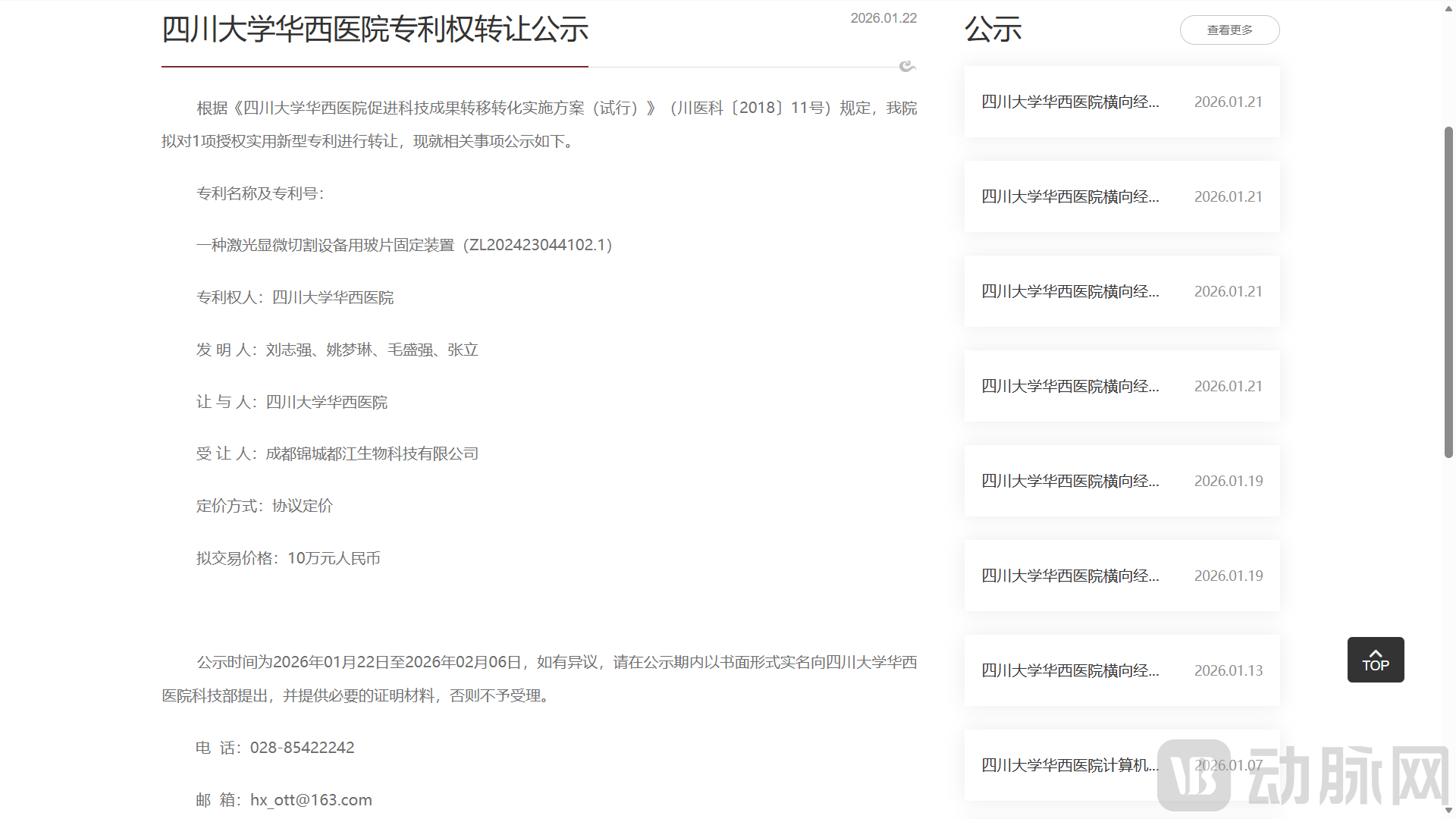
Image source: Public Information Disclosure of West China Hospital, Sichuan University
This patented device, through its innovative design of a limiting component, addresses the pain point of inconvenient operation for personnel wearing gloves in traditional slide fixation methods, enabling rapid and synchronized slide fixation. Its successful transfer will provide key technical support for the standardized and convenient conduct of biomedical experiments involving laser microdissection, helping to improve experimental operational efficiency and equipment practicality in related fields. The inventor of this patent isYao Menglin and her team.
Laser Microdissection TechnologyIt is a key technology for conducting pathological diagnosis, tumor mechanism research, and other work in the field of biomedicine. Its core principle isPrecise isolation of target cells or tissue regions from histological sections using laser technology to provide high-purity samples for downstream applications such as gene sequencing and protein expression analysis., is an important prerequisite for achieving precise disease diagnosis and research into personalized treatment.
In clinical and scientific research practice,Stable Fixation of SlidesIt is a critical step in ensuring the precision of laser cutting. Once the slide shifts or vibrates, it will not only cause deviations in the cutting of target samples and reduced purity but may also lead to irreversible waste of precious materials such as tumor tissues and pathological samples from rare diseases, directly affecting the reliability of subsequent diagnostic results and research conclusions. However, existing slide fixation methods mostly rely on manually pushing metal slides, which has significant drawbacks.
First, when operators wear protective gloves, their manual dexterity is limited, significantly reducing the precision of sliding component manipulation and making it prone to inadequate fixation.
Secondly, the metal sliders require manual adjustment one by one, making it impossible to achieve simultaneous fixation; this cumbersome operational process significantly reduces experimental efficiency.
Third, the limited contact area between traditional slides and glass slides results in insufficient fixation stability, making them difficult to adapt to the high-precision operational requirements of laser microdissection.
In summary, the numerous shortcomings of traditional slide fixation protocols have become core bottlenecks restricting the clinical efficacy of laser microdissection technology and compromising experimental accuracy and efficiency. Consequently, there is an urgent need for a specialized product that addresses issues of precision, synchronization, and stability in slide fixation, thereby overcoming technical application barriers and ensuring that laser microdissection fully realizes its core value in pathological diagnosis and scientific research.
The core advantages of this patented device are primarily reflected inStructural Synergy and User-Friendly OperationTwo major dimensions have achieved a comprehensive upgrade compared to traditional fixed protocols. The device precisely addresses the three core pain points of laser microdissection slide fixation: first,Addressed the issue of "inconvenient operation while wearing gloves" in traditional solutions, the knob-turning design eliminates the need for fine motor skills, complying with protective standards for clinical research; secondly,Addressed the industry-wide problem of "inefficient one-by-one adjustment", the synchronized movement of the three limit clamps can reduce the fixation time by more than 60%, thereby improving the overall efficiency of the experimental workflow; third,Solved the Key Challenge of “Unstable Fixation Leading to Easy Sample Loss”The combination of bidirectional limit blocks and anti-slip pads can effectively secure slides of various specifications, preventing the waste of precious samples such as tumor tissues and pathological sections for rare diseases due to displacement, thereby ensuring the accuracy of subsequent experimental results including gene sequencing and protein analysis.
InStructural InnovationIn terms of structure, the device uses a perforated mounting base as its primary carrier; the perforations are designed to accommodate the optical path requirements of laser microdissection equipment, thereby avoiding obstruction of the cutting area. Multiple sets of threaded mounting slots on the bottom of the mounting base enable rapid interfacing with various models of microdissection systems, enhancing the device’s compatibility and versatility. Its core limiting component employs“Threaded Rod + Three-Limit Clamps + Dual Limit Blocks”co-design, where the threaded rod in the left limiting slot, combined with the sliding groove, can drive three limiting clamps to move forward synchronously along a fixed trajectory, working in conjunction with the first limiting block in the right limiting slot and the second limiting block on the left, thereby forming“Bidirectional Clamping + Multi-Point Positioning”its robust structure completely eliminates the cumbersome traditional method of adjusting metal sliders one by one.
InOperation OptimizationOn this level, the rotating knob installed at the front end of the threaded rod significantly reduces the required operating force, allowing for easy rotational adjustment even when the operator is wearing thick protective gloves. The anti-slip pad on the front side of the limiting clip increases friction with the glass slide, which not only prevents the slide from shifting during cutting but also avoids breakage caused by uneven clamping force.
In recent years, laser microdissection and its associated technologies have undergone continuous iterative upgrades. From precision innovations in core cutting systems to practical optimizations of auxiliary devices, a series of innovative achievements are providing more efficient and less damaging technical support for life science research, thereby facilitating the in-depth advancement of multi-disciplinary studies in genomics, proteomics, and other fields.
Leica Microsystems CMS GmbHR&DLaser Microdissection System, featuring a unique design that employs mobile laser rather than moving the sample, combined with a hole-positioning unit controlled by contour data and gravity-based collection technology, it enables precise isolation ranging from single cells to entire tissue regions while minimizing sample contamination. Its LMD6 and LMD7 systems are tailored for standard soft-tissue sectioning and diverse tissue-cutting requirements, respectively, providing reliable tools for multi-omics research, live-cell culture, and other applications.
Huazhong University of Science and TechnologyDeveloped“Laser Microdissection System Based on Coherent Raman Imaging”, innovatively integrating a dual-beam femtosecond laser design, it first achieves label-free, chemically specific imaging via coherent Raman technology to precisely identify target components such as lipids and proteins in the sample, then switches the optical path to perform cutting. This system eliminates the coordinate registration errors between imaging and cutting inherent in traditional methods, enhancing both the precision and real-time capability of the cutting process, while avoiding sample damage caused by staining steps, making it particularly suitable for processing rare samples and easily degradable RNA samples.
Suzhou Disait Pathology Diagnosis Center Co., Ltd.R&D"Anti-Adhesion Slide Holding Mechanism"By incorporating a stop-bar structure into the clamping assembly, a counterforce is applied to adherent slides during the slide clamping and movement process, facilitating smooth separation of the slides from the clamping jaws. This device effectively addresses slide adhesion issues caused by factors such as residual labels, ensuring stability and integrity during sample handling. It is broadly compatible with various experimental scenarios involving slide operations, providing stable auxiliary support for procedures such as laser capture microdissection.
From technological breakthroughs in core cutting systems to detailed optimizations of auxiliary devices, these innovative achievements are driving microdissection technology toward greater precision, efficiency, and minimal tissue damage, continuing to inject strong momentum into the in-depth development of life sciences research.