

Ningxia Medical University to Transfer TCM Patent for Ischemic Stroke Treatment at RMB 17,000
Recently, Ningxia Medical University released a public notice on the transformation of scientific and technological achievements. The university intends to transfer its intellectual property through negotiated pricing."A Chinese Medicine Composition for Treating Ischemic Stroke and Its Preparation Method"Relevant patents were assigned to Jiangxi Jingcheng Scientific and Technological Research Co., Ltd., with a transfer fee of RMB17,000 yuan. The inventor of this patented technology isProf. Ma Xueqin and Her Team。
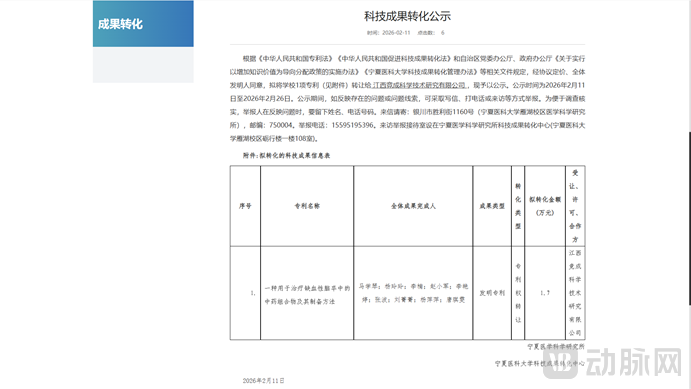
Image source: Official website of the Ningxia Hui Autonomous Region Institute of Medical Sciences
The core of the present invention is throughClove, Nutmeg, Musk, SaffronScientific compatibility and standardized extraction and preparation of four traditional Chinese medicinal herbs yield a herbal composition capable of preventing cerebral ischemia-reperfusion injury, protecting neurological function, and reducing cerebral infarct volume, for the prevention and treatment of ischemic stroke.
Ischemic StrokeAs the most prevalent type of stroke, accounting for approximately 80% of all cases, itsHigh Incidence, High Mortality, and High Disability Rates, posing a serious threat to human health and becoming the leading cause of death among residents in China, whileCerebral Ischemia-Reperfusion Injuryis a key precipitating factor that exacerbates neurological deficits in patients and leads to severe sequelae such as hemiplegia,How to Effectively Prevent and Treat Ischemic Stroke and Alleviate Cerebral Ischemia-Reperfusion Injury, becoming a critical challenge urgently needing resolution in clinical practice. Meanwhile, in the clinical treatment and prevention of ischemic stroke, existing drugs and therapeutic regimens still face multiple challenges—difficulty in simultaneously meeting the core demands of “long-lasting efficacy, multi-target protection, and ease of clinical adoption”—thus creating multidimensional market pain points.
From a clinical application perspective, conventional Western medicines remain the mainstream choice for treating ischemic stroke, yet they exhibit significant limitations. On one hand, commonly used antithrombotic agents and neuroprotective drugs are constrained by narrow therapeutic time windows, characterized by short onset periods and single mechanisms of action. These limitations hinder their ability to address the complex pathophysiological mechanisms of cerebral ischemia-reperfusion injury, resulting in limited protection for neurons and the blood-brain barrier. Consequently, most patients still experience varying degrees of neurological deficits. On the other hand, some Western medicines carry certain side effects and are prone to inducing drug resistance with long-term use, leading to suboptimal efficacy in preventing stroke recurrence and failing to provide patients with a long-term, safe protective strategy. Taking the treatment of acute ischemic stroke as an example, approximately half of the patients suffer from sequelae such as hemiplegia and cognitive impairment due to missing the optimal therapeutic window or insufficient drug-mediated protection. This significantly reduces patients' quality of life and exacerbates the burden on both clinical treatment and home care.
Although some single-herb traditional Chinese medicine (TCM) formulations or conventional compound preparations have attempted to intervene in the treatment of ischemic stroke, they have fallen into“Single-target action, poor synergistic effect”dilemma. Currently, some single-herb Chinese medicines used in clinical practice can exert certain effects at a single stage; for example, some blood-activating herbs can improve cerebral blood circulation, and some calming herbs can provide mild neuroprotection. However, since cerebral ischemia-reperfusion injury involves damage to multiple targets, including blood vessels, neurons, and the blood-brain barrier, single-herb Chinese medicines are difficult to achieve comprehensive protection across multiple stages and targets, significantly compromising therapeutic efficacy. Meanwhile, conventional Chinese herbal formulas are mostly large-complex formulations with numerous ingredients and intricate ratios. Some of these formulas also suffer from low extraction efficiency of active constituents and unclear mechanisms of action, making it difficult to achieve industrialized production through standardized manufacturing processes and hindering rapid, uniform promotion and application in clinical settings. This limits the realization of the clinical value of traditional Chinese medicine in the treatment of ischemic stroke.
Although existing extraction and formulation technologies for traditional Chinese medicine have made some explorations in terms of enrichment of active ingredients and optimization of preparation processes, they have not yet achieved breakthroughs.“Non-standardized processes and insufficient adaptability”dual bottlenecks. Most related technologies focus on optimizing a single extraction method, such as aqueous or alcoholic extraction alone, failing to design targeted extraction protocols based on the compositional characteristics of different medicinal materials. This results in insufficient extraction of active ingredients, thereby compromising drug efficacy. Meanwhile, in formulation preparation, some technologies lack standardized process parameters, leading to significant batch-to-batch variability in active ingredient content and making it difficult to ensure the stability and safety of clinical medication. Furthermore, the selection and ratio of excipients in certain traditional Chinese medicine (TCM) formulations lack scientific design, failing to balance drug bioavailability with clinical convenience. Additionally, some manufacturing processes are complex and require sophisticated equipment, hindering large-scale industrial production and failing to meet the substantial clinical demand for drugs for the prevention and treatment of ischemic stroke.
It is precisely the core pain points in the treatment of ischemic stroke—such as the narrow therapeutic window for drug efficacy, the limited effects of single-target agents, and the lack of standardized manufacturing processes for traditional Chinese medicine (TCM)—that have driven innovation in TCM-based therapies for ischemic stroke. The TCM formulation and preparation method provided by this patent offer a solution whose core advantages and advancements lie in breaking through the limitations of conventional pharmacotherapies for ischemic stroke, by"Synergistic Enhancement through Multi-Ingredient Herbal Combinations"with“Standardized Industrial Preparation”deep integration, establishing a safe, efficient, and easily promotable technical pathway for the prevention and treatment of ischemic stroke using traditional Chinese medicine.
This protocolFirst, it achieved the synergistic effect of multi-target neuroprotection and maximized protective efficacy.Conventional Western drugs act only at a single step, making it difficult to address the complex pathological mechanisms of cerebral ischemia-reperfusion injury, while single-herb Chinese medicines also fail to achieve comprehensive multi-target protection of neurons, the blood-brain barrier, and other components.
This patentScientifically formulated with four premium herbs: clove, nutmeg, musk, and saffron., establishing an optimal weight ratio of 30:100:1:30. Each herbal ingredient plays a distinct role and works synergistically to enhance efficacy in the prevention and treatment of ischemic stroke: eugenol from Clove improves neurological behavior and reduces cerebral infarct volume; Nutmeg extract inhibits neuronal necrosis and loss; Musk protects the structural integrity of the blood-brain barrier following cerebral ischemia-reperfusion injury; and Saffron extract alleviates energy metabolism disorders induced by stroke. The combination of these four herbs forms a multi-target, multi-link protective system. Compared with the use of individual herbs alone, this formulation significantly lowers neurological deficit scores, substantially reduces cerebral infarct volume, and effectively prevents cerebral ischemia-reperfusion injury. Animal experiments have confirmed no obvious toxic or side effects, providing a safer and more effective traditional Chinese medicine regimen for the prevention and treatment of ischemic stroke.
Another major core advantage of the solution lies inTargeted Extraction of Medicinal Materials and Standardization and Industrialization of Preparation Processes. Traditional Chinese medicine (TCM) compound prescriptions often suffer from limitations such as singular extraction methods and insufficient extraction of active ingredients. Furthermore, ambiguous preparation process parameters and complex operations hinder large-scale production and clinical promotion. This patent presents a comprehensive optimization design for the preparation process, achieving precision in medicinal material processing and extraction: Based on the compositional characteristics of Clove, Nutmeg, Musk, and Saffron, a graded pulverization process is employed. Clove and Nutmeg are pulverized and passed through 14–100 mesh sieves, while Musk and Saffron are ground and passed through 100–200 mesh sieves, thereby accommodating subsequent diverse extraction and mixing requirements. For Clove and Nutmeg, various targeted extraction methods have been designed, including ultrasonic extraction, heating reflux, aqueous extraction of volatile oils combined with decoction, which can be selected according to actual needs. Additionally, an ethanol-water solution (60%–80%, preferably 75%) can be used as the extraction solvent to fully enrich the effective active constituents in the medicinal materials, ensuring therapeutic efficacy.
Meanwhile, the preparation process features a high degree of standardization and operability, with the overall workflow divided into onlyHerbal Material Pulverization, Clove and Nutmeg Extraction, and BlendingThe three-step process clearly defines the process parameters and operational requirements for each step, such as the temperature and duration of ultrasonic extraction, the solid-to-liquid ratio and number of extractions for heating reflux, and the solid-to-liquid ratio and decoction time for water-based volatile oil extraction. This approach effectively mitigates the issue of fluctuating component content commonly encountered in traditional Chinese medicine (TCM) preparation, thereby ensuring the stability and safety of clinical medications. Furthermore, the process employs only ethanol and distilled water as extraction solvents, making it environmentally friendly and cost-effective. It is compatible with conventional pharmaceutical excipients such as starch, sugar powder, dextrin, and lactose, allowing adaptation to various dosage forms. The entire process features simple operations and standard equipment requirements, facilitating large-scale industrial production. This breaks through the bottleneck hindering the standardized promotion of TCM compound formulas, significantly enhancing the technology's clinical practicality and market promotion value.
In addition, this technology also featuresClearly Defined Botanical Origins and Controllable Quality of Medicinal MaterialsThe advantages include clearly defined specifications for the botanical sources, nature and flavor, meridian tropism, as well as functions and indications of Clove, Nutmeg, Musk, and Saffron in the protocol. All these comply with the standards of the 2015 edition of the Pharmacopoeia of the People's Republic of China, ensuring the quality and therapeutic consistency of the traditional Chinese medicine (TCM) formulation from the raw material stage, thereby laying a solid foundation for subsequent clinical application and industrial development.
With the persistently high incidence of ischemic stroke and the escalating clinical demand for multi-target, long-acting preventive and therapeutic agents, the market for related treatments is exhibiting a trend toward diversification. Domestic and international enterprises and research institutions are increasingly focusing on technical approaches such as traditional Chinese medicine (TCM) compound formulations, nanomedicines, and targeted therapies, strategically developing products centered on the core pathological mechanisms of cerebral ischemia-reperfusion injury, thereby forming“Upgrading Traditional Chinese Medicine” and “Breakthroughs in Innovative Technologies” Proceed in Parallelcompetitive landscape.
Xianbixin (Edaravone and Dexborneol Concentrate for Injection) - Simcere Pharmaceutical, as a National Class 1 new drug, Xianbixin is the only innovative drug approved for marketing in the global stroke treatment field in the past five years, with its core advantage lying in“Dual-Mechanism Synergy + Extended Therapeutic Time Window”. It combines edaravone and dexborneol in a scientific ratio of 4:1. As a potent free radical scavenger, edaravone inhibits oxidative stress injury; dexborneol suppresses the expression of inflammatory cytokines, protects the blood-brain barrier, and alleviates cerebral edema. Together, they synergistically interrupt the vicious cycle of cerebral ischemia-reperfusion injury.
Phase III clinical trials demonstrated that the drug significantly improves neurological outcomes in patients with acute ischemic stroke and extends the therapeutic time window from the traditional 24 hours to 48 hours, thereby covering more patients who missed early thrombolytic therapy.
NBP (Butylphthalide Soft Capsules/Injection) - CSPC Pharmaceutical Group, Butylphthalide is a natural active ingredient extracted from celery seeds. As a Class I new drug independently developed in China, its core mechanisms include improving cerebral circulation, protecting mitochondrial function, and inhibiting neuronal apoptosis, thereby exerting multi-target effects on the pathological processes of acute ischemic stroke. The product is available in two formulations: soft capsules and injection. These are respectively indicated for oral treatment and intravenous administration in patients with mild-to-moderate acute ischemic stroke, effectively alleviating neurological deficits.
With its well-defined pharmacological mechanism and robust clinical data, this drug has become a first-line chemical agent for the treatment of acute ischemic stroke. Its market promotion is mature, covering neurology departments in hospitals at all levels across China. CSPC Pharmaceutical Group has also secured a significant market share in the field of cerebrovascular diseases thanks to this product.
Nimodipine, as a classicCalcium Channel Blockers, by dilating cerebral blood vessels, improving cerebral blood supply, and alleviating vascular spasm, it is widely used in the prevention and treatment of ischemic stroke. It is particularly indicated for ischemic neurological injuries associated with cerebral vasospasm caused by subarachnoid hemorrhage, and can also improve blood circulation during the recovery phase of acute cerebrovascular disease.
This drug has been on the market for many years, with extensive clinical application experience. Its dosage forms include oral preparations (immediate-release tablets and sustained-release tablets) and injections, catering to the medication needs of different patients. Products from multiple pharmaceutical manufacturers have passed the consistency evaluation, ensuring ample market supply. It is a foundational medication for improving cerebral circulation in the treatment of ischemic stroke.
Naoxintong Capsules - Shaanxi Buchang Pharmaceutical Co., Ltd.Naoxintong Capsules are a modern patented traditional Chinese medicine (TCM) developed based on the TCM theory of “tonifying qi, activating blood circulation, resolving stasis, and unblocking collaterals.” Its core ingredients include 16 medicinal herbs such as Astragali Radix, Salviae Miltiorrhizae Radix et Rhizoma, Chuanxiong Rhizoma, Hirudo, and Scorpio. By inhibiting platelet aggregation, reducing blood viscosity, and increasing cerebral blood flow, it plays a role in the prevention and treatment of cerebral infarction. It is indicated for stroke affecting the meridians caused by qi deficiency and blood stasis with collateral obstruction, corresponding to the treatment of the recovery and sequelae phases of ischemic stroke.