

Henan University of Science and Technology to Transfer Novel Epidural Anesthesia Positioning Device for RMB 50,000
Recently, the First Affiliated Hospital of Henan University of Science and Technology released a public notice on the transfer of patent rights, intending to assign its invention patents“An Assistive Device for Intraspinal Anesthesia”withRMB 50,000The price was transferred to Luoyang Xingfei New Material Technology Co., Ltd. This patent is held byLiu Wen, Miao YafeiR&D.
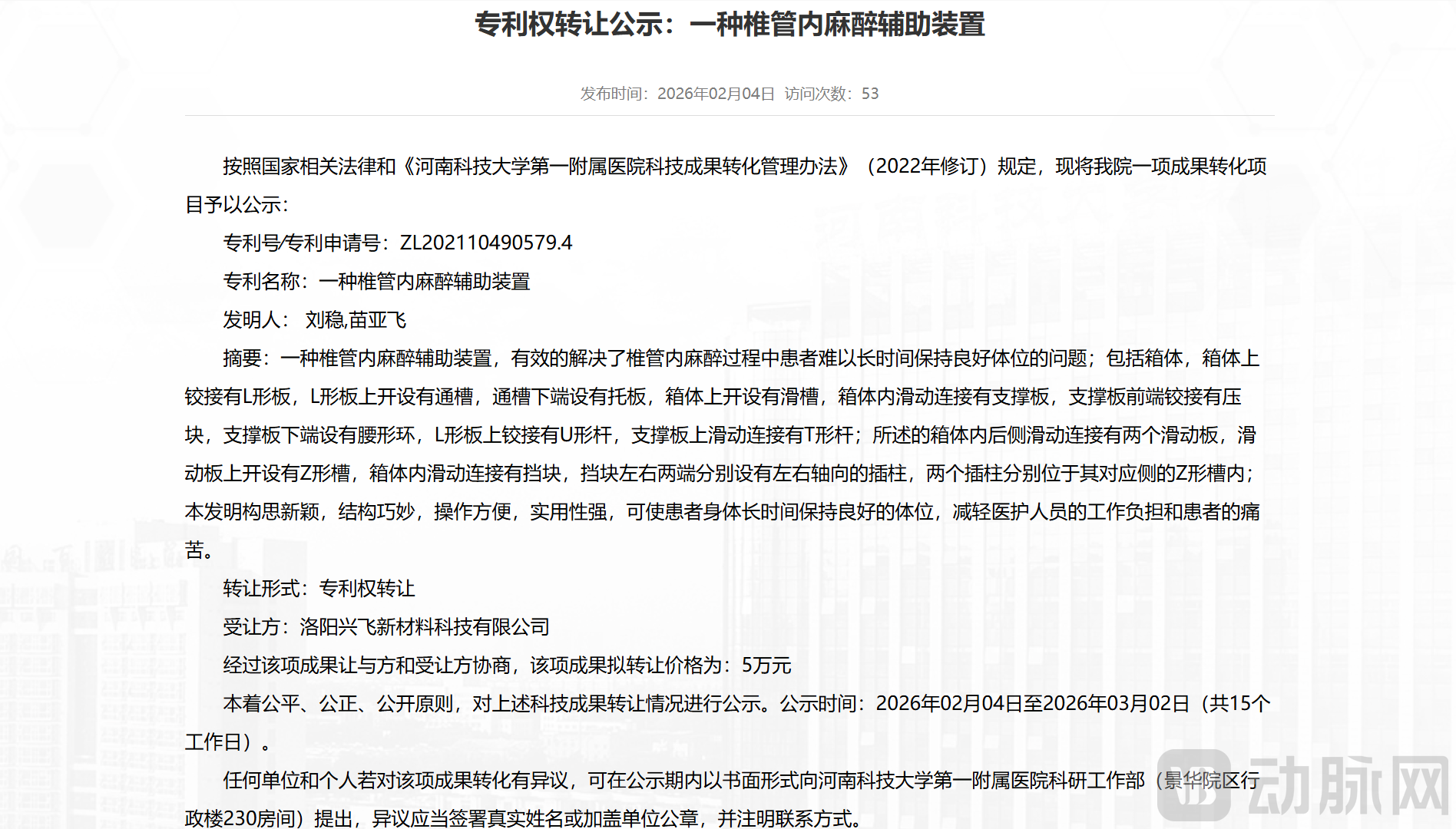
Image from the official website of Henan University of Science and Technology
The core of this invention is to addressDuring intrathecal anesthesia, patients may find it difficult to maintain the standard lateral decubitus flexed position for an extended period due to factors such as pain from trauma, elevated intra-abdominal pressure, advanced age, and obesity.industry pain points. Its innovation lies in the linkage design of structures such as the housing, swingable L-shaped plate, U-shaped rods of differentiated lengths, pressure blocks, and stoppers. Medical personnel need only move the handle up and down to convert the patient from a supine position to a standard lateral decubitus position, while automatically opening the interspinous space. The position can be automatically locked without repeated adjustments, which not only reduces the risk of nerve injury but also improves the efficiency of anesthetic puncture, alleviating the workload of medical staff and the suffering of patients.
Intraspinal AnesthesiaIt is a commonly used clinical anesthesia method, which refers to injecting anesthetic drugs into the subarachnoid space or epidural space of the spinal canal. By blocking the spinal nerve roots, it produces an anesthetic effect in the corresponding innervated areas. Depending on the injection site, it can be classified asSubarachnoid Block (Spinal Anesthesia), Epidural Block, Combined Spinal-Epidural Anesthesia, and Caudal Block Anesthesiaetc.
In clinical practice, to facilitate successful puncture, patients are typically required to assume a lateral decubitus or sitting position (for saddle block), with the back perpendicular to the bed surface and the lumbar spine maximally flexed posteriorly to widen the interspinous spaces. Currently, clinical positioning primarily relies on patient cooperation or assistance from medical staff; however, this approach has significant limitations. On one hand, some patients, due to factors such as traumatic pain, fracture displacement, lung injury, or communication difficulties, are not only unable to independently assume the lateral position but also struggle to maintain a stable lateral posture even with medical assistance. On the other hand, patients with elevated intra-abdominal pressure—such as those undergoing cesarean section or those with large pelvic or abdominal masses—as well as obese and elderly patients, are often unable to achieve sufficient spinal flexion during anesthetic puncture due to physical constraints. This results in poor exposure of the puncture interspace, thereby increasing the difficulty of the procedure.
Furthermore, certain anesthetic puncture procedures are time-consuming. Patients often experience fatigue from maintaining a flexed position for prolonged periods, and body movements can cause displacement of the puncture needle. This not only increases the risk of nerve injury but also necessitates repeated positional adjustments by medical staff. Consequently, this reduces the efficiency of anesthetic puncture, exacerbates the workload of healthcare providers, intensifies patient discomfort, and may even delay the start time of surgery.
Therefore, there is an urgent clinical need for a user-friendly and highly stable assistive device that can help various special-needs patients rapidly assume standard anesthesia positions and maintain them stably over extended periods. This would optimize puncture conditions, reduce procedural risks, improve anesthesia efficiency, and simultaneously alleviate patient discomfort and the workload of healthcare professionals.
This intrathecal anesthesia assistance device, by virtue ofStructural Linkage Design, Operational Convenience, Positional StabilityThree Core Advantages Achieve Technological Innovation in Clinical Anesthesia Positioning Assistance, with Specific Highlights as Follows:
Its core innovation lies inMulti-Structure Collaborative Linkage MechanismBy organically integrating the housing, L-shaped plate, pressure block, stopper, and U-shaped rods of differentiated lengths, this device combines patient position conversion with standardized posture fixation. Swinging the L-shaped plate upward synchronously rotates the patient from the supine to the lateral decubitus position, while the linkage among the sliding plate, Z-shaped slot, and pin drives the stopper to extend, providing stable support for the patient’s abdomen. When swinging the L-shaped plate downward, the longer U-shaped rod on the left pushes the corresponding pressure block backward by a greater distance than that on the right, naturally forming a standard arc in the patient’s back with “greater curvature at the upper end than at the lower end.” This precisely opens the interspinous spaces, addressing the pain point of traditional positioning methods, which struggle to accurately control the degree of curvature.
In terms of operational design,The device is equipped with user-friendly control components, including a handle, pressure column, and pull plate., healthcare professionals require no complex training; simple maneuvers such as lifting, pressing, and pulling suffice to complete positioning adjustments and reduction. The entire procedure can be performed by a single operator, significantly reducing the workload of medical staff; meanwhile,Dual Locking Structure of Elastic Hooks and Slots, Limit Blocks and Grooves, which enables stable patient positioning throughout the entire anesthesia process, prevents needle displacement caused by body movement, and thereby reduces the risk of nerve injury at its source.
Furthermore, the device is designed toTorsion Spring, First Spring, Second Spring...and other components to achieve automatic reset of the briquette, support plate, and T-shaped rod, allowing for rapid recovery to the initial state after anesthesia, thereby meeting the demands of continuous clinical procedures; the overall structural design accommodates patients with varying physical conditions. Whether it is cesarean section parturients with elevated intra-abdominal pressure, obese or elderly patients, or those unable to position themselves independently due to trauma-induced pain, the device enables them to achieve a standardized and comfortable anesthetic position. This effectively alleviates the fatigue and discomfort associated with maintaining a curled posture for prolonged periods, significantly enhancing the efficiency and safety of anesthetic puncture.
In summary, this intraspinal anesthesia assistance device precisely addresses the core clinical challenges of difficult maintenance of anesthesia positioning, low puncture efficiency, and high operational risk through its ingenious structural design and synergistic linkage mechanism. It not only simplifies the workflow for medical staff and reduces their workload but also provides a stable and comfortable standard anesthesia position for patients with varying physical conditions, effectively minimizing the risk of nerve injury and patient discomfort, thereby significantly enhancing the safety and efficiency of anesthesia puncture.
Current products and patents in the field of neuraxial anesthesia assistance are still predominantly focused on basic functions, with a need for greater specialization. Although various clinical assistive devices can meet positioning support needs to some extent, there is room for improvement in functional adaptability, and a gap remains between these solutions and actual clinical pain points.
Universal Positioning PadIt is the most widely used foundational support product in the field of neuraxial anesthesia assistance, with widespread adoption across anesthesia departments in hospitals at all levels and high penetration rates in both primary healthcare institutions and general hospitals. It primarilyPassive Support, Distribute Body Pressure, Prevent Localized Pressure UlcersDesigned primarily for use in surgeries requiring neuraxial anesthesia, these products are particularly common in routine procedures and for managing baseline positioning in elderly, obese, and other special patient populations. Typically manufactured from flexible materials such as foam or silicone, they offer cost-effectiveness, flexibility, and broad compatibility. As a standard component in clinical baseline positioning management, their primary function is to provide basic support.
Simple Immobilization Frame and Restraint StrapsIt is a commonly used position-stabilizing assistive device in clinical neuraxial anesthesia, widely applied in the anesthesia departments of various medical institutions, particularly suitable forLow patient complianceclinical scenarios. Such tools primarily rely on mechanical fixation or restraint straps to minimize patient positional shifts during anesthesia and puncture procedures, thereby enhancing positional stability throughout the intervention. They are predominantly used for position management in special patient populations, including those with impaired consciousness, communication difficulties, agitation, and pediatric patients. The overall product design is simple and easy to operate, making it a routine clinical choice for ensuring positional stability. The fixation frames are mostly rigid structures, while the restraint straps mainly function by binding and limiting limb movement. Collectively, these devices represent basic fixation solutions commonly used in clinical practice, focusing primarily on fundamental stability in terms of functionality and adaptability.