

Dongguan People's Hospital to License Innovative Peritoneal Dialysis Catheter with 10,000 RMB Upfront and 10% Royalty on Net Annual Sales
Recently, Dongguan People's Hospital released a public notice on the transformation of its scientific and technological achievements, proposing to transfer its“A Peritoneal Dialysis Catheter”The patent has been transferred to Guangdong Mengtai Technology Transfer Co., Ltd. The transaction adoptsBase Fee Plus Subsequent Commissionproposed transfer of the modelThe base price is RMB 10,000., and Guangdong Mengtai Technology Transfer Co., Ltd. shall, in accordance withPay a commission fee of 10% of the annual net sales., the license term isFive Years。
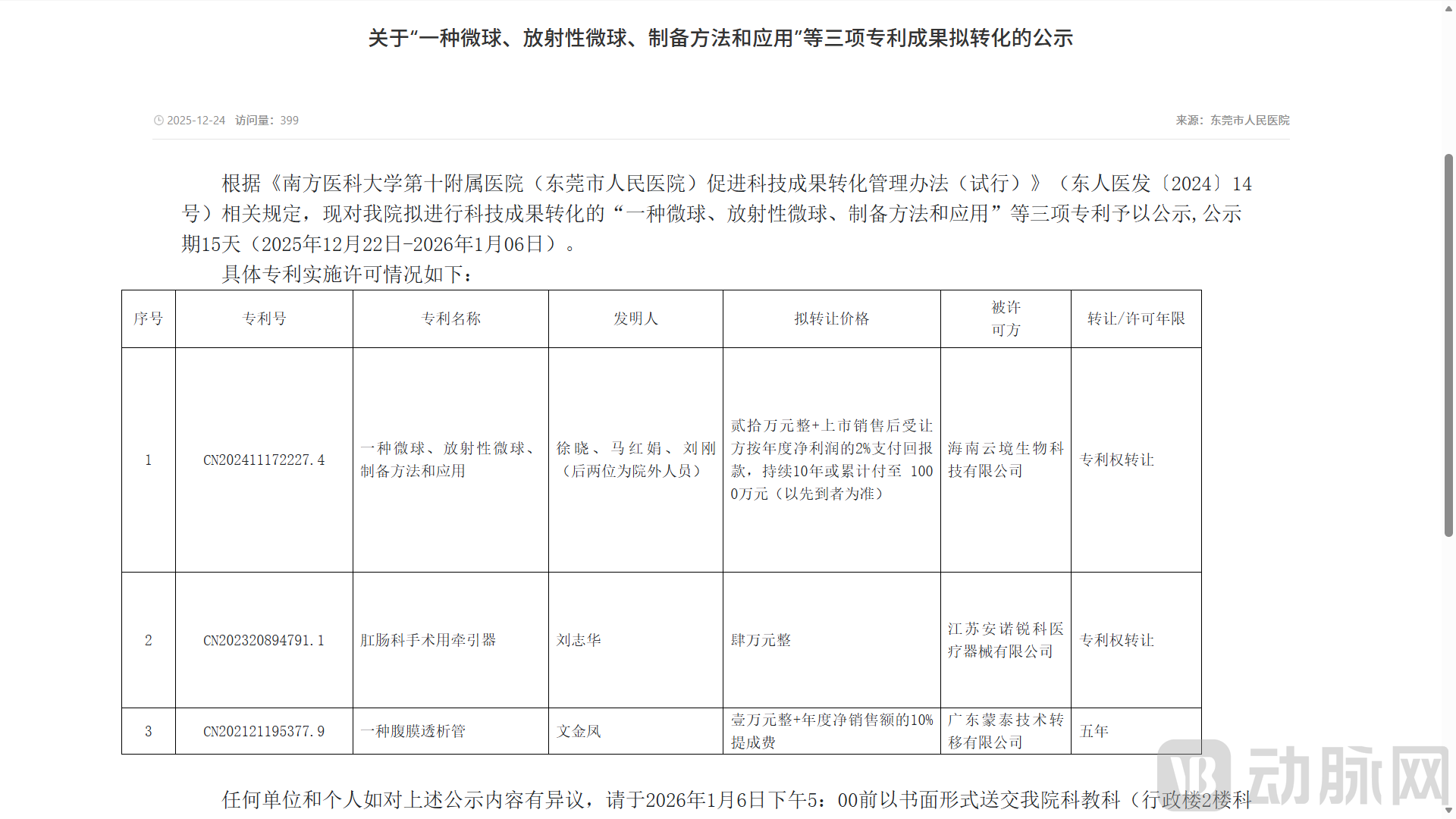
Image from the official website of Dongguan People's Hospital
Peritoneal Dialysisis one of the core clinical treatments for kidney diseases such as acute kidney injury and chronic renal failure, whilePeritoneal Dialysis CatheterAs an essential core instrument for this procedure, itsAseptic Storage and Standardized Use Throughout the Entire ProcessIt directly determines the success or failure of dialysis procedures and the safety of patient diagnosis and treatment, representing a critical requirement that cannot be overlooked in the clinical practice of peritoneal dialysis.
At present, although medical institutions can achieve bulk sterile storage of peritoneal dialysis catheters during the warehousing stage through professional equipment such as cleanrooms and sterile cabinets, thereby meeting the needs of centralized management, there is currently no dedicated sterile protection device specifically designed for individual peritoneal dialysis catheters once they are removed from the supply room in clinical practice. This represents a significant technical gap in clinical diagnosis and treatment.
During clinical procedures, healthcare providers can only use medical-grade film to provide simple, individualized wrapping protection for a single peritoneal dialysis catheter. This temporary protective measure not only involves a cumbersome operational process but is also constrained by procedural standards, requiring the replacement of new medical-grade film after each catheter insertion or removal. This significantly increases the clinical workload for healthcare staff and reduces diagnostic and treatment efficiency.
More importantly, the sterile status of medical films is susceptible to various factors such as storage conditions and handling practices, making it difficult to ensure stable and sustained sterility. Furthermore, even after wrapping, individual dialysis catheters remain partially exposed to the external clinical environment, rendering them highly vulnerable to contamination by environmental bacteria, dust, and potential microbial load on the film itself. This significantly increases the risk of complications such as wound infections and peritonitis following the insertion of peritoneal dialysis catheters into patients. These issues pose substantial potential hazards to the safety of clinical peritoneal dialysis care and significantly constrain the standardization and normalization of clinical procedures.
The proposed patent-related protective device for peritoneal dialysis catheters features multiple technical innovations, specifically addressing various pain points in clinical storage and use, with an overall design that balancesPracticality, Safety, and Convenience, the core innovative designs can be categorized into three major types:
First,Sealed, Contact-Free Structural Design, the device adoptsDouble-shell structure with openable and closable sealed connection, a sealing strip is installed at the housing connection to form a dedicated containment cavity upon closure; the diameter of this cavity exceeds that of the dialysis tube’s insertion end, allowing the insertion end to be suspended without any contact with the housing, thereby fundamentally preventing contact contamination through structural design.
Second,Flexible and Convenient Operational Design, designSnap-fit, magnetic connection, elastic clampingThree connection mechanisms are available to accommodate diverse clinical preferences, offering simple and intuitive operation. The device is also equipped with an elastic snap-fit holder to secure the dialysis tubing connector, enabling contact-free handling of the insertion end throughout placement and removal, thereby further reducing the risk of contamination. Moreover, the device is designed for repeated use, combining environmental sustainability with cost-effectiveness.
Third,Intelligent and Practical Functional Design, the device integrates multiple functionalities and intelligent design features. A miniature UV lamp is installed within the cavity to sterilize and disinfect dialysis tubing, thereby enhancing sterile protection. The bracket incorporates a linkage structure between a detection switch and a housing indicator light; once the dialysis tubing is inserted, the indicator light automatically illuminates, allowing users to ascertain the internal storage status without opening the housing, thus improving the efficiency of handling multiple tubes. Additionally, the housing can be fabricated from transparent materials, enabling medical personnel to visually monitor the storage condition of the dialysis tubing, making clinical operations more efficient and precise.
Currently, protective products for peritoneal dialysis catheters on the market are still dominated by basic protective accessories. There is no specialized device identical to this patent that provides sterile storage protection for the entire peritoneal dialysis catheter. Existing products mainly focus on local protection of the catheter connector or batch storage, with limited functionality and protective efficacy. They can be specifically categorized into two types:
One category consists of basic protective accessories that are already on the market.This product features a silicone core combined with an outer waterproof membrane to create a dual-layer sealed structure. It contains built-in sustained-release povidone-iodine pads that form a 12-hour bacteriostatic barrier, providing wrapped protection for the connector of the peritoneal dialysis catheter and achieving basic waterproofing, anti-contamination, and localized bacteriostatic effects.
Another category is the bulk storage devices routinely used by healthcare institutions.This device provides a sterile storage environment for multiple peritoneal dialysis catheters in fixed locations through its sealed structure, effectively reducing bacterial intrusion and lowering the risk of infection, ensuring standardized dialysis procedures, and is suitable for centralized storage.