

Tongji Hospital of Huazhong University of Science and Technology to Transfer Novel Vertebral Lesion Biopsy Device Patent for RMB 250,000

Geasure Medical
Medical Device R&D Manufacturer
Recently, Tongji Hospital affiliated with Tongji Medical College of Huazhong University of Science and Technology released a public notice on the transformation of scientific and technological achievements. The hospital intends to transfer its intellectual property through negotiated pricing."A Vertebral Lesion Tissue Sampling Device"The relevant patents were assigned to Changzhou Geasure Medical Apparatus and Instruments Co., Ltd., with the assignment fee being250,000 yuan. The inventors of this patent areGuo Jianfeng and Gao Fang。
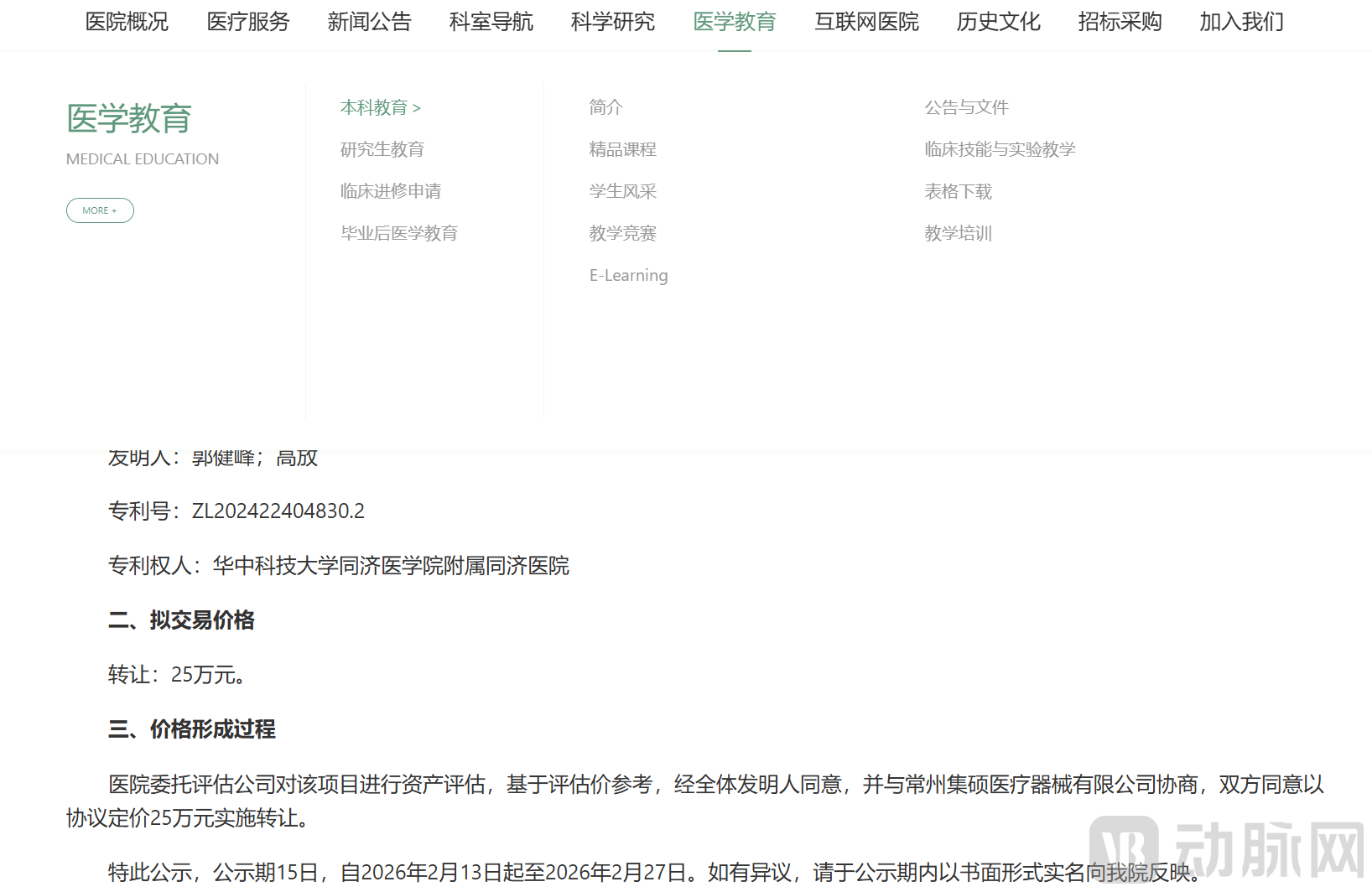
Image source: Official website of Tongji Hospital, Tongji Medical College, Huazhong University of Science and Technology
This technology isUtility Model Patent Technology for a Vertebral Lesion Tissue Sampling Device, belonging to the field of medical devices, primarily used forBiopsy Procedures in the Diagnosis and Treatment of Indeterminate Lesions of the Spinal Vertebral Bodies, specifically designed to provide specialized tools for clinically obtaining vertebral lesion tissue samples (such as tumor lesions and tissues from areas of bone destruction). Physicians can perform pathological or microbiological examinations on the samples obtained using this device to determine the nature of the lesions and formulate treatment plans.
Biopsy Sampling in the Diagnosis and Treatment of Indeterminate Vertebral Lesions: Long-standing ChallengesLow sampling efficiency, poor adaptability, and cumbersome operation...the core pain points. Traditional sampling devices mostly rely on a single cutting blade to excise lesion tissue, which neither enables rapid and effective separation of the lesion nor expedites the sampling process, resulting in prolonged procedure times. Furthermore, these devices struggle to accommodate vertebral lesion tissues of varying consistencies, such as hard and soft tissues, often failing to completely excise and retrieve portions of the lesion. This leads to sample acquisition failure, thereby compromising subsequent pathological examination and the formulation of treatment plans.
From the perspective of sampling procedures, existing vertebral sampling devices have many application limitations. On one hand,Monotonous Sampling Structure Design, the lack of a coordinated mechanism between secondary cutting and precise collection makes it prone for resected lesion tissue to remain in the patient’s body, preventing complete removal and resulting in insufficient sample volume and distorted test results; on the other hand,Poor Disassembly, Assembly, and Reusability of the Device, making it impossible to perform continuous multiple samplings at the same lesion site. If re-sampling is required, the connection kit must be replaced, resulting in a cumbersome operational procedure that not only prolongs clinical operation time but also increases intraoperative risks and exacerbates patient suffering. Furthermore, traditional devicesLack of Precise Depth-Positioning Structure, it is difficult to control the insertion depth during sampling, which can easily cause additional damage to the normal tissues surrounding the lesion, further reducing the safety and precision of the biopsy procedure.
For sampling special lesions such as vertebral tumors and bone destruction, the complex structure and heterogeneous texture of the lesion site impose higher requirements on the cutting capability and adaptability of the sampling device. However, existing methods fail to achieve rapid incision and effective separation of lesion tissue, and lack a secure locking and positioning structure. This makes the device prone to loosening and displacement during operation, leading to deviations in the sampling location and making it difficult to obtain tissue samples from the core of the lesion.
These issues have placed clinical vertebral biopsy in a dilemma“Low Sampling Efficiency” and “Poor Sample Quality”dilemma, there is an urgent need for a novel vertebral lesion tissue sampling device that combines high-efficiency cutting, adaptability to multiple tissue textures, and ease of operation, to break through the core bottleneck of clinical biopsy sampling.
Addressing the clinical pain points in vertebral lesion biopsy, namely “low sampling efficiency, poor adaptability to tissue texture, and cumbersome sampling procedures at the same site,” the patented technology for a vertebral lesion tissue sampling device developed by the team of Guo Jianfeng and Gao Fang from Tongji Hospital affiliated with Tongji Medical College of Huazhong University of Science and Technology, withNested Design of Outer Cannula + Inner Cannula + Stylet Sampling Structure and Two-Stage Cutting System of Initial Cut + Secondary CutCentered on this core, we have developed an integrated biopsy solution adaptable to lesions of varying tissue densities and capable of multiple sampling. This solution achieves comprehensive technological upgrades in cutting efficiency, sample collection, and operational convenience, thoroughly breaking through the clinical limitations of traditional biopsy devices—namely, single-cut capability, prone to sample retention, and the need for component replacement for repeated sampling.
This technology achieves an innovative breakthrough in structural design—Pioneering Three-Layer Nested Movable Structure, through precise dimensional matching and snap-fit positioning, making the sampling operation more accurate and stable. The inner core rod of the device has a diameter of 3.5 mm and features a solid structure; the inner cannula has an inner diameter of 3.5 mm and an outer diameter of 4 mm; and the outer cannula has an inner diameter of 4 mm. These three components form a tightly fitted nested assembly. The inner core sampling structure can move flexibly within the inner cannula, while the inner cannula is secured via snap-fit engagement between positioning blocks on both sides and corresponding positioning slots on the inner wall of the threaded sleeve of the outer cannula. Magnets embedded within the slots provide magnetic attraction to fix the blocks, ensuring robustness after assembly while facilitating convenient disassembly and reassembly. Furthermore, scale markings on the inner core rod enable precise determination of sampling depth, effectively avoiding additional damage to surrounding normal tissues during operation and significantly enhancing the accuracy and safety of the sampling procedure.
In terms of the sampling cutting and specimen collection mechanism, this technologyEstablishing a Full-Process Sampling System of “Initial Incision and Disruption, Secondary Incision and Separation, Closure and Collection”, achieving the dual goals of efficient cutting and complete sampling.
First,The tip of the sampling rod in the inner core sampling structure is equipped with a conical section featuring rotating threads and a threaded tip., enabling rapid incision into vertebral lesion tissues of varying consistencies, such as hard and soft types, during rotational advancement, thereby achieving initial lesion resection and sample collection, and resolving the core issue of traditional devices being unable to accommodate lesions of diverse textures.
Second,An annular cutter is provided at the bottom of the inner cannula, forming an angle of 45°–60° with the tube body., enabling secondary precise cutting of the lesion tissue during the rotational downward movement of the inner cannula, thereby achieving effective separation of the lesion tissue from the surrounding tissue.
Third,Continued downward displacement of the inner cannula after secondary cutting, accommodating the sampling rod and threaded tip of the inner-core sampling structure within it, thereby forming a closed combined cavity, it can completely encapsulate and collect the resected lesion tissue, thoroughly avoiding sample residue and ensuring sufficient sample volume and accurate test results.
Furthermore, this technology possesses clinical practicality.“Multiple Sampling Without Component Replacement + Easy-to-Use Operation”significant advantages, greatly adapting to the actual needs of clinical diagnosis and treatment. InSampling Procedureabove, the device does not require replacement of any socket kits; by simply re-engaging the inner cannula and the inner core sampling structure into the outer cannula, multiple samples can be obtained from the same lesion site. The operation process is simple, effectively reducing clinical procedure time and intraoperative risks, while alleviating patient discomfort associated with repeated sampling; inApplicable Scenariossuperiorly, it can be widely used for biopsy of various indeterminate vertebral lesions, such as spinal vertebral body tumors and sites of bone destruction, meeting the clinical sampling needs for diverse vertebral lesions; inOperational ExperienceThe outer cannula is equipped with a main handle, the inner cannula with a secondary handle, and the inner core rod with a knob. With clearly defined roles for each operational component, physicians can perform actions such as rotation and advancement using one hand, significantly enhancing operational convenience and better aligning with actual intraoperative clinical scenarios.
Meanwhile, the device’s structural design balances practicality and cost-effectiveness. Its modular components facilitate disassembly, cleaning, and sterilization, enabling reuse and reducing clinical usage costs. Furthermore, the absence of complex, precision parts simplifies manufacturing, laying a solid foundation for subsequent industrialization and widespread clinical adoption.
For biopsy of vertebral body lesions in the spine“Insufficient sampling accuracy, poor adaptability to multi-texture lesions, and cumbersome operational procedures”To address clinical pain points, medical device companies and innovative R&D platforms both domestically and internationally have accelerated their strategic布局 around three core directions: “precise positioning, efficient cutting, and clinical adaptability.” Through structural innovation and functional optimization, they are driving the upgrade of vertebral sampling instruments from traditional single-cutting tools to multifunctional, integrated sampling devices, thereby meeting the clinical needs for biopsies of various vertebral lesions, such as spinal tumors and bone destruction.
Global Orthopedic Device Giant StrykerLaunchSolis Instruments Spinal Surgery Instrument Set, with the bone trephine kit serving as the core component for vertebral bone tissue sampling. Manufactured from premium medical-grade materials such as Ti6Al4V titanium alloy and 304 stainless steel, it is designed to facilitate bone tissue sampling and bone grafting procedures in various spinal surgeries, including those involving the implantation of SOLIS interbody fusion cages. The product has obtained registration for imported medical devices in China and holds a significant share of the domestic high-end orthopedic device market, leveraging Stryker’s mature global supply chain and clinical collaboration network. Its core advantage lies in its high compatibility with spinal fusion surgical instruments, enabling an integrated workflow for both sampling and bone grafting.
Bard and other international companiesLaunchedDisposable Integrated Biopsy Needle (BARD® MARQUEE®)As a classic product for multi-site tissue biopsy, it enables efficient biopsies of the liver, kidney, soft tissue tumors, and other sites. The needle body is constructed from 304/301 stainless steel, featuring multiple diameter specifications and a user-friendly activation slider design for flexible operation and high sampling efficiency. The product has obtained import registration and is widely used in clinical settings.
In summary, within the current market for vertebral lesion sampling instruments, imported products have established a solid advantage in the high-end sector by leveraging mature material technologies and extensive clinical application experience. Domestically produced products, focusing on structural and functional innovations tailored to actual clinical needs, demonstrate notable strengths in precise positioning, operational convenience, and cost-effectiveness, thereby better aligning with the usage scenarios of primary healthcare institutions in China. The vertebral lesion tissue sampling device developed by Tongji Hospital, affiliated with Tongji Medical College of Huazhong University of Science and Technology, offers new directions for the technological upgrading and industrial development of vertebral lesion biopsy instruments, thanks to its core design features of nested cannulas, two-stage cutting, and multiple sampling capabilities.