

Sun Yat-sen University Cancer Center to Transfer Two AI-Powered Pathology Lab Management Systems for RMB 80,000
Recently, the Sun Yat-sen University Cancer Center released a public notice on the conversion of scientific and technological achievements, proposing to transfer its“AI-Driven Prediction of Internal Audit Deficiencies and Closed-Loop Management System for Pathology Laboratories,” “Knowledge Graph-Based Intelligent ISO 15189 Inspection Support System for Pathology Laboratories”Two patents were assigned to Shenzhen Huikang Information Technology Co., Ltd. in the form of transfer, with a transaction amount of80,000 yuan。
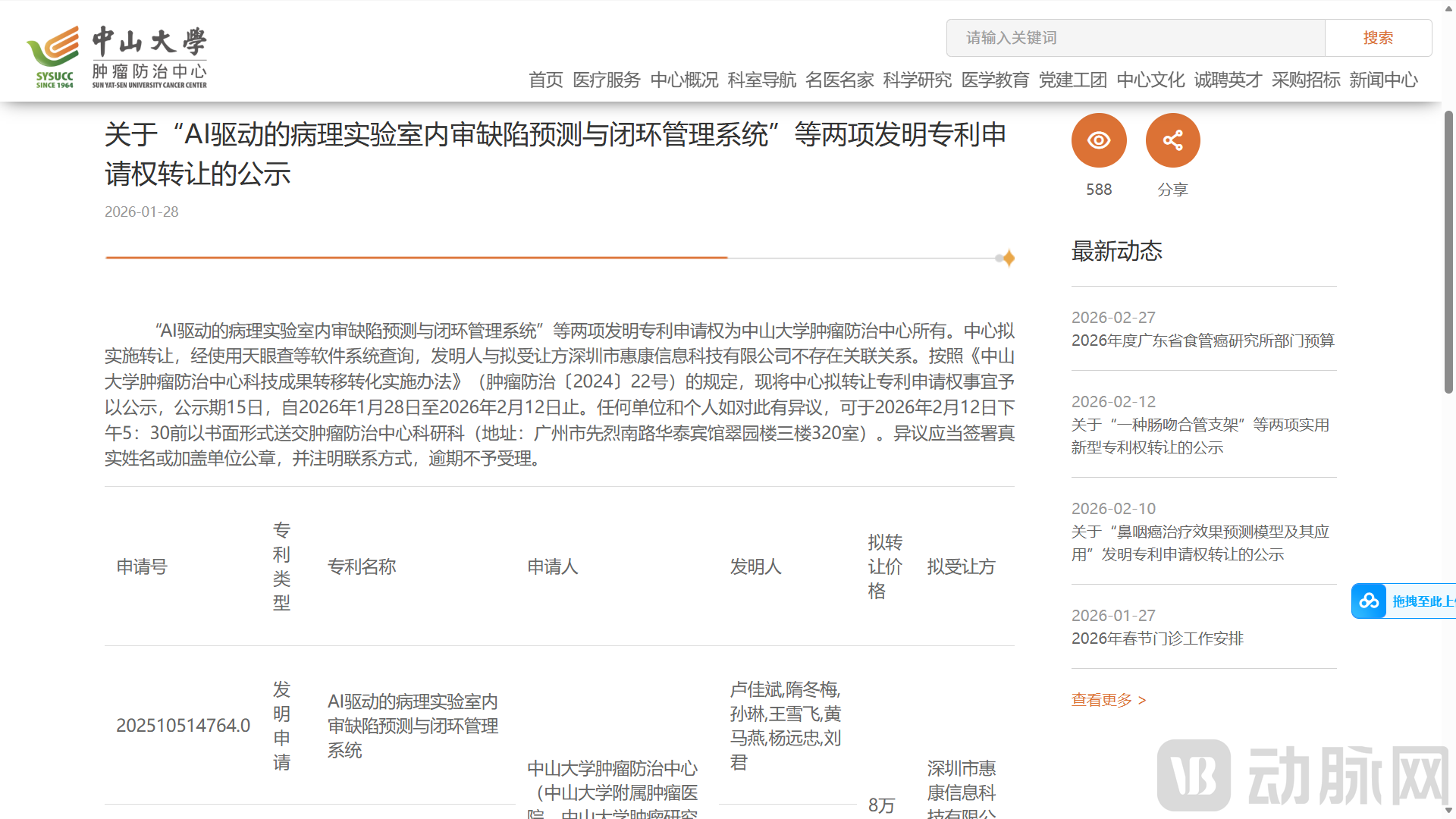
Image from the official website of Sun Yat-sen University
Both patents represent core innovations in the intelligent quality management of pathology laboratories, addressing industry gaps in smart inspection readiness, internal audit defect prediction, and closed-loop management. This technology will facilitate the practical application of artificial intelligence in pathology laboratory quality management, promoting the standardization and intelligent upgrading of medical laboratory quality management.
Pathological DiagnosisAs the “gold standard” for disease diagnosis, its core lies in the detection and analysis of samples such as lesion tissues and cells, providing a precise basis for clinical diagnosis and treatment planning for diseases like tumors. The operational standardization and quality control capabilities of pathology laboratories directly determine the accuracy of diagnostic results and constitute a critical link affecting patients’ diagnostic and therapeutic decisions.
Under the dual demands of clinical diagnosis and treatment and industry accreditation, pathology laboratories must not only manage the testing and analysis of a high volume of daily samples while ensuring that every step complies with laboratory Standard Operating Procedures (SOPs), but also meet the stringent requirements of the ISO 15189 international standard for quality and competence in medical laboratories, thereby completing regular accreditation and re-assessment inspections.
However, the current quality management system in pathology laboratories faces numerous clinical pain points. On one hand, in daily internal audit work,Quality defects such as reagent limit exceedances, missed equipment calibrations, and non-standardized diagnoses are difficult to detect in a timely manner., the traditional manual review model is not only time-consuming and labor-intensive but also susceptible to subjective influences, resulting in a lack of objectivity and consistency in review outcomes. Furthermore, it only allows for reactive corrective actions after issues have occurred, failing to proactively identify potential quality risks; on the other hand, ISO 15189 inspection preparation requires extensive documentation organization and mapping of standard clauses,The Semantic Correspondence Between Pathology Terminology and Standard Clauses Is Complex, manual review is prone to oversights, making it difficult to implement real-time risk monitoring across the entire testing process, resulting in inefficient inspection preparedness.
Currently, most Laboratory Information Systems (LIS) on the market are limited to basic data recording and simple statistical analysis. They lack a deep understanding of pathology-specific knowledge and intelligent analytical capabilities, rendering them unable to perform semantic mapping between standard clauses and laboratory operations. Furthermore, quality management methods based on data mining are often restricted to specific test items, failing to achieve comprehensive coverage of the entire pathology laboratory workflow. Traditional inspection-preparation support tools mostly rely on static rule matching; they cannot automatically generate compliance-ready reports for inspections, nor do they offer real-time risk assessment and early warning mechanisms. Consequently, these tools struggle to meet the dual demands of pathology laboratories for internal audit quality control and international standard certification. There is an urgent need in the industry for intelligent solutions to fill this technological gap.
Both of these invention patents are based onArtificial Intelligence Technologyas the core, precisely addressing quality management in pathology laboratoriesInspection and Certification, Internal AuditTwo Core Segments, inTechnical Architecture, Functional Implementation, and Practical ApplicationAchieving multiple innovative breakthroughs, the two solutions each possess distinct technical advantages while offering highly complementary functionalities. They overcome the technical limitations of existing pathology quality control solutions, creating an end-to-end intelligent quality management framework for the industry that spans from internal defect prevention to external regulatory compliance.
Knowledge Graph-Based Intelligent Auxiliary System for ISO 15189 Inspection Preparation in Pathology Laboratories's core innovation lies inAchieved intelligent integration of pathology expertise with the ISO 15189 international standard.This system is the first to deeply apply knowledge graph technology to the scenario of pathology laboratory inspections. It constructs a domain-specific knowledge graph for pathology and utilizes the TransD model to achieve many-to-many mapping of entities and relationships, thereby addressing the industry pain point where traditional methods struggle to comprehend the semantics of specialized pathological terminology. Furthermore, by integrating natural language processing techniques, the system employs a CNN-BiLSTM architecture to accurately identify professional terminology entities in pathology reports. Combined with the BERT model for semantic similarity matching between terms and standard clauses, and leveraging TF-IDF technology to extract key information from samples, the system enables the automated and structured generation of inspection documentation. This reduces the manual document organization process, which originally took several days, to just a few hours, significantly improving efficiency. In addition, this system innovativelyBuilding a Dual Risk Assessment System Combining Quantitative and Qualitative Analysis, supports compliance verification for multimodal data, including stained images, immunohistochemistry (IHC) images, and whole slide scans. It enables real-time collection of laboratory workflow data for risk scoring and stratification, automatically triggers alerts when thresholds are exceeded, and completes the statistical analysis, tracking, and closed-loop management of risk events, thereby facilitating a paradigm shift from "passive inspection readiness" to "proactive compliance."
andAI-Driven Prediction of Internal Audit Deficiencies and Closed-Loop Management System for Pathology Laboratories's core innovation, thenAchieved a Critical Leap in Pathology Internal Review from "Post-Hoc Rectification" to "Pre-Event Prediction". This system overcomes the subjective limitations of traditional manual internal audits by constructing an internal audit defect prediction model based on multiple AI algorithms, including support vector machines, random forests, and deep neural networks. By integrating OCR technology to convert unstructured internal audit documents into standardized structured data, it significantly enriches the training sample library, thereby enhancing the accuracy and reliability of defect prediction.
MeanwhileEstablishing a Full-Chain Closed-Loop Defect Management System, from probabilistic prediction of potential defects and result screening, to automatic generation of corrective action work orders pushed to the relevant departments, followed by real-time monitoring of rectification progress, overdue alerts, and escalation for threshold breaches, as well as closed-loop verification upon completion, thereby achieving full lifecycle management of internal audit findings and thoroughly addressing industry pain points such as incomplete remediation and recurrence of similar issues.
The system alsoPossesses exceptional system compatibility and self-learning capabilities, it can seamlessly integrate with existing hospital systems such as LIS, HIS, and PACS through the data integration module, enabling the consolidation and efficient utilization of multi-source heterogeneous data; the innovatively designed self-learning optimization module continuously collects comparative data between predictions and actual internal audit results, automatically triggering retraining when model accuracy improvements plateau, thereby updating the sample library and optimizing model parameters to achieve dynamic enhancement of predictive capabilities; the accompanying equipment management and risk assessment modules further enable real-time monitoring of equipment status and precise risk evaluation, making internal quality management in pathology laboratories more systematic and scientific.
Both technologies have undergone algorithm optimization and functional customization tailored to the specialized characteristics of pathology and the actual workflows of laboratory operations, significantly lowering the barrier to manual operation and enabling efficient application without requiring professional AI technical knowledge. The two solutions complement each other perfectly in their application scenarios, focusing respectively on external international standard accreditation for pathology laboratories and internal daily quality control, jointly establishing"Proactive Prevention of Internal Defects + Intelligent Compliance with External Standards"an intelligent quality management system covering the entire workflow, providing a practical and scalable technical solution for the standardized and intelligent upgrade of quality management in pathology laboratories.
The intelligent quality management sector for pathology laboratories has evolved into a competitive landscape where domestic and international companies are strategically positioned side by side. Leveraging their respective technological strengths, various healthcare technology enterprises have launched intelligent solutions tailored for laboratory quality control and ISO 15189 compliance inspections. These solutions cover specialized scenarios such as laboratory information management, quality control data analysis, and internal audit deficiency management, thereby serving as a critical foundation for the digital transformation of quality management in pathology laboratories.
Guangzhou KingMed DiagnosticsDeveloped byIntelligent Quality Control Management System for Pathology Laboratories, with core functionalities including ISO 15189 inspection preparation support, classification management of internal audit findings, and corrective action tracking, while also supporting quality control analysis of pathological slide images. Leveraging the practical experience of KingMed Diagnostics, a third-party clinical laboratory, the product has achieved scenario-based implementation of its features.
Hangzhou Dyingjia TechnologyR&DAI Pathology Laboratory Quality Closed-Loop Management System, leveraging machine learning algorithms to achieve AI-based prediction of internal audit defects, automatic generation of corrective action work orders, and visualization of quality control data; practical application has validated that the product’s defect prediction accuracy has achieved a new breakthrough.
The aforementioned products have achieved intelligent upgrades in certain aspects of quality management within pathology laboratories, serving as a critical foundation for digital transformation in the industry. In the future, more customized technological designs tailored to the pathology specialty and technologies offering comprehensive scenario coverage are expected to emerge. These advancements will likely provide new directions for the research and development of intelligent pathology quality control products, thereby driving technological upgrades and functional integration of intelligent solutions for pathology laboratory quality management.