

Dongguan People's Hospital to Transfer Innovative Radiolabeled Microsphere Technology with 200,000 RMB Upfront and 2% Annual Profit Royalty
Recently, Dongguan People's Hospital released a public notice on the conversion of scientific and technological achievements, proposing to“A Microsphere, a Radioactive Microsphere, a Preparation Method and an Application”Transferred to Hainan Yunjing Biotechnology Co., Ltd., with a transaction amount ofRMB 200,000.00, the subsequent transferee shallPay a return amount equal to 2% of the annual net profit for 10 years, or until the cumulative payments reach RMB 10 million.(whichever comes first).
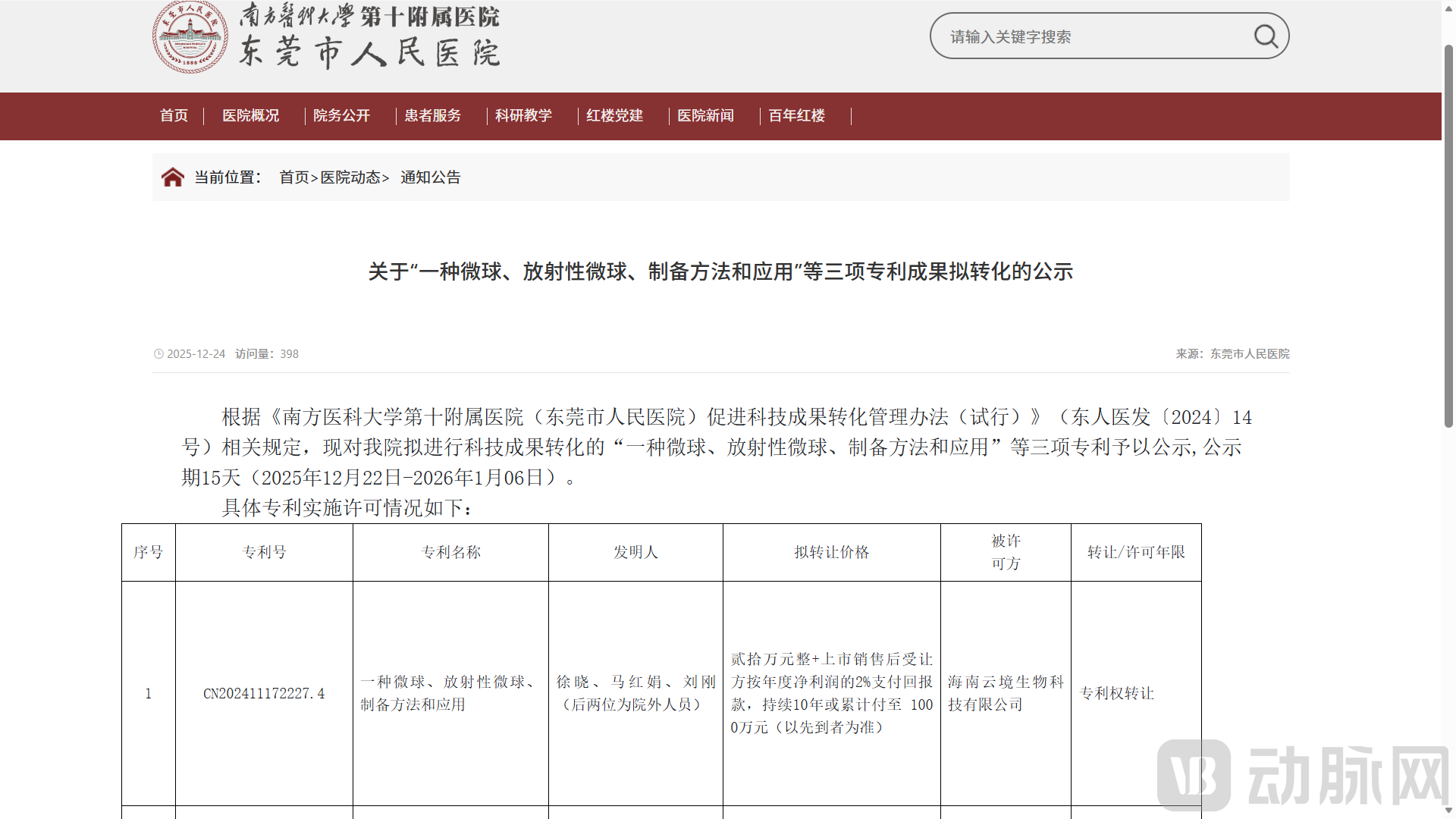
Image from the official website of Dongguan People's Hospital
This patent is held byXu Xiao et al. (3 people)Joint R&D, with the core achievement being the innovative development ofPoly(cycloimide) dioxime microspheres and their preparation technology for radioactive microspheresThis technology loads radioactive metal nuclides through specific coordination chelation, offering advantages such as good biocompatibility, structural stability, and strong targeting capability. It can be used for brachytherapy of tumors such as liver cancer via methods like catheter-based arterial puncture and superselective delivery, while also supporting in vivo drug distribution tracing, thereby providing a novel solution for tumor treatment.
In the field of brachytherapy for oncology, the performance of radioactive microspheres directly impacts treatment efficacy and safety. However, traditional radioactive microspheres and related pharmaceuticals still face four major technical challenges that urgently need to be addressed in clinical applications:
First,Insufficient Radionuclide Loading Stability, traditional resin or glass microspheres carry a risk of radionuclide leakage, which can easily cause non-targeted radiation damage, while the labeling efficiency of some novel carriers struggles to exceed 95%, failing to meet the clinical requirements for high-purity radiopharmaceuticals.
Secondly,Suboptimal Clinical Delivery Safety and Compatibility, the current products differ significantly in density from blood, making them prone to gravity-induced sedimentation and subsequent ectopic embolism; furthermore, their uneven particle size distribution makes it difficult to precisely match the tumor's peripheral vasculature, which compromises therapeutic efficacy and increases the risk of damage to normal tissues.
Third,Lack of Integrated Diagnosis and Treatment Capabilities, mainstream 90Y microspheres rely on low-resolution bremsstrahlung imaging, which fails to enable precise pre-treatment planning and real-time post-treatment efficacy verification, while most products support only a single radionuclide, making it difficult to meet both diagnostic and therapeutic needs.
Fourth,Localization and Cost Control Urgently Need BreakthroughsHigh-end products have long been monopolized by international manufacturers, with high import prices per dose imposing a heavy financial burden on patients; existing domestic solutions are mostly process imitations or rely on specialized nuclear equipment, leading to issues such as high costs and insufficient supply stability, making large-scale adoption difficult.
Addressing numerous market pain points in the field of tumor brachytherapy, this patent has achieved multiple core innovations in the research and development of radiopharmaceutical carriers, fromFrom Carrier Structure and Coordination Bonding to Preparation Process and Clinical ApplicationBreaking through traditional technical bottlenecks across all dimensions, the innovations are reflected in four core aspects:
First,Precision-Oriented Innovations in Carrier Structure Design, developedPoly(cyclododecadiene dioxime) microspheresPrecise control of particle size to20μm~100μm, with the specific gravity controlled at 1.0 g/mL–1.3 g/mL, closely approximating that of blood, thereby addressing the issues of uneven distribution and facile sedimentation associated with traditional carriers in the bloodstream. Furthermore, the microspheres exhibit excellent monodispersity and sphericity, enabling precise matching with tumor peripheral vasculature and enhancing targeted delivery efficiency.
Secondly,Innovations in Ultra-Stabilization via Radionuclide Coordination Binding, the poly(cyclododecane dioxime) structure of the microspheres exhibits specific coordination and chelation with various radioactive metal nuclides, including 177Lu, 90Y, 99mTc, and 68Ga, achieving labeling efficiencies ofOver 99%. Moreover, the leakage rate of the radionuclide after coordination binding in simulated tissue fluid, physiological saline, and serum in vitro is far below 0.01%. It can withstand normal tissue pH and the mildly acidic tumor microenvironment, achieving long-term stable accumulation of the radionuclide at the tumor lesion site, thereby thoroughly resolving the issues associated with traditional radiopharmaceutical radionuclidesProne to leakage, poor tumor retentionpain points.
Third,Adaptation and Engineering Innovation of Preparation Processes, developedDifferential Preparation Processes of Radiation-Induced Graft Polymerization and Chemically Initiated Graft Polymerization, radiation-induced graft polymerization is suitable for substrate microspheres lacking hydroxyl groups, while chemically initiated graft polymerization is suitable for substrate microspheres containing hydroxyl groups; furthermore, a wide range of substrate microsphere materials can be selected, including polystyrene, polyvinyl alcohol, chitosan, and others; meanwhileSimple Process Steps, supports various substrate preparation methods such as monodisperse suspension emulsion polymerization and reverse-phase emulsion crosslinking, is amenable to engineered scale-up for production, and enables rapid labeling at low temperatures, demonstrating feasibility for large-scale manufacturing.
Fourth,Functional Innovation in Theranostics, these radioactive microspheres can be loaded with different diagnostic and therapeutic radioactive metal nuclides. They not only enable tumor brachytherapy using nuclides such as 177Lu and 90Y, but also facilitate multimodal imaging and in vivo biodistribution localization through nuclides like 68Ga and 99mTc. Furthermore, they allow simultaneous in vivo distribution tracing of ultra-stable radioactive microspheres during treatment, thereby achieving an integrated approach to diagnosis, therapy, and treatment efficacy monitoring, which breaks through the limitations of traditional single-function radiopharmaceuticals.
The current radioactive microsphere market has formed a diversified product landscape, with multiple mature products and projects under development inTechnical Pathways, Performance Characteristics, and Clinical PositioningEach with its own emphasis, jointly driving the development of interventional radiation therapy for tumors.
As a classic product with extensive global application,Yttrium-90 Glass MicrospheresWith its superior mechanical stability and radiological properties, it has accumulated extensive clinical data and real-world evidence in the treatment of hepatocellular carcinoma. Its precise embolization effect and controllable radiation dose delivery have made it an important therapeutic option for patients with unresectable liver cancer, particularly suitable for hypervascular lesions in intermediate to advanced stages.
Domestically Produced Yttrium-90 Resin MicrospheresBy leveraging its specific gravity, which closely approximates that of human blood, it significantly reduces the risk of reflux during intraoperative perfusion, thereby enhancing procedural safety. Furthermore, it is suitable for multiple indications, including colorectal cancer liver metastases and cholangiocarcinoma, promoting the domestic adoption and improved accessibility of radioembolization therapy in China.
AtNovel Radionuclide MicrospheresField,Lutetium-177-Labeled MicrospheresWith superior radiation characteristics and safety profiles, it has become a focal point of research and development, with some products advancing to clinical trials. These efforts are centered on the precise treatment of solid tumors such as liver cancer, offering patients additional therapeutic options.
In summary, the radioactive microsphere technology developed in this patent addresses industry pain points such as the propensity for radionuclide leakage in tumor radiotherapy. It achieves multiple innovations in carrier design, manufacturing processes, and theranostic functionality. Compared with mature products on the market, it offers advantages in stability, compatibility, and functional diversity. Furthermore, its manufacturing process is easily scalable, and it has broad application scenarios. This translation lays the foundation for the industrialization of the technology, provides a new domestically produced technical solution for tumor radiotherapy in China, and demonstrates both clinical value and market potential.