

Sun Yat-sen Memorial Hospital of SYSU to Transfer Two Thoracic Drainage Technology Packages for RMB 149,500
Recently, Sun Yat-sen Memorial Hospital of Sun Yat-sen University released a public notice on the transformation of scientific and technological achievements, announcing its intention to“Two Patents, Including ‘A Chest Drainage Device with Intelligent Monitoring Function’”Transferred to Jiangxi Hanpu Medical Technology Co., Ltd., with a transfer fee ofRMB 149,500. The inventor of this patented technology isZhen Yan and Her Team。
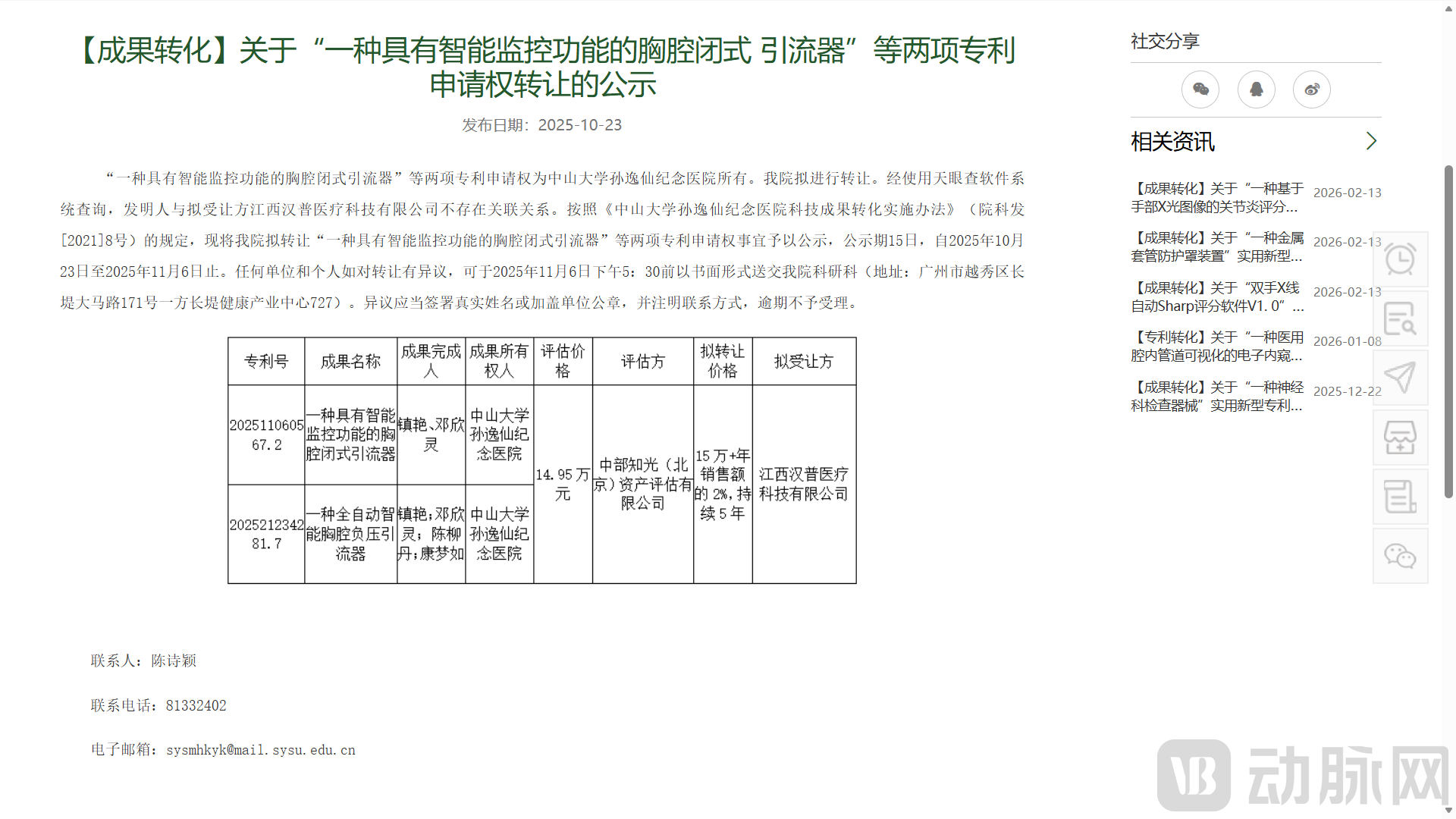
Image from the official website of Sun Yat-sen Memorial Hospital, Sun Yat-sen University
These two technologies are applied inSpecialized Equipment for Thoracic Drainage in the Medical Device Field, primarily designed for postoperative drainage management in thoracic procedures such as those for pleural effusion, pneumothorax, hemothorax, or empyema. Its core objective is to address the pain points of traditional closed thoracic drainage systems, including inefficient adjustment, resource waste, and lack of monitoring. By enabling intelligent monitoring, dynamic regulation, and convenient assembly/disassembly of the drainage process, it enhances the safety, efficiency, and cost-effectiveness of clinical drainage.
Chest Tube DrainageIt is a core diagnostic and therapeutic modality for postoperative management of thoracic conditions such as pleural effusion, pneumothorax, and hemothorax. Although it has been widely used in clinical practice for many years, traditional equipment has long facedInefficient Manual Control, Severe Resource Waste, and Lack of Intelligent Monitoringthe core challenge; even though some devices have added negative pressure suction functionality, they still struggle to meet the clinical demands for precise and efficient diagnosis and treatment, becoming a key bottleneck that restricts the efficacy of drainage therapy and medical efficiency.
FromDrainage Procedures and ManagementFrom this perspective, negative pressure regulation in traditional devices relies on manual operation, resulting in slow adjustment speeds and low precision. These systems cannot dynamically adapt to the real-time status of patient drainage, making them prone to causing lung tissue injury or incomplete drainage due to improper negative pressure, thereby prolonging the patient's recovery period. Meanwhile, the drainage bottle and water-seal bottle feature a fixed connection structure. Although the physiological saline in the water-seal bottle typically does not require replacement, it is discarded along with the drainage bottle during frequent changes, leading to significant waste of medical resources and substantially increasing clinical consumable costs.
Absence of Intelligent Monitoring and Risk Early WarningThis constitutes a core limitation of traditional devices. The equipment lacks any quantitative detection mechanisms, forcing medical staff to rely solely on visual observation to assess drainage status. Consequently, they cannot accurately monitor key indicators such as drainage volume and negative pressure in the water-seal bottle, making it difficult to promptly identify issues like catheter obstruction or abnormal negative pressure. Furthermore, the absence of an automated warning system means that abnormalities can only be detected through scheduled rounds. This not only increases the workload for healthcare professionals but also raises the risk of missed diagnoses and delayed interventions, thereby increasing the likelihood of complications such as failed lung re-expansion and medical incidents.
Furthermore, traditional devices also suffer fromPoor structural adaptability, limited mobilitydeficiencies. The equipment features a fixed structure with uniform dimensions, making it incompatible with drainage bottles and water-seal bottles of varying specifications, thereby increasing the difficulty of consumable procurement and management. The negative pressure pump relies on an external fixed power source and lacks an independent power supply module, rendering the device immobile. This necessitates prolonged bed rest for patients to accommodate drainage, which reduces comfort and hinders early postoperative mobilization. Furthermore, the device is unsuitable for scenarios such as emergency transport and bedside mobile diagnosis and treatment.
However, some existing improved devices suffer from limited functionality and low integration, achieving only single-function upgrades without establishing an integrated system encompassing detection, display, early warning, and convenient assembly/disassembly. The cumbersome assembly and disassembly procedures of certain devices make them ill-suited for rapid-response scenarios such as emergency resuscitation, failing to truly address core clinical pain points and resulting in limited clinical adoption.
In the Field of Closed Thoracic DrainageInefficient manual control, resource wastage, lack of monitoring, and poor adaptabilitythe core pain points, the patented technology package developed by Zhen Yan’s team at Sun Yat-sen Memorial Hospital, Sun Yat-sen University, toDetachable Structure and Intelligent Monitoring Systemas the core, to create an integratedEasy Assembly and Disassembly, Precise Adjustment, Real-Time Monitoring, Multi-Scenario AdaptabilityAn integrated solution that achieves breakthroughs across all dimensions—from device structure and operational efficiency to procedural safety and resource utilization—reshaping the clinical application model of closed thoracic drainage.
This technologyPioneering Novel Detachable Independent Fixation Structure, thereby addressing the root cause of medical resource waste. By breaking away from the traditional design of fixed bottle connections, an independent placement chamber is constructed using a connecting plate along with top and bottom plates. This works in conjunction with a fixation assembly composed of plug-in connectors and elastic components to enable the individual replacement of drainage bottles while allowing water-seal bottles to be reused. The inclined surface design of the plug-in connectors facilitates automatic locking and fixation of the bottles; disassembly requires only pulling a lever, eliminating the need for special tools throughout the process and significantly improving operational efficiency. The accompanying threaded rod lifting structure allows for flexible adjustment of the top plate height to accommodate bottles of various specifications, breaking through fixed-size limitations, enhancing equipment versatility, and reducing consumable management costs. Additionally, positioning blocks on the bottom plate ensure rapid and precise alignment of the bottles, further simplifying the operational workflow.
Meanwhile, technologyConstruction of an Integrated Intelligent Monitoring System for Detection, Display, and Early Warning, thereby achieving precise and visualized control of the drainage process. The water-seal bottle is equipped with a negative pressure detection device, the drainage tube is fitted with a flow rate detection device and a one-way valve, and the negative pressure pump is configured with a display unit. These three components are electrically connected to enable real-time acquisition and intuitive visualization of key indicators such as negative pressure values and drainage flow rates, assisting medical staff in precisely regulating negative pressure to avoid lung tissue injury or incomplete drainage caused by improper negative pressure. The power supply box is paired with warning lights and alarms linked to the detection devices, providing immediate audible and visual alerts in case of abnormal negative pressure or flow rates, thus enabling automatic anomaly warnings, shortening emergency response time, and reducing the risk of complications and medical accidents. Furthermore, the one-way valve effectively prevents backflow of accumulated fluid, mitigating the risk of infection at its source.
Another core advantage of the technology isIntegrated Design + Multi-Scenario Adaptation, breaking through the bottleneck of limited mobility in traditional devices while balancing clinical efficiency and patient experience. By integrating the power supply unit and vacuum pump on one side of the baseplate, the independent power module eliminates the constraint of external power sources, allowing for flexible device movement. This design adapts to various scenarios such as emergency transport and bedside diagnosis and treatment, while also supporting appropriate postoperative patient activity to enhance comfort and promote recovery. The separate layout of water pathways and electrical circuits prevents cross-interference, thereby improving the overall stability of the device.
Moreover, the technology integratesHighPracticality and Ease of Promotion, catering to the clinical needs of medical institutions at all levels. The device features highly integrated functional modules and a streamlined structure, with standardized core components for easy maintenance and replacement. Operations such as negative pressure adjustment, canister assembly/disassembly, and parameter reading have a low learning curve, allowing general medical staff to quickly master the device without specialized training. Meanwhile, it retains the core principles of traditional drainage, enabling healthcare professionals to maintain their existing operational habits, thereby significantly reducing the cost of clinical adoption and adaptation.
Overall, this patented technology deeply integrates structural innovation with intelligent technology to address multiple clinical pain points of traditional drainage devices. It delivers multifaceted value, including resource conservation, precise diagnosis and treatment, operational convenience, and adaptability to diverse clinical scenarios. This innovation provides a new direction for the upgrading and transformation of closed thoracic drainage equipment, demonstrating significant potential for clinical translation and widespread application.
In the closed chest drainage device sector, focusing on“Intelligent Upgrades, Clinical Adaptation Optimization, and Functional Integration Innovation”core needs, domestic and international enterprises and research institutions have established multi-path layouts, presenting“Multinational giants hold firm in the high-end segment, domestic brands accelerate their breakthroughs, and innovative technologies achieve progress across multiple fronts”competitive landscape. Currently, similar products on the market mainly focus onIntelligent Monitoring, Structural Optimization, Functional IntegrationThree major directions, with varying R&D progress and product positioning among different stakeholders, are jointly advancing thoracic drainage technology from “traditional mechanical operations” to “precise intelligent diagnosis and treatment.”
Weigao Group (Shandong Weigao)As the leading domestic medical device company, itsDisposable Drainage Catheters and AccessoriesFocusing on the needs of minimally invasive drainage, this device is made of polyurethane without plasticizers, offering excellent biocompatibility. The pigtail catheter with a side multi-hole design prevents tube blockage and tissue damage. Combined with the Seldinger puncture technique, it enables precise single-operator catheter placement. It is suitable for draining blood and fluid accumulations in the thoracic and abdominal cavities and has been approved for market launch.
Ningbo Xinyue Medical (Ningbo Xinyue)ofDigital Chest Drainage SystemComprising a main unit and a disposable dry-seal valve drainage device, this system is suitable for scenarios such as traumatic pneumothorax and pleural effusion. The main unit integrates a display screen with stable negative pressure delivery, offering portability and ease of use while eliminating the fluid management hassles associated with traditional water-seal bottles. It has completed NMPA registration and entered the clinical promotion phase.
Zhejiang Lexin Medical (Zhejiang Lexin)ofG-Mac Digital Chest Drainage Monitoring SystemAs the first innovative product of its kind in China, it provides adjustable negative pressure ranging from -1 cmH₂O to -100 cmH₂O, monitors drainage volume and air leak rate in real time while generating data charts, supports quantitative assessment for extubation timing, and features automatic tube flushing and intelligent alarms. The device is lightweight and quiet, enabling early patient ambulation, and has been included in the Zhejiang Province Innovative Medical Device Catalog.
In summary, these two patented technologies from Sun Yat-sen Memorial Hospital of Sun Yat-sen University precisely address industry pain points such as inefficient manual regulation, resource waste, and lack of monitoring. By leveraging dual-core innovations in detachable structures and intelligent monitoring, they enable independent replacement of drainage bottles, real-time multi-parameter monitoring, adaptation to multiple specifications, and mobile use. Combining the multiple advantages of cost-effectiveness, precision, and convenience, these technologies fill the industry gap in the deep integration of structural and intelligent technologies.