

Shanghai Jiao Tong University to Transfer 3D-Printed Biodegradable Magnesium Mesh Technology for Alveolar Bone Defect Reconstruction at RMB 600,000
Recently, Shanghai Jiao Tong University released a public notice on the transformation of scientific and technological achievements, proposing to transfer“3D-Printed Personalized Degradable Magnesium Mesh for Alveolar Bone Defect Reconstruction”Relevant patents are being commercialized, with an assessed value of RMBRMB 600,000. This patent is jointly held by Shanghai Jiao Tong University and Shanghai Ruibo Medical Technology Co., Ltd., with each party holding an equal share50%, inventor:Professor Yuan Guangyin and his team。
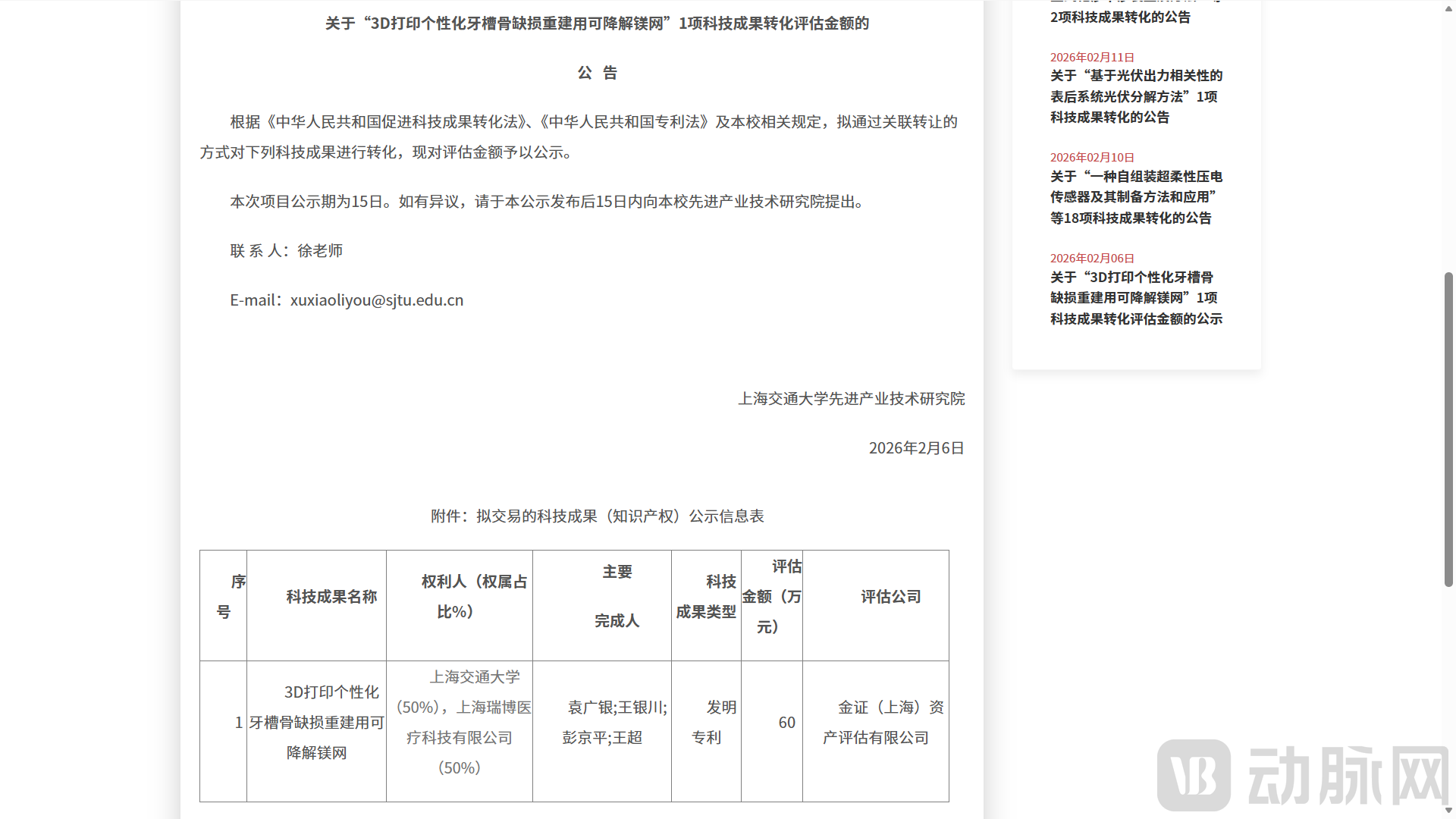
Image from the official website of Shanghai Jiao Tong University
The present invention is directed toAlveolar bone defects in clinical dentistry lead to insufficient bone volume, which fails to meet the requirements for dental implant placement.To address such treatment needs, biodegradable magnesium meshes are fabricated using pure magnesium or magnesium alloys with specific compositions, integrating personalized data from oral CT scans and 3D printing technology. These meshes precisely conform to the patient’s alveolar bone defects, serving as mechanical support scaffolds that provide a stable three-dimensional space for bone regeneration, guide bone tissue repair and growth, and ultimately achieve reconstruction of alveolar bone defects, thereby laying the foundation for subsequent dental treatments such as dental implantation.
Repair of Extensive Alveolar Bone Defectsis a core clinical challenge in oral implantology,Insufficient Bone MassDirectly limiting the indications for implant therapy, this issue compromises implant stability, longevity, and aesthetic outcomes, thereby becoming a major obstacle in oral implant treatment. Meanwhile, existing bone augmentation strategies for alveolar bone defects struggle to simultaneously meet the core requirements of precise fit, mechanical support, biocompatibility, and clinical convenience, resulting in multidimensional market pain points.
Traditional Guided Bone Regeneration (GBR) and Supporting Titanium MeshSignificant limitations exist: Guided Bone Regeneration (GBR) membranes alone exhibit low mechanical strength, failing to maintain the three-dimensional osteogenic space required for large-area bone defects, resulting in poor bone augmentation outcomes. Traditional prefabricated titanium meshes demonstrate poor conformity to the anatomical morphology of the alveolar bone and require intraoperative manual contouring. This not only increases surgical difficulty and duration but also leads to a high rate of postoperative titanium mesh exposure, significantly reducing surgical success rates.
Personalized titanium meshes leveraging digital technology have resolved the issues of fit and intraoperative shaping associated with traditional titanium meshes, yet they face a clinical dilemma due to their non-degradability: the titanium mesh requires a second surgical procedure for removal during subsequent dental implant placement, which increases patient suffering and financial burden, and may also damage newly formed bone tissue; furthermore, the significant discrepancy in elastic modulus between titanium and human bone easily triggers“Stress Shielding” Effect, inhibiting bone tissue growth and remodeling, and limiting the efficacy of bone augmentation.
Magnesium alloys, as ideal biodegradable alternative materials, face challenges in clinical translation due to bottlenecks in 3D printing technology. Their flammability and oxidation tendency, along with low boiling points and high vapor pressure, pose safety risks during 3D printing and cause severe powder spattering. Additionally, limitations in fabrication precision often result in distorted or clogged pores in the printed magnesium scaffolds, which not only compromise mechanical properties but also lead to localized corrosion and uncontrolled degradation, failing to meet clinical application requirements.
in the field of alveolar bone defect reconstructionLow Conformity, Secondary Surgical Trauma, Poor Material Compatibility...such core pain points have driven innovations in restorative materials and fabrication technologies. This patent's3D-Printed Personalized Biodegradable Magnesium Mesh Solution, with its core advantage lying in overcoming the limitations of traditional titanium mesh and magnesium alloy 3D printing technologies, throughPersonalized Precision Forming, Degradable Biological Compatibility, High-Performance Structural DesignDeep integration to create a clinical-oriented technical pathway for alveolar bone defect reconstruction, combining mechanical support with osteoinductive functionality.
This technology enables personalized, precision shaping, significantly optimizing the clinical surgical experience. Relying onCone Beam CT Scanprecise alveolar bone data, after software-based reconstruction and modeling, throughHigh-Precision Fabrication of Magnesium Mesh via Laser Powder Bed Fusion 3D Printing, ensuring a snug fit to the bone defect without the need for intraoperative shaping, thereby shortening surgical time, reducing operational difficulty, minimizing the risk of postoperative exposure, and improving surgical success rates; furthermore, by precisely controlling printing parameters, it resolves the technical challenges of powder spattering and mesh distortion or clogging associated with 3D printing of magnesium alloys, ensuring the structural integrity and dimensional accuracy of the magnesium mesh.
The material's high biocompatibility fundamentally addresses the clinical pain points of traditional titanium meshes. SelectedHigh-purity magnesium with purity ≥99.99% or Mg-Nd-Zn-Zr magnesium alloy with specific composition ratios, its mechanical properties are similar to those of human bone, thereby avoiding the "stress shielding" effect associated with titanium meshes; magnesium materials can fully degrade in vivo, eliminating the need for secondary surgical removal, reducing patient suffering and economic burden, and preventing damage to newly formed bone tissue; furthermore, magnesium ions released during degradation can induce osteogenesis, promote osteoblast proliferation and bone tissue regeneration, achieving the dual functions of "mechanical support + osteoinductive bone formation," thus enhancing the efficacy of bone augmentation repair.
Dual optimization of structure and coating, balancing mechanical performance with clinical safety. The magnesium mesh adoptsFully Open-Cell Hexagonal Structure, exhibits excellent self-supporting properties and optimal mechanical support performance, capable of stably maintaining the three-dimensional osteogenic space for bone defects;U-shaped cross-section, smooth edges, and bilateral fixation hole design, tailored to meet clinical fixation requirements with secure installation. The surface of the magnesium mesh can be coated with biocompatible materials such as calcium phosphate or polymers to precisely regulate the degradation rate, thereby preventing loss of mechanical support due to rapid degradation or inflammation caused by localized corrosion. Meanwhile, it further promotes osteoblast adhesion and proliferation, accelerates bone healing, and enhances safety in clinical applications.
In addition, the preparation process of this technologyHighly Efficient, Eco-Friendly, and Highly Controllable. 3D printing directly forms complex, personalized structures with short preparation cycles, minimal raw material loss, no pollution, and high reproducibility; standardized material ratios and printing parameters enable the stable fabrication of magnesium meshes with high precision and controllable geometry. The surface treatment process further lays the foundation for coating application, balancing scalable manufacturing with clinical personalization needs, thereby offering extremely high value for clinical translation and application.
With the continuous growth in demand for dental implants, the market for alveolar bone defect repair materials is entering a period of rapid development.Integration of Biodegradable Materials and 3D Printing TechnologyHave become a core direction for industry innovation. Enterprises and research institutions both domestically and internationally are focusing on key requirements such as material biocompatibility, personalized adaptability, and osteogenic activity, laying out product development and commercialization strategies, thereby forming a diversified competitive landscape.
Shenzhen Zhongke Jingcheng Medical Technology Co., Ltd.As a benchmark enterprise in the field of magnesium-based bone repair materials, [it] launched the world's first“Bogelie® Magnesium-Containing Degradable Polymer Bone Repair Material”, and received NMPA approval for market launch in May 2025. This product innovatively employs a ternary component design, fabricated via ultra-low temperature 3D printing technology, integrating the osteoinductive advantages of biodegradable polymers and magnesium ions. The product has completed clinical translation and is currently undergoing market promotion, while simultaneously pursuing FDA and CE certifications to expand into international markets.
Yantai Zhenghai Biotechnology Co., Ltd.Leveraging technology transfer from the Shanghai Institute of Ceramics, Chinese Academy of Sciences, we have developed China’s first3D-Printed Calcium Silicate Bioceramic Oral Bone Repair Materials, and obtained the Class III medical device registration certificate in January 2026. This product focuses on the repair of alveolar bone defects, utilizing light-cured 3D printing technology to construct biomimetic porous structures. It is the first to incorporate functional elements such as silicon and magnesium, achieving a balance between personalized customization and mass production while promoting osteogenic differentiation and angiogenesis, thereby optimizing the dynamic balance between "degradation and osteogenesis." The product has now officially entered the clinical application stage, enriching the product portfolio of oral bone repair materials.
In summary, 3D-printed personalized biodegradable magnesium mesh technology has overcome multiple clinical and technical challenges in alveolar bone repair, representing a significant technological breakthrough in this field. Currently, oral bone repair materials are evolving toward personalization and biodegradability. China has achieved a first-mover advantage in this technology, and in the future, highly bioactive repair materials integrated with 3D printing will become the market mainstream, driving continuous innovation in the industry.