

Capital Medical University Completes RMB 10 Million Technology Transfer of Proximity Scanning High-Energy Pulsed UV Disinfection Device
Recently, Beijing Shijitan Hospital, Capital Medical University, and Beijing Zhonghang Taida Environmental Protection Technology Co., Ltd. completedClose-Range Scanning High-Energy Pulsed Ultraviolet Disinfection DeviceTechnology transfer transactions for patent application rights, with a contract value reaching10 million yuan. This patent is held byDeveloped by Professor Yao Qi。
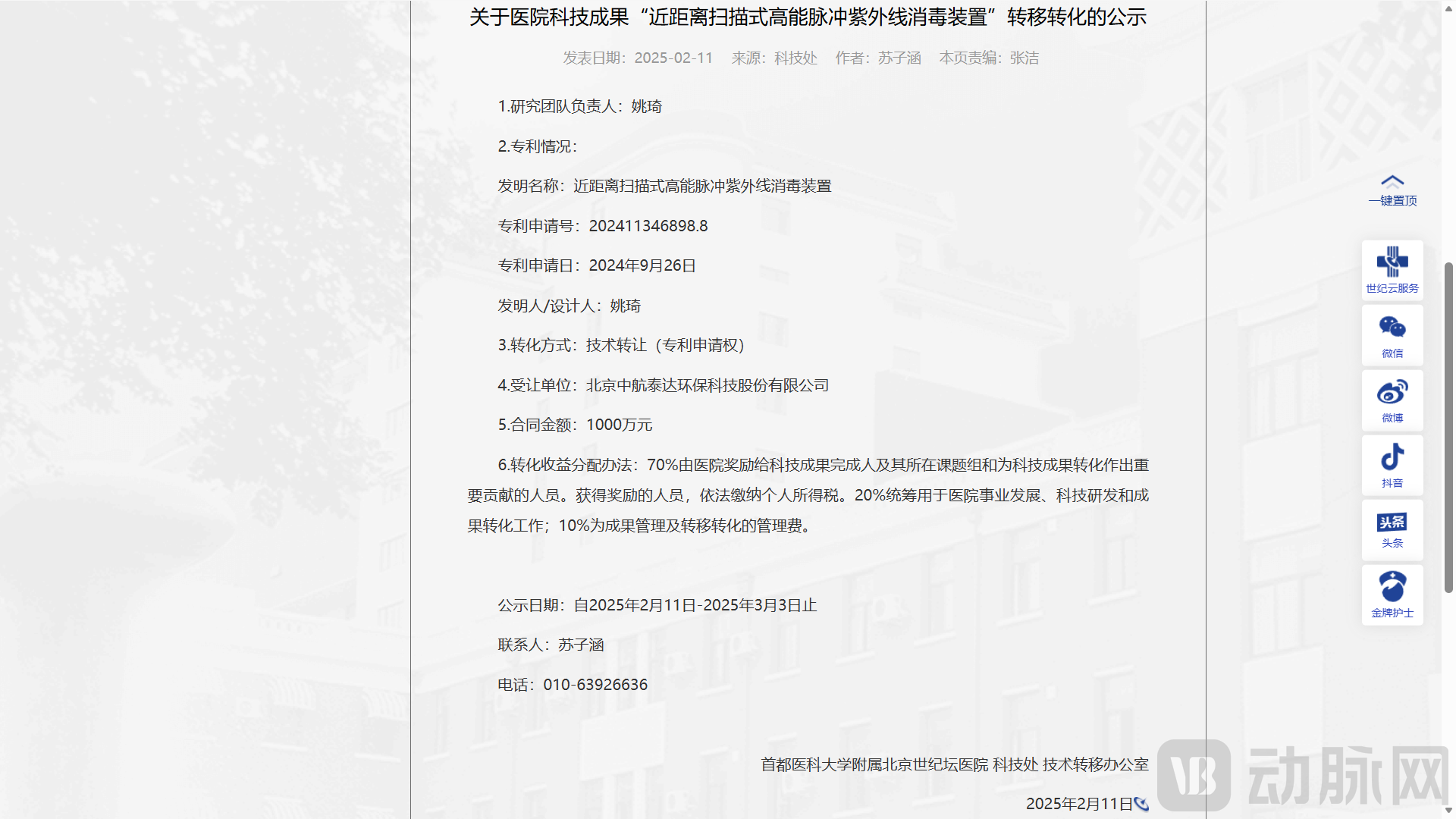
Image from the official website of Beijing Shijitan Hospital, Capital Medical University
The core of this patent isAn Intelligent Disinfection Device Adapted for Hospital Ward Scenarios, its greatest technological innovation lies inThree-axis rotatable force arm unit integrated with a mobile chassis, enabling close-range, scanning-style disinfection of both planar and three-dimensional obstacles within hospital wards. This approach overcomes the common drawbacks of traditional ultraviolet (UV) disinfection, such as numerous blind spots, low efficiency, and high radiation risks. Furthermore, by integrating functions like obstacle recognition, prioritized disinfection, and human infrared detection, it makes hospital ward disinfection more intelligent, precise, and safe.
Nosocomial InfectionHospital-acquired infections (HAIs) represent a critical medical safety issue requiring urgent prevention and control in clinical practice. HAIs refer to infections acquired by patients during diagnosis and treatment within a healthcare facility, as well as infections contracted by healthcare workers during their occupational duties. Microorganisms such as bacteria and fungi in ward environments can spread through various routes, including air, aerosols, and direct contact, serving as the primary drivers of HAIs. These infections not only prolong hospital stays and increase treatment costs but may also exacerbate patients’ conditions and lead to severe complications, thereby significantly adversely affecting patient prognosis and the quality of medical care. Consequently, efficient and comprehensive disinfection of hospital wards is a key measure in preventing and controlling HAIs.
Current clinical UV disinfection protocols for hospital wards are predominantlyUltraviolet light with wavelengths of 200 to 280 nm is emitted using a mercury lamp., thereby achieving disinfection by destroying microbial cell structures and causing cell death. Meanwhile, some technologies have attempted to apply high-energy pulsed UV lamps in the field of sterilization and disinfection, such as mobile pulsed UV disinfection robots and airborne disinfection systems.
However, all existing disinfection protocols exhibit significant technical limitations and fail to meet the clinical demand for precision disinfection. Traditional mercury lamp disinfection suffers from inherent drawbacks such as mercury content and fragility, posing potential risks of chemical contamination. Furthermore, it is characterized by prolonged disinfection cycles and unstable ultraviolet (UV) intensity in practical applications. The sole reliance on long-distance irradiation readily creates disinfection blind spots, leading to microbial residue. Conversely, while disinfection systems equipped with high-energy pulsed UV lamps can achieve rapid and efficient area-wide disinfection, they pose substantial radiation safety risks due to the intense ionizing radiation emitted by the lamps and their high operational complexity. Consequently, these systems are unsuitable for the unique clinical scenarios of hospital wards, which feature frequent personnel movement and complex environments.
Against this backdrop, there is an urgent clinical need to upgrade ward disinfection technologies, necessitating a novel disinfection device tailored to hospital ward settings. Such a device must overcome the limitations of traditional disinfection methods—including numerous blind spots, low efficiency, and contamination risks—while avoiding the radiation hazards associated with high-energy pulsed ultraviolet light. By enabling intelligent and precise disinfection processes, it aims to comprehensively enhance the efficacy and safety of ward disinfection, reduce the incidence of healthcare-associated infections at the source, and establish a robust medical safety barrier for clinical diagnosis, treatment, and patient recovery.
This close-range scanning high-energy pulsed UV disinfection device achieves hospital ward disinfection through multi-dimensional technological innovations.Intelligent, Precise, and Efficient, demonstrating comprehensive technical advantages over traditional disinfection solutions, with core innovations and benefits reflected inStructural Design, Sterilization Method, Safety Protection, Intelligent Controland other aspects.
In terms of structural design,, the device innovatively adoptsTriaxial Rotatable Force Arm Unit AssemblyThe first, second, and third linkage arm units can rotate to predetermined angles in the vertical plane, horizontal plane, and vertical plane, respectively. Coupled with a mobile chassis structure, the device allows flexible adjustment of disinfection angles and positions, overcoming the spatial limitations of traditional disinfection equipment. It enables blind-spot-free scanning of all surfaces of both planar and three-dimensional obstacles, such as hospital beds and cabinets, within patient rooms. Meanwhile, storage compartments on both sides of the fuselage house the linkage arms and UV lamp tubes, achieving multifunctional switching and a compact design.
In terms of disinfection methods, the device innovatively adoptsShort-Range Targeted Disinfection Mode, controlling the distance between the high-energy pulsed UV lamp tube and the surface of obstacles to ≤20 cm, with the lamp tube directionally emitting high-energy pulsed ultraviolet rays, which not only significantly improves disinfection efficiency but also avoids indiscriminate scattering of ultraviolet light; meanwhile, the high-energy pulsed UV lamp tubes equipped in the device are filled with xenon and argon gases, combined with a cooling channel design, eliminating the mercury-containing structure of traditional mercury lamps, thereby eradicating the risk of chemical pollution at its source. The device also integrates three modes—fixed scanning, three-dimensional scanning, and conventional disinfection—to meet the disinfection needs of different scenarios within hospital wards.
At the Level of Intelligent Control, the device integrates multiple intelligent modules, including obstacle type recognition, priority setting, and path planning, throughConstruction of 3D Maps of Ward Environments Using Multi-Sensor Fusion and SLAM Technologies, combined with convolutional neural networks to achieve precise identification and matching of obstacles. It can assign scanning weights ranging from 0.5 to 1.0 based on patient contact frequency, prioritizing high-contact items such as hospital beds to enable disinfection in order of risk level, thereby making the disinfection process more targeted. Meanwhile, the path planning module automatically plans the movement trajectory of the device and the operational path of the robotic arm, adjusting the arm’s actions according to the three-dimensional structure of different obstacles to achieve fully automated scanning disinfection, significantly reducing manual operation costs.
In terms of safety protection, Innovative Device ConfigurationInfrared Detection Unit, enabling real-time detection of human presence, orientation, and distance to promptly avoid exposure during force arm adjustment and disinfection processes. Combined with the design of directional ultraviolet (UV) emission, this dual approach significantly reduces the radiation risks associated with high-energy pulsed UV light, thereby addressing safety challenges in the application of high-energy pulsed UV lamps in hospital wards. Furthermore, the device marks and provides feedback on disinfection points that are inaccessible, ensuring that the completion of disinfection tasks is traceable and verifiable.
Overall, the device willMechanical Structure Innovation, Intelligent Algorithm Application, and High-Energy Sterilization TechnologyDeep integration not only addresses the pain points of traditional ultraviolet disinfection—such as numerous blind spots, low efficiency, and secondary pollution—but also avoids the radiation risks associated with existing high-energy pulse sterilization technologies. This approach achieves a triple enhancement in disinfection efficacy, operational efficiency, and usage safety, providing a novel technical solution for the prevention and control of nosocomial infections in hospital wards.
From the perspective of the overall market prospects for high-energy pulsed ultraviolet (UV) disinfection products, the healthcare sector’s increasing emphasis on preventing and controlling healthcare-associated infections has led to rising demands for intelligent, precise, and safe disinfection equipment, thereby creating substantial growth opportunities for such products.
The patented technology being transferred precisely addresses key pain points in the medical disinfection industry. Its innovative technical design and functional configuration fill existing technological gaps in the market. Although large-scale production and commercial launch have not yet been realized, its differentiated technological advantages already demonstrate strong market competitiveness, laying a solid technical foundation for future entry into the medical disinfection equipment market.
Sait Intelligent Disinfection RobotIt is an intelligent mobile disinfection device developed for medical scenarios, focusing on the efficient, unmanned disinfection needs of hospital environments. As one of the representative products in the field of intelligent disinfection robots, it is widely used for routine disinfection operations in medical institutions at all levels.
In terms of product design and functionality, the robot adopts“Intelligent Navigation + Multiple UV Lamp Tubes”'s core configuration, equipped withDual-Chamber UV Lamp DesignTo enhance disinfection efficiency, it enables simultaneous sterilization of both air and object surfaces. Its core advantages lie in intelligent navigation and path planning capabilities, supporting SLAM-based environmental modeling technology. It can autonomously construct an environmental map of the operational area, precisely plan movement paths, and effectively avoid obstacles such as hospital beds and cabinets within patient rooms, thereby achieving full-area coverage disinfection without the need for continuous manual operation.
Meanwhile, the robot is equipped with comprehensive safety mechanisms and human presence sensors. When a person is detected approaching within the operational range, it automatically triggers shutdown or obstacle avoidance to prevent UV exposure injuries. Certain models also support remote control and scheduled disinfection, allowing staff to flexibly set disinfection times and work areas via a terminal, thereby adapting to the diverse workflows and paces of hospital environments.
Xinhua Medical UV Disinfection CartDesigned for medical settings, this basic mobile disinfection device is primarily positioned to meet routine air and surface disinfection needs in various environments. Its simple and practical design has made it one of the most widely adopted disinfection products on the market.
In terms of product design and functionality, this series of disinfection cartsAdopts a vertical, movable frame structure, equipped with casters at the base to facilitate flexible movement between different areas by staff, allowing for immediate use without fixed installation. The device is fitted with multiple ultraviolet (UV) lamp tubes, primarily arranged vertically. By adjusting the height and angle of the lamp holders, it can accommodate disinfection requirements for spaces of varying dimensions.
Operation method:Manual ControlPrimarily, staff can manually activate the device and set the disinfection duration according to the size of the disinfection area. Some models support a timer function, allowing users to pre-set the operating time; the device will automatically shut down upon completion of the disinfection cycle, thereby enhancing ease of use. Its core disinfection principle isEmitting ultraviolet light at specific wavelengths via UV lamps, disrupts the cellular structures of bacteria and microorganisms, thereby achieving disinfection of air and object surfaces to meet the basic requirements of conventional disinfection scenarios. In terms of market application, this series of disinfection robots is deployed across medical institutions at all levels and public health venues with basic disinfection needs.
At the policy level, environmental protection requirements are driving the gradual phase-out of traditional mercury-containing disinfection equipment.Mercury-Free, High-Energy Novel Ultraviolet Disinfection TechnologyIt has become a key direction for industry development, providing policy support for the market adoption of related products. At the technical level, the deep integration of artificial intelligence, multi-sensor fusion, and precise robotic arm control with disinfection equipment is driving product upgrades toward full-scenario adaptability and end-to-end intelligence. The design concepts represented by this patent—such as close-range scanning, prioritized disinfection, and directional emission—have become core trends in technological advancement within the industry.
In terms of application scenarios, the scope of these products is continuously expanding. Beyond core medical settings such as hospital wards, operating rooms, and intensive care units at all levels, their use is extending to facilities with stringent disinfection requirements, including elderly care institutions, health examination centers, and biological laboratories, thereby sustaining the release of market demand. Overall, disinfection equipment centered on high-energy pulsed ultraviolet technology and integrated with intelligent control and precise sterilization aligns with industry development trends and actual market needs. Such devices are poised to gradually become one of the mainstream products in the field of medical disinfection, offering considerable market growth potential while providing more efficient and safer technical support for strengthening nosocomial infection prevention and control systems.