

Tongji Hospital of Huazhong University of Science and Technology to Transfer Urinary Free Cortisol Detection Technology for RMB 320,000
Recently, Tongji Hospital affiliated with Tongji Medical College of Huazhong University of Science and Technology“A Method for Detecting Urinary Free Cortisol Using Liquid Chromatography-Tandem Mass Spectrometry”public notice on the transformation of scientific and technological achievements of the invention patent. The achievement is proposed to be priced through agreement, atRMB 320,000at a price to Ke'erpu Xin (Wuhan) Biopharmaceutical Co., Ltd. The inventor of this patent isShen Ying and Cheng LimingThis patent primarily provides a simplified pretreatment method that omits traditional extraction steps by directly adding a specific cortisol isotope internal standard working solution to the urine sample to be tested, followed by centrifugation, thereby enabling rapid quantitative detection of urinary free cortisol using liquid chromatography-tandem mass spectrometry.
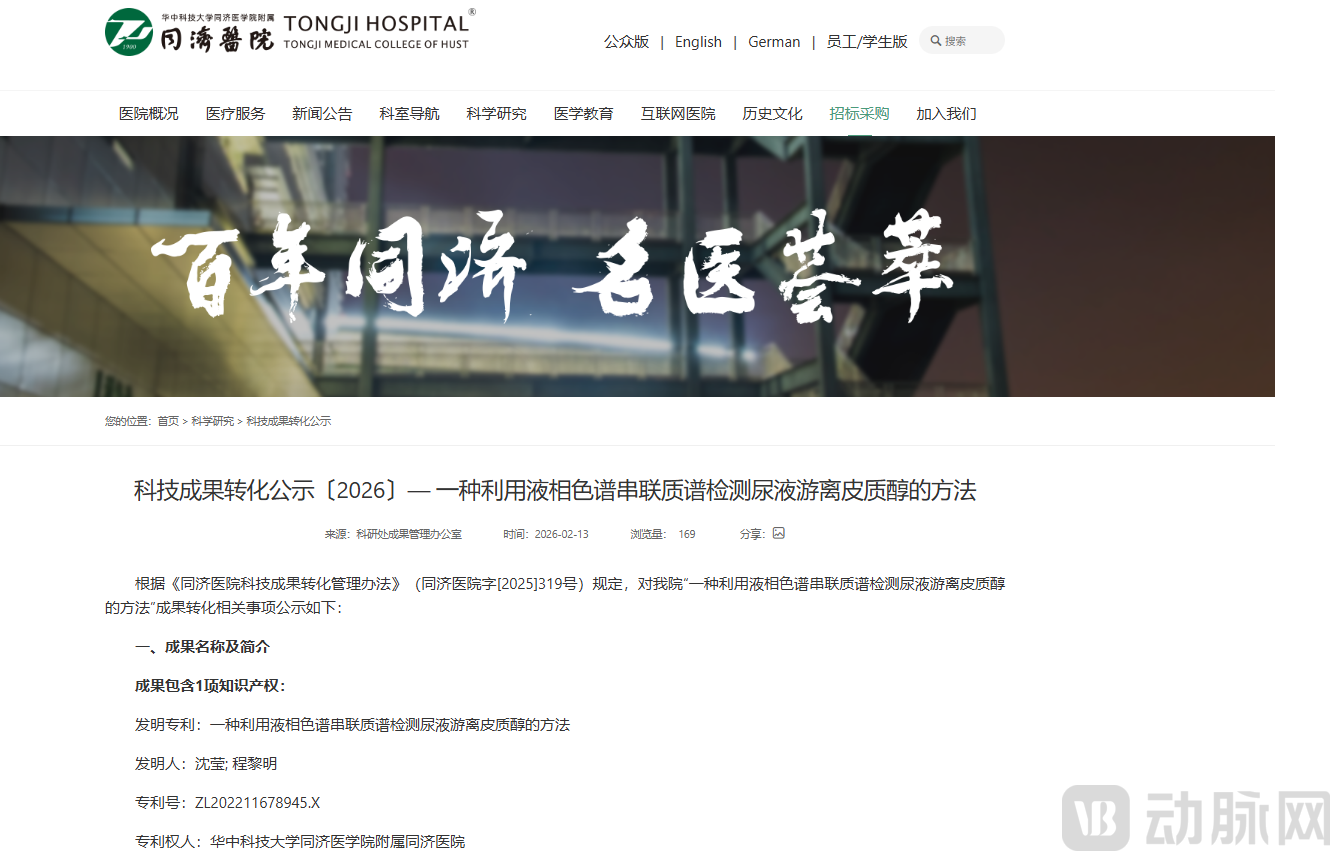
Image from the official website of Tongji Hospital, Tongji Medical College, Huazhong University of Science and Technology
Patients with Cushing's Syndrome (Hypercortisolism)Prolonged excessive cortisol secretion significantly predisposes individuals to severe cardiovascular events and serious infections, with a mortality rate four times higher than that of the general population. Early screening and diagnosis are crucial for improving patient prognosis. Currently,24-Hour Urinary Free Cortisol (UFC) AssayAlthough it has been listed as a first-line screening test for the disease by authoritative guidelines, existing clinical detection technologies generally face the dual bottlenecks of technical barriers and prohibitive costs, making them unable to meet the demands of large-scale routine clinical screening.
On one hand, the radioimmunoassay and chemiluminescent immunoassay methods commonly used in traditional clinical practice have significant technical limitations. They are highly susceptible to protein-binding interference, and due to the high structural similarity of human steroid hormones (such as estradiol and testosterone), cross-reactivity easily occurs during detection, directly leading to errors in test results and compromising screening accuracy. On the other hand, the "gold standard" for trace-level detection,Liquid Chromatography-Tandem Mass Spectrometry (LC-MS/MS), yet it suffers from a lengthy pre-processing workflow and high detection costs.
Current mainstream sample pretreatment methods, such as protein precipitation, liquid-liquid extraction (LLE), and solid-phase extraction (SPE), involve extremely cumbersome procedures. SPE, in particular, requires multiple steps including column equilibration, washing, elution, and nitrogen blow-down. This process is not only time-consuming but also heavily reliant on expensive disposable extraction cartridges, significantly increasing testing costs. Furthermore, existing detection methods often use 4% bovine serum albumin (BSA) solutions or pure solvent-based standards for calibration. These differ substantially from the matrix of real human samples, leading to calibration inaccuracies. Consequently, they fail to align precisely with actual clinical testing scenarios, making it difficult to reflect true patient conditions. There is an urgent need for more efficient, accurate, and cost-effective technical solutions to break this bottleneck.
Addressing the numerous pain points of existing detection technologies, the research team at Tongji Hospital hasDetection Mechanisms and Process OptimizationBy addressing two key aspects, we have radically streamlined cortisol screening technologies for Cushing’s syndrome, creating a novel testing solution that combines high efficiency, precision, and low cost. This approach effectively resolves core challenges in clinical screening, balancing analytical accuracy with practical operability, and is well-suited for large-scale routine clinical testing.
This technology pioneers innovation"Direct Mixing and Dilution Method", thoroughly simplifying the traditionally complex pretreatment procedures. In practice, it is only necessary to add a cortisol isotope internal standard solution (with a methanol-to-water volume ratio ranging from 1:3 to 3:1) to a micro-volume urine sample. This solution serves a dual purpose: it fully dissolves solutes in the sample while efficiently precipitating trace proteins in the urine. After simple mixing and centrifugation, the resulting supernatant can be directly analyzed by the instrument. This approach eliminates the cumbersome steps associated with traditional extraction, significantly reducing pretreatment time and operational complexity.
To thoroughly address the calibration distortion caused by matrix effects, the team innovatively introduced"Blank Urine Matrix" Preparation StrategyResearchers employed solid-phase extraction to pre-adsorb and remove free cortisol from pooled human urine samples, thereby preparing a clean, authentic blank urine matrix as the basis for calibrator preparation. Compared with traditional calibrators, these calibrators based on authentic human urine matrix better reflect the actual state of human specimens, effectively eliminating assay errors caused by matrix differences and meeting the stringent requirements for large-scale routine clinical analysis.
"Validated through a series of rigorous experimental data, this innovative technology demonstrates outstanding performance in cost reduction and efficiency enhancement, while maintaining high detection accuracy, fully complying with the standards of medical laboratory testing."
In terms of time cost, processing 96 samples requires 60 minutes for traditional liquid-liquid extraction and up to 120 minutes for solid-phase extraction, whereas the novel methodOnly 10 MinutesAll pre-processing can be completed, and the total time for a single test (including on-machine analysis) can be controlled withinWithin 13 minutes, achieving a leapfrog improvement in detection efficiency. In terms of consumables and reagent costs, taking the processing of 1,000 samples as an example, the cost of traditional solid-phase extraction consumables was as high as RMB 32,000, whereas the new technology has drastically reduced this cost to RMB 1,000. Meanwhile, reagent costs have been halved from RMB 4,000 to RMB 2,000, significantly alleviating the economic burden of clinical testing.
Under the premise of significant cost reduction,Technical detection accuracy remains compliant.. Precision evaluation data show that within-run precision is ≤2.98% and between-run precision is ≤2.97%; spike recovery rates remain stable between 93.3% and 109%, with a linear correlation coefficient as high as 0.9998. All core metrics meet the stringent standards for medical laboratory testing, while delivering the three key advantages of low cost, high efficiency, and high accuracy.
Currently, clinical mass spectrometry is emerging as a premier sector in precision medicine, leveraging its high specificity and capability for multi-analyte simultaneous detection. Industry data indicate that China’s clinical mass spectrometry market size had already exceeded RMB 16 billion by 2021, accounting for approximately 30% of the global market. With relevant policies designating mass spectrometry as a core technology, the commercialization process in this field is accelerating comprehensively.
In this red ocean market worth tens of billions,Mass Spectrometry Assay for Steroid HormonesOwing to its irreplaceable precision, it has become a strategic high ground fiercely contested by major in vitro diagnostics giants. In China,Zhongshan Hospital, Fudan UniversityPioneered the development ofLC-MS Method for the Detection of 20 Major Steroid Hormones and Exogenous Drugs in Blood. February 2026,Domestic In Vitro Diagnostics Company Autobioannounced its independently developedCortisol Assay Kit (Liquid Chromatography-Tandem Mass Spectrometry)Has officially obtained the medical device registration certificate. Meanwhile,Meikang Bio, Calibrus TechSteroid hormone assay kits from these and other enterprises have also successively obtained Class II medical device registration certificates and are being rapidly deployed in major Grade A tertiary hospitals. As the number of approved kits increases, industry competition will swiftly shift from merely “being able to test” to “how to conduct testing at low cost and with high throughput.”
The patented technology transferred by Tongji Hospital, leveraging innovations in its underlying reagent system, has minimized pre-treatment procedures and consumable costs to the utmost extent without compromising accuracy. This highly cost-effective testing solution not only provides a powerful new tool for large-scale clinical screening in medical laboratories but also holds promise for delivering more accessible precision medicine services to patients with endocrine disorders.