

Tongji Hospital of Huazhong University of Science and Technology to Transfer Novel Magnetic-Guided Chronic Total Occlusion Revascularization Device for RMB 280,000
Recently, Tongji Hospital affiliated with Tongji Medical College of Huazhong University of Science and Technology released a public notice on the transformation of scientific and technological achievements. The hospital intends to transfer its intellectual property through negotiated pricing.“An Interventional Device for Recanalization of Occluded Vessels Based on Dual-Catheter Guidewire Collaborative Docking”Relevant patents were assigned to Wuhan Wuyouchuang Technology Co., Ltd., with an assignment fee of RMBRMB 280,000. The inventor of this patented technology isLiu Chenchen and Team。
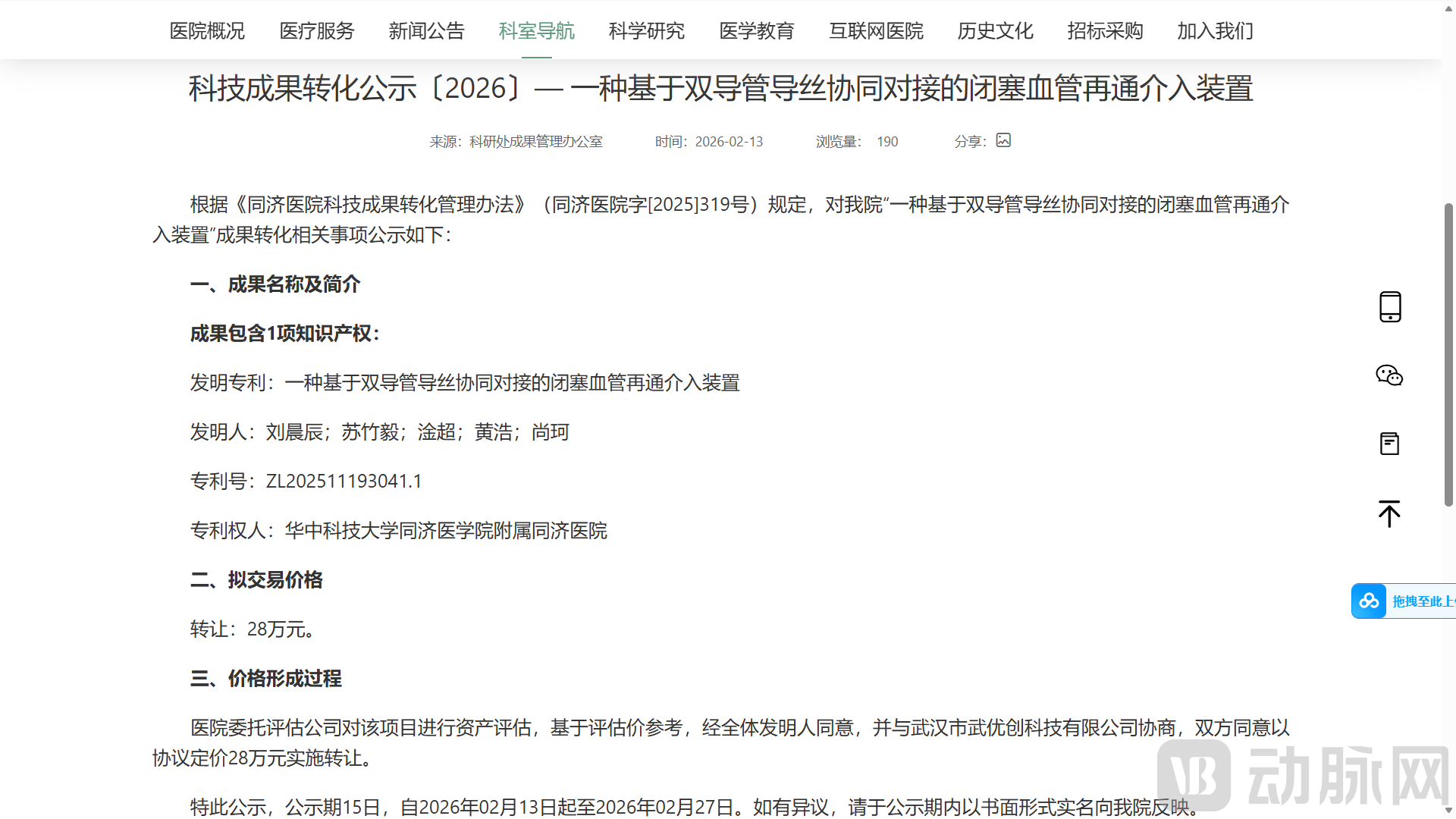
Image from the official website of Tongji Hospital, Tongji Medical College, Huazhong University of Science and Technology
This technology isAn Interventional Device for Recanalization of Occluded Vessels Based on Dual-Catheter Guidewire Collaborative Docking, with its core application in interventional recanalization procedures for subclavian artery occlusion; it is also compatible with interventional treatments for similar vascular occlusions. Essentially, it isAddressing the challenge of difficult channel navigation in traditional dual-catheter guidewire procedures to achieve efficient recanalization of occluded vessels。
Endovascular Recanalization for Subclavian Artery Occlusion to Restore Blood Flow...as the core technique, which requires coordinated catheter and guidewire puncture of the thrombus via bilateral femoral and radial arterial approaches to establish a through-and-through channel; the precision of this procedure directly determines the outcome of vascular function recovery in patients.
However, in current clinical practice, traditional dual-catheter guidewire kits suffer from inherent design flaws that constitute a major therapeutic challenge: the distal ends of the devices lack directional adjustability, and the excessive length of the kit makes intravascular direction adjustment difficult. Consequently, procedural outcomes are highly dependent on the operator’s experience, and channels established within the thrombus via bilateral access are prone to misalignment, directly leading to failure in achieving vascular recanalization.
This situation poses multiple challenges for both patients and healthcare providers:Patient Level, surgical failure entails the physical trauma and economic burden of secondary treatment, while repeated instrument adjustments prolong operative time and increase the risk of X-ray radiation exposure;Healthcare Personnel Level, requiring repeated attempts to manipulate the device based on experience, which entails high operational difficulty and significant mental and physical exertion. The success rate remains difficult to guarantee in complex thrombotic lesions, leading to ineffective consumption of medical resources and hindering the clinical adoption of this therapeutic technique.
Currently, mainstream solutions still rely onConventional Non-Steerable Catheter GuidewiresOptimizing operational techniques cannot address the core issue of directional adjustment of the device; furthermore, a few simple guided interventional devices suffer from drawbacks such as complex structures, poor adaptability, and insufficient guidance accuracy. These devices are difficult to adapt to different types of vascular occlusive lesions, rely entirely on visual judgment and manual manipulation by medical staff throughout the procedure, and are prone to operational deviations due to limited intrathrombus visibility, resulting in persistently high surgical failure rates.
Such industry pain points have created an urgent market need for an interventional device for recanalizing occluded vessels, featuring magnetically guided precise navigation and coordinated docking of a dual-kit system. This innovation aims to fill the gaps left by traditional approaches in terms of precise puncture and efficient docking, thereby addressing the core challenges of endovascular treatment for vascular occlusions at the device level.
ThisInterventional Device for Recanalization of Occluded Vessels Based on Dual-Catheter and Guidewire Collaborative Docking,With an innovative structural design featuring magnetic guidance and functional adaptation through dual-kit synergy, precisely addressing the core pain points of traditional interventional therapy for vascular occlusion, demonstrating“Precise Alignment, Easy Operation, Safe Adaptation”Three Core Advantages: Delivering More Efficient and Reliable Endovascular Solutions for Recanalization of Vascular Occlusions, Including Subclavian Artery Stenosis.
Magnetic Precision Guidance, Enhancing Recanalization Success Rate.Device withMagnetic Ringas the magnetic signal terminal, paired with the second kitMagnetic Deflection Structure/Metal BlockEstablish a precision guidance mechanism whereby, when the kits from bilateral approaches are in close proximity within the thrombus, magnetic forces automatically deflect the working end of the second guidewire toward the port of the first kit. This enables precise alignment (“kissing”) of the channels established via femoral and radial artery approaches within the thrombus, thereby addressing the challenge of channel misalignment inherent in traditional methods at the device level. This significantly increases the probability of successful recanalization, while reducing procedural time prolongation caused by repeated puncture adjustments and lowering patients’ risk of X-ray radiation exposure.
No complex operation required, lowering the threshold for clinical use.The device adheres to the clinical operational logic of traditional catheters and guidewires, achieving guided docking solely through the assembly of kit components and natural magnetic attraction. This eliminates the need for medical staff to master additional complex operational techniques or rely on extensive clinical experience for manual directional adjustments. During the procedure, rapid initiation of magnetic guidance is achieved simply by selecting either the first guidewire or the third guidewire equipped with a magnetic ring, based on surgical requirements. This significantly reduces procedural difficulty and physical exertion for healthcare providers, allowing them to focus on core surgical maneuvers, thereby enhancing the efficiency and stability of clinical treatment.
The structure is scientifically designed, balancing safety in use with clinical practicality.The deflection structure of the device adoptsDesign of the Deflection Ring Connected to the Rotating Shaft, paired with elastic components to automatically reset when no magnetic force is applied, ensuring normal guidewire passage while achieving precise angular deflection;Flexible Membrane CylinderThis design effectively prevents the guidewire from protruding through gaps, thereby avoiding intravascular injury. Meanwhile, hydrophilic coatings are applied to the outer surfaces of core components such as the magnetic ring and deflection structure, significantly reducing resistance during device navigation within blood vessels and minimizing frictional irritation to the vessel walls. Furthermore, all components of the device are precisely dimensioned; magnetic elements, including the magnetic ring and metal blocks, meet the requirements for passage through catheters. The system is compatible with conventional interventional surgical procedures and adaptable to vascular occlusive lesions of varying severity, demonstrating strong clinical practicality.
The market for interventional devices for vascular occlusion has currently taken shape“Traditional Catheter-Guidewire + Innovative Guidance Technology”a diversified landscape, with domestic and international enterprises and research institutions revolving around“Precision Navigation, Simplified Operation, Enhanced Safety”Strategic layout centered on core needs, with products demonstrating differentiated development in guidance mechanisms, level of automation, and scenario adaptability, among whichMagnetic Guidance, Robot-Assistedis the mainstream R&D direction.
iBoHeChuang PANVIS-A Robotic System for Cerebrovascular Interventional Surgery, as a representative of independent domestic innovation, it has been approved for market launch by the National Medical Products Administration (NMPA) and has initiated a nationwide, multicenter real-world study. Its core breakthrough lies in precise manipulation technology over long vascular pathways, enabling 0.1-millimeter-level precision control of guidewires and catheters. Physicians can complete the procedure using a control joystick located outside the radiation shielding, which not only ensures the safety of medical personnel but also enhances procedural stability;Second-Generation Product: PANVIS STARThe clinical study for the first indication has been completed, and the product has entered the registration application phase. The integrated design of sterile consumables has been optimized, reducing preoperative preparation time from 34.59 minutes to under 10 minutes. Additionally, remote interventional surgeries can be performed via 5G technology, facilitating the dissemination of complex interventional techniques to primary healthcare institutions.
MicroPort® Fire Spear™/Huofeng™ Piezoelectric Intravascular Ultrasound Therapy System for Coronary Arteries, as the world’s first interventional device for chronic total occlusion (CTO) lesions, has been approved for market launch through the National Medical Products Administration (NMPA)’s Green Channel for Innovative Medical Devices. Its core advantage lies in its ability to penetrate complex lesions; it innovatively applies the piezoelectric effect to guidewire technology, delivering directional impact forces to the guidewire tip via controlled mechanical vibrations. This enables breakthrough of fibrous caps and calcified lesions without damaging normal vascular tissue, thereby creating a “tunnel” within the occluded vessel. The system consists ofMicroPort® Coronary, jointly developed with the team of Academician Ge Junbo from Zhongshan Hospital affiliated to Fudan University, it specifically addresses the challenge of traditional guidewires struggling to cross hard lesions, significantly improving the success rate and efficiency of CTO recanalization, shortening procedure time, and reducing the risk of complications, thereby enhancing the comprehensive solution for coronary artery disease that integrates “passive consumables, active devices, and imaging products.”
Dingke Medical DKutting™ LL Peripheral Scoring Balloon Dilatation CatheterAs an innovative device for endovascular intervention of lower extremity arteries, it has received NMPA approval for market launch. The product leverages the proprietary triangular nitinol coil technology, with design optimizations tailored to the clinical needs of lower extremity artery interventions. It features an extended scoring element length of 150 mm, a fully coaxial balloon delivery system compatible with 0.014”/0.018” guidewires, and a comprehensive range of balloon diameters in 0.5 mm increments. Validated by the DELTA study, the largest global comparative trial of specialized peripheral balloons, this product demonstrates both “high expansion force” and “low trauma.” It outperforms similar products in terms of lumen gain and reduction of residual stenosis, while lowering the risks of dissection and the need for bailout stenting, thereby establishing itself as a core device for the “preparation phase” in peripheral vascular interventions.
In summary, this technology utilizesMagnetic Guidanceas the core innovation, specifically addressing issues in traditional interventional procedures for vascular occlusionDifficult adjustment of catheter and guidewire direction, easy misalignment of the access channel, low surgical success rate, and high dependence on physician experienceindustry pain points. Through the synergistic design of a magnetic ring and a magnetic deflection structure/metal block, this device achieves precise docking of guidewires via bilateral approaches, significantly improving the success rate of recanalization for occluded vessels. Meanwhile, it simplifies operational procedures and lowers the threshold for clinical use. Its detailed designs, such as hydrophilic coating and elastic reset mechanism, further balance procedural safety with clinical adaptability of the device, providing a more efficient and reliable novel interventional solution for the recanalization treatment of vascular occlusions, including those in the subclavian artery.
From an industry development perspective, the successful R&D and commercialization of this device confirm that magnetic navigation and precise guidance have become key directions for vascular interventional devices, offering new technical approaches to overcome the operational bottlenecks of traditional interventional techniques. In the future, with the deep integration of technologies such as magnetic guidance, robotic assistance, and intelligent sensing into vascular interventional devices, interventional treatment tools will further evolve toward simplified operation, more precise positioning, and minimally invasive procedures. This advancement will not only continuously improve therapeutic outcomes for conditions such as vascular occlusion but also promote the adoption of complex interventional techniques in primary healthcare institutions, enabling more patients to benefit from efficient and safe minimally invasive interventions. Meanwhile, it will drive innovation and upgrading in the vascular interventional device market, accelerating technological breakthroughs and industrialization of high-end domestically produced interventional devices.