

Two Hospitals in China to Transfer Pediatric Fracture Reduction Maintenance Device for Nearly RMB 210,000
Recently, Union Hospital, Tongji Medical College of Huazhong University of Science and Technology, released a public notice on the transformation of scientific and technological achievements. The hospital intends to transfer its intellectual property through negotiated pricing.“A Brace for Maintaining Reduction During Surgery for Supracondylar Fracture of the Humerus in Children”Transfer of the relevant patent, which is jointly held by Union Hospital, Tongji Medical College, Huazhong University of Science and Technology, and Jingshan People's Hospital, to Wuhan Jishi Prosthetic and Orthotic Device Co., Ltd., for a transfer fee of RMB208,900 yuan。
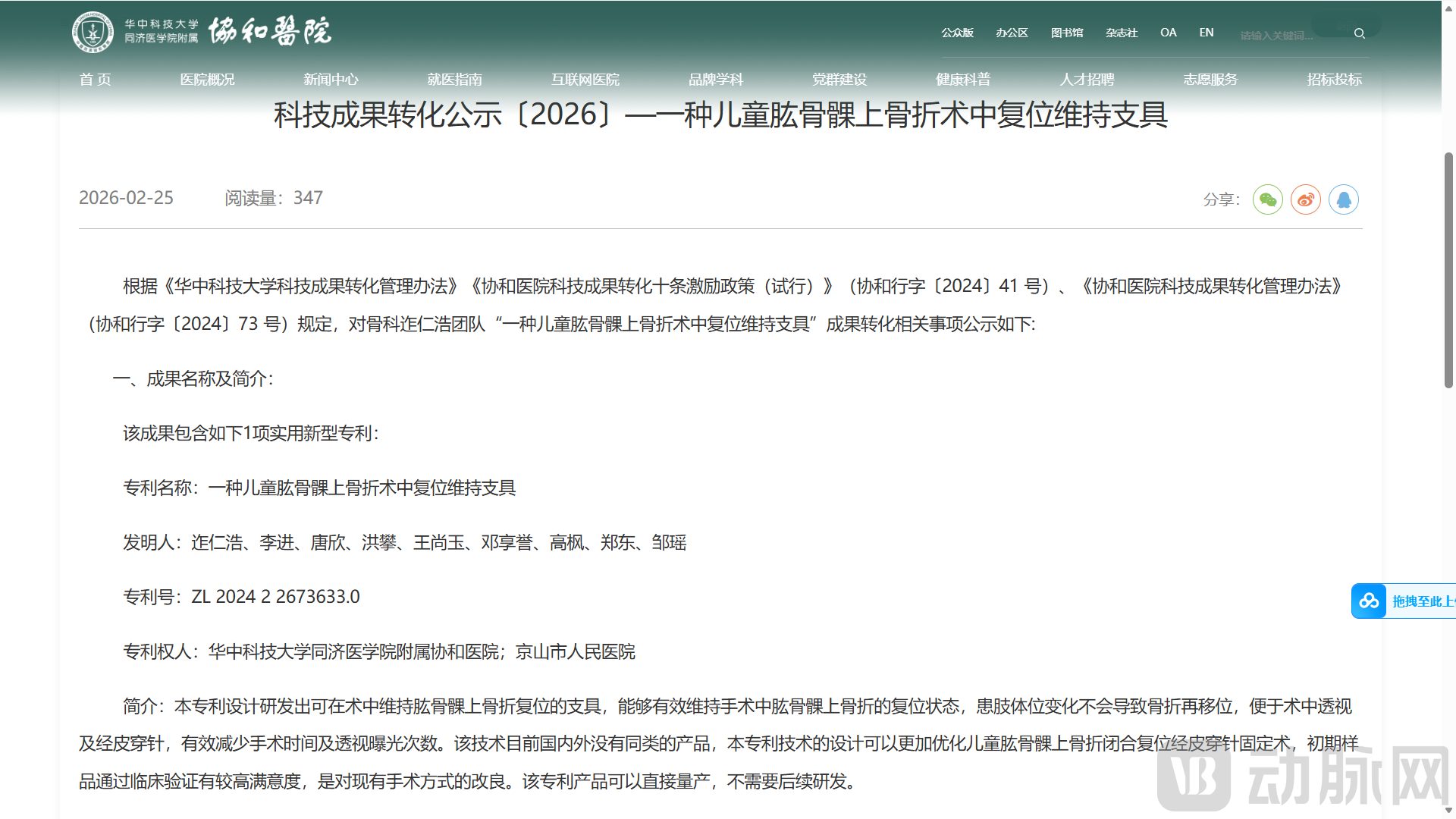
Image from the official website of Union Hospital, Tongji Medical College, Huazhong University of Science and Technology
This technology is aIntraoperative Reduction Maintenance Brace for Supracondylar Humerus Fractures in Children, belonging to the field of medical devices, specifically designed forIntraoperative Management of Supracondylar Humerus Fractures in Children, to position, immobilize, and support the elbow joint of pediatric patients, with the core function of maintaining limb alignment after fracture reduction, ensuring the smooth conduct of surgery, and enhancing the stability of fracture reduction.
Supracondylar fractures of the humerus in children account for 40% of pediatric elbow fractures, and the mainstream clinical approach adoptsClosed Reduction and Pin Fixation, the elbow joint must be maintained in a position of extreme flexion to complete the procedure, while the existing fixation method using bandage wrapping has significant drawbacks, becoming a core pain point in surgical diagnosis and treatment.
It is difficult to precisely control the tightness of bandages.If too loose, it may loosen intraoperatively, causing displacement of the elbow joint in flexion, poor stability of fracture reduction, and affecting surgical manipulation and postoperative healing, even leading to complications such as joint deformity; if too tight, it may easily damage children's delicate skin and soft tissues, causing secondary injury, which violates the principles of safe clinical treatment in pediatrics.
This critical pain point creates multiple challenges in clinical diagnosis and treatment: physicians must repeatedly adjust the immobilization, thereby increasing the difficulty and duration of surgical procedures and elevating the risk of surgical failure; pediatric patients are prone to impaired limb recovery due to inadequate immobilization or suffer additional distress from excessively tight bandages; furthermore, healthcare institutions face an increased likelihood of complications and medical disputes due to non-standardized immobilization practices, which hinders the standardization of diagnostic and therapeutic protocols.
Currently, there are no dedicated fixation devices available in clinical practice. Deficiencies are merely mitigated by optimizing wrapping techniques and increasing manual monitoring, which fails to fundamentally address the core issue of unstable fixation. This approach not only incurs higher medical labor costs but also lacks standardized operational protocols, resulting in inconsistent fixation outcomes.
Therefore, there is an urgent clinical need in pediatric orthopedics for a dedicated intraoperative reduction maintenance device that canPrecise immobilization of the elbow joint in extreme flexion, adapted to pediatric limb characteristics to prevent secondary injury, whileEasy to operate, suitable for pediatric patients of different ages, filling the gap in clinical-specific instruments and resolving the diagnostic and therapeutic challenges associated with traditional fixation methods.
Precise Scientific Positioning, Directly Addressing the Pain Points of Surgical Fixation:Unlike the crude method of manual wrapping with traditional bandages,Damping Positioning HingeCentered on this design, the flexion direction can be flexibly adjusted to accommodate the limb, while the extension direction generates strong frictional resistance. The mechanical lock secures the elbow joint in a position of extreme flexion, completely preventing intraoperative displacement. This fundamentally resolves the core dilemma of bandages being “unstable when loose and damaging when tight,” significantly enhancing the stability of fracture reduction.
High Adaptability, Aligned with Pediatric Clinical Needs:The U-shaped trough armrest conforms to the lateral aspect of the limb. Coupled with a sliding block mechanism and a telescopic connecting arm, it flexibly accommodates upper limb dimensions in pediatric patients of varying ages and body types. The concave surface of the armrest is equipped with a silicone pad featuring anti-slip protrusions, which enhances friction to prevent slippage while cushioning pressure through its soft material properties, thereby balancing secure fixation with wearing comfort.
Simple and efficient operation, adapted to surgical practice scenarios:The overall structure is simple; positioning is achieved by inserting the device into the joint with the hinge angle adjusted and securing it with Velcro straps, significantly reducing intraoperative preparation time. The polyethylene armrest is radiolucent, ensuring no interference with intraoperative fluoroscopy and needle insertion. The stainless steel connecting arm offers high strength and resistance to deformation, making it suitable for the entire workflow of orthopedic surgeries.
Enhanced Safety Protection to Prevent Secondary Injury:ApprovedArm Rest + Silicone PadForms a double-layer barrier to prevent direct contact between the fixation device and children's delicate skin, thereby avoiding secondary injuries such as redness, swelling, and abrasions; the brace is individually packaged in sterile, disposable materials, adhering to intraoperative aseptic principles and effectively reducing the risk of cross-infection.
Practical and diverse design, easy to promote on a large scale in clinical practice:The arm support features a buckle that allows flexible adjustment of the strap configuration to accommodate various intraoperative procedural requirements. The slider and arm support are detachable, enabling individual replacement in case of damage, thereby balancing operational flexibility with cost-effectiveness. Constructed from standard materials, the components offer controllable manufacturing costs and facilitate standardized production, making the device suitable for clinical application across healthcare institutions at all levels.
The market for fixation devices for pediatric elbow fractures has currently taken shape.“Universal Immobilization Orthosis + Biodegradable Implants + Surgical Assistance Technology”Diverse Landscape: Domestic and international medical device companies and research institutions are developing related products and technologies tailored to the characteristics of children's skeletal systems, with a core focus on“Secure and Stable, Child-Friendly, Easy to Operate”Despite ongoing research and development, significant differences remain in terms of applicable scenarios, functional positioning, and technical compatibility, and there is currently no dedicated device specifically designed for maintaining reduction during surgery for supracondylar humerus fractures in children.
Guan'ai, Hongchengkang, and other domestic brands of medical elbow joint fixation braces, this category of products serves as a universal fixation brace for pediatric elbow fractures, with extensive distribution across e-commerce and medical device channels. It is a commonly used basic device for postoperative clinical rehabilitation, with its core solution adoptingAdjustable Chuck + Velcro StrapDesigned to adjust the elbow joint fixation angle within a range of 0°–120°, some products are equipped with widened steel plate supports and skin-friendly, breathable linings. They achieve limited fixation of the elbow joint by clamping the upper arm and forearm, suitable for postoperative rehabilitation fixation after pediatric humeral fractures and elbow sprains. Such products have achieved commercial mass production and are sold both online and offline, currently widely used in rehabilitation departments of hospitals at all levels and in home care settings.
Wuhan Baida Zhimei Medical Technology Co., Ltd. Adjustable Elbow Fixation Brace, the company is a specialized domestic manufacturer of medical external fixation braces, holding medical device registration credentials, with its core solution adoptingWidened Fixation Strap + High-Elasticity Compression Material, it can conform to the skeletal curvature to wrap around the limb, allowing adjustable limit fixation within a range of 0° to 120°, and is equipped with a one-touch adjustment button. It is suitable for fixation and care following elbow ligament instability, stable fractures, and post-reduction of dislocations. The product has achieved large-scale clinical application and has been adopted by the orthopedics and rehabilitation departments of numerous hospitals across China. Its core advantages include superior fixation stability, ease of operation, and compliance with clinical medical standards, primarily addressing the routine external fixation needs for both adult and pediatric elbow fractures.
In the future, pediatric orthopedic surgical instruments will evolve toward specialization, precision, and child-friendly design. Such customized instruments tailored to specific surgical scenarios will drive the transition of pediatric orthopedic surgery from extensive manual operations to standardized, mechanically assisted procedures. Meanwhile, lightweight and personalized orthopedic surgical assistance devices will become a key focus of industry R&D, helping to enhance the efficiency and safety of pediatric orthopedic diagnosis and treatment, and promoting the specialized and refined upgrading of the pediatric orthopedic medical device sector.