

Ningxia Medical University Licenses Two Novel Non-coding RNA Patents Targeting Ischemic Heart Disease in Aging Myocardium for RMB 323,000
Recently, Ningxia Medical University released a public notice on the transformation of scientific and technological achievements, proposing to transfer two independently developed invention patents to Sichuan Derun Tianchen Medical Device Co., Ltd. through patent right assignment, with a total transfer amount ofRMB 323,000。
Both patents transferred in this transactionFocusing on the Field of Ischemic Heart Disease, centered aroundTreatment of Myocardial Ischemia-Reperfusion Injury in AgingExpand and separately uncoverlncMSTRG.7803.1 and piRNA-005854: Two Novel Molecular TargetsThis innovation elucidates the molecular mechanisms by which non-coding RNAs regulate autophagy in aging cardiomyocytes, overcoming the limitations of traditional target research in ischemic heart disease therapy. It provides novel molecular targets and technical directions for the clinical diagnosis, risk assessment, and drug development of ischemic heart disease, representing a significant innovative achievement in the application of non-coding RNA research within this field.
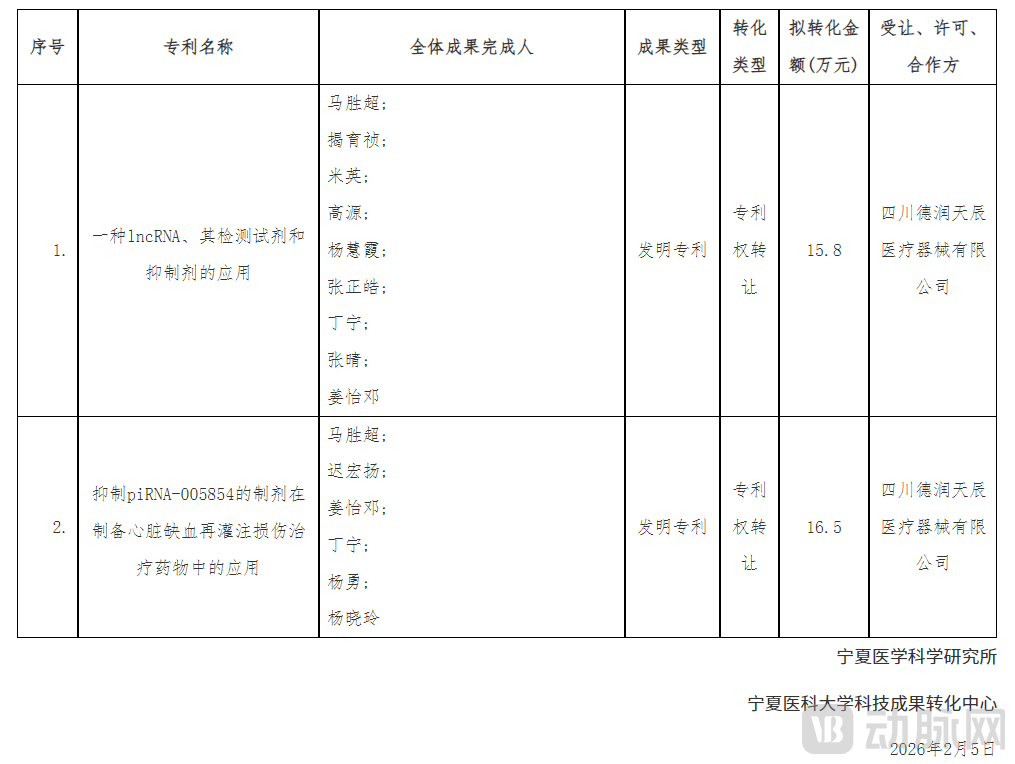
Image from the official website of Ningxia Institute of Medical Sciences
Ischemic Heart Disease (IHD)It is a clinical syndrome caused by coronary artery occlusion or stenosis triggered by multiple factors such as inflammation and ion channel injury, resulting in an imbalance between coronary blood flow and myocardial energy status.Atherosclerosisis its primary cause. The incidence and mortality rates of this disease have been rising year by year, becoming a public health issue that seriously threatens human health, whileIschemia-Reperfusion (I/R) InjuryIt is a core challenge in the clinical management of ischemic heart disease, leading to irreversible cardiomyocyte death and myocardial dysfunction, and represents the primary cause of morbidity and mortality among elderly patients with ischemic heart disease.
Current clinical research on ischemia-reperfusion injury is mainly focused onIschemic PreconditioningandPostconditioningThere are two types of strategies. Ischemic preconditioning must be implemented prior to myocardial ischemia; however, the unpredictability of the onset of ischemia in clinical patients limits its practical applicability. In contrast, ischemic postconditioning involves several brief cycles of reperfusion/ischemia performed after myocardial ischemia but before reperfusion. This approach can mobilize endogenous protective mechanisms to mitigate reperfusion injury, offering greater clinical utility and thus becoming a key focus of current research.
However, significant critical gaps remain in current research and clinical applications. On one hand, aging markedly increases the susceptibility of the heart to ischemia-reperfusion injury (IRI) and exacerbates its severity. Clinical data indicate that 50% of patients with myocardial infarction (MI) and 80% of those who die from MI are aged ≥65 years. Furthermore, elderly patients exhibit poor prognosis post-MI, with mortality rates rising sharply with age. Currently, there is a lack of effective targeted therapeutic strategies for aging-associated myocardial ischemia-reperfusion injury.
On the other hand,AutophagyAs a critical mechanism for maintaining cellular homeostasis, autophagy plays a dual role during myocardial ischemia-reperfusion. Under mild ischemic conditions, autophagy serves as an adaptive protective response; however, under severe or prolonged ischemia, excessive activation of autophagy can induce autophagic cell death in cardiomyocytes. Although ischemic postconditioning can inhibit abnormal autophagy in aging cardiomyocytes, the specific molecular mechanisms underlying its regulation of autophagy in these cells have remained unclear, thereby failing to provide precise therapeutic targets for drug development.
Meanwhile,Non-coding RNAPlays an important role in the regulation of cellular autophagy, but its specific regulatory function in post-ischemic processing of aging myocardium remains to be further explored. The lack of relevant targets has led to a dilemma in the diagnosis and treatment of ischemic heart disease, particularly among elderly patients, characterized by ambiguous therapeutic targets and limited treatment options. In this context, there is an urgent clinical need to identify specific molecular targets that regulate myocardial ischemia-reperfusion injury in aging, elucidate their core mechanisms in modulating cardiomyocyte autophagy, provide novel biomarkers for clinical diagnosis and risk assessment of ischemic heart disease, and offer new directions for the development of targeted therapeutics. This approach aims to address the limitations of current clinical strategies and resolve the critical clinical challenges of poor treatment efficacy and unfavorable prognosis in elderly patients with ischemic heart disease.
The two invention patents transferred in this transaction are based onClinical Management of Ischemic Heart DiseasePain Points, Centered AroundNon-coding RNAs Regulate Autophagy in Aging CardiomyocytesConduct innovative research that combines theoretical breakthroughs with clinical application value. The core advantages and innovations are reflected in multiple dimensions, including target discovery, mechanistic elucidation, and application expansion, as detailed below:
1. Identify novel specific molecular targets to fill gaps in field research:Two patents have respectively discovered and verified for the first time thatlncMSTRG.7803.1、piRNA-005854To identify key molecular targets for regulating myocardial ischemia-reperfusion injury in the aging heart, lncMSTRG.7803.1 is a specific long non-coding RNA that regulates autophagy in aged cardiomyocytes, while piRNA-005854 is the first piRNA molecule discovered to be involved in postconditioning against ischemia in the aging myocardium. Both represent novel research targets in the field of ischemic heart disease, addressing the previous lack of known non-coding RNA targets in the regulation of myocardial ischemia-reperfusion injury in aging.
2. Precisely elucidate molecular regulatory mechanisms and refine the theoretical research framework:The study, utilizing dual in vivo and in vitro models (an aging rat ischemia/reperfusion [I/R] model and a D-galactose-induced aging cardiomyocyte hypoxia/reoxygenation [H/R] model), elucidated the core mechanistic roles of two targets: lncMSTRG.7803.1 acts throughPromoting Autophagy in Senescent Cardiomyocytes Induced by Hypoxia/Reoxygenation, attenuating the cardioprotective effects of ischemic postconditioning; piRNA-005854 throughRegulation of ULK1 Phosphorylation Levels, mediating an increase in the LC3-II/I ratio and a decrease in p62, thereby promoting autophagy and apoptosis in senescent cardiomyocytes. Meanwhile, it was confirmed that ischemic postconditioning significantly downregulates the expression of these two targets, achieving protection of senescent myocardium. This study elucidates for the first time the complete molecular pathway by which non-coding RNAs mediate autophagy to regulate ischemia-reperfusion injury in senescent myocardium, thereby refining the theoretical framework of endogenous protective mechanisms associated with ischemic postconditioning.
3. Achieving dual applications in detection and treatment, combining clinical practicality with scalability:The patented technology not only clarifies the clinical application value of the target, but also achieves"Test-to-Treat"of bidirectional empowerment. The detection reagent for lncMSTRG.7803.1 can be directly used for clinical risk assessment, diagnosis, and screening of potential therapeutic agents for ischemic heart disease, while its specific siRNA inhibitor can be developed into a therapeutic drug. The specific inhibitor of piRNA-005854 can be directly applied to the development of drugs for treating myocardial ischemia-reperfusion injury, precisely inhibiting abnormal autophagy and apoptosis in senescent cardiomyocytes. Both provide actionable and implementable technical solutions for clinical diagnosis and treatment, breaking through the limitations of traditional therapies that focus solely on symptom relief and lack precise targeting capabilities.
4. The research model aligns closely with clinical practice, demonstrating high feasibility for translational application:The study consistently employed an aging myocardial model that aligns with the clinical characteristics of elderly patients, rather than using normal cardiomyocyte or animal models. Consequently, the experimental results more accurately reflect real-world clinical scenarios, and the research findings hold greater value for clinical translation. Furthermore, the study clearly defined the detection method for the target (qRT-PCR), the sequence of the specific inhibitor, and its efficacy, thereby providing concrete technical parameters and experimental evidence for subsequent reagent development and drug preparation. This significantly lowers the technical barriers to translational application and demonstrates strong potential for rapid industrialization.
5. Expanding the Dimensions of Non-Coding RNA Applications in Cardiovascular Medicine:First TimeSimultaneous Application of Long Non-Coding RNAs and piRNAs, Two Classes of Non-Coding RNAs, in Aging Myocardial Ischemia-Reperfusion InjuryThis study breaks through the limitations of existing research, which has largely focused on a single type of non-coding RNA, providing novel insights into non-coding RNA targets for cardiovascular diseases and laying a foundational basis for future exploration of additional non-coding RNA regulatory targets.
The two invention patents for non-coding RNA targeting myocardial ischemia-reperfusion injury, transferred by Ningxia Medical University in this transaction, precisely address the critical unmet clinical need concerning aging myocardium. Combining technological innovation with market scarcity, these patents hold broad prospects for future market development.
From the perspective of clinical demand, the number of elderly patients with ischemic heart disease continues to rise against the backdrop of an aging population. Traditional drugs and existing non-coding RNA candidate therapeutics lack targeted design for senescent myocardium. This patent fills the market gap in precision-targeted therapy for ischemia-reperfusion injury in the aging myocardium.
Traditional Anti-Myocardial Ischemia-Reperfusion Injury DrugsThese are foundational medications for the clinical treatment of ischemic heart disease. Their clinical application is primarily based on core mechanisms that improve myocardial metabolism, counteract oxidative stress, and dilate coronary arteries.Trimetazidine, Nicorandil, DexrazoxaneRepresentative varieties are widely used in scenarios such as myocardial protection after percutaneous coronary intervention (PCI) or thrombolysis for myocardial infarction, and relief of angina pectoris in coronary heart disease. They can be combined with antiplatelet agents and statins, serving as foundational medications across multiple clinical settings. Currently, the market is dominated by foreign original research products, with domestically produced generics rapidly catching up. Core varieties are included in the National Reimbursement Drug List; while volume-based procurement has increased market penetration, it has compressed profit margins per product. The overall market size maintains steady growth driven by population aging. However, existing varieties are all broad-spectrum myocardial protective agents without specific design for aged myocardium, resulting in limited efficacy in elderly patients. Their action targets are dispersed, lacking precise intervention in the core pathways of autophagy regulation. Meanwhile, some drugs cause adverse reactions such as hepatic and renal impairment and hypotension, limiting the applicable population. In authoritative clinical guidelines, they are mostly recommended as second-line therapies, requiring reliance on basic treatment.
miRNA ClassThe most mature type of non-coding RNA-targeted drugs under development, with related productsAntisense Oligonucleotides, Small Interfering RNACore tools include, for example, anti-miR-155 inhibitors and anti-miR-34a oligonucleotides. These agents function by inhibiting or mimicking the expression of specific microRNAs (miRNAs). The strategic layout covers the entire value chain, including target sequences, formulation development, delivery systems, and indications. The primary focus is on cardiovascular diseases such as myocardial ischemia and myocardial infarction, with target discovery centered on pathways involving inflammation regulation, apoptosis, and myocardial fibrosis. Several candidate drugs have completed validation in cellular and animal studies. Overall, the field is in a development stage dominated by preclinical research, supplemented by early-stage clinical exploration. The main R&D participants include multinational pharmaceutical companies, leading biotechnology firms specializing in RNA therapeutics, and academic institutions. Core foundational patents for key targets have been secured by leading organizations, while later entrants are primarily focusing their patent strategies on innovations in chemical modification technologies and delivery systems.
FromTechnical Value PerspectiveSpecifically, the two patents have identified novel molecular targets in lncRNA and piRNA, elucidated the core mechanisms by which they regulate autophagy in aging cardiomyocytes, and completed robust in vitro and in vivo experimental validation, demonstrating strong potential for technological implementation.Detection Reagents, Targeted InhibitorsDeveloping product series in two major directions to achieve an integrated “diagnosis-treatment” layout, expanding the application boundaries of non-coding RNA in the cardiovascular field, with significant potential for pipeline extension.
FromMarket CompetitionCurrently, non-coding RNA-targeted cardiovascular drugs remain in the research and development phase, with particularly limited progress in piRNA-based therapeutics. However, with the widespread adoption of precision medicine concepts and continuous breakthroughs in RNA drug delivery technologies, the clinical translation of non-coding RNA-targeted therapies is expected to accelerate. This patented technology can be combined with existing clinical treatment regimens in the future, further expanding its application scenarios. It holds strong commercial potential in the cardiovascular precision therapy market and is poised to become a core product for treating elderly patients with ischemic heart disease, offering a novel solution to advance the diagnosis and treatment of this condition.