

West China Hospital, Sichuan University Licenses Innovative Catheter Management Information System for RMB 400,000 Plus 15% Revenue Royalty
Recently, West China Hospital of Sichuan University released a public notice on the transformation of patent achievements, proposing to transfer its“A Medical Nursing Catheter Information Management System”patents, licensed exclusively to Ruida Zhiji Medical Technology (Chengdu) Co., Ltd., with a transaction amount of400,000 plus 15% commission on sales revenue。
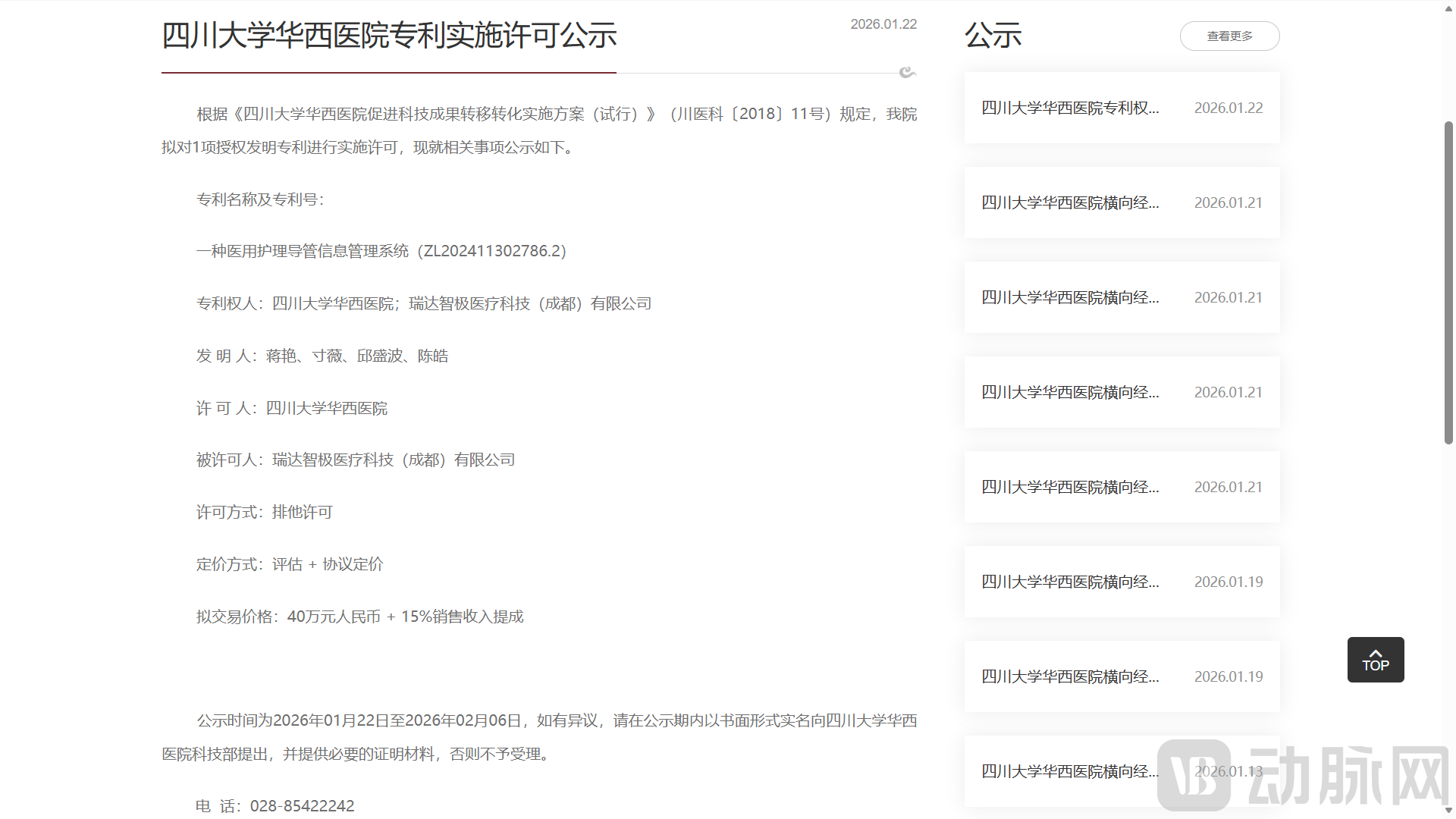
Image source: Information disclosure from West China Hospital, Sichuan University
This information management system, throughCatheter Data Management Subsystem Converts Unstructured Nursing Orders and Care Instructions into Structured Data, combined withFive Major Subsystems, Including Statistical Data Analysis, Specialized Nursing Handover, and Cross-Sectional Monitoring, enabling precise data collection, intelligent aggregation, full-cycle tracking, and quality evaluation throughout the entire catheter care process. It effectively addresses the pain points of traditional manual documentation, such as low efficiency, high error rates, and difficulty in data consolidation, thereby helping to enhance the standardization and intelligence of hospital catheter care, reduce the incidence of adverse events such as unplanned extubation, and provide stronger safeguards for patient safety.
Catheter Careis a critical component in scenarios such as clinical intensive care and postoperative surgical care, with its core requirements lying inPrecise Monitoring of the Catheter's Full Lifecycle, thereby preventing"Unplanned Extubation"This core adverse event. From a clinical perspective, unplanned extubation can easily trigger a cascade of complications. Catheter displacement or dislodgement can directly cause vascular injury, organ perforation, and a sharp increase in the risk of infection. In severe cases, it may prolong hospital stays, increase patient mortality, and significantly raise healthcare costs. Furthermore, the occurrence of catheter-related infections is closely associated with factors such as non-compliant catheter maintenance procedures and untimely observation and documentation.
In clinical practice, the pain points of catheter care have long persisted and remain difficult to resolve. On one hand,Inpatient catheter types are diverse and numerous,Nurses are required to manually record information such as the insertion time, location, and maintenance frequency of each catheter, which not only consumes significant manpower but also makes it highly prone to issues like data omission and recording discrepancies. On the other hand,Lack of Dynamism in Catheter Risk Assessment, after the patient's condition changes, the risk level cannot be updated in a timely manner, making it difficult to implement targeted protective measures promptly. Furthermore,Absence of a Full-Process Nursing Evaluation System, relying solely on real-time feedback from caregivers makes it impossible to systematically review nursing outcomes at critical junctures, thereby hindering efforts to fundamentally reduce the incidence of adverse events.
The shortcomings of traditional manual management models further exacerbate clinical pain points.At the Data Management Level, unstructured information recorded manually cannot be intelligently summarized and analyzed, making it difficult for hospitals to exercise macro-level control over the quality of catheter care across the entire institution. During shift handovers, information transfer relies on verbal communication or paper records, which are prone to omissions of critical information, leading to gaps in the continuity of nursing care.In the quality assessment phase, lacking standardized data support, the evaluation results are highly subjective, making it impossible to accurately identify weak links in the nursing process, let alone provide a scientific basis for the continuous improvement of nursing quality.
Addressing the industry pain points of low efficiency and difficult risk control in traditional manual catheter care management, this Medical Catheter Care Information Management System offers a new solution for clinical nursing through multiple core innovations.
The core innovation of this system lies in"Structuring of Unstructured Information". Through the catheter data management subsystem, the system transforms fragmented and non-standard catheter care physician and nursing orders into structured information containingFive Major Modules: Risk Assessment, Catheterization, Observation, Interventions, and Extubationa standardized nursing execution checklist, leveraging mobile nursing terminals to achieve precise data entry and upload, thereby eliminating deviations and omissions inherent in manual recording at the source.
Meanwhile,The system is equipped with an intelligent trigger linkage mechanism,When the selection results from the nursing execution list meet preset conditions, corresponding nursing interventions are automatically triggered or data is distributed to relevant subsystems. For instance, if catheter fixation becomes loose, a high-risk alert for unplanned extubation is automatically issued; alternatively, upon detection of complications, information is promptly pushed to the Hospital Information System (HIS) to alert physicians for intervention.
Furthermore,"Multi-Subsystem Collaborative Coordination"constitutes another major innovative advantage of the system. WithCatheter Data Management SubsystemCentered around the core, five major subsystems—including data statistical analysis, specialized nursing handover, and cross-sectional monitoring—perform their respective duties while working in close coordination to achieve closed-loop management of the entire catheter care process.Data Statistical Analysis SubsystemSupports multi-dimensional data analysis across horizontal and vertical dimensions, providing visualized reports for management decision-making;Cross-Sectional Monitoring SubsystemQuantify the weights of exposure factors associated with unplanned extubation to facilitate precise risk prevention and control;Quality Evaluation SubsystemBy integrating the Hospital Information System (HIS) with discharge assessment data, a comprehensive quality evaluation of the entire nursing cycle is achieved. This innovative architecture shifts catheter care from “passive documentation” to “active early warning,” and from “fragmented management” to “systematic control,” significantly enhancing the standardization and intelligence of nursing practices.
With the rapid development of smart healthcare, nursing informatics has become a core support for improving the quality of medical services and optimizing nursing processes. Recently, smart nursing management systems tailored to different application scenarios have been introduced one after another. These systems break through traditional nursing bottlenecks from dimensions such as multi-terminal collaboration, AI-driven personalized services, and lightweight configuration, providing diverse smart solutions for medical institutions at all levels and promoting the advancement of nursing work towards precision, high efficiency, and homogenization.
Winning Health Integrated Nursing Platform:The product isData Fusionas the foundation,Professional Knowledge BasePowered by an engine that deeply integrates all clinical nursing and nursing management scenarios. Core features include multi-terminal synergy, a professional knowledge base, and integrated management. By enabling single-entry data input with multi-point sharing, it effectively enhances the standardization of nursing care and improves management efficiency.
Jiangsu Yiweikang Information Technology Co., Ltd.'s AI-Based Smart Nursing Management System:As an AI-driven innovative solution, the system consists ofMulti-source Heterogeneous Processing, Privacy-optimized Modeling, Dynamic Path Generation, and Strategy Evolution ImplementationComposed of four major modules. Core features include cross-modal data fusion, privacy-preserving security modeling, personalized care pathway generation, and rapid adaptation mechanisms. The product’s value lies in breaking the limitations of traditional static care plans by delivering dynamic, personalized nursing services, while ensuring data privacy and security, thereby significantly enhancing the intelligence and precision of care delivery.
Yachuang Smart Nursing Management System:The system is based onLightweight, Highly AdaptableWith its core advantages, the system includes subsystems such as the Mobile Nurse Workstation, Nursing Documentation, Head Nurse Management, and Panoramic Nurse Station. Its core functionalities cover the entire basic nursing workflow, including closed-loop physician order management, vital signs recording, nursing medical records, and health education. It provides comprehensive template support (including quality control templates, incident reporting templates, and nursing intervention templates), supports real-time monitoring and intelligent alerts for nursing plan execution, and features multi-dimensional statistical analysis of key indicators along with visual configuration of documents. The system can rapidly enhance closed-loop physician order management in hospitals, optimize nursing workflows, and lower the barriers to system deployment and operation. Without requiring complex configurations, it meets the basic nursing needs of small and medium-sized hospitals and community hospitals, effectively improving nursing efficiency and quality.
Currently, smart nursing management systems on the market each possess distinct features and focal points. They not only provide healthcare institutions with diverse options but also drive the transformation of the nursing industry from a traditional labor-intensive model to a technology-driven one through technological innovation. In the future, with the continuous iteration of smart healthcare technologies, nursing informatics will further break through temporal and spatial constraints, delivering safer, more efficient, and higher-quality nursing services to patients, thereby supporting the high-quality development of the healthcare sector.